Tuning Fork Density Meter
tuning fork concentration meter · vibrating fork density meter · fork density meter
A pair of piezo-driven tines vibrates in the liquid. The denser the liquid, the lower the resonant frequency. Clean physics, simple hardware — and the tines have to stay free to move.
Tap the diagram to open it full size
Weighing the liquid that rides on the fork
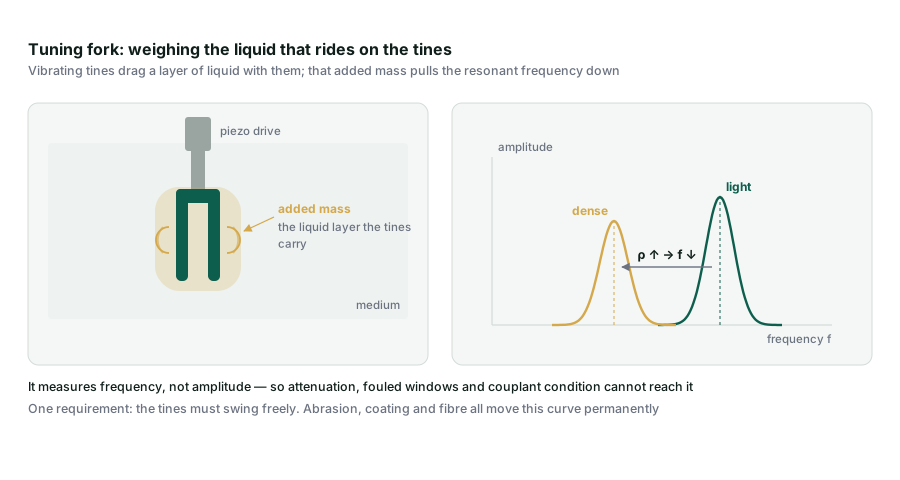
The tines of a fork densitometer are driven by a piezo element at their own resonant frequency. As they vibrate they drag a thin layer of surrounding liquid with them, and the mass of that layer becomes added mass on the system: denser liquid, more added mass, lower resonant frequency. Measure the frequency and you have the density. Frequency is the easiest electrical quantity to measure accurately, which is why this method is so stable.
Because it measures frequency rather than amplitude, a fork is largely immune to the things that trouble other principles — signal attenuation, fouled optical windows, couplant condition. As long as the tines can swing freely, the reading stands. PS7400 uses this principle with PT1000 compensation: process temperature changes both the density of the liquid and the elastic modulus of the tine material, and both paths have to be corrected.
Its limits are mechanical, not electronic
Everything that constrains a fork follows from the requirement that the tines swing freely:
- Abrasion. Quartz particles in mineral slurry grind the tines. Once they thin or deform, the resonant frequency drifts — in one direction, permanently.
- Coating and crystallisation. A deposit on the tines is added mass that never leaves, so the reading is biased high. On site that bias is very hard to tell apart from a real rise in concentration.
- Fibre. In pulp, sludge and fibrous effluent, a fork is an excellent place for fibre to collect.
- Bubbles. Gas clinging to the tines removes added mass and biases the reading low.
Turn that around and the picture is equally clear: in a clean, non-crystallising, fibre-free liquid a fork is close to maintenance-free. No moving parts, no consumables, no optical surface to keep clean. That is why they are everywhere in chemical storage, refined fuels, alcohol, sugar solutions and dairy.
Against the other principles
Against Coriolis: a fork is far cheaper, adds negligible pressure drop and can be inserted directly into a tank; Coriolis gives better accuracy and mass flow, but the whole stream has to go through the measuring tube. Against ultrasonic impedance: in clean liquid the fork is simpler and more robust, but the moment there is a solid phase the job belongs to ultrasound. Against differential pressure: a fork needs neither a stable level nor a stable hydraulic line, so the mounting position is far freer.
A common mistake is to treat a fork as a cheap slurry meter. Below roughly 5% solids, fine and non-abrasive, it does work. At flotation or coal-washing loadings the service life is too short to be an engineering answer.
Coal preparation thickeners are the textbook case. Both the feed and the underflow carry fine coal slime — sticky clays, and in the underflow a flocculated, settled slurry — and that is exactly what collects at the root of the tines and between them. The reading drifts high and still looks normal. These points suit a flush-mounted acoustic impedance sensor instead; see coal slurry thickener feed and underflow.
Installation notes
- Keep the tines fully immersed and in a place where liquid actually moves — a dead zone does not represent the process.
- Stay clear of the turbulent, air-entraining region at a pump discharge, and of the settled layer near a tank wall.
- On an insertion mount, orient the plane of the tines with the flow to reduce loading and build-up.
- The temperature signal must be the process temperature, not the pipe wall.
Buying from China
CE marked as standard; ATEX / IECEx and hygienic (3-A / EHEDG) options depend on configuration and are worth confirming before the order. Quotations in USD or EUR, EXW / FOB Shanghai / CIF, with HS code and declaration of conformity supplied alongside. Tell us the medium, the temperature range, the process connection and whether the point is a tank or a line, and the selection takes one exchange rather than five.
Where it works
- Inline density and concentration in clean liquids: acids, caustics, solvents, alcohol, syrups, dairy, refined fuels
- Blending and batching control in chemical storage and mixing tanks
- Dilute, fine, non-abrasive suspensions
- Points where an insertion fitting is available and re-piping is not
- Long-running duties that need no consumables and no optical window to clean
Where it doesn't
- Abrasive mineral slurry and high solids loading — the tines will not last
- Crystallising or coating media with no cleaning access
- Fine coal slime and flocculated sludge (thickener feed and underflow) — clays and flocs lodge at the tine root and between the tines
- Fibrous media: pulp, sludge, textile effluent
- High entrained gas, or media where bubbles cling to surfaces
- Duties that also require mass flow

Common questions
What mounting options does PS7400 tuning fork support? How do I pick insertion length?
PS7400 supports flange / tri-clamp / threaded / cable-separated process connections; F1~F6 accessories (bracket, bypass loop, flow cell, flushing port, flanged seat, protective shield) cover inline pipes, open tanks, agitated tanks, scaling media. Insertion lengths: 100 / 150 / 200 / 300 / 400 mm. Selection: inline pipe — insertion = 1/3 to 1/2 pipe diameter, away from wall turbulence; open/storage tank — mid-liquid, away from surface waves and bottom sediment; agitated tank — beyond 1.5× the agitator radius.
Get a free field assessment
Tell us your medium, process and what you're measuring — we'll match the right principle and model.