Coriolis Density Meter
coriolis mass flow density meter · vibrating tube density meter · coriolis mass flow meter
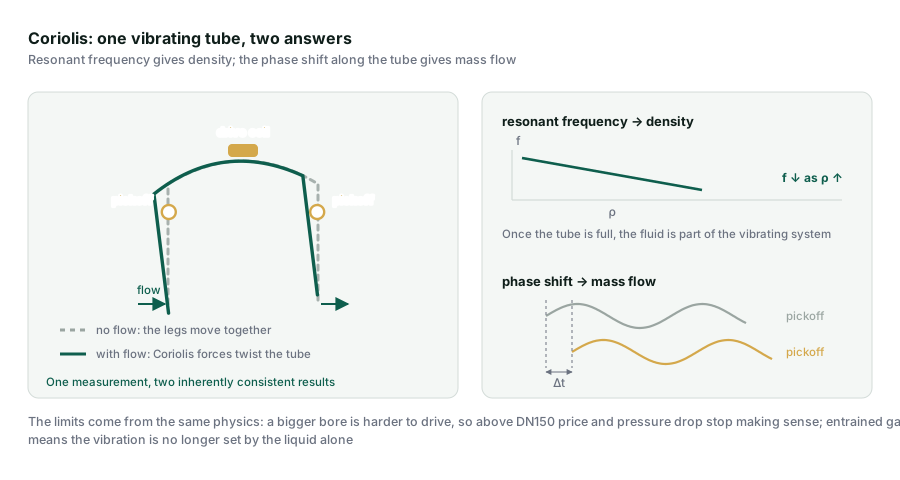
One vibrating tube, two results: the resonant frequency is density, the phase shift between inlet and outlet is mass flow. Same instrument, same measurement.
Tap the diagram to open it full size
One vibrating tube, two answers
A Coriolis instrument keeps a measuring tube oscillating at its own resonant frequency. When the tube is full, the fluid becomes part of the vibrating system, so the resonant frequency falls as fluid density rises — that is the density measurement. At the same time, fluid moving through a vibrating tube generates Coriolis forces that twist it, producing a phase shift proportional to mass flow. Density and mass flow come out of the same measurement, which means they are inherently consistent and volumetric flow and dry-solids throughput follow directly.
This is the most accurate density measurement available in clean liquid — resolution better than 0.001 g/cm³ is routine — and because it is again a frequency measurement, long-term stability is excellent.
Bent tube or straight tube
A bent tube (the PS7210 shape) is more sensitive and more accurate, at the cost of higher pressure drop, a low point where solids can settle, and more susceptibility to external vibration. A straight tube (PS7220) drains and cleans easily, drops less pressure and suits hygienic and viscous duty, at the cost of lower sensitivity and a more demanding drive and signal chain. The choice is really a question of which you can least afford to give up: pressure drop or resolution.
The real constraint is line size
The physics sets the economics. The measuring tube has to be driven into vibration, and as bore grows the wall thickens, the mass rises, the drive gets harder and the price climbs steeply. Up to DN50 Coriolis is close to the default choice; by DN150 it is expensive; beyond that, on a slurry main, it is simply out of the conversation. That is not a product limitation, it is the boundary of the principle.
The second constraint is entrained gas. Once gas is present the tube's vibration is no longer set by the liquid alone: density reads low and unstable, and in bad cases drive gain alarms. Coriolis is more sensitive to bubbles than ultrasonic impedance, and that is routinely underestimated at selection time.
When not to choose it
If you need density and not flow, and the medium is a slurry or the line is large, both the price and the pressure drop are paying for capability you will not use. Density only on a slurry main: ultrasonic impedance. Clean liquid in a tank: a fork. Density plus flow, clean medium, modest bore: Coriolis.
Installation notes
- Keep it away from pumps and compressors; use isolating supports where needed, and never couple two Coriolis meters rigidly together.
- Keep the tube full and free of gas pockets; do not put a bent-tube meter at the high point of a line.
- Do the zero calibration the manufacturer asks for — at real process temperature and pressure.
- Calculate the pressure drop for viscous media; go one size up or switch to a straight tube if it does not fit.
Buying from China
CE marked; ATEX / IECEx and hygienic approvals are configuration-dependent and should be confirmed against your specification. Quotations in USD or EUR on EXW, FOB Shanghai or CIF, HS code and declaration of conformity provided with the offer. For custody-transfer duty, tell us the applicable scheme early — the required documentation, not the meter, is usually the long pole.
Where it works
- Duties that need density and mass flow from one instrument
- High-accuracy density and concentration in clean liquid (±0.001 g/cm³ class)
- Custody transfer, batching, blending and dosing
- Small and medium bore — most economic at DN50 and below
- Hygienic and viscous service (straight tube)
Where it doesn't
- Large-bore slurry mains — neither the price nor the pressure drop works
- High or fluctuating entrained gas
- Abrasive slurry: wear inside the measuring tube changes the calibration directly
- Sites with strong vibration and no way to isolate
- A single density-only point on a tight budget
Get a free field assessment
Tell us your medium, process and what you're measuring — we'll match the right principle and model.