INDUSTRY 02

Power Emission Control

02 / POWER

FGD desulfurization (limestone / gypsum / AFT / wastewater) plus SCR denitrification (urea / liquid ammonia reducer) — full emission-control loop.

3 applicable products 5 application cases

Overview

Coal-fired power-plant emission control spans desulfurization (FGD) and denitrification (SCR). FGD measurements focus on limestone slurry feed, gypsum slurry outlet, AFT (after-filter tank) gypsum density, and wastewater solids; SCR measurements track reducer concentration — urea solution (32.5 wt% AdBlue), liquid ammonia (25 wt%) and ammonia injection ratio. PS7000 / PS7400 are deployed across dozens of plants of China's top-5 power groups (Huaneng, Huadian, Datang, China Energy, SPIC), covering 100-1000 MW single-unit capacity.

Typical challenges

  • Limestone / gypsum slurry corrodes wetted parts severely; chloride pitting risk
  • Crystallization causes insertion meters to scale and require frequent service
  • Sealed-source (Cs-137) meters face licensing and shielding overhead — retrofit demand is strong
  • SCR reducer concentration directly drives NOx removal rate and ammonia slip
  • DeNOx side requires high-pressure / Ex-rated instrumentation for liquid ammonia service

Recommended solutions

Measurement pointPrincipleModels
FGD absorber inlet — limestone slurryUltrasonicPS7000
FGD absorber outlet — gypsum slurryUltrasonicPS7000
FGD AFT tank — gypsum densityUltrasonic / Tuning forkPS7000 / PS7400
FGD wastewater dischargeUltrasonic / MicrowavePS7000 / PS7600
SCR urea / AdBlue reducer concentrationTuning fork + PT1000PS7400
SCR liquid ammonia tank densityTuning fork + Ex-rated HPPS7400
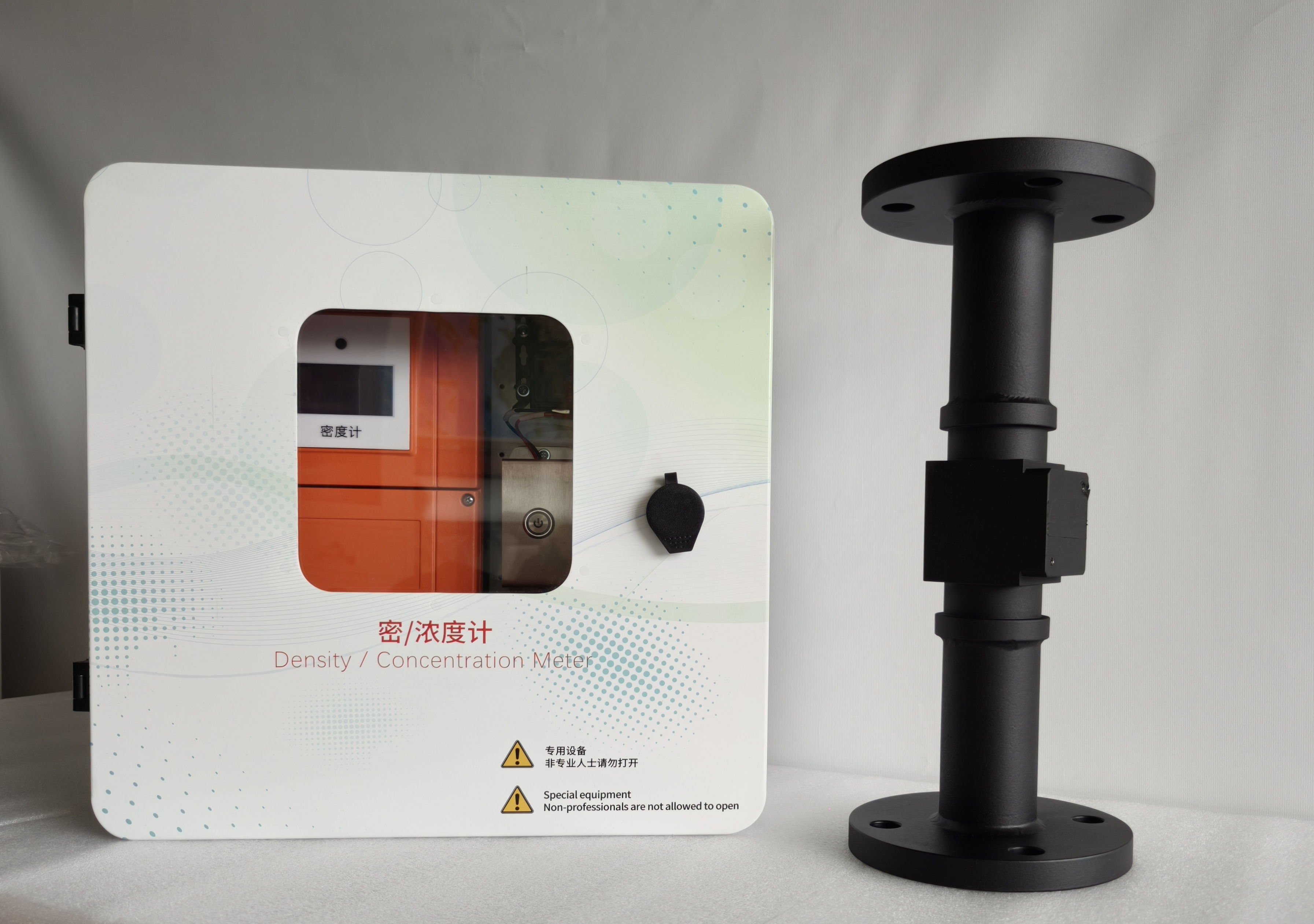
Slurry density meter · PS7000

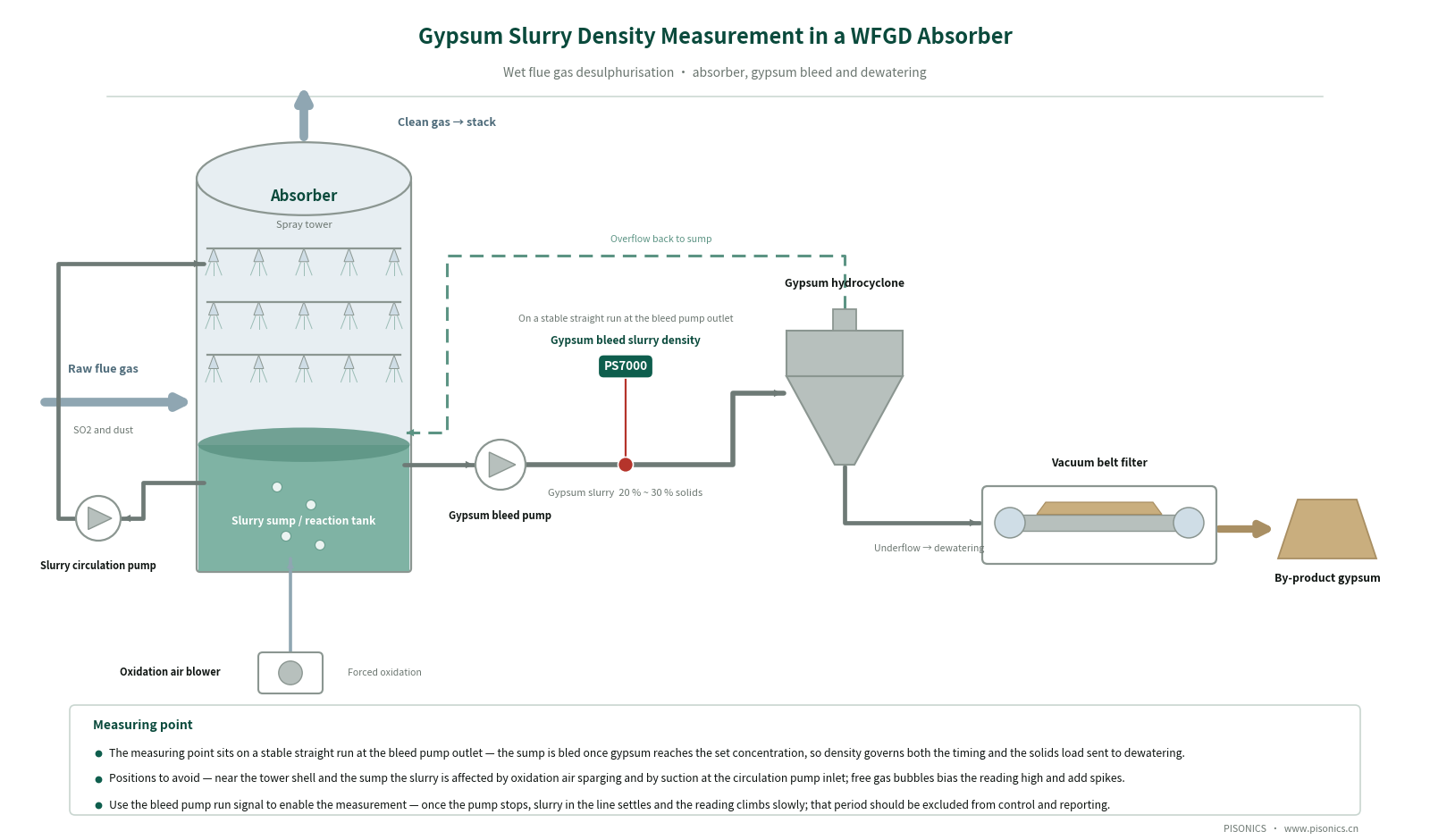
Online Measurement of Gypsum Slurry Density in Absorption Towers

In the wet flue-gas desulfurization process, real-time monitoring of gypsum slurry concentration is crucial for ensuring the quality of the by-product gypsum and the proper operation of equipment. However, conventional concentration meters—such as mass flow meters, tuning fork sensors, and differential pressure concentration meters—suffer from issues like radiation safety concerns, bubble interference, and scaling. Pisonics’ PS7000 employs ultrasonic technology for non-contact measurement, can penetrate bubble layers to deliver stable and reliable concentration data, and requires no maintenance, with a service life exceeding five years.

View case
Slurry density meter · PS7000

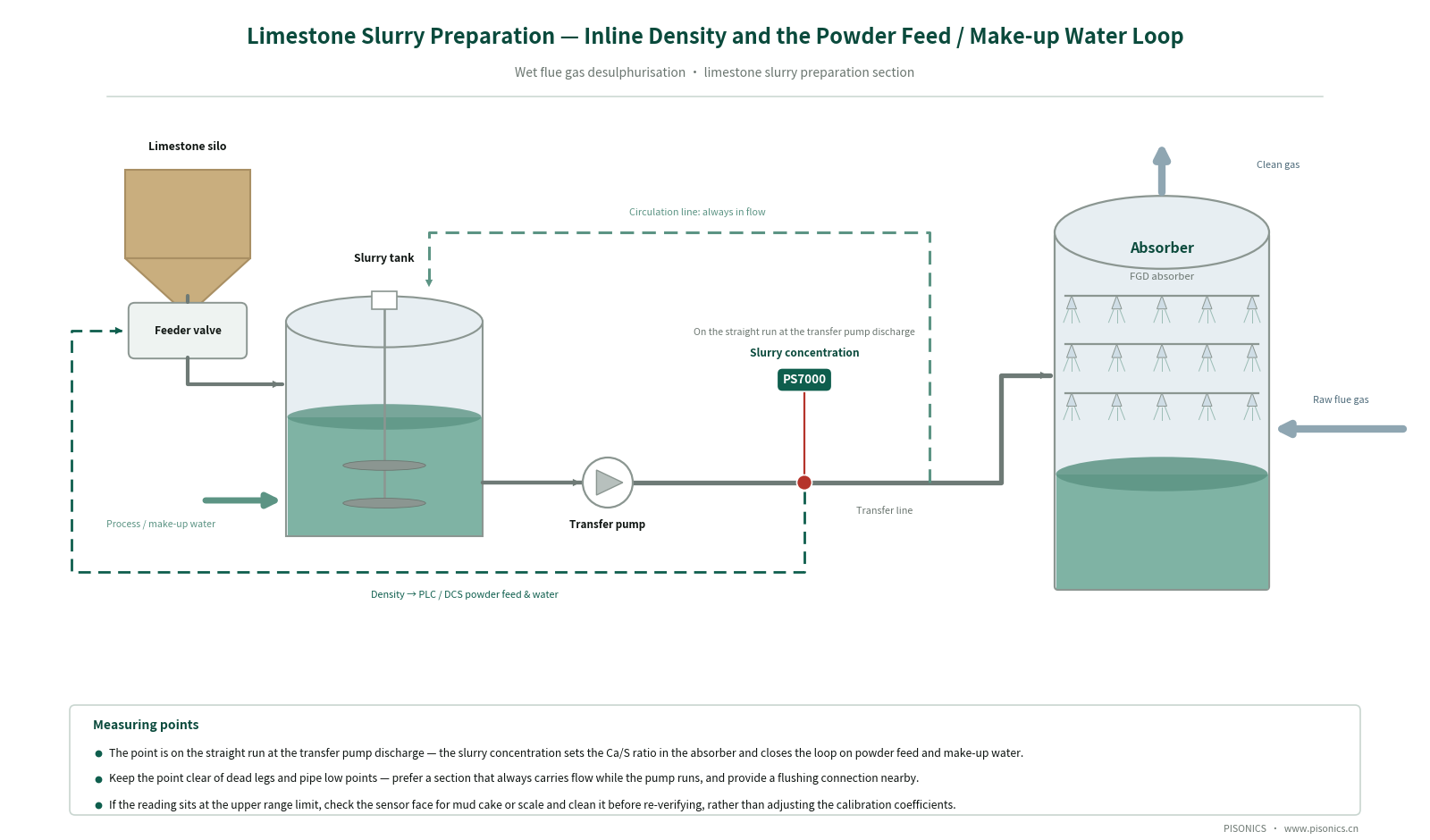
Online Density Measurement for Limestone Slurry Preparation

During the preparation of limestone slurry, conventional density-measurement solutions suffer from issues such as wear and scaling, leading to inaccurate data and compromising flue-gas desulfurization efficiency. The PS7000 acoustic impedance concentration meter overcomes these challenges through non-contact ultrasonic measurement, delivering stable, high-precision online density monitoring and ensuring consistent control of slurry concentration.

View case
Slurry density meter · PS7000

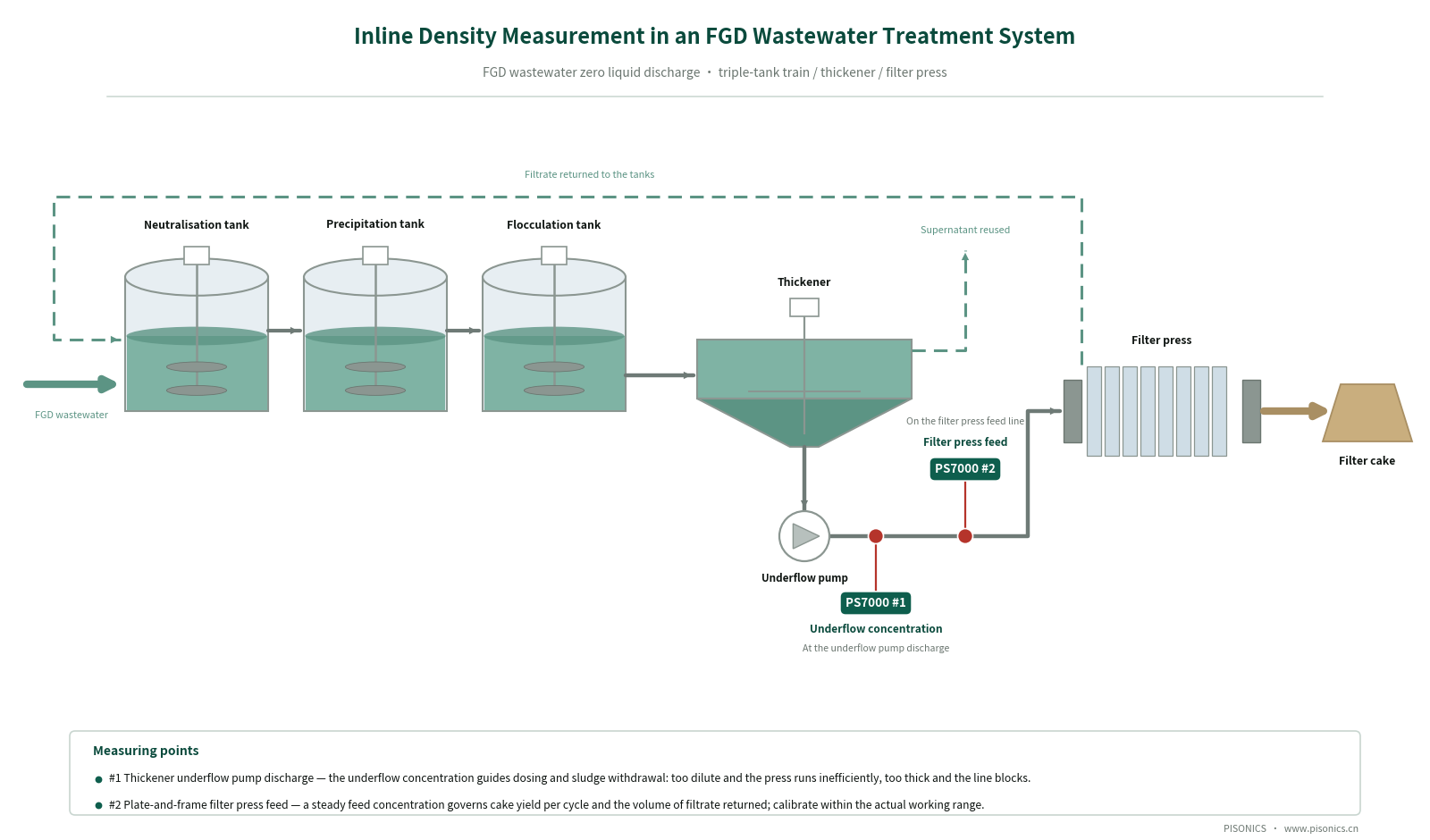
Online Measurement of Desulfurization Wastewater Density

In the flue-gas desulfurization process at power plants, online monitoring of the slurry density in the underflow from the thickener is critical. Conventional contact-type instruments are prone to scaling and corrosion, making it difficult to meet the demands of long-term, stable operation. Pisonics’ PS7000 acoustic impedance concentration meter employs a non-contact ceramic probe and a corrosion-resistant lining, effectively addressing severe corrosion and fouling while ensuring the accuracy and stability of the measurement data.

View case
Slurry density meter · PS7000

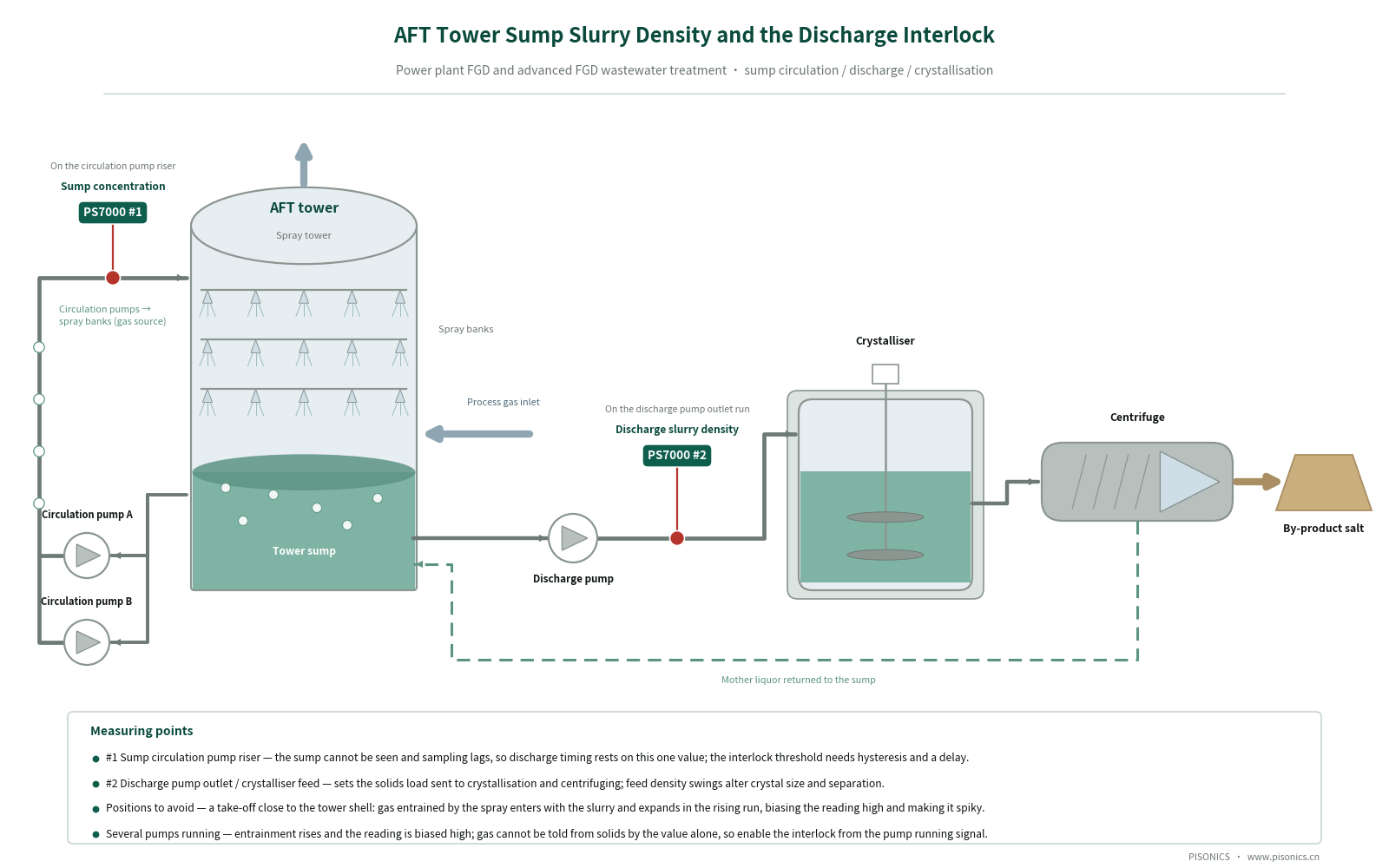
Online Density Measurement for the AFT Tower (High-Concentration Desulfurization Slurry Processing Tower)

In the AFT tower, measuring the density of high-concentration, high-viscosity, and easily crystallizing slurries has long been a challenge. The PS7000 acoustic impedance concentration meter, employing non-contact measurement, overcomes the failures of conventional instruments caused by clogging, wear, and crystallization, enabling real-time, continuous monitoring of slurry density and automated control of the discharge process, thereby ensuring stable system operation.

View case
Online tuning fork density meter · PS7400

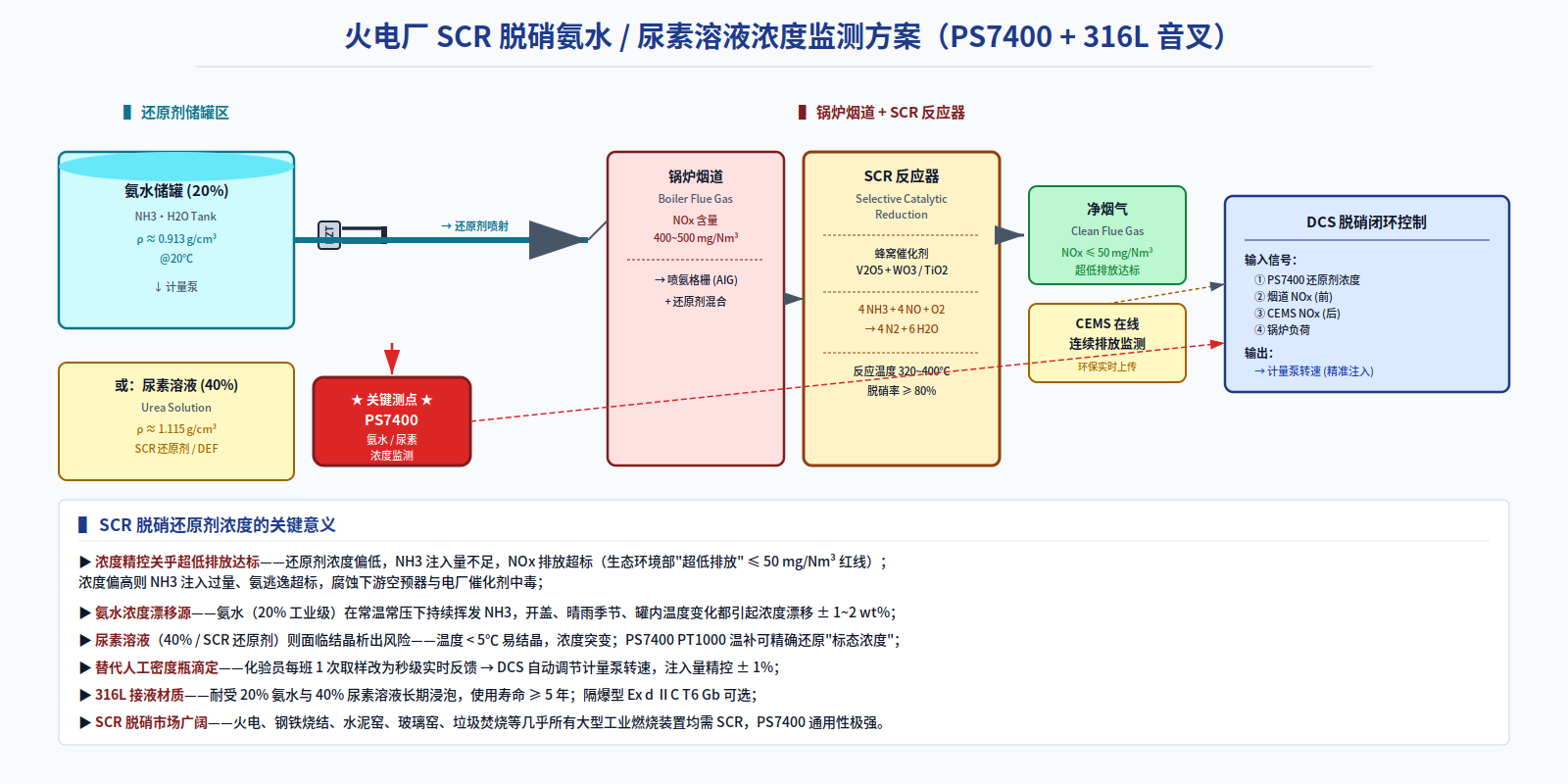
Ammonia Water 20% / Urea Solution 40% Reductant Concentration Online Monitoring

In the SCR denitrification system of a thermal power plant, the concentrations of 20% ammonia solution and 40% urea solution drift due to evaporation or low-temperature crystallization, and the lag in manual sampling leads to fluctuations in NOx emissions and excessive ammonia slip. The PS7400 online tuning fork density/concentration meter is installed on the storage tank’s outlet pipeline to measure concentration in real time and transmit the data to the DCS for closed-loop control, enabling ±1% precision control of the reductant injection rate and ensuring stable compliance with ultra-low emission standards.

View case

Selection support for this industry

Guides

All guides →

Comparisons

All comparisons →

Voices from this industry

"Our original tuning fork and differential pressure meters on the absorber gypsum discharge main had recurring problems with bubbles and scaling — we had to shut down weekly to clean them. After switching to PS7000, both problems disappeared. Basically maintenance-free now, accuracy is stable, and it fully meets our FGD process control needs."

Thermal Control Foreman Wang
Thermal Control Specialist
A certain thermal power plant in Inner Mongolia
All customer voices

Industry FAQ

Which density meter is recommended for power-plant FGD systems?

Typical Pisonics configurations for FGD:

  • Limestone slurry tank / absorber recirculationPS7400 tuning fork, excellent scaling resistance, range 1.0–1.4 g/cm³ covers all normal operating conditions
  • Gypsum slurry / discharge pump downstreamPS7300 differential pressure, cost-effective for large-bore main lines
  • FGD wastewater (high chloride)PS7010 ultrasonic attenuation, clamp-on install removes the corrosion-protection problem

Final selection depends on your specific PFD, pipe sizes, temperature, and SO₃ content. Send us your process parameter sheet and we'll return a written sizing proposal within 2 business days.

Which density meter goes at each FGD measurement point?

Typical measurement point configurations for FGD systems:

  1. Limestone slurry tank / pulp-making tank outlet → PS7000 acoustic impedance (strong anti-fouling);
  2. Absorption tower gypsum slurry / discharge pump main line → PS7000 ultrasonic acoustic impedance (bubble-resistant, non-contact);
  3. Flue-gas desulfurization wastewater (chlorine-corrosive) → PS7000 acoustic impedance or PS7400 titanium/ Hastelloy tuning fork;
  4. AFT tower high-concentration slurry → PS7000 or PS7400 titanium/ Hastelloy tuning fork;
  5. SCR denitrification ammonia water / urea solution → PS7400 tuning fork (medium accuracy) or PS7100 spectroscopy (multi-component).

All FAQs