Density & concentration across leach → SX → EW
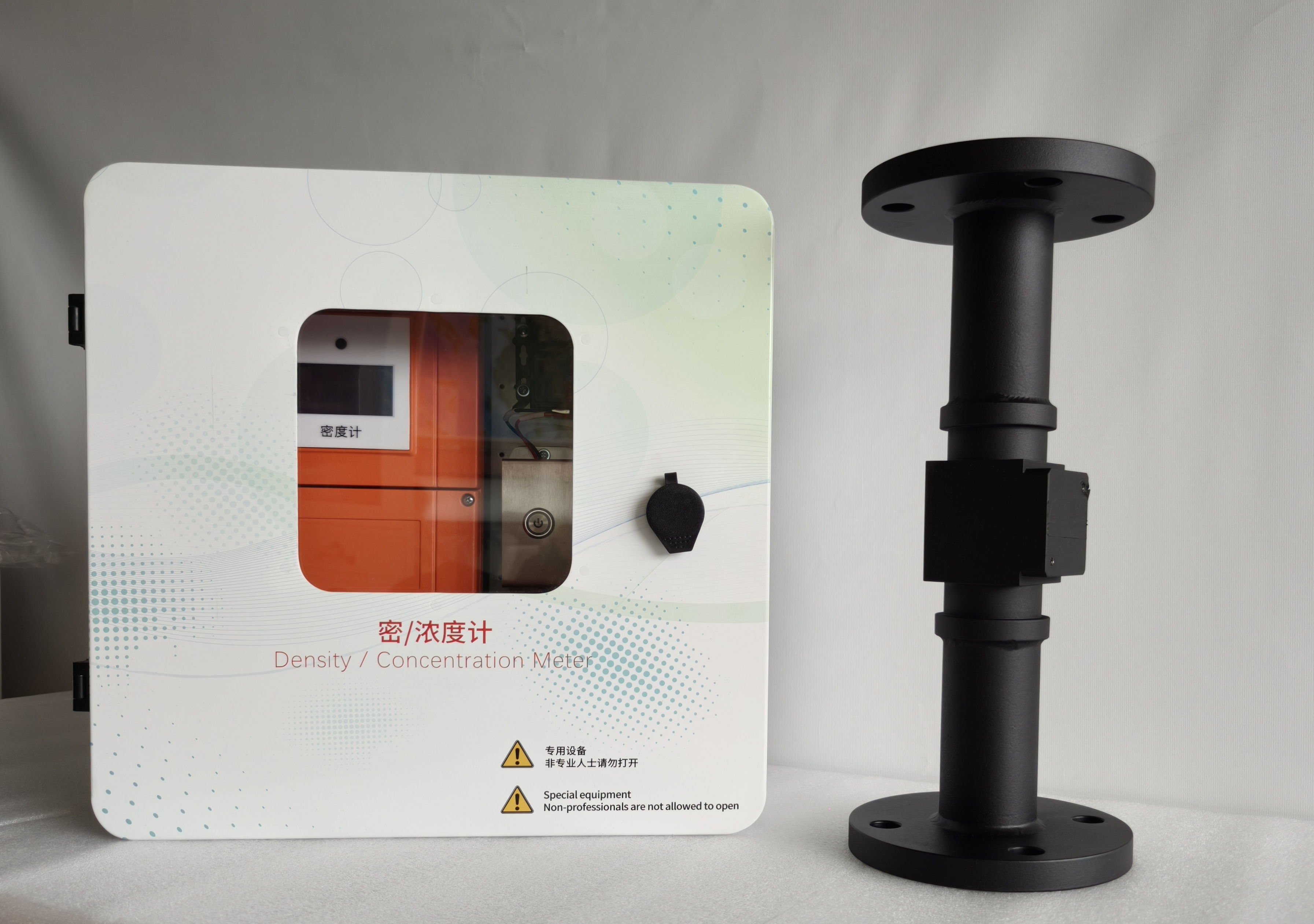
Hydrometallurgy extracts metals via leach → solvent extraction (SX) → electrowinning (EW). Leach-liquor acidity, the organic-to-aqueous ratio in SX, and Cu²⁺ concentration in EW tankhouse electrolyte are the critical control parameters — across copper (heap-leach SX-EW), cobalt (laterite SX), nickel (HPAL) and lithium (brine / spodumene). Pisonics meters read these inline, non-nuclear — see the concentration meter range.
Measurement points, by stage
| Process point | Principle | Model |
|---|---|---|
| Leach liquor Cu²⁺ / Ni²⁺ | Ultrasonic sound velocity + T comp | PS7020 |
| SX organic-to-aqueous (O/A) ratio | Optical / microwave | PS7110 / PS7600 |
| EW tankhouse Cu²⁺ electrolyte | Ultrasonic sound velocity | PS7020 |
| Brine Li concentration | Coriolis / ultrasonic | PS7200 / PS7020 |
| Crystallization mother liquor | Ultrasonic, scale-resistant | PS7000 |
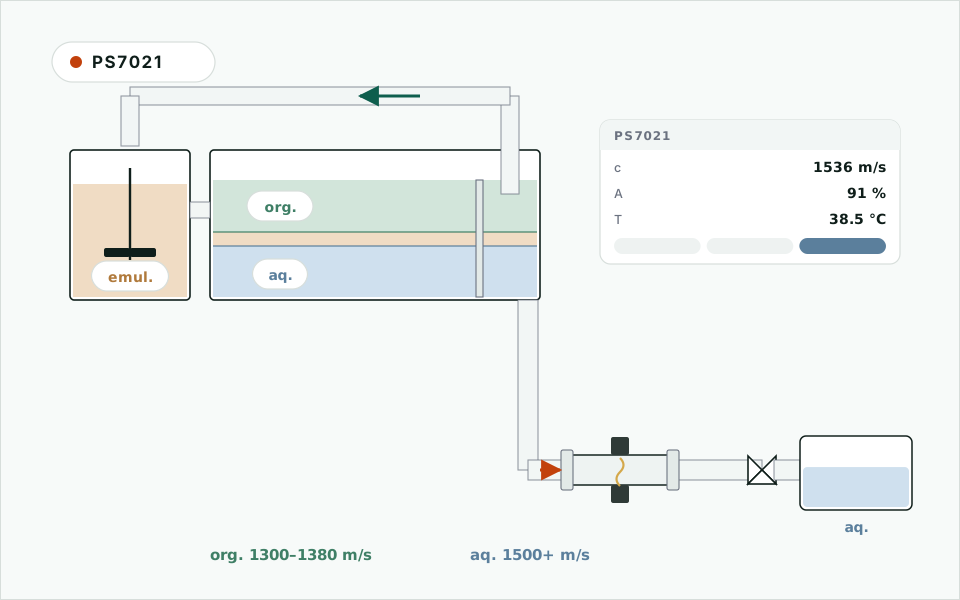
| SX settler organic / aqueous phase | Ultrasonic velocity + amplitude | PS7021 |
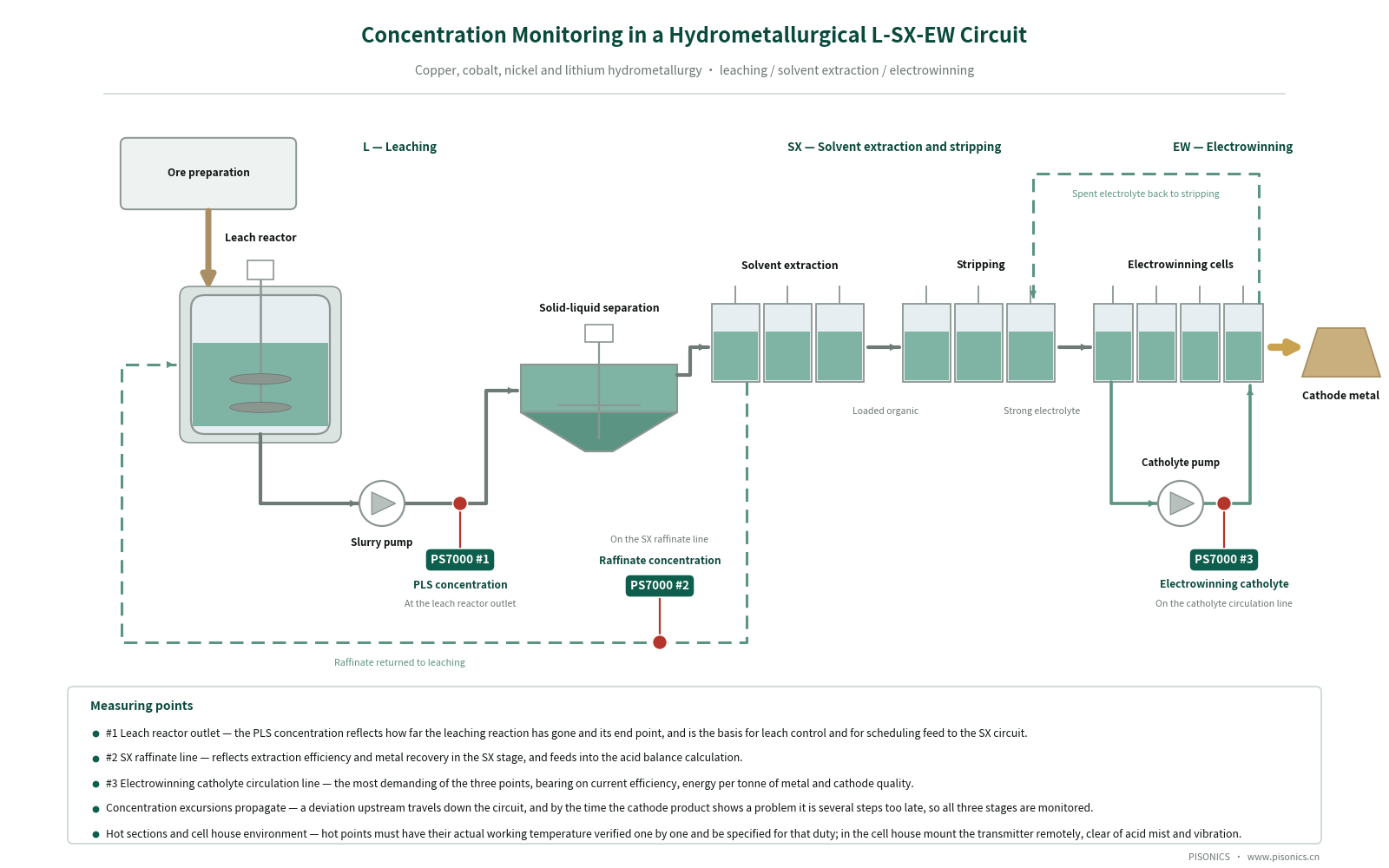
Related field case: PLS · raffinate · catholyte concentration online monitoring.
Why hydromet streams are hard
- Leach liquor is strongly acidic (pH < 1) and hot (80–150 °C) — needs corrosion-resistant wetted parts.
- SX phase carries kerosene + extractant — phase-boundary detection is hard.
- EW electrolyte needs ±0.1 g/L Cu²⁺ precision — directly drives cathode yield.
- Brine at 200–300 g/L total salts crystallizes on differential-pressure cells; sound-velocity / Coriolis avoid that.
Non-nuclear, by design
Radioactive gauges face strict licensing in remote refineries. Compare: PS7000 vs Berthold nuclear gauge · PS7000 vs Cs-137.
Selection help
Tell us your stage and metal (Cu / Co / Ni / Li) for a recommendation.