PISONICS | Xi’an Pisonics
PS7600 Series
Microwave Concentration / Density Meter
Through‑beam microwave measurement· Phase shift accurately determines concentration and density
Product Overview Product Overview
The PS7600 Series microwave concentration / density meter is an intelligent through‑beam microwave instrument developed by Xi’an Pisonics Information Technology Co., Ltd. (PISONICS) to meet the needs of online measurement for water‑containing materials. Leveraging the physical property that water molecules exhibit asignificantly higher dielectric constant (ε ≈ 80) compared to solid particles, resulting in strong microwave absorption, the PS7600 precisely captures the phase shift and amplitude attenuation of microwaves as they pass through the medium, thereby providing real‑time measurements of slurry concentration, density, moisture content, and Brix. It serves as a reliable alternative to nuclear‑source density meters, differential pressure instruments, and tuning‑fork devices in complex, water‑laden operating conditions.
Equipped with amicrowave phase‑shift analysis algorithm, coupled with Pt‑100 real‑time temperature compensation, the meter confidently handles challenging scenarios such as suspensions, pastes, highly corrosive media, and fouling‑prone environments. It suits flue‑gas desulfurization in thermal power plants, papermaking black liquor, sugar evaporation and crystallization, and concentration control in the food and beverage industries, delivering high‑sensitivity, highly repeatable real‑time data to ensure stable process operation and enhance product quality.
Measurement Principle How It Works
In water‑containing materials (such as suspensions, pastes, and slurries), water molecules, due to their strong polarity and a dielectric constant ε far exceeding that of other solids, exhibit asignificantly greater absorption capacity for microwaves. When a beam of microwaves passes through such a medium, changes in water content directly induce measurable variations in itsphase shift Δφ and amplitude attenuation. The PS7600 capitalizes on this physical phenomenon, employing finely calibrated mathematical models to translate phase and attenuation signals into concentration, density, or moisture content in real time.
The PS7600 adopts atransmission‑type dual‑probe design with one transmitter and one receiver: the transmitter continuously emits high‑frequency microwaves, while the receiver simultaneously acquires the signal after it has passed through the slurry. The host unit completes the analysis by comparing the phase difference between the reference and measurement channels. Meanwhile, a built‑inPt‑100 temperature sensor continuously monitors the medium’s temperature, automatically compensating for dielectric constant drift with temperature changes to maintain consistent measurement accuracy across all operating conditions.
→ The higher the moisture content, the more pronounced the phase shift Δφ, and the more accurate the concentration calculation.
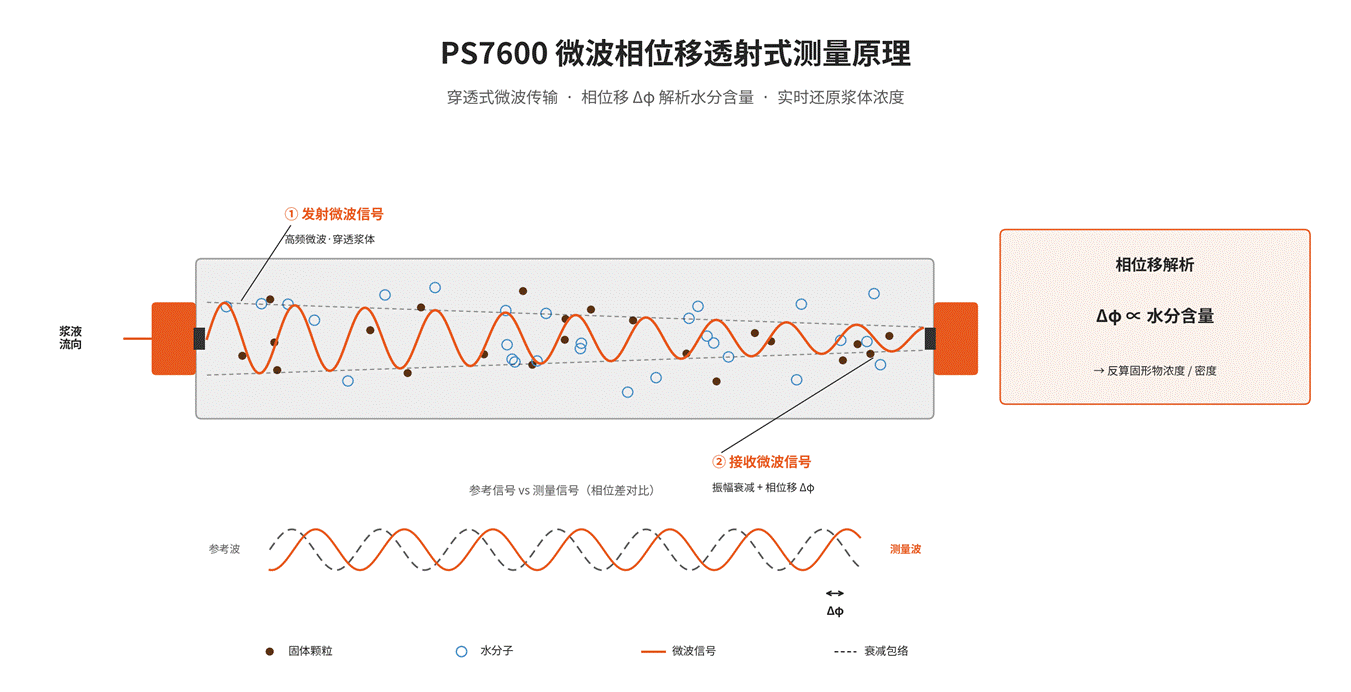
Figure 1 | Schematic diagram of the PS7600’s microwave phase‑shift transmission measurement principle
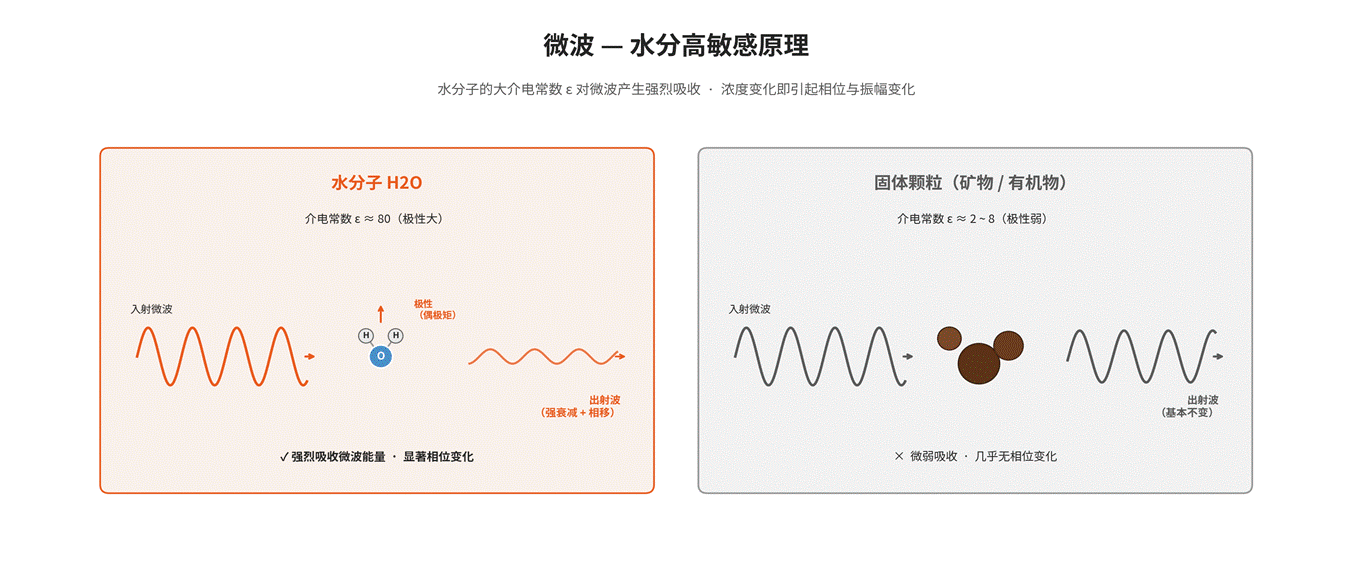
Figure 2 | The physical mechanism behind microwave sensitivity to water: differences in dielectric constant determine the signal response
Comparison of Three Microwave Measurement Methods
① Phase‑Shift Method (PS7600’s Preferred Approach) offers the highest accuracy and strongest anti‑interference capability. The instrument simultaneously transmits measurement and reference microwave beams; changes in moisture content produce a functional relationship in the phase difference, enabling precise determination of the slurry’s solid content.
② Signal‑Strength Measurement infers concentration from the attenuation of microwave amplitude after passing through the medium. The principle is straightforward, but the method is relatively sensitive to bubbles. The PS7600 uses it as an auxiliary verification channel alongside the phase‑shift approach.
③ Frequency‑Difference Method determines concentration based on the difference between transmission and reception frequencies, but it is easily affected by strong electrical interference from on‑site frequency converters. The PS7600 does not employ this susceptible approach.
Core Technological Advantages Core Advantages
No. | Key Technologies / Features | Customer Value |
1 | Microwave phase-shift measurement method | The most accurate moisture-sensitive method directly derives the concentration from the phase difference between the reference wave and the measured wave, offering strong anti-interference capability |
2 | Non-nuclear source, zero radiation | Safely bid farewell to the radiation risks and environmental‑approval hassles of gamma‑ray density meters, ensuring zero risk throughout deployment and maintenance |
3 | Transmissive dual-probe design | One transmitter and one receiver, with a clear signal path, minimal influence from changes in fluid velocity and flow direction, ensuring long-term measurement stability |
4 | Pt-100 Temperature Automatic Compensation | Built-in Pt-100 sensor for real-time media temperature acquisition, eliminating the impact of temperature drift on the dielectric constant and ensuring consistent accuracy across all operating conditions |
5 | Wide-range free adjustment | 0–100% concentration with free configuration, capable of displaying multiple parameters such as moisture content, suspended solids concentration, density, and brix |
6 | Tubular / Insertion dual installation methods | Inline DN65/DN80 flange‑integrated installation; plug‑in M18×1 probe compatible with various tanks and pipelines |
7 | 316 stainless steel probe housing | High-temperature and corrosion-resistant; the probe operates at temperatures ranging from −40 to 130°C, with a maximum pressure rating of 20 bar |
8 | Self-cleaning flush structure | Optional flushing pipeline available, enabling non‑disassembly online maintenance for scaling‑prone and highly adhesive media |
9 | 3.9-inch color LCD display | 320×240 resolution, adjustable brightness, simultaneous display of multiple parameters including concentration, signal strength, and phase difference |
10 | Multi-signal output | 4–20 mA analog output (≤500 Ω load) + RS485 digital output; PROFIBUS-DP optional |
11 | Bluetooth / USB / SD data interfaces | Compact models support USB 2.0 and SD card storage, while the All-In-One series features built-in Bluetooth communication |
12 | Small-Signal Cutoff and Drift Suppression | A configurable cut-off threshold can filter out process data disturbances, ensuring a smooth, stable, and reliable output curve |
Comparison with Traditional Solutions Why PS7600
Addressing the common pain points of online measurement for water‑containing slurries—namely, the regulatory burden of radiation associated with nuclear‑source instruments, the frequent drift of differential pressure and tuning‑fork devices due to scaling and slurry fluctuations, and the susceptibility of conventional sensors to temperature changes—the PS7600, leveragingmicrowave phase‑shift principle andPt‑100 real‑time compensation, achieves comprehensive superiority in three key dimensions: safety, sensitivity, and stability:
Comparison Dimensions | Nuclear (γ-ray) density meter | Differential pressure / tuning fork density meter | PS7600 Microwave Density Meter |
Safety | Radiation present; environmental approval required | Safety | Safe, radiation-free, and approval-free |
Moisture Sensitivity | Indirect (based on density difference) | Indirect (based on density difference) | Direct phase response, high sensitivity |
Bubble / Precipitation Interference | Significantly affected | Significantly affected | Phase-shift method for interference rejection, ensuring stability and reliability |
Temperature Influence | Mechanical compensation required | Manual calibration required | Pt-100 Real-Time Compensation |
Maintenance Costs | High (requires nuclear source replacement) | Medium (frequent cleaning and zero calibration) | Extremely low (optional self-cleaning design) |
Applicable Media | Versatile but with limited accuracy | Clean, homogeneous media | Water-containing slurries / pastes / suspensions |
Typical Application Scenarios Typical Applications
▪ Flue‑Gas Desulfurization in Thermal Power Plants for lime slurry concentration control, post‑desulfurization gypsum slurry density monitoring, and real‑time measurement of circulating slurry concentration
▪ Mineral Processing for concentration control of phosphate, zinc, and iron ore slurries; measurement of density at the thickener outlet and underflow from hydrocyclones
▪ Water Treatment / Sludge Management for monitoring sludge concentration in sewage treatment sedimentation tanks, controlling filler levels in biogas fermentation towers, and managing municipal and industrial sludge dewatering
▪ Pulp and Paper Production for measuring wood pulp and chemical pulp concentrations, monitoring black liquor concentration, and providing feedback on washing and recycling processes
▪ Sugar Industry for online Brix measurement of syrups, concentration control during evaporation and crystallization, and adjustment of returned syrup concentrations
▪ Food and Beverage for online measurement of solid content in juices, beers, edible oils, dairy products, coffee, and other beverages
▪ Petrochemical Industry (Ex‑rated Models) for monitoring crude oil water content and identifying oil‑water interfaces (suitable for the Ex series)
▪ Other Industries for measuring density of aerated brick mixtures and ensuring concentration uniformity in chemical ingredient preparation processes
Technical Parameter Overview Technical Specifications
Item | Specifications |
Product Model | PS7600 Series (Microwave Concentration/Density Meter) |
Measurement Principle | Microwave phase-shift method (primary) + signal strength method |
Measurement Parameters | Moisture content, suspended solids concentration, density, Brix |
Measurement Range | 0 ~ 100% (freely adjustable, calibrated per medium) |
Repeatability accuracy | < ± 0.01 % |
Resolution | Automatic range adaptation, with 0–2 digits after the decimal point (depending on the displayed value) |
Drift Suppression | The small-signal cutoff threshold can be set (process data filtering) |
Medium Temperature | Probe: −40 ~ +130 ℃ | Microwave cable: −40 ~ +90 ℃ |
Ambient Temperature | −30 ~ +70 ℃ |
Maximum Pressure | Insertion type: typically 10 bar (depending on the flange); inline type: 20 bar |
Probe Material | 316 stainless steel; wear-resistant/corrosion-proof lining available |
Installation Method | DN65 / DN80 flanged pipe‑mounted type | M18×1 insertion type (with or without flushing) |
Sensor cable | High-frequency microwave cable with a polyurethane jacket; standard length 2 m, maximum 5 m |
Self-cleaning | Optional flushing pipeline for online cleaning without disassembly |
Display Screen | 3.9″ monochrome/color QVGA LCD (320×240), with adjustable brightness |
On-site Operation | 4-key interactive menu, full-function local configuration |
Analog Output | 0/4–20 mA (load ≤ 500 Ω) |
Digital Output | RS485 (standard model); USB 2.0 + SD card (compact model); Bluetooth (All-In-One); optional PROFIBUS-DP |
Temperature Compensation | Pt-100 built-in temperature sensor, automatically compensates for dielectric constant temperature drift |
Power Supply | DC 24 V / max 1000 mA; AC 90–220 V, 50/60 Hz optional |
Enclosure | Aluminum pressure-resistant casting, 160 × 160 × 120 mm, IP65 |
Installation Dimensions | 4 fasteners, H × W = 120 × 180, hole diameter ø6 mm |
Sensitive to Water · Smart by Microwave
※ For customized non‑standard ranges, special linings, explosion‑proof models, or detailed selection guidance, please contact Pisonics’ technical engineers in Xi’an.
