Overview
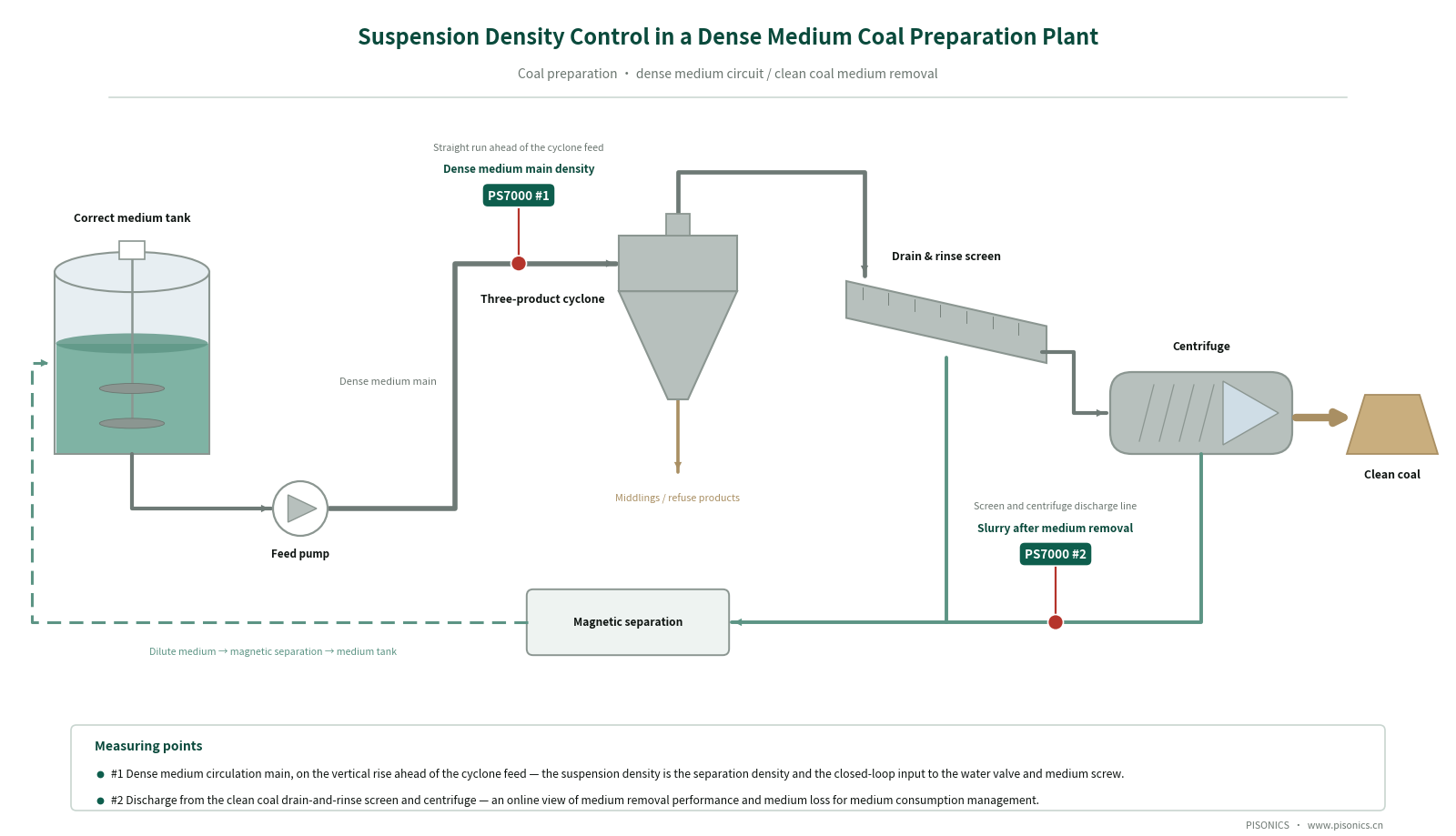
Separation accuracy in a coal preparation plant is set by density. The suspension density in a heavy-medium cyclone is the cut point — a 0.01 g/cm³ drift measurably shifts clean-coal yield and ash. Downstream, slime-water concentration drives flocculant dosing, thickener load and filter-press throughput; coal-water slurry preparation and pipeline transport are likewise concentration-controlled.
Typical challenges
- Magnetite-loaded medium is highly abrasive and needs closed-loop density control
- Slime water is opaque — optical methods cannot penetrate it
- Entrained gas and coarse particles wear or block insertion-style meters
- Some lines cannot be shut down for tapping, so a non-invasive option is required
Recommended solutions
| Measuring point | Principle | Model |
|---|---|---|
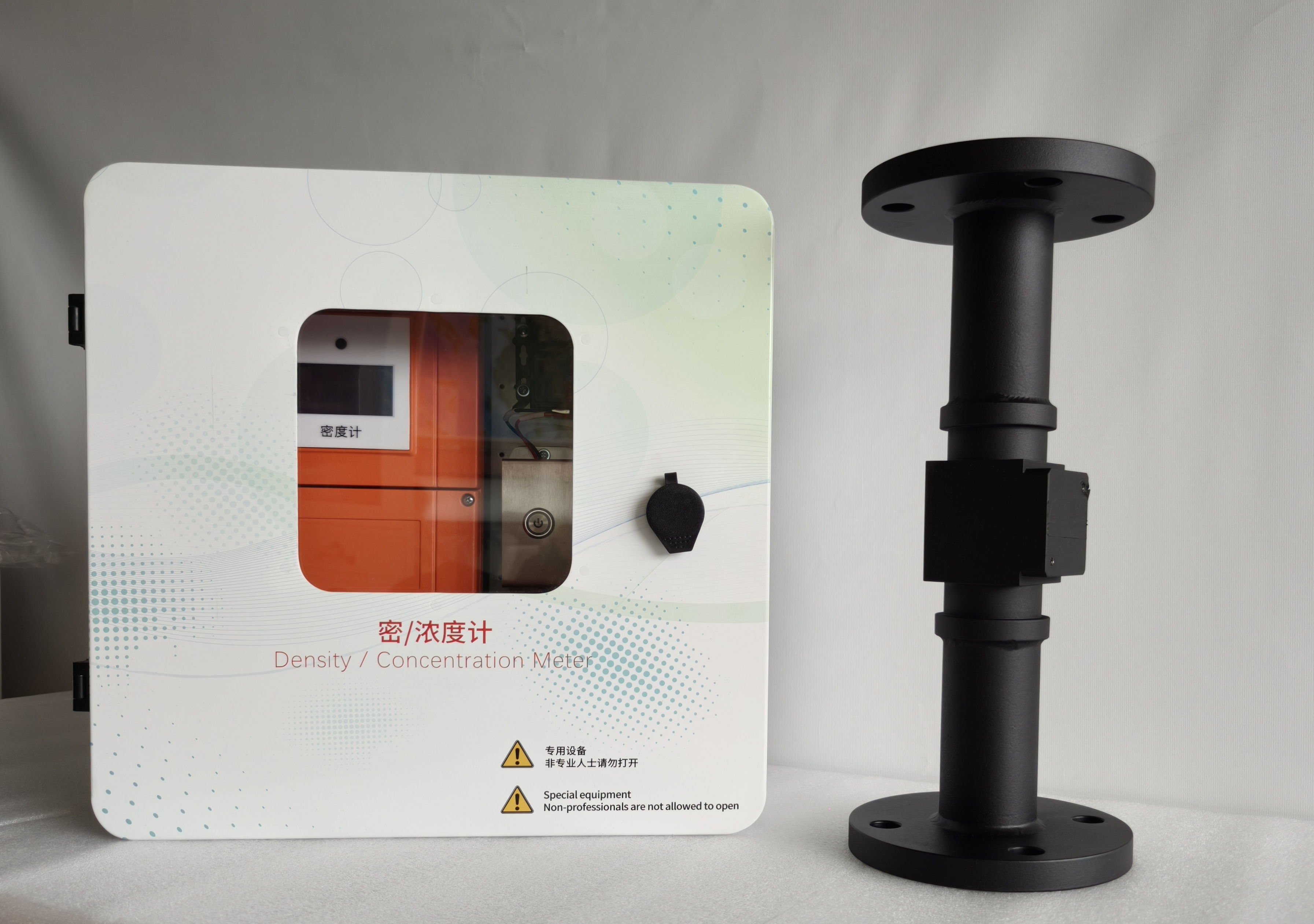
| Heavy-medium suspension (correct-medium sump / cyclone feed) | Ultrasonic acoustic impedance | PS7000 |
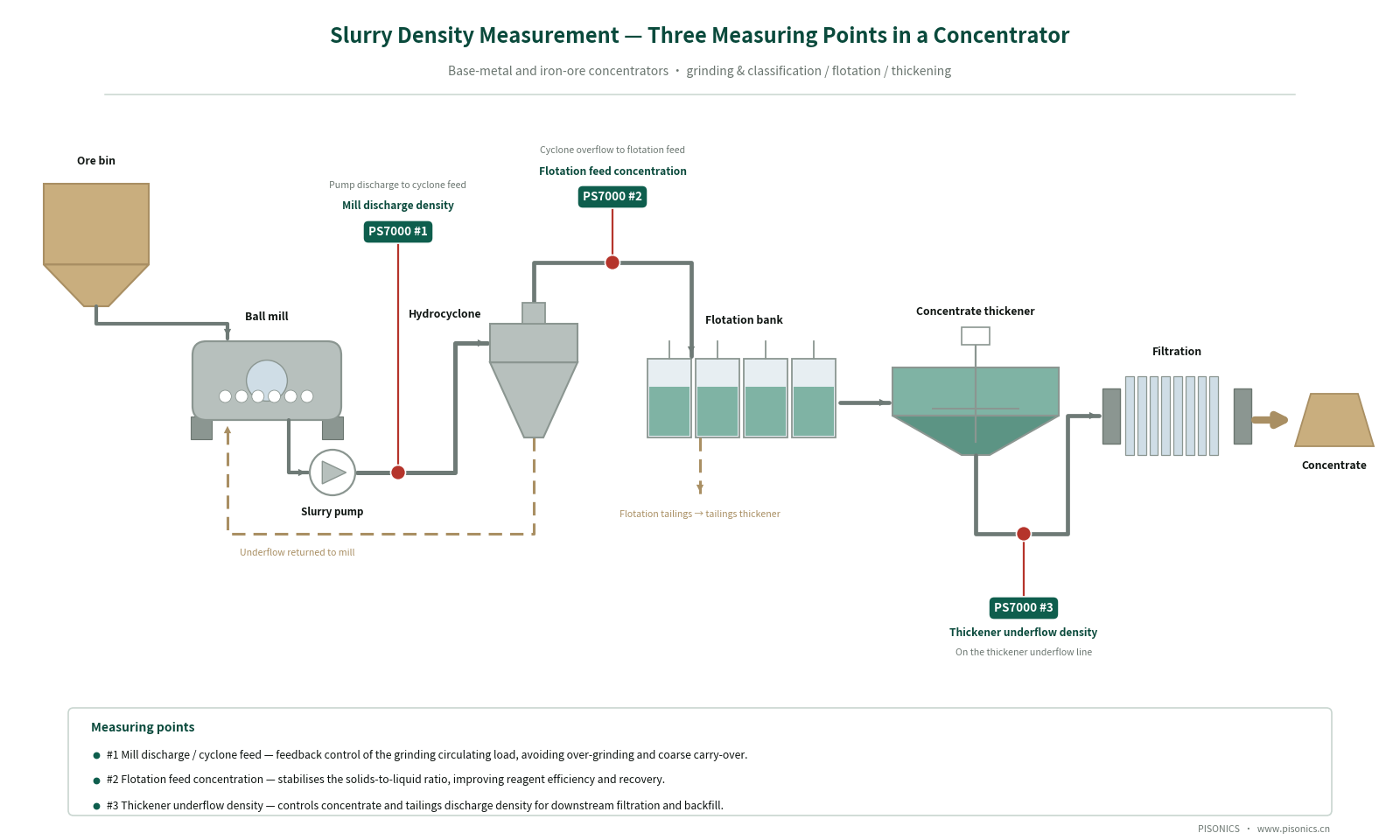
| Slime-water pipeline concentration | Ultrasonic attenuation (clamp-on, no tapping) | PS7000 |
| Thickener underflow / filter-press feed | Ultrasonic acoustic impedance | PS7000 |
| Coal-water slurry preparation and transport | Ultrasonic / Coriolis | PS7000 / Coriolis series |
Selection notes
Coal and slime water are dark and high in solids, which rules out optical methods. Where a line cannot be tapped, attenuation can be mounted clamp-on with the transducers on the outside of the pipe. Confirm pipe OD, wall thickness, material and lining up front — the signal crosses the wall twice, and rubber-lined pipe usually cannot be penetrated.