Differential Pressure Density Meter
hydrostatic density meter · DP density meter · pressure differential density meter
Two taps on the same vertical run: divide the pressure difference by the height difference and you have density. Nothing is more direct — and everything depends on the impulse lines.
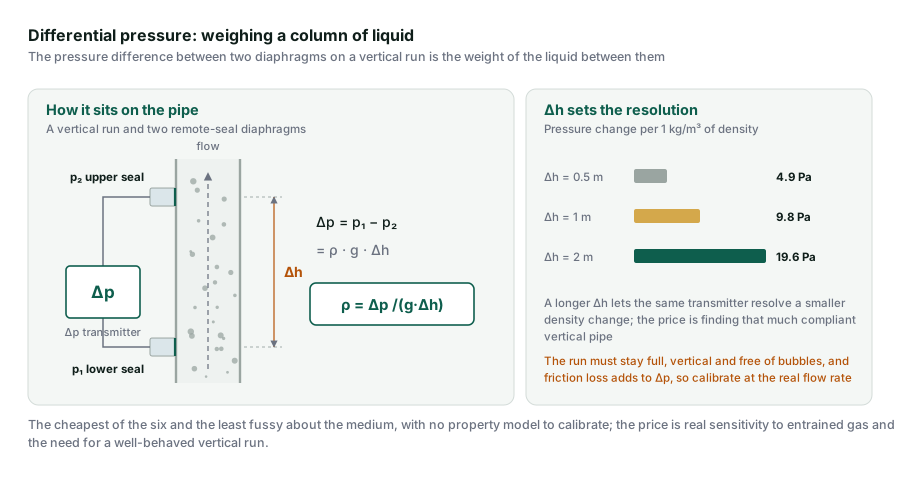
Tap the diagram to open it full size
The most direct density measurement there is
Take two taps at different heights on the same vertical run of pipe or on a vessel. The static pressure difference between them is Δp = ρ·g·Δh. The height separation Δh is known, so measuring Δp gives ρ directly. No calibration curve, no media model, no fitted parameters. That is the one advantage of the DP route, and it is a substantial one: it returns the physical quantity itself and assumes nothing about the medium. PS7300 uses a dual-diaphragm arrangement with three mounting styles.
Because it assumes nothing, a change of feedstock, ore or composition needs no recalibration. On a line whose material changes often, that can be worth more than accuracy.
Three things it depends on
- A full pipe and steady flow. Any dynamic-pressure component mixed into Δp is an error in ρ. The taps have to sit on a vertical section, full, with settled flow; a riser carrying gas produces a reading that never stops moving.
- Clear impulse lines. Conventional impulse piping plugs in slurry, almost as a matter of course, and one plugged leg is a one-sided offset that usually presents as slow drift rather than an obvious fault. Remote diaphragm seals with capillary fill exist to solve exactly this, at the cost of slower response and more sensitivity to ambient temperature.
- Enough height. The smaller Δh is, the smaller the Δp produced by a given density change, and the larger the noise share. In a cramped installation the resolution drops visibly.
Choosing between DP, ultrasound and microwave
DP is meaningfully cheaper, and where composition varies, accuracy requirements are moderate and a suitable vertical run exists, it is a pragmatic answer. Any one of the following, though, and the job belongs to ultrasonic impedance instead: entrained gas, significant pipe vibration, impulse-line maintenance that will not actually happen, or no vertical straight run to mount on.
The coal-washing comparison data behind SEO-14 makes the same point: DP is not incapable in dense coal slurry, it is that maintenance and drift consume its cost advantage. Put three years of maintenance hours into the comparison and the answer often differs from the one the purchase price suggests.
Installation notes
- Vertical runs or vessels only, with no branch, valve or size change between the two taps.
- Make Δh as large as the space allows; prefer 1.5 m or more.
- With remote seals, watch capillary routing and ambient temperature — keep them out of direct sun and away from heat sources.
- Make the zero check routine. The reading on an empty line or on clean water is the best health indicator this instrument has.
Buying from China
CE marked; ATEX / IECEx depends on the transmitter and seal configuration. Wetted materials, diaphragm material and fill fluid should all be specified against the process — for high-temperature or vacuum service the fill fluid choice matters more than the transmitter. Quotations in USD or EUR on EXW, FOB Shanghai or CIF, with HS code and declaration of conformity. Send the vertical run available and the process connection with the enquiry; Δh is the first thing that decides whether this principle is even viable.
Where it works
- Lines whose composition changes often and cannot be recalibrated repeatedly
- Moderate-accuracy density monitoring where a suitable vertical run or vessel exists
- Budget-sensitive installations with many measuring points
- Plants already standardised on DP transmitters and their spares
Where it doesn't
- Media carrying gas — dynamic pressure and gas columns land straight in the reading
- Plugging or crystallising slurry with no impulse-system maintenance in place
- Installations without enough vertical height separation
- Locations with strong pipe vibration or unsettled flow
- Control loops that need high accuracy or fast response
Common questions
How do I choose between PS7300's three mounting styles (A/B/C)?
The PS7300 offers three installation configurations:
A—Straight‑tube insertion—vertically inserted through a single hole in the tank roof; this is the most common method and is suitable for atmospheric‑ or low‑pressure storage tanks without agitation or with stable liquid levels (such as finished‑oil tanks and urea solution tanks).
B—Bent‑joint insertion—inserted through a single hole and then bent to a specified depth inside the tank, bypassing agitators or heating coils; this is ideal for large chemical polymerization reactors and MVR evaporation crystallizers.
C—Side‑mount installation—two openings on the tank sidewall, with the diaphragm directly facing the liquid column; this is appropriate for stirred reaction vessels, oil‑gas field three‑phase separators, and horizontal pipeline applications.
Simple guidelines: vertical installation with no obstructions → A; obstacles inside the tank requiring bypass → B; feasible with two side‑wall openings → C.
All three methods have a measurement range of 0–1.0/2.0/3.0 g/cm³, with a resolution of 0.001 g/cm³.
Get a free field assessment
Tell us your medium, process and what you're measuring — we'll match the right principle and model.