PISONICS· Xi’an Pisonics
PS7300 Series
Differential-Pressure Density Meter
Dual-flange differential pressure · Integrated transmitter · Three mounting options available
Oil‑Gas Field / Three‑Phase Separator Industry Application Case
—— Online monitoring of the oil‑water‑gas interface · Intelligent estimation of water cut ——
Offshore platforms / Onshore oilfields · Intrinsically safe Ex ia ⅡC T6 · Early warning of interface control loss
【Key Measured Parameters: Oil‑Water Interface Position + Oil‑Phase Water Cut】
【Mounting Method: C‑Side Mounting · Intrinsically Safe】
Oil‑Gas Field / Three‑Phase Separator · PS7300 Differential‑Pressure Density Meter Application Solution
1. Process Background
The three‑phase separator is a core process unit in oil‑gas field well pads, crude oil gathering stations, offshore drilling platforms, and oily wastewater treatment facilities. Produced fluid from the wellhead (a three‑phase mixture of crude oil, produced water, and associated gas) enters a horizontal or vertical separator, where density differences cause natural stratification: a bottom water layer (ρ ≈ 1.00–1.05 g/cm³), a middle oil layer (ρ ≈ 0.85–0.92 g/cm³), and a top gas phase, which are discharged through three separate outlets—gas to the flare or recovery system, oil via transfer pumps to storage tanks, and water to the oily wastewater treatment system before being reinjected into the formation.
Accurate monitoring of the oil‑water interface position is a critical control variable for separator operation, directly affecting production efficiency, produced water quality, and downstream equipment safety: if the interface drops, water enters the oil stream (“water in oil”), triggering fines and rejection by downstream refineries when water cut exceeds specifications; if the interface rises, oil enters the water stream (“oil in water”), contaminating the reinjected produced water and posing dual risks of environmental incidents and formation plugging.
2. Pain Points of Traditional Density Measurement Solutions
• Conventional oil‑water interface detection methods (floats, capacitance probes, radar) are susceptible to multiple interferences such as wax deposition, oil‑water emulsification, entrained air bubbles, and solid sand, resulting in high failure rates and frequent maintenance;
• In the confined spaces of offshore platforms, with limited personnel and stringent explosion‑proof requirements, the heavy workload of maintaining and replacing traditional contact instruments is difficult to sustain;
• In scattered onshore well pads, where power supply is unstable and communication conditions poor, conventional instruments struggle to deliver long‑term reliable performance;
• The cascading losses caused by an uncontrolled oil‑water interface can be enormous—a single “water in oil” incident may require downstream refineries to reprocess tens of thousands of tons of crude oil, while a single “oil in water” event can contaminate reinjected produced water and trigger environmental enforcement actions.
3. PS7300 Solution
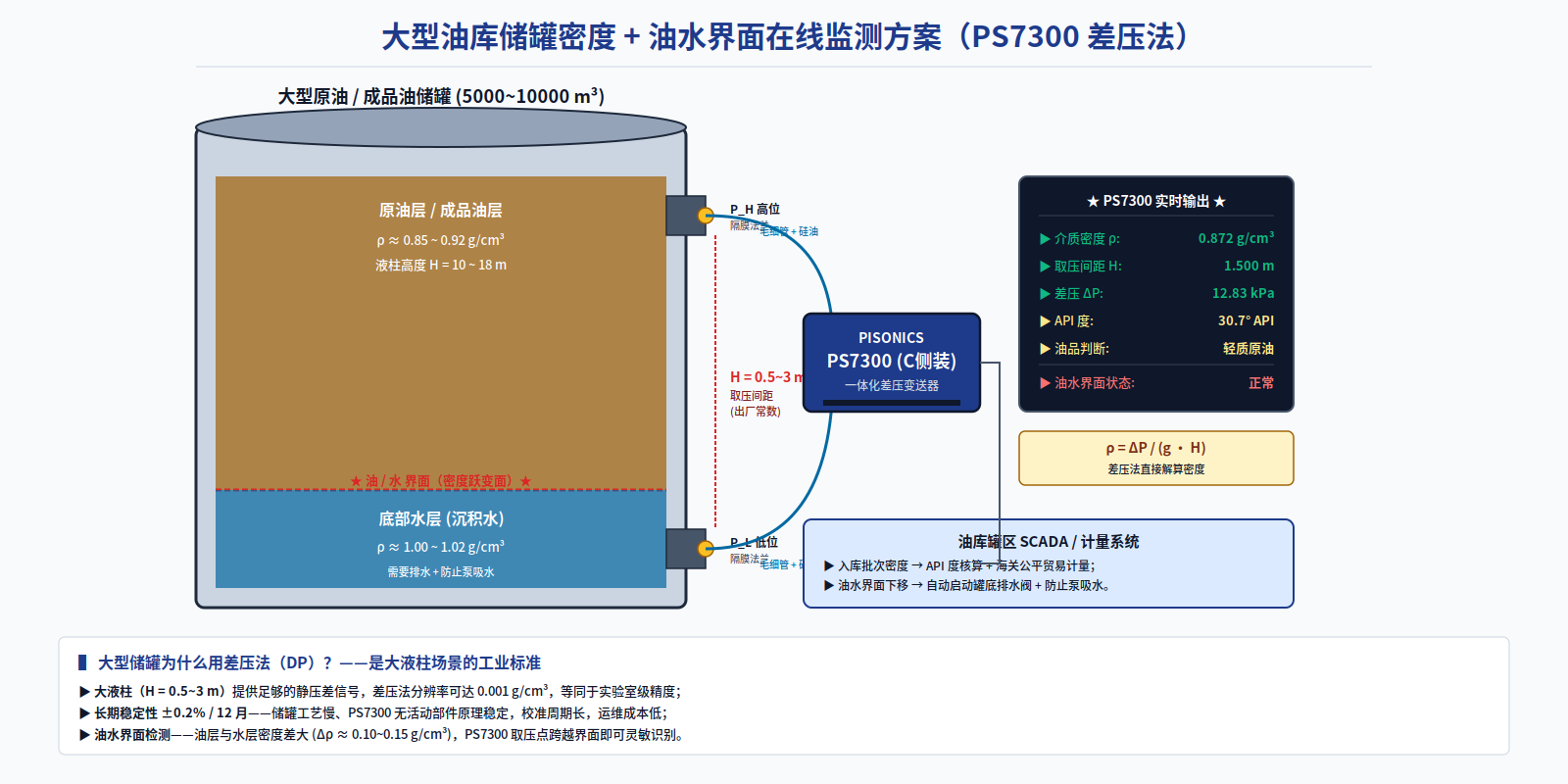
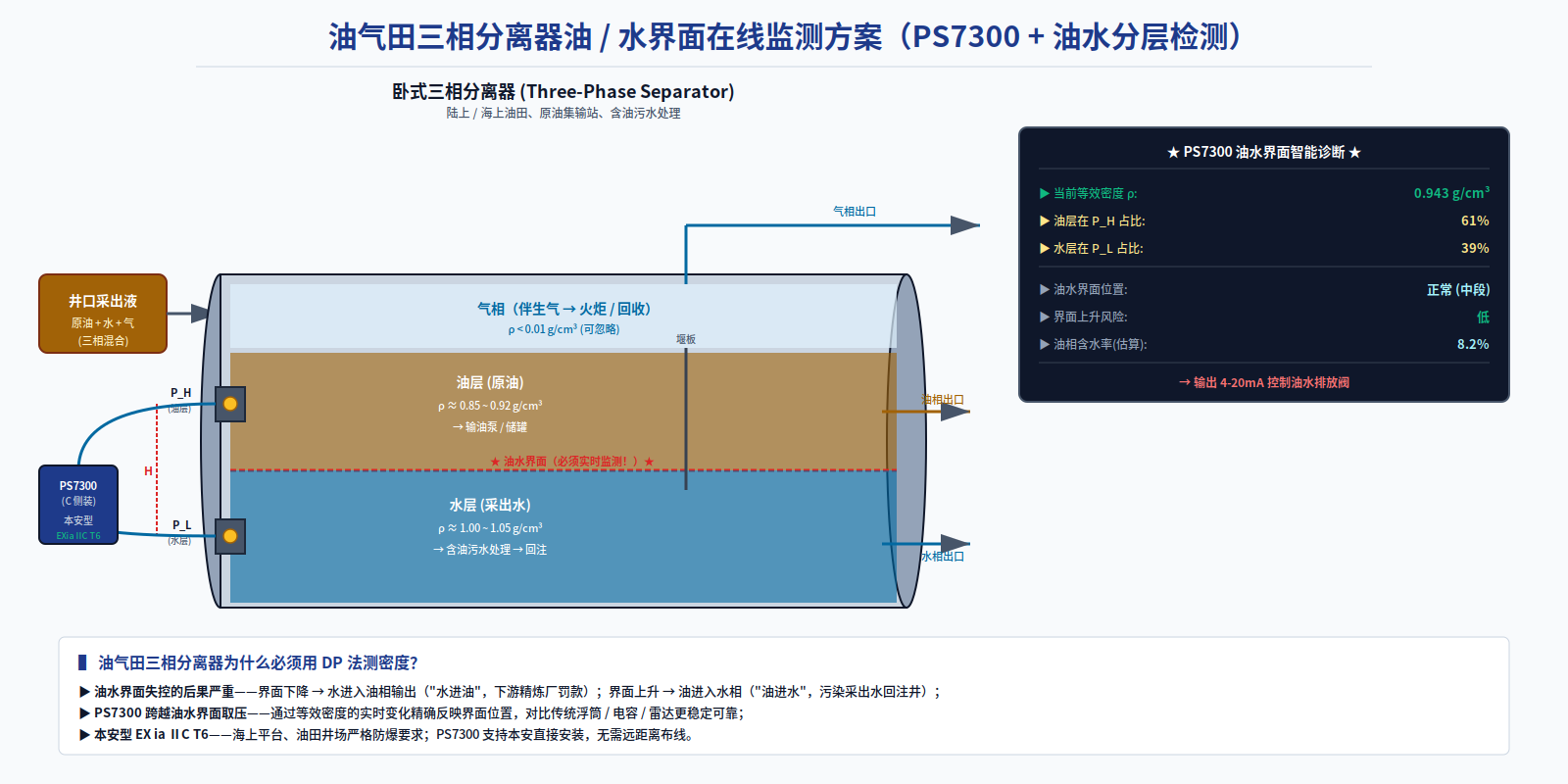
The PS7300 C‑side mount model (intrinsically safe Ex ia ⅡC T6) is installed on the side wall of the three‑phase separator, with the P_H tap positioned in the middle of the oil layer and the P_L tap in the middle of the water layer, spanning the oil‑water interface. As the interface position changes, the equivalent density output from the PS7300 varies accordingly: a descending interface increases the measured density (more water enters the sensing section), while a rising interface decreases it. An intelligent diagnostic algorithmin real time calculates the relative proportions of oil and water within the measurement section, providing estimates of the interface position and the oil phase’s water cut, and outputs a 4–20 mA signal to control the oil‑water discharge valves.
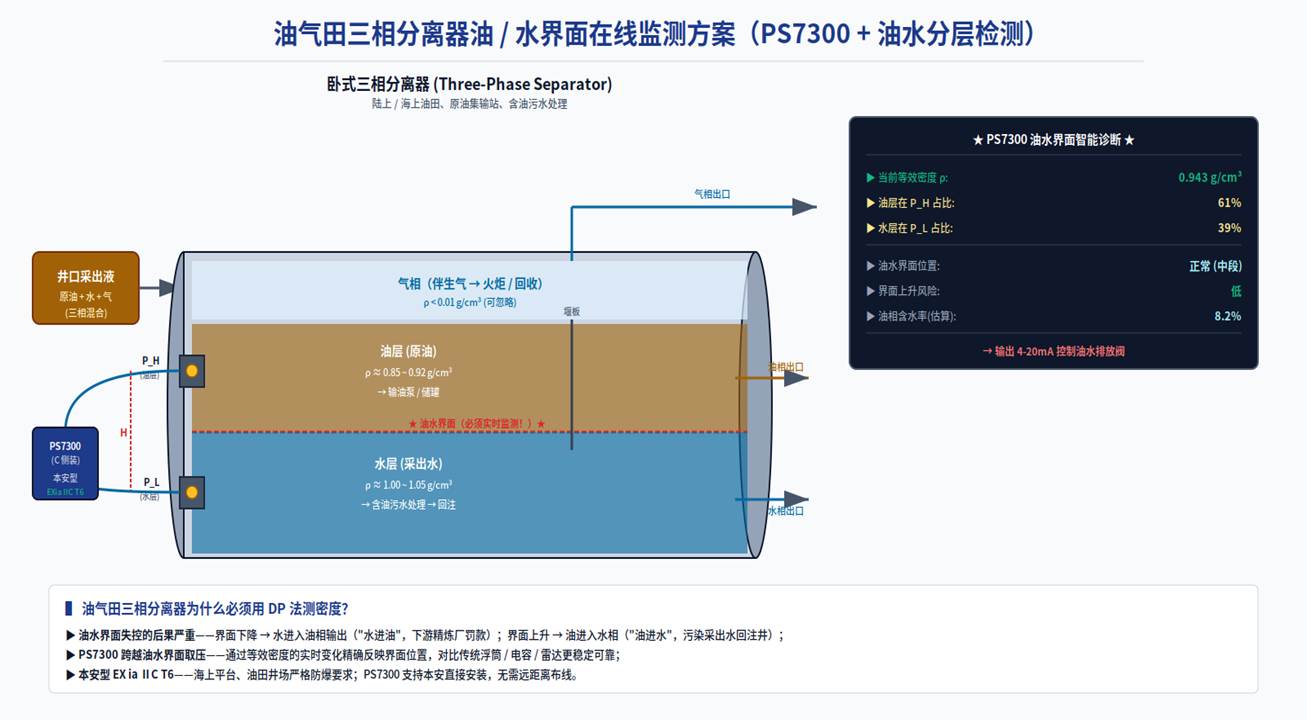
Figure 1: Online Monitoring Scheme for the Oil‑Water Interface in an Oil‑Gas Field Three‑Phase Separator
Core Technical Value of the PS7300 in Oil and Gas Fields / Three-Phase Separators ▶ C‑side mounted pressure tapping spans the oil–water interface—based on real‑time changes in equivalent density, it accurately reflects the interface position, offering greater stability and reliability compared to conventional float, capacitance, or radar instruments; ▶ Intrinsically safe Ex ia ⅡC T6—meeting the stringent explosion‑proof requirements of offshore platforms and oilfield well sites, the PS7300’s intrinsically safe design allows direct installation in Zone 1 hazardous areas without the need for long‑distance wiring; ▶ Intelligent diagnostic algorithms—real‑time backcalculation of oil and water layer proportions + estimation of oil phase water content + early warning of interface rise risks; ▶ No moving mechanical parts—resistant to multiple disturbances such as crude oil wax deposition, oil–water emulsification, bubble entrainment, and solid sand, with maintenance‑free operation for ≥ 5 years; ▶ Optional Hastelloy C‑276 diaphragm—withstanding the corrosive acidic environment of produced water from high‑Cl⁻/H₂S oilfields; ▶ 4–20 mA + HART—seamlessly interfaces with wellsite RTUs and oilfield SCADA systems, supporting remote monitoring and fault diagnosis. |
4. Customer Value
Comparison Dimensions | Original float/capacitance solution | PS7300 Differential Pressure Method Solution |
Interference Immunity | Wax deposition / Emulsion breakdown | Completely immune |
Maintenance Frequency | Monthly cleaning / calibration | ≥ 5 years of maintenance-free operation |
Explosion-proof capability | Long-distance wiring is required | Intrinsically safe direct-mount |
Interface Diagnosis | Position inaccurate | Position + moisture content dual output |
Interface Out-of-Control Early Warning | It was discovered afterward | Real-time early warning |
Suitable for offshore platforms | High maintenance workload | Plug-and-play |
Long-term Reliability | High failure rate | Industrial-grade stability |
In a three‑phase separator retrofit project at a domestic offshore oil production platform, four PS7300 C‑side mount units (intrinsically safe, with Hastelloy diaphragms) replaced the original float‑type oil‑water interface meters and were deployed across four 25 m³ horizontal three‑phase separators. After one year of operation, interface control loss incidents were eliminated (previously averaging 1–2 per month), annual crude oil production increased by approximately 2.3% (about 18,000 tons), and downstream refineries’ quality claims for “water in oil” cases were also zeroed out. Meanwhile, annual instrument maintenance hours dropped from 280 to under 20, significantly reducing the platform’s costly personnel maintenance burden. This solution benchmarks against international products such as E+H Deltabar FMD77, Emerson Rosemount 3051SAL+1199 remote‑diaphragm seals, and others, and has been extended to various oil‑gas field sub‑segments, including onshore well pads, crude oil gathering stations, and oily wastewater treatment facilities.
Conclusion
Based on the PS7 series’ five density/concentration measurement principles (PS7000 acoustic impedance, PS7020 sound velocity, PS7100 spectroscopy, PS7300 differential pressure, and PS7400 tuning fork), Xi’an Pisonics (PISONICS) has developed a comprehensive industrial process instrumentation portfolio, covering everything from solid‑containing two‑phase slurries to clean, homogeneous liquids, from single‑component to multi‑component systems, and from inline process monitoring to large‑scale tank gauging. Among these, the PS7300 differential‑pressure density meter—grounded in the classic ΔP = ρ · g · H physical principle and benchmarked against international mainstream brands such as E+H Deltabar PMD75/FMD77, Emerson Rosemount 3051SAL+1199 remote‑diaphragm seals, and VEGA VEGADIF 65/85—is a “long‑term stable, low‑maintenance” industrial standard solution for large tanks, tall liquid columns, and slow‑process density monitoring.
Tailored to the process characteristics of the oil‑gas field and three‑phase separator industries, the PS7300 series offers full‑scope selection and customization capabilities, covering mounting options (A straight‑pipe, B elbow, C side), wetted‑part materials (316L, Hastelloy, Monel, tantalum, titanium, PFA coating), process connections (HG/T20592, JIS, ASME, sanitary clamp), explosion‑proof ratings (intrinsically safe ExiaIICT6, flameproof ExdIIBT4), and communication protocols (4–20 mA, HART, Modbus RS‑485). For an in‑depth discussion of your project’s specific operating conditions or to obtain a tailored selection proposal, please feel free to contact the Xi’an Pisonics technical engineering team at any time.