Overview
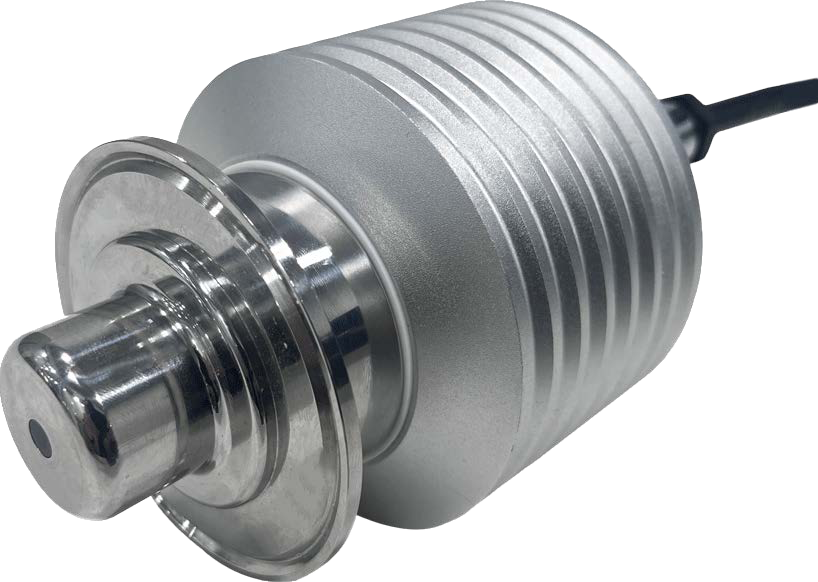
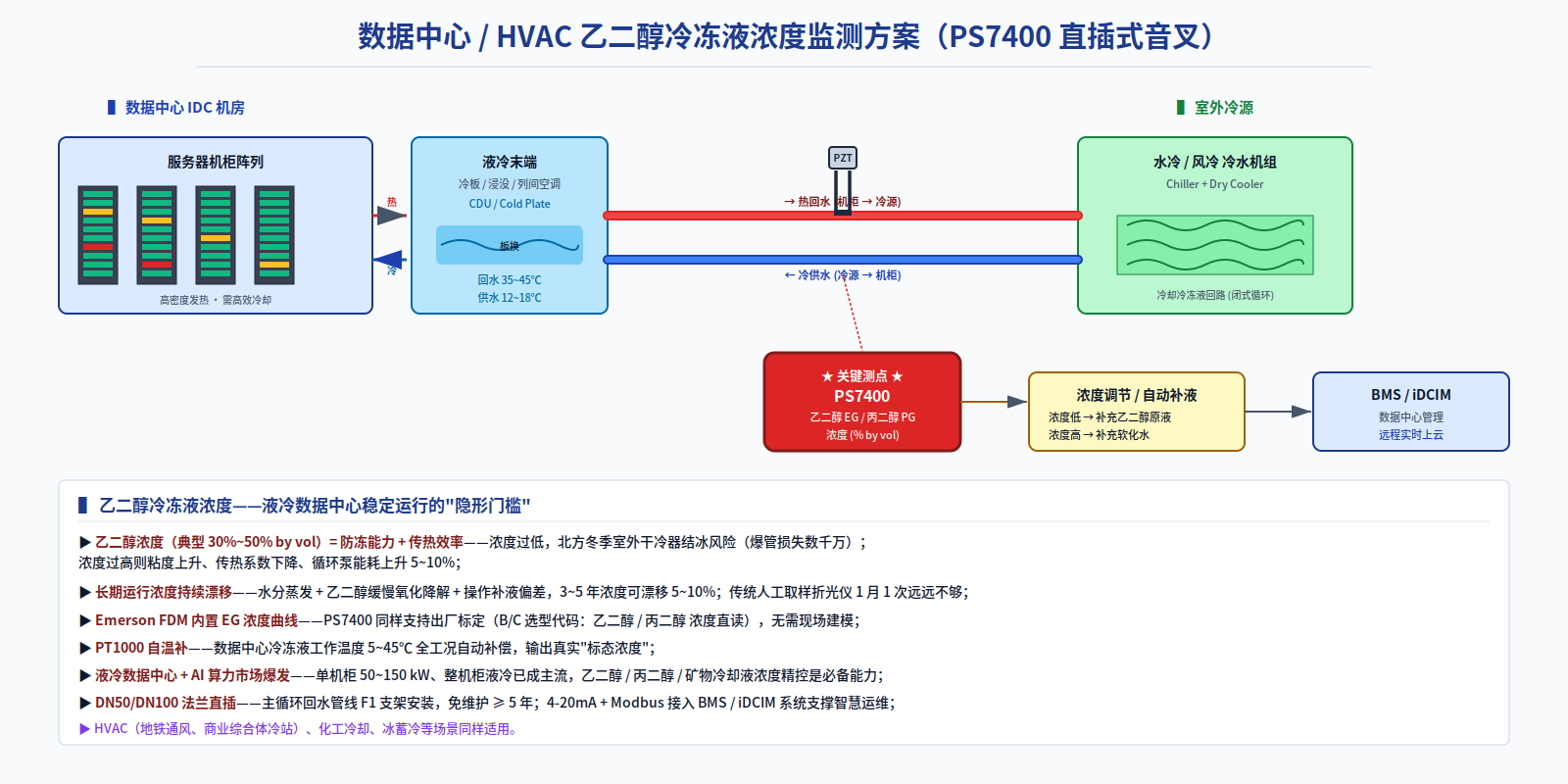
AI workloads have driven per-rack power from 5-15 kW to 50-150 kW, making liquid cooling (cold plate, immersion, in-row) the default for new hyperscale data centers. Loops run ethylene glycol (EG, 30-50 vol%) or propylene glycol (PG) in water. Too lean: dry coolers freeze and burst in winter (single incident worth millions plus SLA penalties). Too rich: viscosity rises, heat-transfer efficiency falls, pump energy +5-10%. PS7400 inline tuning-fork density monitors EG / PG concentration continuously — a core instrument for Alibaba, Tencent, ByteDance, Huawei and the three-carrier IDC operators. Same approach covers HVAC scenarios: metro ventilation chillers, commercial cooling, chemical cooling and ice-storage systems.
Process challenges
- EG concentration drifts continuously — water evaporation + glycol oxidation + operator top-up bias, accumulating 5-10% over 3-5 years
- IDC operators are network specialists, not chemists — monthly handheld-refractometer sampling can't catch drift
- Tier 3/4 facilities need long-life unmaintained sensors — instrument failure means downtime
- HVAC pipe sizes vary widely (DN50-DN200), needing flexible installation
- Glycol operates 5-45°C — automatic temperature compensation is mandatory
- A PG loop grows biofilm more readily than an EG loop — propylene glycol is far more biodegradable than ethylene glycol, which is exactly why it is preferred on toxicity grounds, but in a warm closed loop that makes it a nutrient
- Refractive index cannot tell PG from EG: at 25 vol% the two differ by about 0.0002 RI, while 1 vol% of concentration is about 0.001 RI. The instrument has to be told which fluid it is reading, and the make-up fluid has to be confirmed explicitly at commissioning and written into the checklist
Why a PG loop has to go optical
EG and PG are not the same selection problem. Refractive index is monotonic across the range for both; sound velocity is monotonic for EG over the working range but folds back for PG — it turns over, and one sound velocity then corresponds to two concentrations. There is no acoustic route to PG.
| Coolant | Tuning fork PS7400 | Sound velocity PS7020 | Refractometer PS7110 |
|---|---|---|---|
| EG (ethylene glycol) | Yes | Yes | Yes |
| PG (propylene glycol) | Yes | No — sound velocity turns over | Yes |
Glycols move refractive index by roughly 0.001 RI per vol%. The PS7110 is specified at ±0.0001 RI, which works out at ±0.1 vol%; its 0.00001 RI resolution works out at 0.01 vol%. Typical operating points — PG10 ≈ 1.343, PG25 ≈ 1.358, PG40 ≈ 1.373, EG30 ≈ 1.363 — all sit in the lower third of the PS7110-B range (1.33299–1.51782), with headroom on both sides. The prism face is rated to 1.5 MPa against a typical CDU secondary loop at 6 bar or less.
Temperature is what picks the variant. The PS7110-B runs 0–70 °C, which covers an indoor CDU secondary loop at 10–60 °C — but its lower limit is 0 °C, not below zero. An outdoor dry-cooler loop can fall below 0 °C in winter, and that duty needs the PS7110-C (−10 to 100 °C). Saying so plainly is how the wrong variant stops being ordered.
One limitation belongs in the open: refractive index cannot tell PG from EG. At 25 vol% the two differ by about 0.0002 RI, while 1 vol% of concentration is about 0.001 RI — the gap between the two liquids is a fifth of the smallest concentration step that means anything. The consequence is concrete: top a PG loop up with EG and the instrument returns a perfectly plausible wrong number, and raises no fault doing it. That is not a sensor defect, it is a configuration and procedure problem, and it has a concrete answer. The fluid must be declared to the instrument rather than guessed at; it should be selectable over Modbus and readable back for verification; and it should be confirmed explicitly at commissioning and written into the checklist.
A change of inhibitor package is not a worry: dissolved solids move refractive index by about 0.0001–0.0002 RI/wt%, which against a 0.001 RI/vol% concentration slope is an offset of 0.1–0.2 vol%.
Finally, a concentration is only complete with its reference temperature. This industry works in vol% referenced to 60 °F (15.6 °C).
Fouling risk in PG, and prism condition diagnostics
Put honestly, PG plus refractometry is the most biologically active fluid paired with the most surface-sensitive method: critical-angle refractometry reads a layer about 1 µm thick at the prism face, so a film does not block the measurement, it grows inside it.
What answers that is the same detector. The position of the shadow line is the measurement; its sharpness and contrast are a second quantity seen at the same time. A film blunts the edge before it shifts the position, so the instrument can report its condition before the reading is visibly wrong, instead of quietly returning a plausible number.
| State | What it means | Action |
|---|---|---|
| Good | Edge quality normal, concentration within specification | None |
| Degraded | Edge quality falling, concentration still within specification | Schedule a clean — this is the state worth having: maintenance gets planned before anyone sees a bad number |
| Failed | Concentration can no longer be supported | The instrument outputs refractive index and temperature and withholds concentration |
Where the measuring point goes
- Location: a bypass or sample loop on the CDU secondary side, taken from the pump outlet and returned to the pump inlet
- Attitude: a vertical measuring chamber with the flow running upward
- Prism: flush with the flow path, not recessed — the scouring action of the flow is part of keeping it clean
- Orientation: the prism face must never point downward. This one is not negotiable
- Filtration: where the fluid can carry abrasive particles, filter them out upstream. The detection window is a wear part
- Small bore: a 1/2″–1″ bypass is 2″ or under, so use the PS7110-MT1 small-bore adapter
- Split mounting: for panel mounting, use the PS7110-SY1 remote display so the electronics and the optical block do not share thermal mass
- Many points: campus-scale loops can be managed centrally with the PS7110-SY2, up to 120 channels
- Flow: a 2 L/min bypass is about 0.25 m/s. Flow here keeps the sample fresh and scours the prism; it plays no part in the measurement
Recommended solutions
| Measurement point | Principle | Models |
|---|---|---|
| Liquid-cooled main loop EG / PG concentration | Tuning fork + PT1000 | PS7400 |
| Immersion-cooling dielectric fluid density | Tuning fork | PS7400 |
| Metro / commercial chiller secondary refrigerant | Tuning fork | PS7400 |
| Ice-storage brine concentration | Tuning fork / ultrasonic SoS | PS7400 / PS7020 |
| CDU secondary-loop PG concentration | Critical-angle refractometry | PS7110-B |
| Outdoor dry-cooler loop (can fall below 0 °C in winter) | Critical-angle refractometry | PS7110-C |