PISONICS· Xi’an Pisonics
PS7400 Series
Online Tuning Fork Density/Concentration Meter
Piezoelectric Excitation · Tuning Fork Resonance · Plug-and-Play · Maintenance-Free
Data Center / HVAC Ethylene Glycol Chilled Fluid Industry Application Case
—— Online Monitoring of Ethylene Glycol EG/Propylene Glycol PG Concentration · Dual Optimization for Freeze Protection and Heat Transfer ——
A New Essential Requirement for AI Liquid-Cooled Data Centers · Real-Time Tracking of Concentration Drift · Zero Loss from Pipe Ruptures
【Key Measured Parameter: Ethylene Glycol EG/Propylene Glycol PG Concentration (% by vol)】
Data Center/HVAC Ethylene Glycol Chilled Fluid · PS7400 Tuning Fork Density Meter Application Solution
1. Process Background
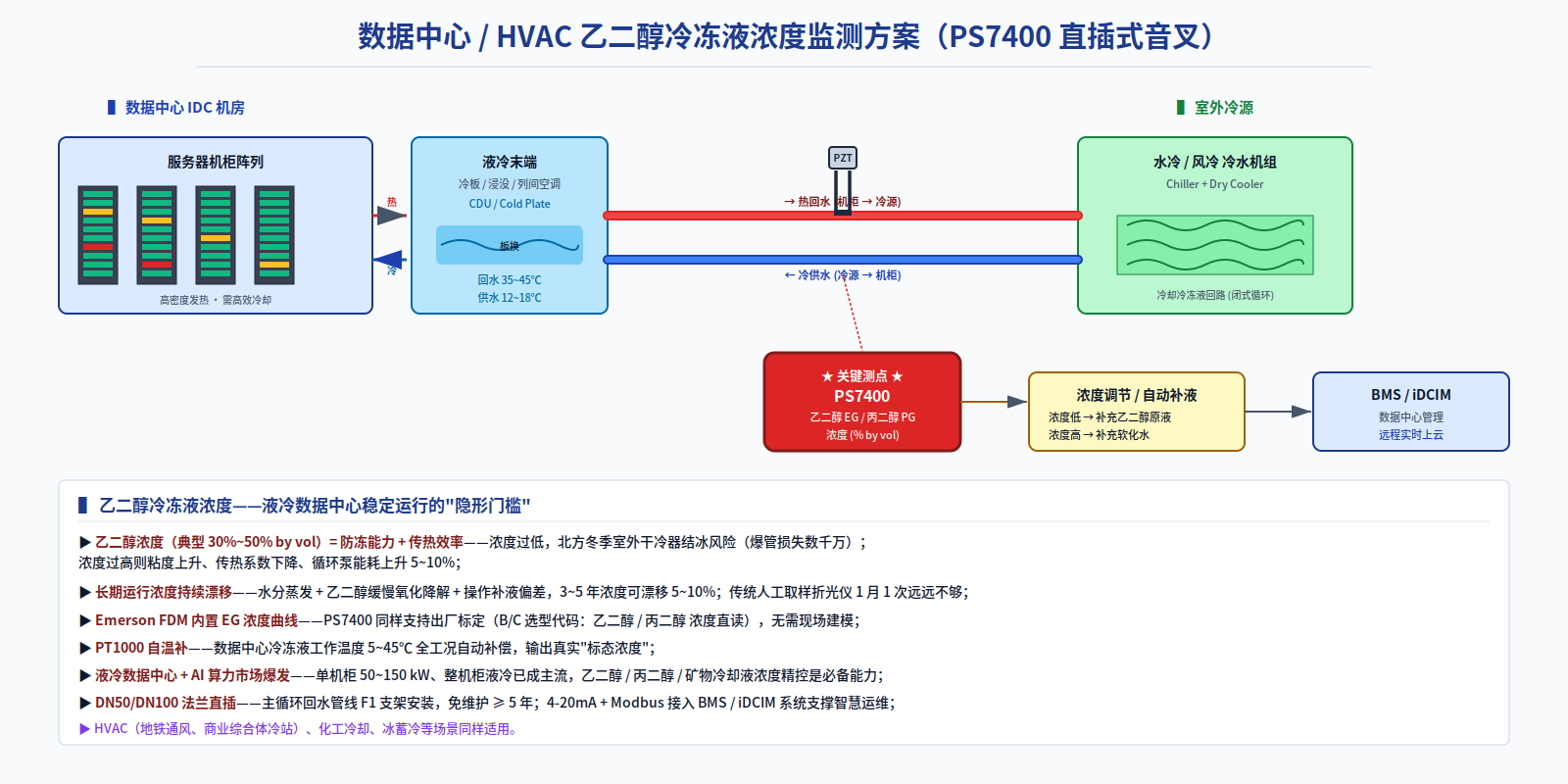
With the explosive growth of AI computing power driven by ChatGPT and large-scale models, the power per server cabinet has surged from the traditional 5–15 kW to 50–150 kW. Conventional air cooling can no longer meet the cooling demands, and **liquid-cooled data centers** (cold-plate, immersion, or in-row air-conditioning systems) have become the mainstream choice for newly built hyperscale data centers. Liquid-cooling systems employ a closed-loop architecture: server cabinets → CDU cold plates or immersion tanks → hot return water → outdoor water-cooled or air-cooled chillers/dry coolers → chilled supply water → cabinets. The circulating medium is typically an aqueous solution of ethylene glycol (EG, usually 30–50 vol%) or propylene glycol (PG, more environmentally friendly).
The concentration of ethylene glycol (typically 30–50 vol%) ensures both freeze protection and efficient heat transfer: too low a concentration risks freezing and bursting of outdoor dry coolers in northern winters, with rupture losses reaching several million yuan; too high a concentration increases viscosity, reduces the heat-transfer coefficient, and raises circulating-pump energy consumption by 5%–10%. Over long-term operation, the concentration gradually drifts (due to water evaporation, slow oxidative degradation of ethylene glycol, and operator dosing errors), accumulating a shift of 5%–10% over 3–5 years. Traditional manual sampling combined with a refractometer once a month is far from sufficient. In addition to data centers, this solution also applies to metro ventilation cooling stations, commercial complex cooling plants, chemical process cooling, ice storage cooling, and other HVAC applications.
2. Pain Points of Conventional Density/Concentration Measurement Solutions
• Too low ethylene glycol concentration → Winter freezing and bursting of outdoor dry coolers, with single-incident losses amounting to millions of yuan (equipment damage + server downtime and SLA breaches);
• Too high concentration → Increased viscosity, reduced heat-transfer efficiency, and a 5%–10% rise in circulating-pump energy consumption, adding hundreds of thousands of yuan to annual electricity costs;
• The root causes of prolonged drift—water evaporation (from open make-up water), slow oxidative degradation of ethylene glycol, and operator dosing deviations—accumulate to 5%–10% over 3–5 years;
• Traditional manual sampling and monthly refractometer checks are woefully inadequate for tracking continuous drift, and IDC facility operators often lack familiarity with chemical analysis.
3. PS7400 Solution
The PS7400 is installed via a flanged F1 bracket directly into the main chilled-water return line of the data-center liquid-cooling loop (typically DN50–DN100), continuously monitoring the concentrations of ethylene glycol and propylene glycol. The instrument calls up proprietary EG/PG concentration curves based on factory‑selected codes (B = hydrochloric acid / C = sulfuric acid / D = ammonia / E = alcohol; ethylene glycol/propylene glycol can be designated as X for special custom orders), requiring no on-site modeling and enabling plug‑and‑play operation.
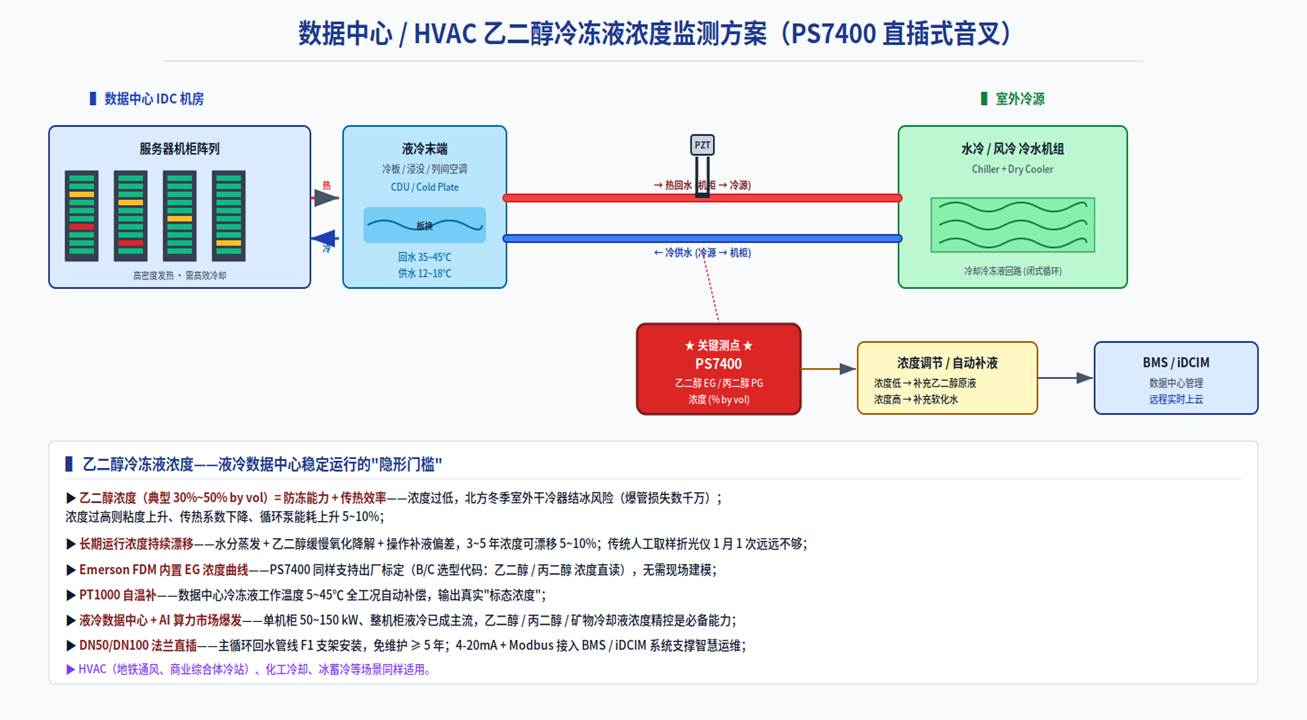
Figure 1: Data Center/HVAC Ethylene Glycol Chilled Fluid Concentration Monitoring Solution
Core Technical Value of the PS7400 in Data Center/HVAC Ethylene Glycol Chilled Fluid Applications ▶ The PS7400 achieves an accuracy of ±0.001 g/cm³—corresponding to an ethylene glycol concentration accuracy of ±0.5 vol%, sufficient to support data center operations and maintenance decision-making; ▶ It comes pre‑configured with factory‑installed EG/PG concentration curves—matching Emerson Micro Motion FDM’s “density + PT1000 temperature → direct concentration readout” capability, eliminating the need for on‑site modeling; ▶ PT1000 automatic temperature compensation—covering the entire operating temperature range of 5–45°C for data center chilled fluids, delivering true “standard‑state concentration”; ▶ DN50/DN100 flange‑mounted direct insertion—installed on the main circulation return pipeline at bracket F1, requiring no maintenance for ≥5 years; ▶ 4–20 mA + Modbus connectivity to BMS/iDCIM systems—enabling intelligent data center operations and remote real‑time cloud‑based monitoring; ▶ Also applicable to HVAC scenarios—metro ventilation chillers, commercial complex chillers, chemical cooling, ice storage cooling, and more. |
4. Customer Value
Comparison Dimensions | Original Manual Sampling Scheme | PS7400 Online Solution |
Sampling frequency | Once per month | second-level continuous |
Drift Identification | Passive detection after the fact | Real-time tracking |
Tube Burst Accident | Risks persist | Risk is significantly reduced |
Viscosity Optimization | Replenish fluid based on experience | Precision concentration control · Reduces pump energy consumption by 5–10% |
Operational and Maintenance Burden | Dependent on chemical analysts | Maintenance-free · Cloud-based data |
BMS Integration | Local instrument · Offline | Direct Modbus integration |
In the new construction of a certain domestic hyperscale AI data center (with a total campus power of 200 MW and over 5,000 liquid-cooled server cabinets), twelve PS7400 units were deployed across the main chilled-water return lines, forming a campus‑level real‑time ethylene glycol concentration monitoring network. After one year of operation, the system increased concentration‑drift detection from the original once‑monthly to continuous at the second level, and no winter freezing‑related pipe ruptures occurred across the entire campus. Annual aggregate energy consumption of the circulating pumps decreased by approximately 6% (equivalent to savings of several million yuan in electricity costs). This solution has become the standard configuration for the client’s subsequent large‑scale liquid‑cooled data‑center projects and has been extended to multiple city metro ventilation cooling stations.
Conclusion
Based on the PS7 series’ diverse density/concentration measurement principles (acoustic impedance PS7000, sound‑velocity method PS7020, spectroscopy PS7100, and tuning‑fork method PS7400), Xi’an Pisonics (PISONICS) has developed a comprehensive industrial‑process instrumentation portfolio, covering everything from solid‑containing two‑phase slurries to clean, homogeneous liquids, from single‑component to multi‑component media, and from cost‑effective to high‑precision models. Among these, the PS7400 tuning‑fork density meter—grounded in the mature physical principle of piezoelectric excitation and resonant‑frequency detection, benchmarked against international mainstream brands such as Emerson Micro Motion FDM and E+H Liquiphant—is an “plug‑and‑play, maintenance‑free” economical choice for measuring the density/concentration of clean to slightly contaminated liquids.
Tailored to the process characteristics of the data‑center/HVAC ethylene glycol chilled‑fluid sector, the PS7400 online tuning‑fork density/concentration meter offers full‑dimensional selection and customization options, including wetted‑part materials (316L, Hastelloy, titanium, zirconium, PTFE), surface finishes (standard polishing, electrolytic polishing, PTFE coating), process connections (flange, clamp, threaded), mounting accessories (F0–F6), explosion‑proof ratings, and communication protocols (4–20 mA, HART, RS485). For an in‑depth discussion of your project’s specific operating conditions or to obtain a tailored selection proposal, please feel free to contact the Xi’an Pisonics technical engineering team at any time.