PISONICS· Xi’an Pisonics
PS7400 Series
Online Tuning-Fork Density/Concentration Meter
Piezoelectric Excitation · Tuning-Fork Resonance · Plug-and-Play · Maintenance-Free
Application Case in the Battery/Lithium‑Battery Dilute Sulfuric‑Acid Electrolyte Industry
—— Precise Concentration Control in a 37 wt% Dilute‑Sulfur‑Acid Mixing Tank · PTFE‑Coated Fork Resistant to Acid ——
Replaces Manual Density‑Bottle Analysis · Narrows Concentration Fluctuations by a Factor of 5–10 · Enhances Battery‑Capacity Consistency
【Key Measured Parameter: Dilute H₂SO₄ Concentration (wt%/Density)】
Dilute Sulfuric‑Acid Electrolyte for Batteries/Lithium‑Batteries · PS7400 Tuning‑Fork Density‑Meter Solution
1. Process Background
Dilute sulfuric acid is the core electrolyte in the battery industry: In the filling process for lead‑acid batteries, approximately 37 wt% dilute sulfuric acid (density 1.275–1.285 g/cm³) serves as the cell electrolyte, and the filling concentration directly determines the battery’s capacity, discharge characteristics, and cycle life—deviation of just 1 wt% can reduce cycle life by 10%–20% and degrade the cranking‑capacity of starter batteries by more than 5%. In lithium‑battery manufacturing, the CuSO₄ electrolyte used during copper‑foil production also contains 90–120 g/L of sulfuric acid as a conductive support; stable acid concentration ensures foil uniformity and line productivity.
Dilute sulfuric acid is prepared by precisely mixing 98 wt% concentrated sulfuric acid with deionized water. In the mixing tank (typical volume 5–50 m³), the PS7400 online density meter continuously monitors concentration, working in tandem with the DCS to automatically control the valves for adding concentrated acid and diluting with DI water, thereby achieving high‑precision closed‑loop regulation of the acid’s concentration.
2. Pain Points of Traditional Density/Concentration Measurement
• Laboratory technicians take samples and perform manual density‑bottle analyses every 1–2 hours, resulting in significant lag and sparse data points—the mixing‑tank concentration remains in a state of “post‑facto correction” with persistent fluctuations, placing heavy pressure on quality control at the battery plant.
• Although 37 wt% dilute sulfuric acid is less corrosive than concentrated acid, prolonged immersion still causes substantial corrosion of standard 316L instruments; diaphragm perforation can contaminate an entire batch of electrolyte (worth hundreds of thousands of yuan).
• Contact-type insertion instruments suffer frequent wear and fouling—high humidity and acidic fumes in battery plants drive up their failure rate.
• In the lithium‑battery sector, foil consistency must meet a tolerance of ±0.5 μm, requiring that the electrolyte’s sulfuric‑acid concentration be controlled within ±1%; traditional manual methods struggle to achieve this.
3. PS7400 Solution
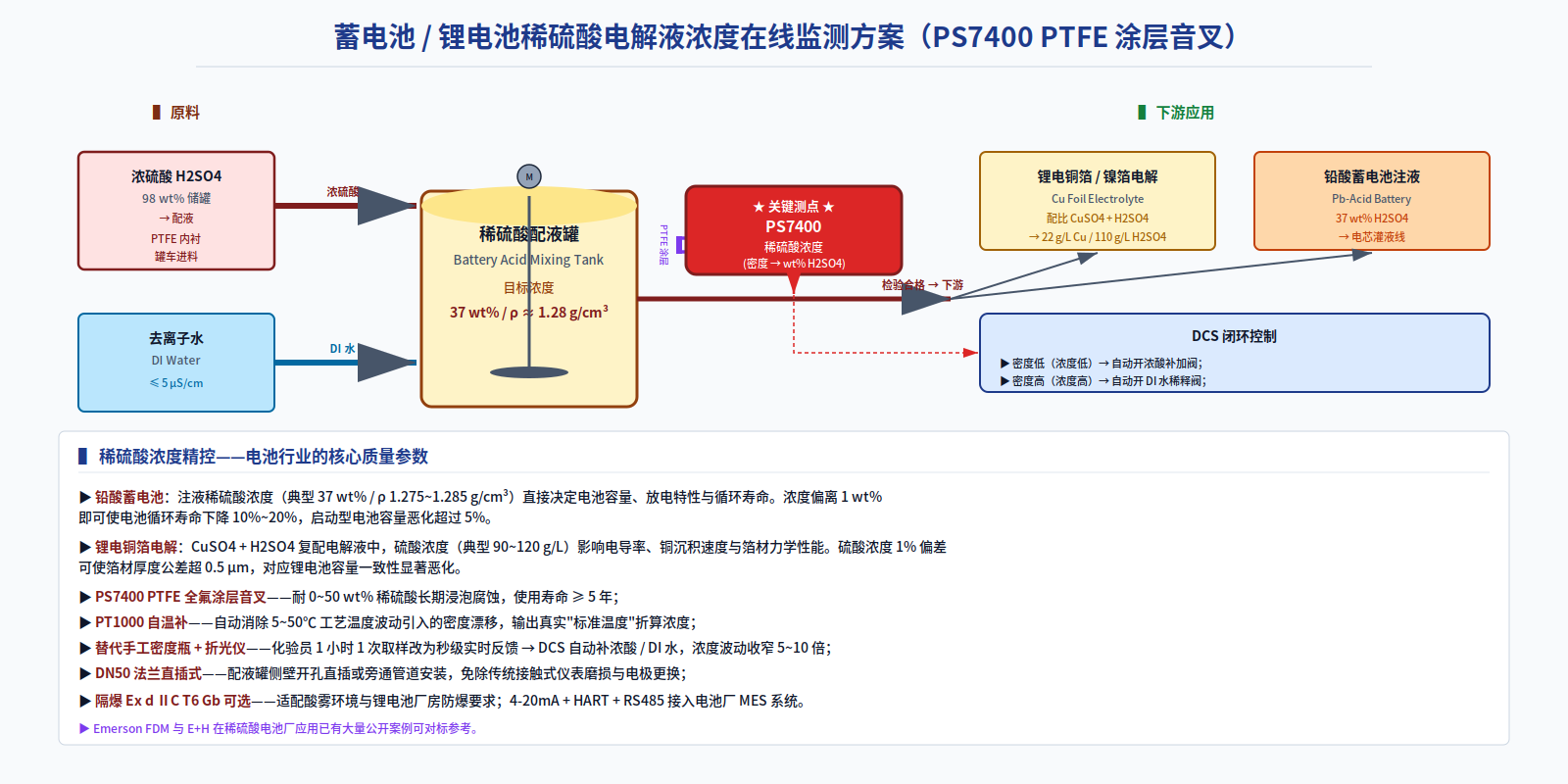
The PS7400 is equipped with a PTFE‑coated tuning‑fork element (wetted material B: 316L lined with PTFE), capable of withstanding long‑term immersion in dilute sulfuric acid across the 0–50 wt% range. The instrument is installed via a DN50 flange directly into the tank wall or through a bypass line (F2), delivering real‑time sulfuric‑acid density within seconds. The DCS converts this to wt% concentration and automatically regulates the valves for adding concentrated acid and DI water.
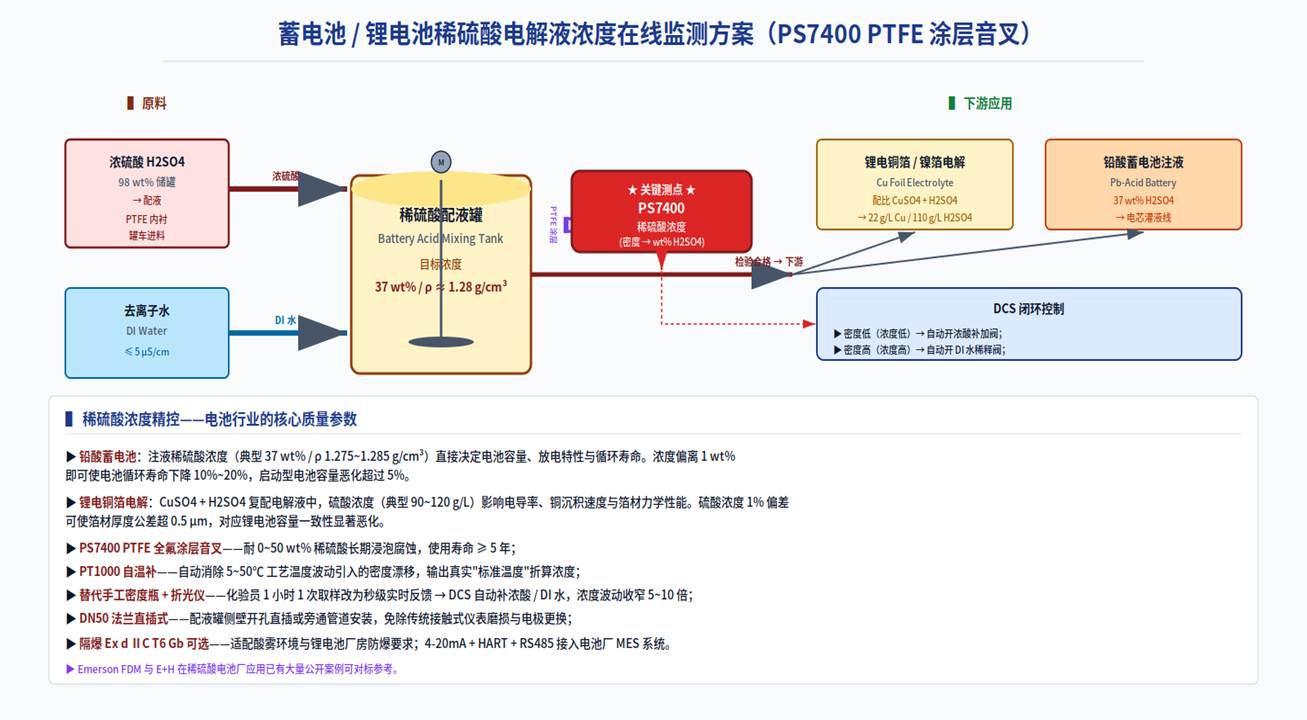
Figure 1: Online Monitoring Scheme for Dilute Sulfuric‑Acid Electrolyte Concentration in Batteries/Lithium‑Batteries
Core Technical Value of the PS7400 in Dilute Sulfuric Acid Electrolyte for Storage/Battery Lithium-Ion Cells ▶ PS7400 PTFE‑coated tuning fork—withstanding long‑term immersion corrosion in 0–50 wt% dilute sulfuric acid, with a service life ≥ 5 years (PTFE is marked as ☆ recommended in the material compatibility table); ▶ PT1000 automatic temperature compensation—eliminating density drift caused by process temperature fluctuations of 5–50°C in the mixing tank, outputting the true “standard‑state concentration” in wt%; ▶ DN50 flange‑mounted direct‑insertion design—installed by directly inserting into a side‑wall opening of the mixing tank or in a bypass line (F2), eliminating wear and electrode replacement associated with traditional contact instruments; ▶ replaces manual density bottles and refractometers—reducing operator sampling from once per hour to second‑level real‑time feedback, with the DCS automatically adding concentrated acid or DI water, narrowing concentration fluctuations by a factor of 5–10; ▶ explosion‑proof Ex d ⅡC T6 Gb available—suitable for acid mist environments and meeting explosion‑proof requirements in lithium‑battery plants; ▶ supports three protocols—4–20 mA, HART, and RS485—enabling integration with the battery plant’s MES system to support product quality traceability. |
4. Customer Value
Comparison Dimensions | Original Manual Sampling Scheme | PS7400 PTFE tuning fork solution |
Response Time | Manual sampling every 1–2 hours | second-level continuous output |
Concentration Fluctuation | ±0.5 wt% or higher | Narrowed to within ±0.1 wt% |
Sample contamination | Contact-type devices carry a risk of leakage | PTFE coating · Long-term acid resistance |
Battery Capacity Consistency | High fluctuation | Electrolyte stability → Yield↑ |
Instrument service life | Conventional 316L < 1 year | PTFE coating for ≥ 5 years |
MES Integration | Local data – difficult to trace | Direct RS485/MES integration |
At the filling section of a leading domestic lead‑acid battery manufacturer (annual output 15 million kVAh), the PTFE‑coated PS7400 replaced the previous “hourly manual density‑bottle analysis” and was deployed on the side wall of a 30 m³ mixing tank. After one year of operation, the sulfuric‑acid concentration fluctuation narrowed from the original ±0.6 wt% to ±0.08 wt%, the first‑pass yield of battery capacity increased from 96.5% to 99.2%, and the success rate in cycle‑life tests improved markedly. Similar solutions have since been extended to the electrolyte‑preparation process in lithium‑battery copper‑foil production. Emerson Micro Motion FDM and E+H Liquiphant already have numerous publicly documented cases in the European and American battery industries that serve as benchmarks.
Conclusion
Based on the PS7 series’ diverse density/concentration measurement principles—acoustic impedance (PS7000), sound velocity (PS7020), spectroscopy (PS7100), and tuning fork (PS7400)—Xi’an Pisonics has built a comprehensive portfolio of industrial-process instrumentation, covering everything from solid–liquid two‑phase slurries to clean, homogeneous liquids, from single‑component to multi‑component systems, and ranging from cost‑effective to high‑precision models. Among these, the PS7400 tuning‑fork density meter—grounded in the mature physical principle of piezoelectric excitation and resonant‑frequency detection, comparable to international mainstream brands such as Emerson Micro Motion FDM and E+H Liquiphant—is an economical, plug‑and‑play, maintenance‑free choice for measuring the density/concentration of clean to mildly contaminated liquids.
Tailored to the process characteristics of the battery/lithium‑battery dilute sulfuric‑acid electrolyte industry, the PS7400 online tuning‑fork density/concentration meter offers full‑scope selection and customization options: wetted materials (316L, Hastelloy, titanium, zirconium, PTFE); surface finishes (standard polish, electro‑polish, PTFE coating); process connections (flanges, clamps, threads); mounting accessories (F0–F6); explosion‑proof ratings; and communication protocols (4–20 mA, HART, RS485). For an in‑depth discussion of your project’s specific conditions or to obtain a tailored solution, please feel free to contact the technical engineering team at Xi’an Pisonics at any time.