PISONICS· Xi’an Pisonics
PS7400 Series
Online Tuning-Fork Density/Concentration Meter
Piezoelectric Excitation · Tuning-Fork Resonance · Plug-and-Play · Maintenance-Free
Chlor-Alkali Chemical Industry / Liquid‑NaOH Storage and Transportation Concentration — Industry Application Case
—— Online Concentration Monitoring of 32% / 48% NaOH Storage Tanks · Trade Billing Based on 100% NaOH Equivalent ——
Real-Time Verification Before Loading · Closed‑Loop Energy Saving in the Evaporation Section · Monthly Payment Discrepancies Reduced to Zero
【Key Measured Parameter: 32 wt% / 48 wt% NaOH Concentration】
Chlor‑Alkali Chemical Industry / Liquid‑NaOH Storage and Transportation Concentration — PS7400 Tuning‑Fork Density Meter Solution
1. Process Background
The chlor‑alkali industry (electrolysis of brine to produce NaOH + Cl₂ + H₂) is one of the pillars of China’s basic chemical sector, with an annual production capacity exceeding 45 million tons. Liquid caustic soda (aqueous NaOH solution) is dominated by two grades: 32 wt% (diaphragm‑cell grade, density ≈ 1.35 g/cm³ @40℃) and 48 wt% (flake‑grade, density ≈ 1.51 g/cm³ @65℃). The 32% NaOH is produced directly in ion‑membrane electrolyzers, while the 48% NaOH is obtained by concentrating the 32% stream in a triple‑effect evaporator; the latter can also be fed into a solid‑flake production unit for further processing.
Liquid‑NaOH trade is typically settled in “100% NaOH equivalent” terms—payments are calculated based on the mass of pure NaOH converted to a 100% basis. A 1 wt% deviation in either 32% or 48% concentration translates to roughly a 3% discrepancy in the billed 100% equivalent tonnage. For monthly shipments at the ten‑thousand‑ton scale, this can result in trade differences amounting to hundreds of thousands of yuan. Meanwhile, precise control of the outlet concentration in the evaporation section directly affects steam consumption (output × concentration difference = steam demand), making it a critical link in the plant’s energy management.
2. Pain Points of Traditional Density/Concentration Measurement Solutions
• Pre‑loading verification relies on manual sampling and laboratory density meter analysis—each batch incurs a delay of 1–2 hours, hampering shipment efficiency; concentration disputes can even lead to returns.
• The 48% NaOH storage tanks operate at 60–70℃ to prevent crystallization, posing a dual challenge to conventional contact-type instruments: high temperatures and prolonged exposure to strong alkali corrosion.
• Lag in adjusting the evaporator outlet concentration—steam flow is manually regulated based on concentration readings, leading to prolonged deviations from optimal operating conditions and annual energy losses totaling millions of yuan.
• Frequent retest disputes with customers—especially when trade involves multiple intermediaries (tank farm, loading, ship loading, unloading)—each stage requires independent confirmation of concentration compliance.
3. PS7400 Solution
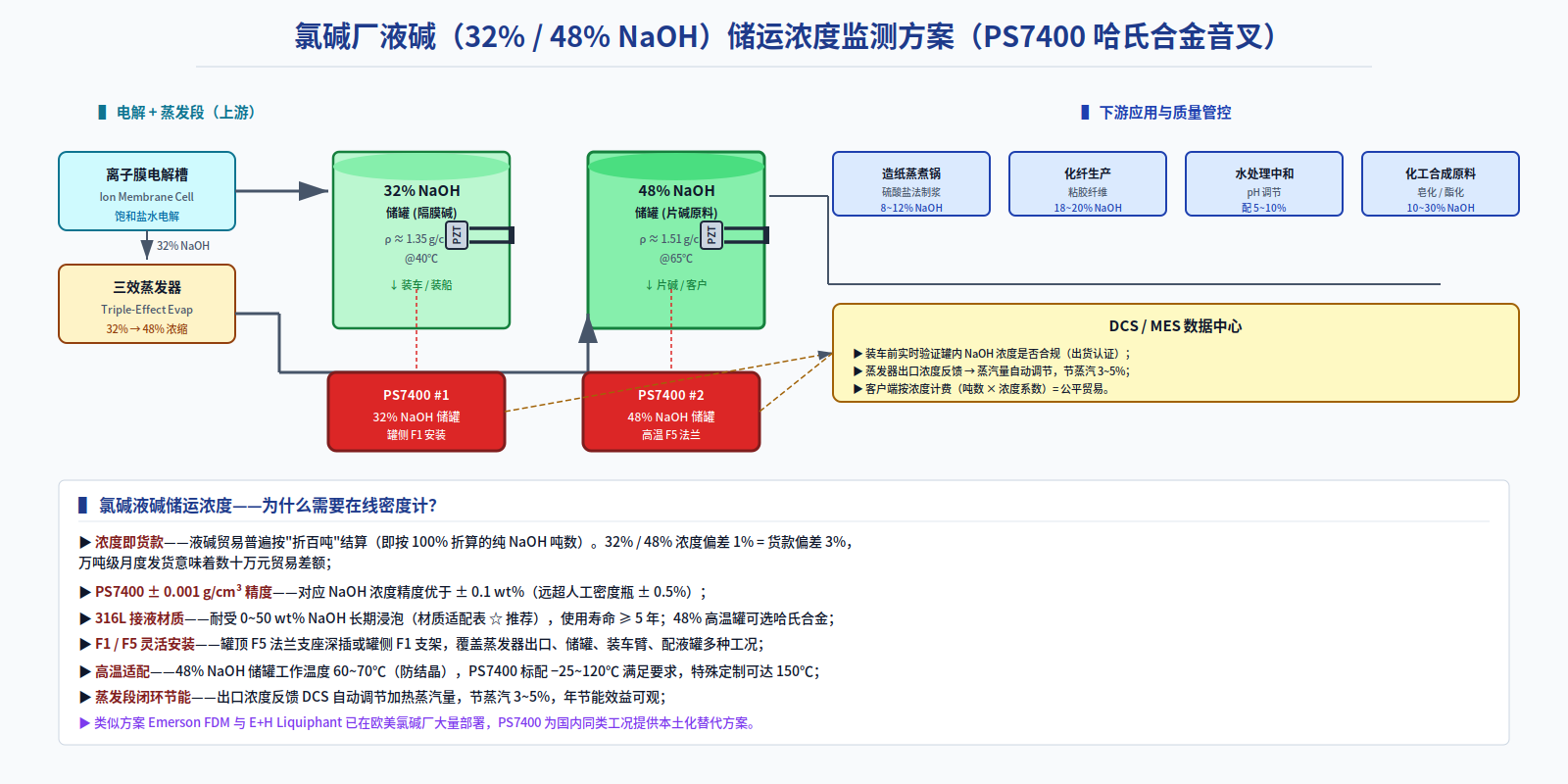
In typical deployments at chlor‑alkali plants, two PS7400 units are installed: PS7400 #1 on the side wall of the 32% NaOH storage tank (wetted parts in 316L stainless steel, operating at 40℃), and PS7400 #2 on the flanged support of the 48% NaOH storage tank (F5 connection; wetted parts in Hastelloy, operating at 65℃). The concentration data from both meters is transmitted in real time to the DCS/MES data center, enabling three key functions: pre‑loading verification, closed‑loop energy‑saving control in the evaporation section, and customer‑side concentration billing.
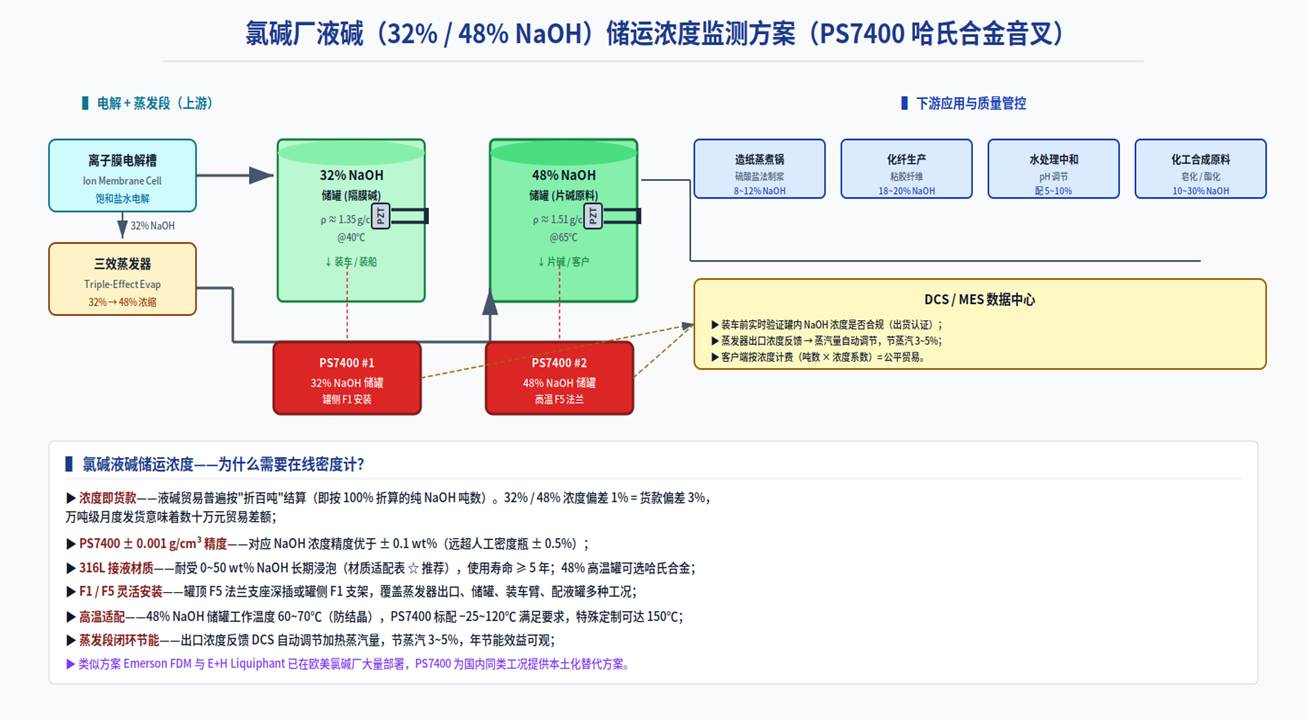
Figure 1: Concentration Monitoring Scheme for Liquid Caustic Soda (32% / 48% NaOH) in a Chlor‑Alkali Plant
Core Technical Value of the PS7400 in Chlor-Alkali Chemicals / Liquid‑NaOH Storage and Transportation Concentration ▶ The PS7400 achieves an accuracy of ±0.001 g/cm³—corresponding to a NaOH concentration accuracy better than ±0.1 wt% (far exceeding the manual density‑bottle accuracy of ±0.5%); ▶ The wetted‑part material is 316L—capable of withstanding long‑term immersion in 0–50 wt% NaOH (with a ☆ recommendation for NaOH in the material compatibility table), offering a service life of ≥5 years; for 48% high‑temperature tanks, Hastelloy is available as an option; ▶ High‑temperature adaptation—storage tanks for 48% NaOH operate at 60–70°C (to prevent crystallization); the PS7400, standardly rated from −25 to 120°C, meets these requirements, with special customization possible up to 150°C; ▶ Flexible installation options F1/F5—deep insertion via an F5 flange mount on the tank top or an F1 bracket on the tank side, covering various operating conditions such as evaporator outlets, storage tanks, loading arms, and blending tanks; ▶ Closed‑loop energy savings in the evaporation section—concentration feedback from the outlet is sent to the DCS to automatically adjust the steam supply, achieving annual steam savings of 3%–5% with significant economic benefits; ▶ Similar solutions—Emerson Micro Motion FDM and E+H Liquiphant—have been extensively deployed in chlor‑alkali plants across Europe and North America; the PS7400 provides a localized alternative for comparable domestic applications. |
4. Customer Value
Comparison Dimensions | Original manual density bottle solution | PS7400 Online Solution |
Concentration accuracy | ±0.5 wt% | ±0.1 wt% |
Loading Efficiency | Sampling delay of 1 to 2 hours | Real-time verification · Install upon arrival |
Customer Re-test Dispute | frequent | Essentially eliminated |
Revenue per hundred tons of cargo | Monthly discrepancy amounts to several hundred thousand yuan | Differential zeroing |
Evaporation energy consumption | Manual empirical adjustment | DCS closed-loop control · steam savings of 3–5% |
Instrument service life | < 1 year | 316L / Hastelloy ≥ 5 years |
At a major domestic chlor‑alkali group (annual NaOH output of 500,000 tons), two PS7400 units—with 316L and Hastelloy wetted parts, respectively—were deployed on the storage tank walls and at the evaporator outlet. After one year of operation: pre‑loading concentration verification time was reduced from an average of 90 minutes to under 5 minutes; return incidents caused by post‑shipment concentration disputes were eliminated; the annual payment discrepancy shrank from approximately 6 million yuan to less than 300,000 yuan. Steam consumption in the evaporation section decreased by about 4%, yielding energy savings exceeding 2 million yuan annually. This solution has become the standard configuration across multiple chlor‑alkali sites within the group.
Conclusion
Based on the PS7 series’ diverse density/concentration measurement principles—acoustic impedance (PS7000), sound velocity (PS7020), spectroscopy (PS7100), and tuning‑fork technology (PS7400)—Xi’an Pisonics has developed a comprehensive portfolio of industrial process measurement instruments, covering everything from solid‑liquid two‑phase slurries to clean, homogeneous liquids, from single‑component to multi‑component systems, and ranging from cost‑effective to high‑precision models. Among these, the PS7400 tuning‑fork density meter—leveraging mature physical principles of piezoelectric excitation and resonant frequency detection, and benchmarked against international mainstream brands such as Emerson Micro Motion FDM and E+H Liquiphant—is an economical, plug‑and‑play, maintenance‑free choice for measuring the density/concentration of clean to slightly contaminated liquids.
Tailored to the process characteristics of the chlor‑alkali chemical industry and liquid‑NaOH storage and transportation, the PS7400 online tuning‑fork density/concentration meter offers full‑scope selection and customization capabilities, spanning wetted materials (316L, Hastelloy, titanium, zirconium, PTFE), surface finishes (standard polishing, electroless polishing, PTFE coating), process connections (flange, clamp, threaded), mounting accessories (F0–F6), explosion‑proof ratings, and communication protocols (4–20 mA, HART, RS485). For an in‑depth discussion of your project’s specific operating conditions or to obtain a tailored selection proposal, please feel free to contact the technical engineering team at Xi’an Pisonics.