PISONICS· Xi’an Pisonics
PS7400 Series
Online Tuning-Fork Density/Concentration Meter
Piezoelectric Excitation · Tuning-Fork Resonance · Plug-and-Play · Maintenance-Free
LPG/Liquefied Petroleum Gas Trade Handover Industry Application Case
—— Volumetric Flowmeter + PS7400 Online Density → Flow Computer → Mass Settlement ——
OIML R117 / API MPMS 11.1 Standards · Real-Time Density Under Actual Operating Conditions in Seconds · Zeroing Out Tonnage-Level Trade Discrepancies
【Key Measured Parameter: LPG (Propane/Butane Blend) Density Under Operating Conditions】
LPG/Liquefied Petroleum Gas Trade Handover · PS7400 Tuning-Fork Density Meter Application Solution
1. Process Background
Liquefied petroleum gas (LPG, primarily a blend of propane C₃H₈ and butane C₄H₁₀ in varying proportions) is an important component of domestic energy consumption, with annual usage exceeding 70 million tons. During liquid storage and pipeline transport, LPG is typically kept under pressures of 2–5 MPa, with temperatures fluctuating between −20 and +50°C depending on seasonal changes. At the trade handover stage (tank farm → loading/unloading → end user), mass measurement (settlement by tonnage) is standard, requiring the multiplication of two independent parameters: volumetric flow and real‑time density under operating conditions.
Accurate measurement of LPG density under operating conditions is crucial for mass-based settlement: propane has a density of about 0.50 g/cm³, while butane is around 0.58 g/cm³. Even slight variations in the blend ratio, combined with the complex effects of temperature (−40 to +40°C) and pressure (2–5 MPa), can cause errors exceeding 0.5% when using static lookup tables. For trade volumes in the tens of thousands of tons, a 0.5% discrepancy translates into roughly 50 tons of cargo, amounting to hundreds of thousands of yuan in financial differences. International metrology organizations such as OIML R117 and U.S. standards like API MPMS 11.1 mandate that LPG trade handovers employ complete metering skids integrating online density meters with volumetric flowmeters and flow computers.
2. Pain Points of Traditional Density/Concentration Measurement Solutions
• Lookup-table estimation yields errors ≥ 0.5%—leading to tens of millions of yuan in discrepancies for large‑scale LPG trades and accumulating significant long‑term errors;
• Manual sampling and laboratory density‑bottle analysis lag by several hours—making it impossible to track real‑time density changes during vehicle or vessel loading;
• LPG tank farms are classified as strict Zone 1 hazardous areas—posing challenges for conventional instruments unable to meet Ex d II C T6 Gb flameproof requirements;
• Temperature fluctuations during vehicle and vessel loading (day vs. night, seasonal shifts) cause operating‑condition density to drift continuously, rendering offline spot measurements inadequate for representing the entire load.
3. PS7400 Solution
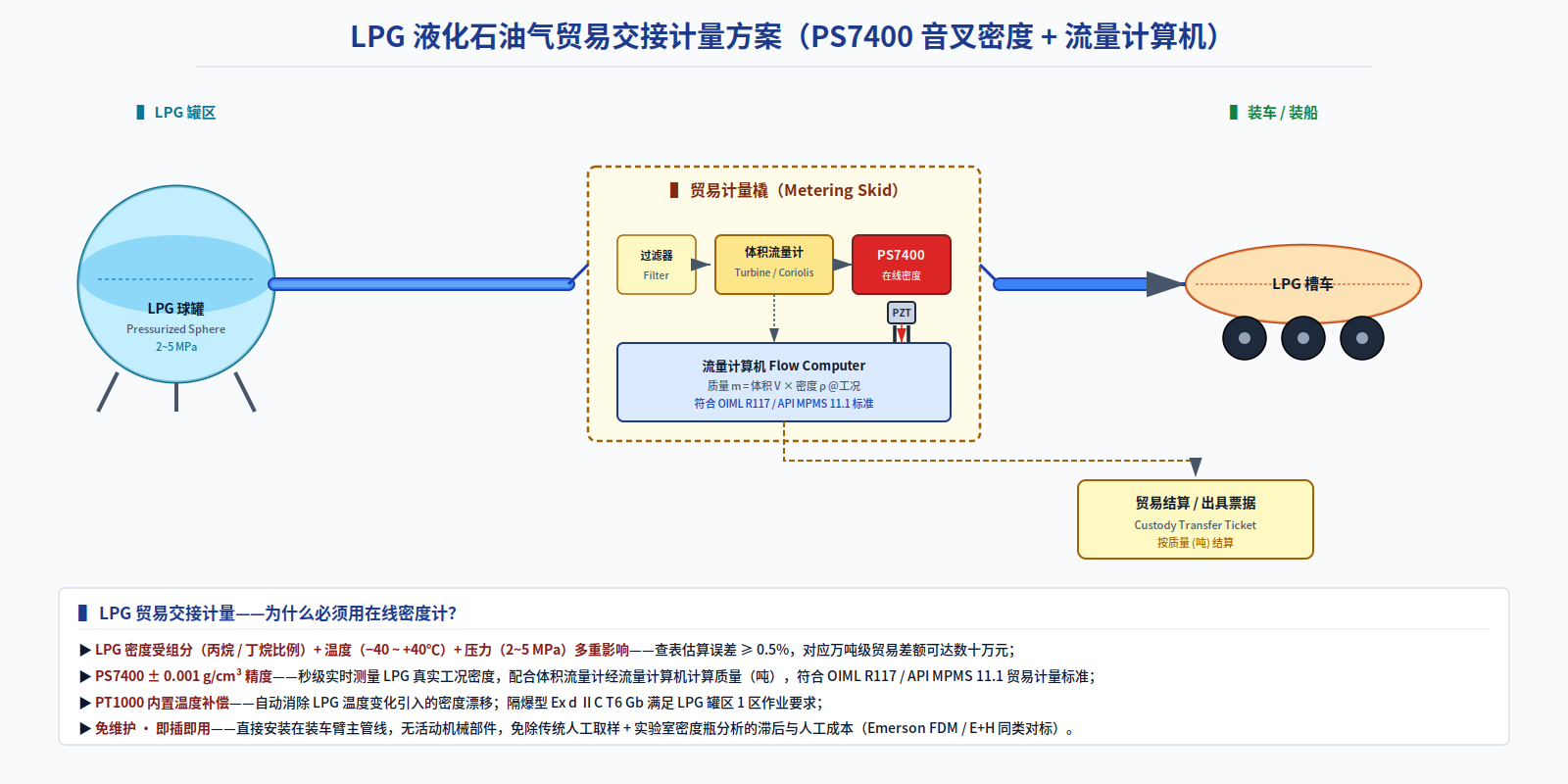
The PS7400 flameproof tuning‑fork density meter is installed on the main line of the trade metering skid (after the filter and flowmeter), forming, together with a volumetric flowmeter (turbine or Coriolis type) and a flow computer, a complete OIML R117/API MPMS 11.1 compliant trade metering system. The flow computer calculates total loaded tonnage in real time according to the formula “mass = volume × density at operating conditions” and automatically generates trade documentation.
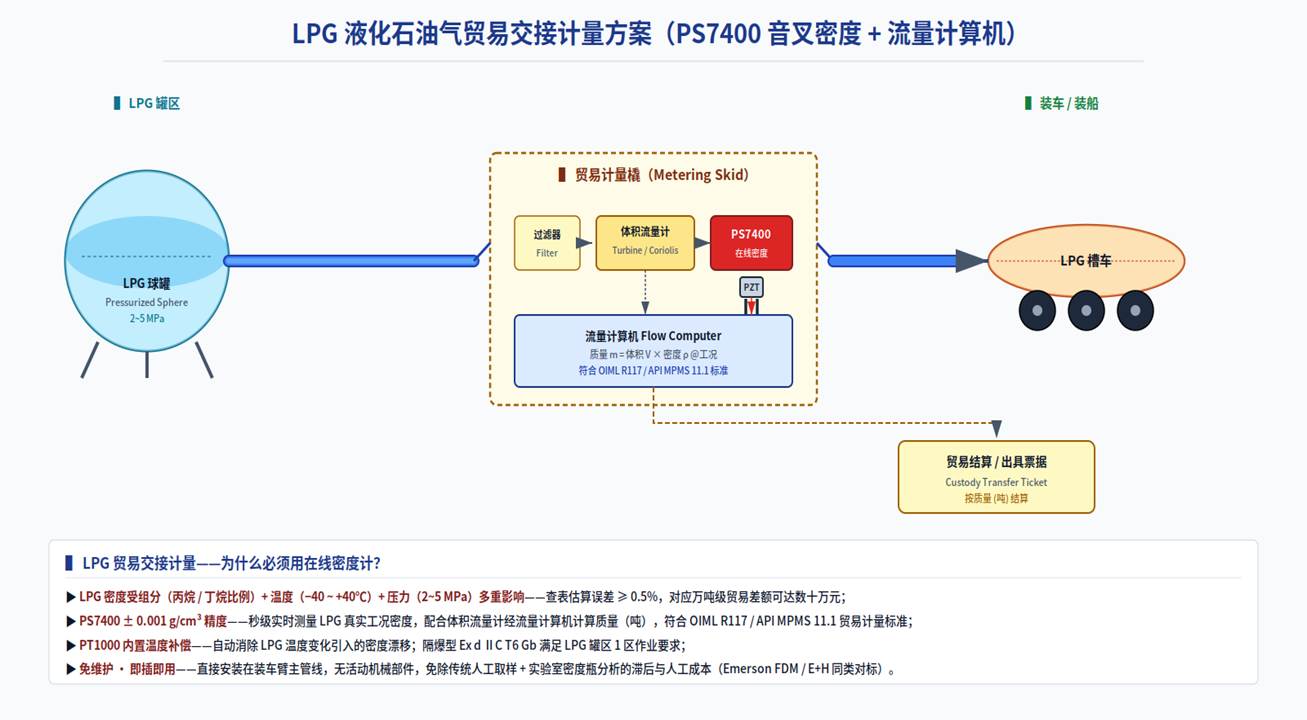
Figure 1: LPG Trade Handover Metering Scheme
PS7400’s Core Technical Value in LPG/Flue-Gas Desulfurization Trade Handover ▶ PS7400 achieves an accuracy of ±0.001 g/cm³—directly measuring the true‑operating‑condition density of LPG, far surpassing the accuracy of table‑lookup estimation methods; ▶ Built‑in PT1000 temperature compensation—automatically eliminates density drift caused by temperature variations during vehicle or vessel loading; ▶ Explosion‑proof Ex d ⅡC T6 Gb—meets the Class 1 Zone 1 requirements for LPG tank farms and can be installed directly on the loading/unloading header lines; ▶ Maximum operating pressure 2.5 MPa (6.3 MPa available upon special customization)—covering the entire pressure range for LPG storage and transportation; ▶ Maintenance‑free · Plug‑and‑play—installed directly on the loading arm header line, with no moving mechanical parts, eliminating the need for traditional manual sampling plus laboratory density‑bottle analysis (Emerson Micro Motion FDM and E+H Liquiphant, as comparable products, have already been extensively deployed in the LPG industry); ▶ Dual‑protocol output—4–20 mA and HART—ensuring seamless integration with trade‑metering skid flow computers and terminal‑side data centers. |
4. Customer Value
Comparison Dimensions | Original lookup table / manual sampling scheme | PS7400 Online Solution |
Measurement accuracy | Estimated error ≥ 0.5% | < 0.05% (depending on flow meter accuracy) |
Response Time | Hourly sampling | Second-level real-time tracking |
Temperature Compensation | Manual correction required | PT1000 automatic compensation |
Explosion-proof capability | Sampling contact poses risks | Ex d ⅡC T6 Gb intrinsically safe |
Trade Balance | Ten-thousand-ton scale, with an error of 50 tons | Differential zeroing |
Standard Compliance | It is difficult to meet international metrology requirements | Compliant with OIML R117 / API 11.1 |
At the loading/unloading docks of a large coastal LPG receiving terminal (with an annual throughput of 2 million tons), the PS7400, paired with a volumetric flowmeter and flow computer, replaced the previous “lookup‑table estimation plus quarterly sampling” approach, forming a complete OIML R117 metering skid. After commissioning, LPG loading‑tonnage measurement accuracy improved by more than fivefold; annual trade discrepancies shrank from approximately 8 million yuan to under 500,000 yuan, and retest disputes among downstream customers (gas wholesalers, chemical plants, export traders) were significantly reduced. Similar solutions have been successfully deployed in refinery self‑use metering, inbound/outbound tank farm metering, and other applications.
Conclusion
Based on the PS7 series’ diverse density/concentration measurement principles—acoustic impedance (PS7000), sound velocity (PS7020), spectroscopy (PS7100), and tuning fork (PS7400)—Xi’an Pisonics has developed a comprehensive portfolio of industrial process measurement instruments, covering everything from solid‑containing two‑phase slurries to clean, homogeneous liquids, from single‑component to multi‑component fluids, and ranging from cost‑effective to high‑precision models. Among these, the PS7400 tuning‑fork density meter—grounded in mature physical principles of piezoelectric excitation and resonant frequency detection, and benchmarked against international leaders such as Emerson Micro Motion FDM and E+H Liquiphant—is an economical, plug‑and‑play, maintenance‑free choice for measuring density and concentration in clean to slightly contaminated liquids.
Tailored to the specific process characteristics of LPG trade handovers, the PS7400 online tuning‑fork density/concentration meter offers full‑scope selection and customization across materials in contact with the fluid (316L, Hastelloy, titanium, zirconium, PTFE), surface finishes (standard polishing, electrolytic polishing, PTFE coating), process connections (flanges, clamps, threaded fittings), mounting accessories (F0–F6), explosion‑proof ratings, and communication protocols (4–20 mA, HART, RS485). For in‑depth discussions on your project’s specific operating conditions or to obtain a tailored solution, please feel free to contact the technical engineering team at Xi’an Pisonics at any time.