Overview
The new-energy / battery-electrolyte industry covers density and concentration measurement across lithium copper-foil electrolyte, lead-acid battery electrolyte, lithium-ion battery electrolyte and nickel-metal-hydride electrochemical storage products.
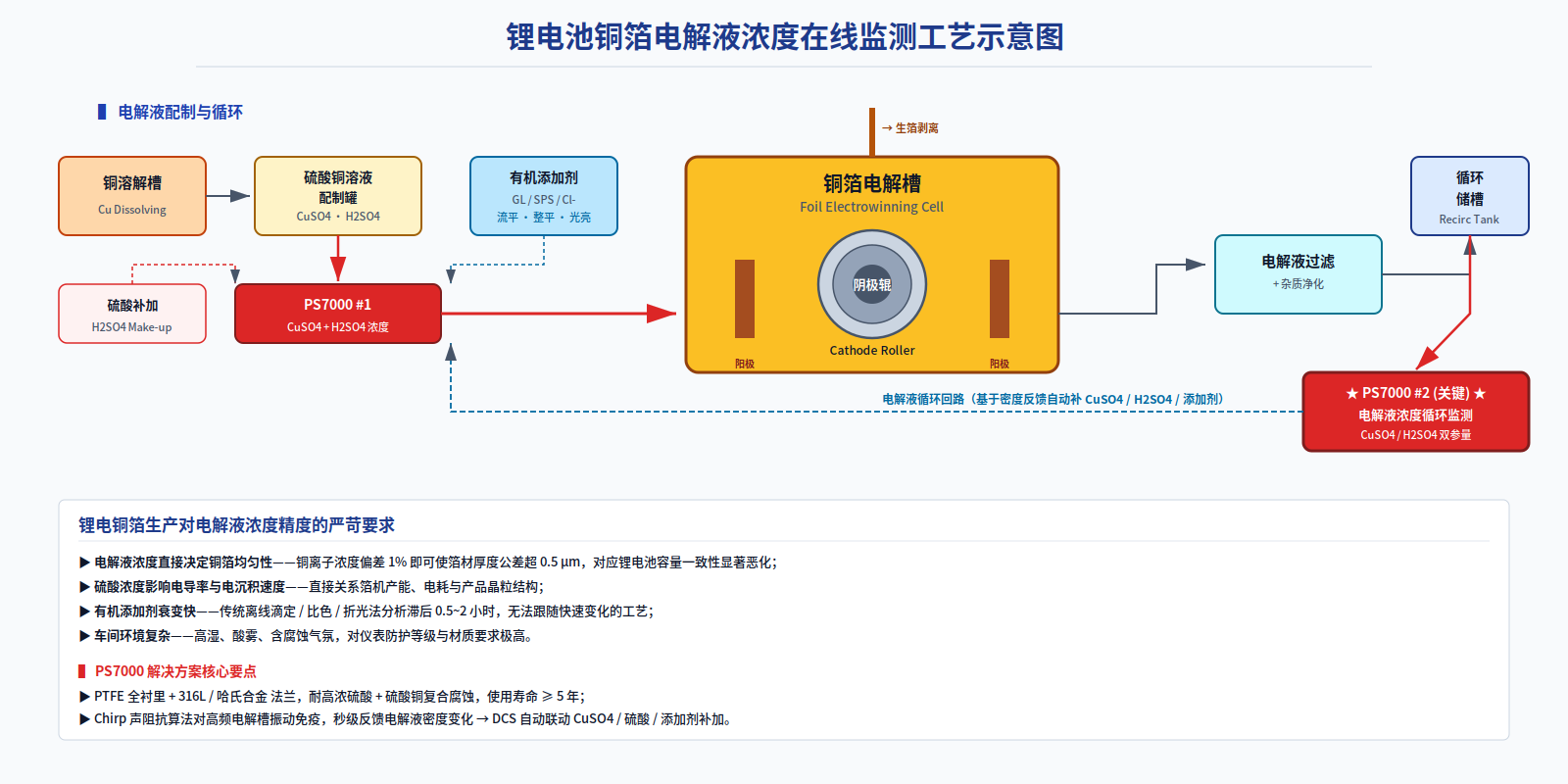
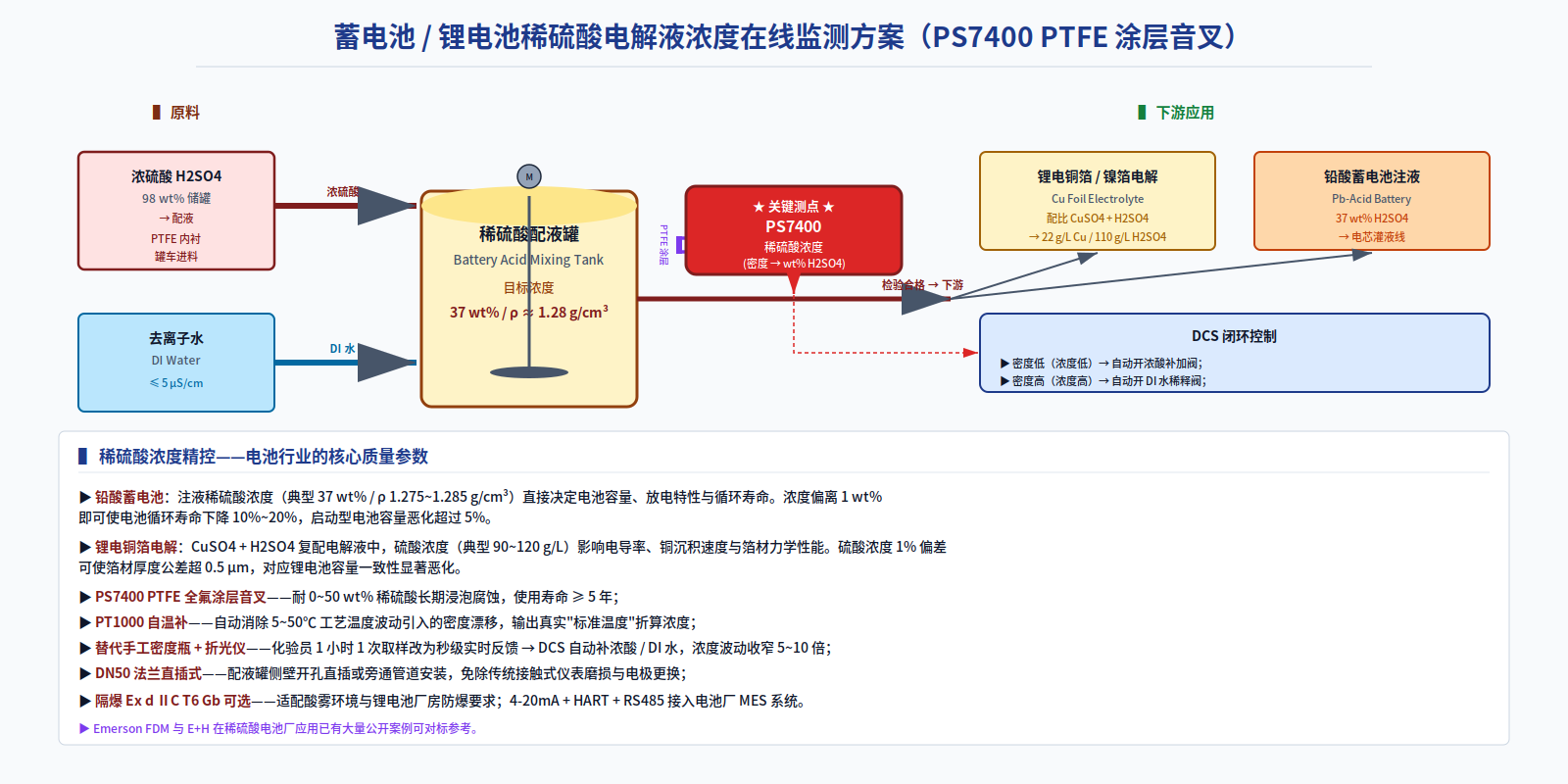
Copper foil (4.5-8μm ultra-thin) is electrodeposited from a CuSO₄ - H₂SO₄ bath where Cu²⁺ concentration, free-acid level and trace additives (gelatin, thiourea, chloride) drive thickness uniformity, tensile strength and surface roughness. Lead-acid batteries are filled with ≈ 37 wt% sulfuric acid (1.275-1.285 g/cm³); a 1 wt% deviation cuts cycle life by 10-20% and SLI capacity by 5%+.
Process challenges
- Copper-foil electrolyte: pH < 1 at 50-60°C — PFA / titanium / tantalum wetted parts required
- Additives at ppm level — beyond resolution of conventional density meters
- 4.5-6μm foil trend leaves no tolerance for process drift (±0.5μm requires ±1% concentration)
- Lead-acid 37 wt% sulfuric acid corrodes standard 316L over time — diaphragm rupture contaminates an entire batch
- Recirculating baths carry fine bubbles — interferes with non-ultrasonic principles
- Multi-drum / multi-plant lines need unified communication to MES
Recommended solutions
| Measurement point | Principle | Models |
|---|---|---|
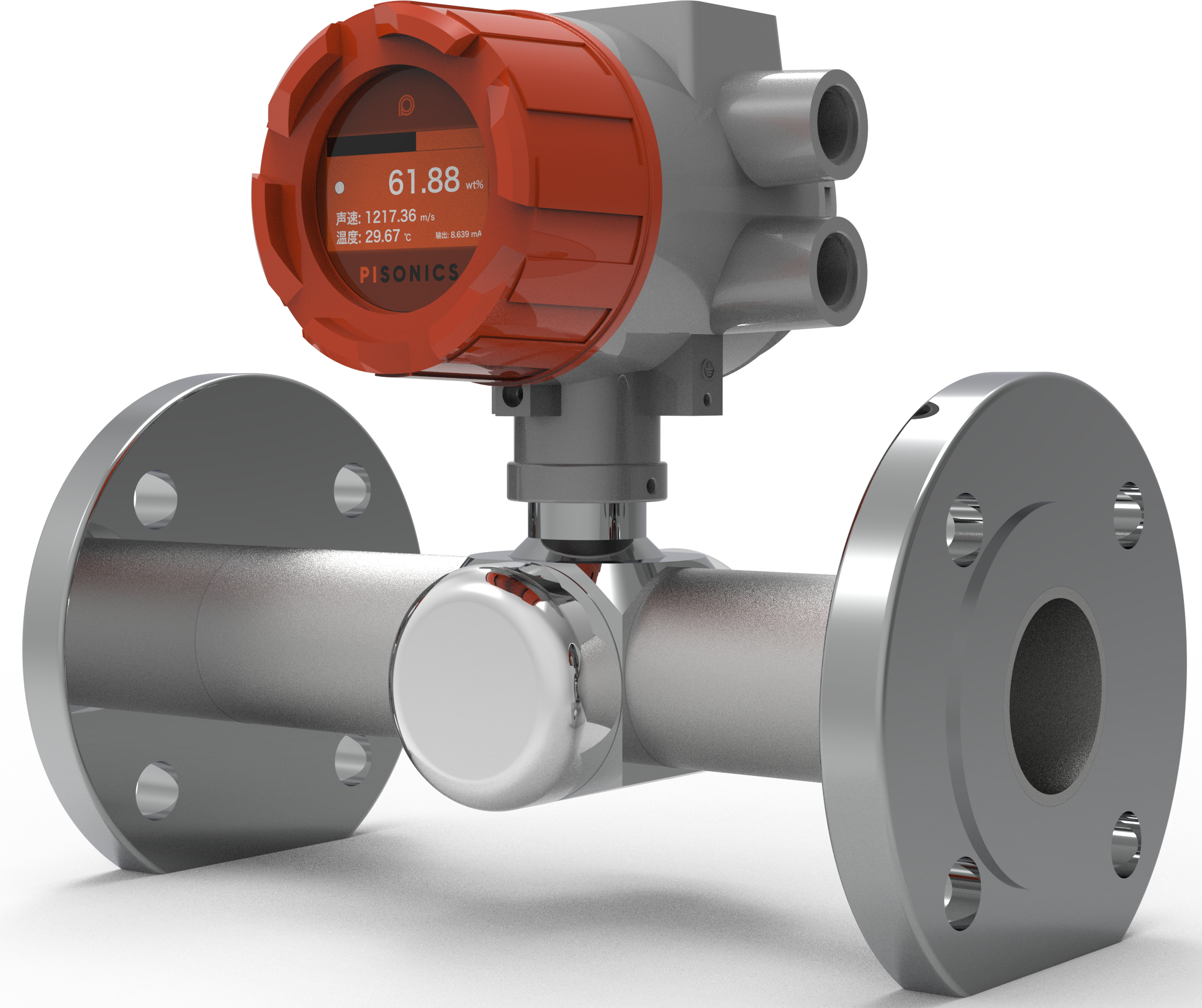
| Copper foil CuSO₄ concentration (main) | Ultrasonic sound velocity + T comp | PS7020 |
| Copper foil free acid (return) | Ultrasonic sound velocity / optical | PS7020 / PS7110 |
| Copper foil additive dosing tank | Coriolis | PS7200 |
| Lead-acid 37 wt% sulfuric acid mixing tank | Tuning fork + PTFE coating | PS7400 |
| Li-ion electrolyte (LiPF₆ + carbonates) | Coriolis | PS7200 |
| Post-treatment surface bath | Ultrasonic / optical | PS7020 / PS7110 |