PISONICS| Xi’an Pisonics
PS7200 Series
Coriolis Density Meter / Concentration Meter
Direct measurement of density via vibrating tube · Available in bent‑tube / straight‑tube configurations · Long‑term drift‑free operation
Product OverviewProduct Overview
PS7200 Series Coriolis Density Meteris a vibratory instrument developed by Xi’an Pisonics Information Technology Co., Ltd. (PISONICS) for real‑time density / concentration monitoring in industrial processes. The meter measures based on thecorrespondence between the natural frequency of a vibrating tube and the density of the fluidunder the influence of Coriolis force, then—combined with built‑in PT100 temperature compensation—precisely converts the density signal into concentration (or directly displays density in g/cm³ or kg/m³).
This series employs apurely physical, frequency‑based measurement principle, with no mechanical wear and no sensor drift, ensuring excellent long‑term stability; it also offers two structural models to suit different process conditions:
- PS7210 Triangular Type (Bent‑Tube Model) Features a balanced dual‑tube vibration structure, highly versatile, ideal for continuous online measurement of most liquids—including petrochemicals, brewing, chemical acids and alkalis, pharmaceuticals, and battery electrolytes—and can be installed with a bypass line or buffer tank.
- PS7220 Straight‑Tube Model Adopts a single straight metal tube, with a wide flow path and low clogging risk, particularly well suited for high‑viscosity fluids (up to 20,000 cP) such as slurries, cement pastes, syrups, and vegetable oils, as well as solids‑containing media.
Both models have passed theEx d ⅡB T6 Gb explosion‑proof certification, enabling safe use in flammable and explosive process environments, and provide dual output signals—4–20 mA / RS‑485—for seamless integration with PLC / DCS control systems.
Measurement PrincipleHow It Works
The vibratory density meter leverages thenatural frequency of a spring‑mass systemto measure liquid density. A portion of the measuring tube is driven to vibrate by an electro‑feedback actuation system (the drive sensor), maintaining its inherent resonant frequency. The total mass of the vibrating tube comprises two components: the tube’s own mass (determined at the factory) plus the mass of the liquid inside. Since the tube’s dimensions and volume are known, thedensity of the liquid corresponds one‑to‑one with the vibrating tube’s frequency.
When the density of the measured medium changes, the total mass of the vibrating tube shifts, causing its resonant frequency to deviate:the higher the density, the lower the frequency; the lower the density, the higher the frequency. The receiving sensor accurately detects this frequency, which the mainboard converts into a density value; meanwhile, the built‑in PT100 temperature sensor compensates for thermal drift, and concentration is calculated from the density‑concentration relationship table, reported at a standard temperature of 20°C.
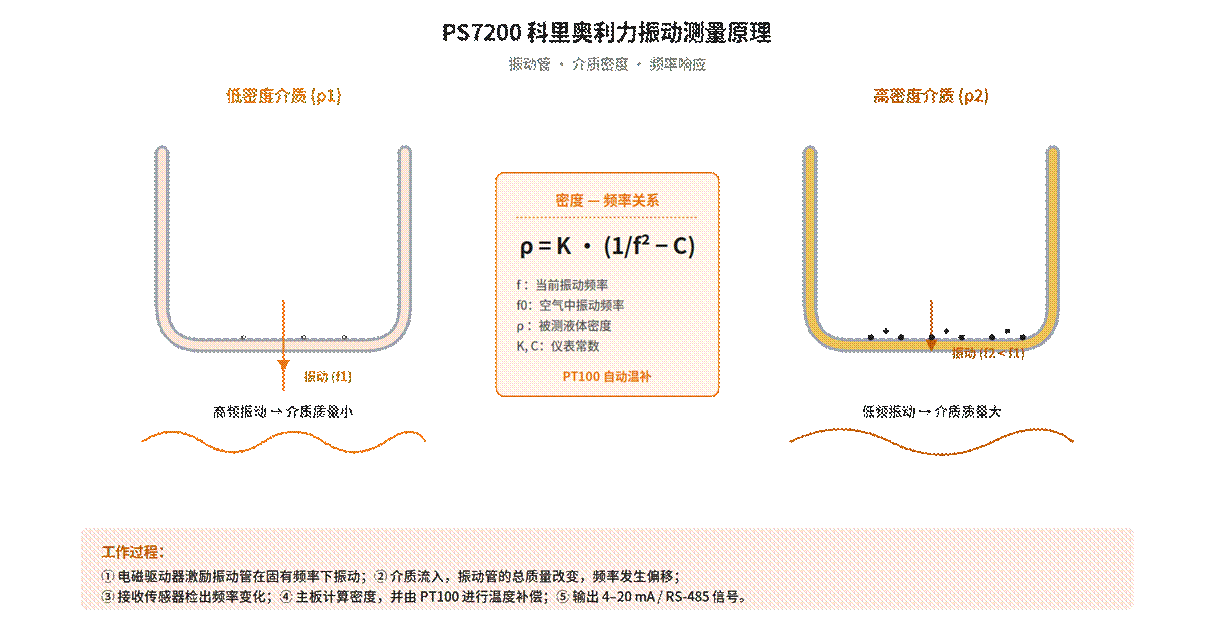
Figure 1 PS7200 vibrating‑tube density‑measurement principle: the higher the density, the lower the natural vibration frequency; ρ = K · (1/f² − C)
→ Because the measured quantity is “frequency”—a purely physical parameter—there areno electrodes, no moving mechanical parts, and no consumable reagents; the smooth surface of the vibrating tube ensures unimpeded flow, naturally minimizing interference from bubbles and solid particles, thus delivering long‑term stable, high‑precision measurements.
Series Product VariantsSeries Models
The PS7200 series comprises two models with distinct structures and complementary technical specifications, allowing customers to select the most suitable option based on media viscosity, gas or solid content, installation space, and interface requirements:
Comparison Dimensions | PS7210 Triangular (Bent‑Pipe) | PS7220 Straight Tube |
Structural Form | Dual-tube balanced vibration / triangular configuration | Single metal straight-tube vibration |
Typical Operating Conditions | General Industry — Good flow performance, strong anti-interference | High-viscosity / solid-containing liquids / applications prone to clogging |
Measurement Accuracy | ± 0.001 g/cm³ | ± 0.001 g/cm³ |
Measurement Range | 0 ~ 2 g/cm³ | 0 ~ 3 g/cm³ / 0~3000 kg/m³ |
Permissible medium temperature | −20 ~ +90 ℃ | −20 ~ +100 ℃ |
Allowable Viscosity | ≤ 500 cP (standard) / 5000 cP (long rod) | 0 ~ 20000 cP |
Process Interface | DN25 flange / 1.5″ clamp | DN25 / DN40 / DN50 flange |
Wetted materials | 316L, titanium | 316L, titanium |
Typical Dimensions | Chuck 459 mm / Flange 475 mm | 850 mm (including transmitter side mounting) |
Explosion-proof rating | Ex d ⅡB T6 Gb | Ex d ⅡB T6 Gb |
Core Technical AdvantagesCore Advantages
No. | Key Technologies / Features | Customer Value |
1 | Coriolis-based direct density measurement | Purely physical frequency detection ensures a stable principle, with no sensor zero-point or span drift |
2 | High Precision and High Repeatability | Accuracy of ±0.001 g/cm³ and repeatability of ±0.1 kg/m³, meeting the requirements for online measurement |
3 | Long-term stability | No moving mechanical parts and no electrode‑contact wear; no calibration or maintenance required over long operating cycles |
4 | Strong anti-interference capability | Pipeline‑optimized design minimizes the impact of bubbles and solid particles on measurements |
5 | Bent/straight-tube dual models | Triangle‑shaped (PS7210) for general applications; straight‑tube (PS7220) specialized for high‑viscosity, solid‑containing liquids |
6 | Wide Measurement Range Coverage | 0–3 g/cm³ / 0–3,000 kg/m³ across the entire measurement range, and can simultaneously output concentration and Baumé degree |
7 | A Variety of Wetted Materials | Standard configuration features 316L stainless steel; optional corrosion-resistant solutions include titanium, Hastelloy C‑276, and PFA coating |
8 | PT100 Temperature Self-Compensation | Built-in PT100 sensor automatically compensates for temperature drift in the medium, outputting concentration values calibrated at 20°C |
9 | Explosion-proof certification | Ex d ⅡB T6 Gb explosion-proof rating, ensuring safe operation in flammable and explosive process areas |
10 | Dual-mode signal output | 4–20 mA (four-wire) + RS-485 (MODBUS-RTU), seamlessly integrated with PLC/DCS |
11 | Flexible Installation Options | Supports various installation accessories such as bypass lines, buffer tanks, and built-in pumps, adapting to complex process layouts |
12 | Protection rating IP65 | Aluminum alloy housing, with strong adaptability to industrial site environments |
Typical Application ScenariosTypical Applications
- Petroleum and Petrochemicals Continuous online monitoring of density / concentration during refining and blending; formulation ratios and storage / transportation metering
- Brewing Industry Continuous quality monitoring of baijiu, beer, and wine fermentation processes
- Food and Beverage Online production‑line detection of sugar industry Brix concentration, vegetable oil density, and juice / soft drink concentrations
- Chemical Industry Control of weak acid/alkali solution concentrations, salt solution densities, dye bath formulations, and organic / inorganic chemical material concentrations
- Pharmaceutical Industry Online monitoring of traditional Chinese medicine extract concentrations, alcohol recovery rates, and API densities
- Battery Industry Precision control of lithium hydroxide, electrolyte, and sulfuric acid solution concentrations (particularly well suited to the PS7220’s high‑viscosity capabilities)
- Mineral Processing Density of clay, carbonate, and silicate slurries—PS7220 straight‑tube model is the first choice
- Environmental Protection Industry Continuous monitoring of flue‑gas desulfurization and denitration liquid concentrations, as well as waste‑liquid density
PS7210 Triangular Vibration Density MeterPS7210 Triangular Vibration Density Meter
PS7210 employs a dual‑tube balanced triangular vibration structureconsisting of two symmetrical bent tubes forming an isosceles triangle, with the electromagnetic driver positioned at the center and the transmitter integrated into the housing. As the fluid flows through, the symmetrical design effectively cancels out external vibrational disturbances, retaining only the frequency components correlated with the liquid’s density, thereby yielding a stable density signal.
This model is suited forcontinuous online density measurement in general industrial applications—in systems with unobstructed piping and minimal bubble or particulate interference. It is the preferred choice across sectors such as petrochemicals, chemicals, brewing, food and beverage, pharmaceuticals, and batteries. Available with DN25 flange and 1.5″ clamp connections; typical dimensions: 250 mm between flanges, overall height 459 mm (clamp) / 475 mm (flange).
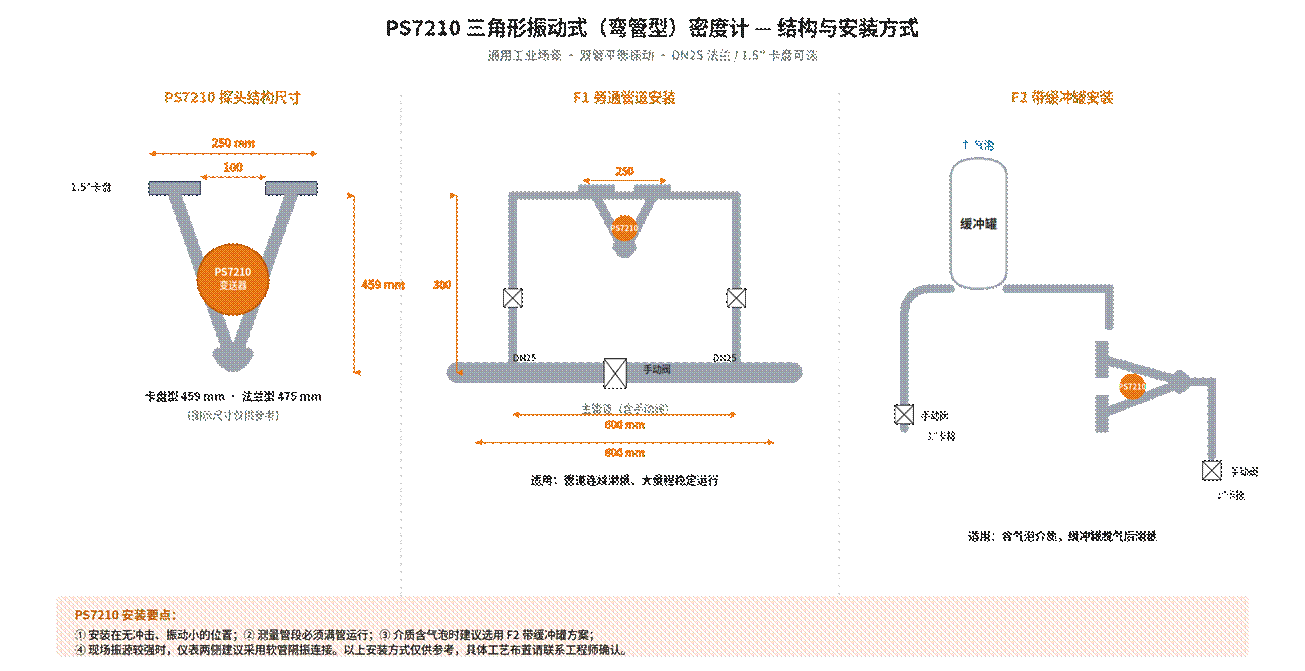
Figure 2 PS7210 probe dimensions (left) / F1 bypass‑line installation (center) / F2 installation with buffer tank (right)
Applicable Fields for PS7210
- Oil and Petrochemical Industries Continuous density monitoring during refining and blending processes
- Organic and Inorganic Chemical Materials Control of acid/alkali concentrations and salt solution densities
- Pharmaceutical Industry Monitoring of traditional Chinese medicine concentration and alcohol recovery strength
- Battery Industry Precise control of lithium hydroxide, electrolyte, and sulfuric acid solution densities
PS7220 Straight‑Tube Vibration Density MeterPS7220 Straight‑Tube Vibration Density Meter
PS7220 features a single‑tube metal vibration structurewith the medium flowing naturally along the straight tube, eliminating bends and fundamentally avoiding clogging risks. The thicker tube walls and larger bore diameter enable it to handle higher viscosities (up to 20,000 cP) and liquids with elevated solid content. Thanks to its temperature compensation design, the instrument integrates density, concentration, and Baumé scale measurements into one, supporting multiple liquid concentration calibration modes.
This model is particularly well suited forhighly viscous or particulate‑laden process media prone to clogging, such as slurry, cement paste, syrup, vegetable oil, battery paste, mineral suspensions, and evaporative crystallization solutions. Offered in DN25, DN40, and DN50 flange options; typical overall length 850 mm, with DN50 flange outer diameter Ø165 mm.
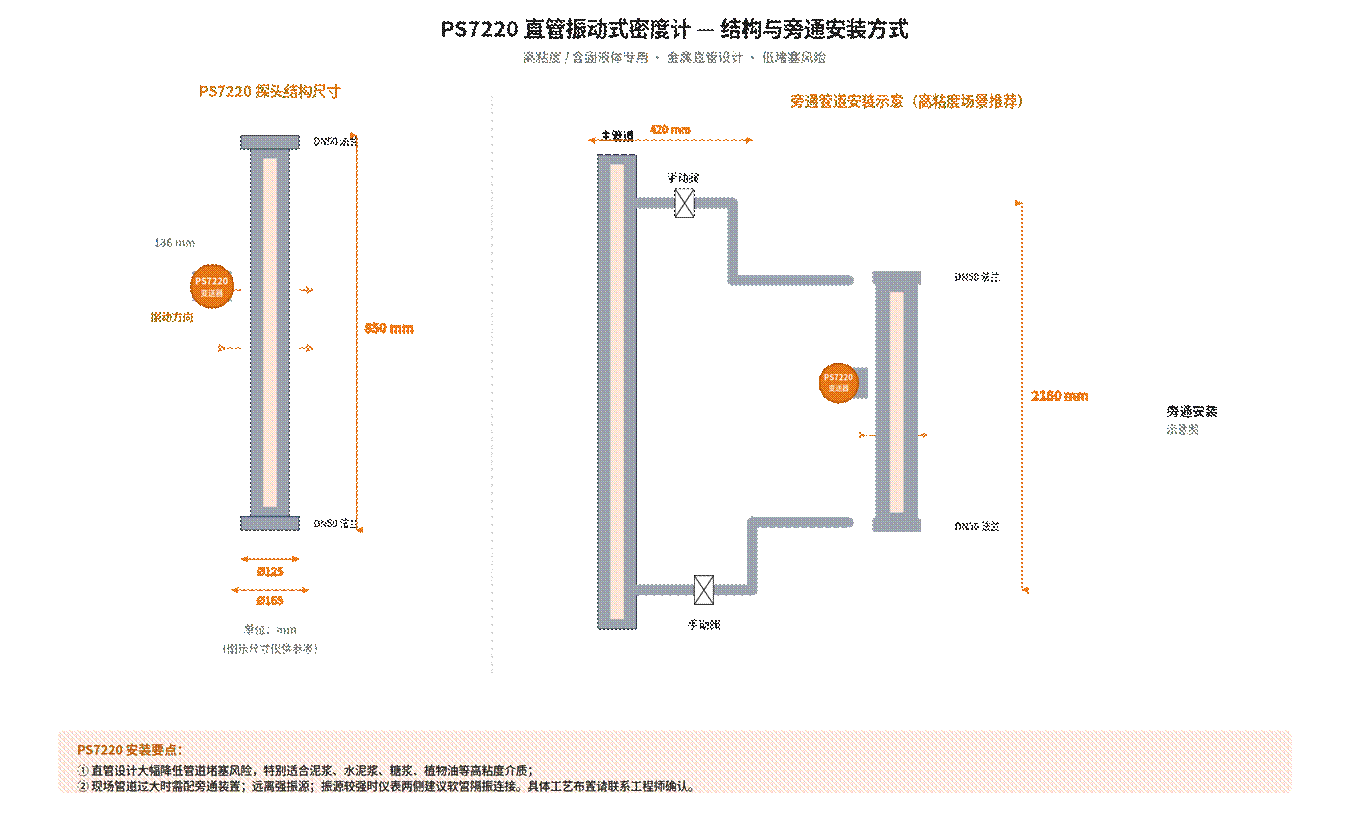
Figure 3 PS7220 straight‑tube probe dimensions (left) / schematic of bypass‑line installation (right, total length approximately 2,150 mm)
Applicable Fields for PS7220
- Evaporative Crystallization Industry Online monitoring of concentrated effluent density at evaporator outlets and crystallization solution densities
- Slurry/Cement Paste Sector Online measurement of slurry concentration and cement paste density, with the straight‑tube design reducing clogging risks
- Pharmaceutical Industry Online monitoring of highly viscous medicinal liquid concentration and extraction processes
- Food and Beverage Continuous density/concentration monitoring of high‑viscosity media such as syrups and vegetable oils
Wetted Material CompatibilityWetted Material Compatibility
Based on the chemical properties and concentration of the fluid being measured, the PS7200 series offers a range of wetted‑part materials, including SUS316L, Hastelloy C‑276, titanium alloy, zirconium, and PTFE. The table below provides recommended material compatibility for common media (not exhaustive; please consult an engineer for special cases):
Category | Name | Molecular Formula | Concentration (%) | 316L | Hastelloy | Titanium alloy | Zirconium | PTFE |
Acid | Hydrochloric acid (fluoride-free) | HCl | 0–40 | × | ○ | × | ☆ | ☆ |
Sulfuric acid | H₂SO₄ | 0–50 | ○ | ☆ | ○ | ☆ | ☆ | |
sulfuric acid | H₂SO₄ | 50–75 | × | ○ | × | ○ | ☆ | |
Sulfuric acid | H₂SO₄ | 75–98 | ○ | ☆ | ○ | ○ | ☆ | |
nitric acid | HNO₃ | 0–100 | ○ | ○ | ○ | ○ | ☆ | |
Phosphoric acid | H₃PO₄ | 0–98 | × | × | × | × | ☆ | |
Alkali | sodium hydroxide | NaOH | 0–50 | ☆ | ☆ | ☆ | ○ | ☆ |
Potassium hydroxide | KOH | 0–50 | ☆ | ☆ | ☆ | ○ | ☆ | |
calcium hydroxide | Ca(OH)₂ | 0–50 | ☆ | ☆ | ☆ | ○ | ☆ | |
Salt | Sodium chloride | NaCl | 0–50 | × | ☆ | ☆ | ☆ | ☆ |
ammonium chloride | NH₄Cl | 0–50 | × | ☆ | ☆ | ☆ | ☆ | |
ammonium sulfate | (NH₄)₂SO₄ | 0–50 | × | ☆ | ☆ | ☆ | ☆ | |
Others | urea | (NH₂)₂CO | 0–100 | ☆ | ☆ | ○ | ☆ | ☆ |
Sodium hypochlorite | NaOCl | 0–16 | × | ○ | × | ☆ | ☆ | |
hydrogen peroxide | H₂O₂ | 0–90 | ☆ | ☆ | ○ | ☆ | ☆ |
☆ Recommended ○ Use under specific concentration and temperature limits × Not recommended
Technical SpecificationsTechnical Specifications
Item | PS7210 | PS7220 |
Product Model | PS7210 triangular vibration-type | PS7220 Straight-Tube Vibrating |
Measurement Parameters | Density, concentration, and temperature | Density, concentration, Baumé degree, temperature |
Measurement Accuracy | ± 0.001 g/cm³ / ± 1.0 kg/m³ | ± 0.001 g/cm³ / ± 1.0 kg/m³ |
Repeatability | ± 0.1 kg/m³ / ± 0.001 g/cm³ | ± 0.1 kg/m³ / ± 0.001 g/cm³ |
Measurement Range | 0 ~ 2 g/cm³ | 0 ~ 3 g/cm³ / 0 ~ 3000 kg/m³ |
Concentration Range | Standard configuration: 0–1.5 / 0–2 g/cm³; customizable | Standard configuration: 0–100%; custom multi-range options available |
Temperature Coefficient (Calibrated) | 0.1 kg/m³ / ℃ | 0.1 kg/m³ / ℃ |
Pressure Influence | Calibrated; negligible | Calibrated; negligible |
Process temperature | −20 ~ +90 ℃ | −20 ~ +100 ℃ |
Ambient Temperature | −10 ~ +85 ℃ | −10 ~ +85 ℃ |
Maximum Working Pressure | ≤ 1 MPa (limited by the process connection) | ≤ 1 MPa; the short-stem model can handle up to 207 bar, while the long-stem model handles 100 bar |
Test Pressure | 1.5 times the maximum working pressure | 1.5 times the maximum working pressure |
Allowable liquid viscosity | ≤ 500 cP (standard) / 5,000 cP (long rod) | 0 ~ 20000 cP |
Built-in Temperature Sensor | PT100 | PT100 |
Wetted materials | 316L, titanium | 316L, titanium |
Housing Material | Aluminum alloy, IP65 | Aluminum alloy, IP65 |
Input Power Supply | DC 24V, 50 mA | DC 24V, 50 mA |
Signal Output | 4–20 mA (four-wire) + RS-485 | 4–20 mA (four-wire) + RS-485 |
Electrical Interface | M20 × 1.5 | M20 × 1.5 |
Process Interface | DN25 flange / 1.5″ clamp | DN25 / DN40 / DN50 flange |
Explosion-proof rating | Ex d ⅡB T6 Gb | Ex d ⅡB T6 Gb |
Typical External Dimensions | Chuck 459 mm / Flange 475 mm | 850 mm (including the transmitter side mount, 186 mm) |
Product ConfigurationProduct ConfigurationOrder code format:
PS7200 ─ [Model] ─ [Measurement Range] ─ [Process Connection] ─ [Wetted‑Part Material] ─ [With Pump or Not] ─ [Explosion‑Proof/Protection] ─ [Accessories]
Selection Criteria | Code | Description |
Model Code | 10 / 20 | 10 = PS7210 triangular vibration type (bent-tube design) 20 = PS7220 straight-tube vibration type |
Measurement Range | R1 / R2 / RX | R1 = 0~1.5 g/cm³ R2 = 0~2 g/cm³ RX = Other (please specify when ordering) |
Process Interface | A1 / A2 / A3 / B / X | A1 = DN25 flange A2 = DN40 flange A3 = DN50 flange B = 1.5″ sanitary clamp X = other |
Wetted materials | 1 / 2 / X | 1 = 316L 2 = titanium alloy X = other (Hastelloy / zirconium / PFA coating, etc.) |
Pump Included | N / P | N = without pump P = with built-in circulation pump (for low-flow applications) |
Explosion-proof / Protective | P0 / P1 | P0 = IP65 standard type P1 = Ex d ⅡB T6 Gb explosion-proof type |
Attachment | F0 / F1 / F2 / F3 / FX | F0 = No attachment F1 = Bypass pipe installation F2 = Installation with buffer tank F3 = Installation with built-in pump FX = Other |
Order Example 1:PS7200-10-R1-A1-1-N-P1-F1 → PS7210 triangular (bend) type, measurement range 0–1.5 g/cm³, DN25 flange, 316L wetted parts, no pump, explosion-proof, bypass installation. Order Example 2:PS7200-20-R2-A3-2-N-P1-F1 → PS7220 straight-tube type, measurement range 0–2 g/cm³, DN50 flange, titanium wetted parts, no pump, explosion-proof, bypass installation (for high-viscosity applications). |
