Microwave Density Meter
microwave concentration meter · microwave moisture meter · microwave solids content meter
Water's dielectric constant dwarfs that of almost every solid, so the phase shift of a microwave crossing the medium is set by how much water is there. Measure the shift, get the solids.
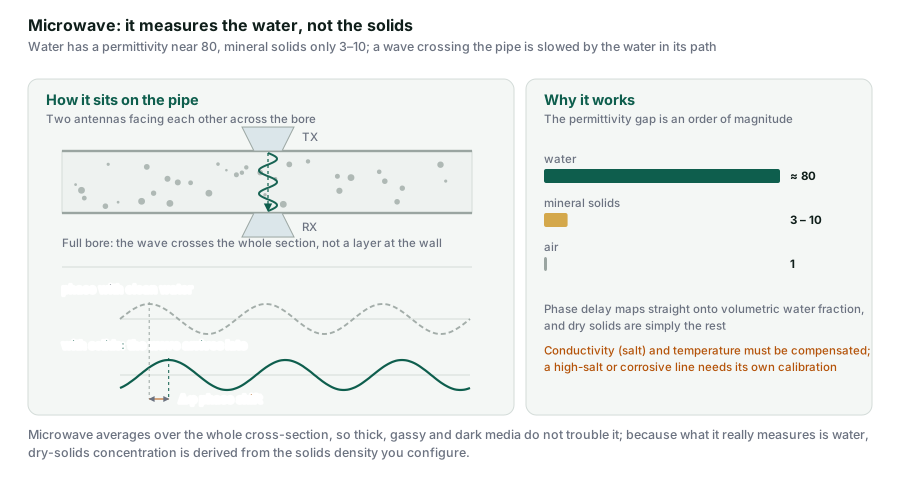
Tap the diagram to open it full size
What a microwave meter actually measures is water
Water has a relative permittivity of about 80; mineral and organic solids sit between roughly 3 and 10. That gap is enormous, and it means the propagation velocity of a microwave through the medium is governed almost entirely by water content. Measuring the phase shift between transmitting and receiving antennas — together with amplitude attenuation — gives moisture, and from moisture, solids content or concentration. PS7600 uses phase-shift transmission with real-time Pt-100 compensation, because the permittivity of water itself moves with temperature and an uncompensated instrument carries a systematic bias.
Think of it as a moisture instrument rather than a density instrument and the selection logic falls out: as long as the permittivity of the solid phase is constant, the method holds. Change what the solids are and the calibration has to be redone.
Where it wins
Microwaves cross high-solids, dark, fully opaque media, which no optical method can do. They need no acoustic coupling either, so for abrasive service the sensor can be non-contact or lined, and probe wear is a far milder problem than for anything wetted and vibrating. Municipal sludge before and after dewatering, paper stock consistency, thickened tailings, paste backfill, TBM slurry — this is its territory.
The other practical advantage is range. Acoustic impedance signals begin to saturate at extreme solids loadings; microwave works comfortably through the 40–70% band.
Three limits worth knowing before you buy
- Salinity and conductivity. Dissolved salts change the dielectric behaviour of the medium and add loss. Media with varying salt load — seawater-based drilling mud, high-chloride effluent — need extra compensation, or a change in salinity is read as a change in concentration.
- Calibration dependence. The instrument gives moisture; the plant wants dry solids. The conversion is tied to what the solids are, so a change of ore or feedstock means recalibration.
- Installation geometry. Transmission measurement needs a full, centred, deposit-free cross-section. A settled bed on the pipe invert biases the reading permanently and is easy to miss.
Dividing the work with ultrasound and DP
Against ultrasonic impedance: low to medium solids (below roughly 40%), fast response and a simple calibration point to ultrasound; high solids, dark paste and a tolerance for a longer commissioning point to microwave. The two overlap between 30% and 45%, and the decision is usually made by whether the site can give the microwave meter the geometry it needs.
Against differential pressure: DP is cheap and transparent, but it needs a stable level and clear impulse lines, which paste will block. A microwave meter has no impulse lines and no moving parts, and costs far less to keep running.
Buying from China
CE marked; ATEX / IECEx status is configuration-dependent and should be confirmed for the exact model and enclosure. Radio-frequency emissions comply with the applicable EMC standards — ask for the test report if your site has its own RF clearance procedure. Quotations in USD or EUR on EXW, FOB Shanghai or CIF, with HS code and declaration of conformity supplied with the offer. Send the solids type, expected range and the pipe geometry with the enquiry; the calibration plan matters more here than in any other principle except spectroscopy.
Where it works
- High-solids slurry and paste: thickened tailings, backfill, dense-medium circuits
- Municipal and industrial sludge solids before and after dewatering
- Pulp and paper stock consistency
- TBM and pipe-jacking slurry systems
- Dark, opaque, abrasive media
Where it doesn't
- Media whose salinity or conductivity swings widely with no way to compensate
- Lines whose feedstock changes often and cannot be recalibrated
- Mounting points that cannot guarantee a full, centred, deposit-free section
- High-accuracy density in clean liquid — use a fork, Coriolis or sound velocity
Common questions
Can a microwave density meter measure sulfuric acid?
Why is PS7600 microwave particularly sensitive to water-bearing media?
The physical basis of microwave measurement lies in differences in dielectric constants: the dielectric constant of water molecules is approximately 80, while that of most solids is around 2 to 10—more than a tenfold difference.
The PS7600 precisely calculates a material’s moisture content, suspended solids concentration, density, and Brix by measuring the phase shift and amplitude attenuation of microwaves as they pass through the medium. This substantial dielectric contrast gives the PS7600 extremely high sensitivity in wet conditions, with typical repeatability better than ±0.01%.
Optimal applications include black liquor in papermaking, evaporation and crystallization in sugar production, concentration monitoring in the food and beverage industries, and sludge. Dissolved salts (conductivity) in the water phase also affect the microwave signal, so where water quality swings widely, calibrate on the site water.
Not suitable for pure organic liquids (such as diesel or pure alcohol); in such cases, it is preferable to use the PS7020 sound‑velocity method or the PS7110 refractometer.
Get a free field assessment
Tell us your medium, process and what you're measuring — we'll match the right principle and model.