Ultrasonic Density Meter
ultrasonic concentration meter · acoustic impedance density meter · acoustic attenuation density meter · sound velocity density meter · online ultrasonic density meter · ultrasonic phase separation detector · liquid-liquid interface detector
Send sound through a liquid and three things change with density: how much reflects at the interface, how much survives the trip, and how long the trip takes. Each is a different instrument.
Tap the diagram to open it full size
One beam, three measurements
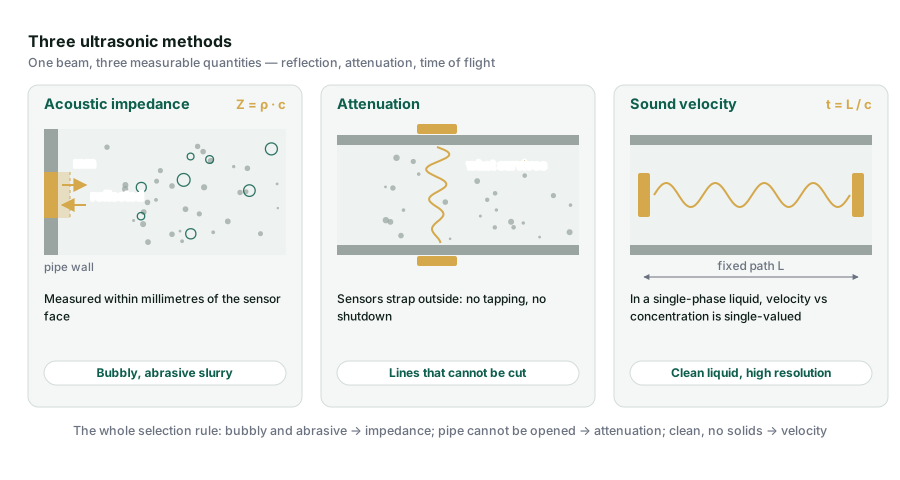
Fire an ultrasonic pulse into a liquid and three quantities track density: the fraction reflected at the interface (acoustic impedance), the fraction that survives the crossing (attenuation), and the time it takes to cover a fixed path (sound velocity). All three correlate with density, but they fail in completely different ways — and treating them as one product category is where most selection mistakes start.
Acoustic impedance — built for bubbly, abrasive slurry
Acoustic impedance is Z = ρ·c, density times sound velocity. The sensor emits a pulse and measures its reflection coefficient at the boundary between the sensor face and the medium. The important consequence: the measurement happens within a few millimetres of the sensor face. The beam never has to cross the pipe. Entrained air, coarse particles and scale destroy the signal of any through-transmission method, but they do not stop a reflection at the interface. That is why impedance instruments keep working in coal-washing slurry, FGD gypsum, and cyclone overflow — and why they are the usual replacement for a Cs-137 gauge. PS7000 uses this method.
The trade-off is temperature sensitivity: sound velocity itself moves with temperature, so compensation and the calibration model — not the transducer — are what separate a good instrument from a bad one.
Attenuation — when the pipe cannot be touched
Sound loses energy exponentially as it crosses a medium, and the attenuation coefficient tracks solids content. Because the beam has to cross, this method can be built clamp-on: sensors strap to the outside of the pipe, no tapping, no shutdown, no wetted parts. PS7010 is that instrument. The trade-off is equally clear: bubbles scatter, and scattered energy reads as higher concentration; pipe material, wall thickness and couplant condition all sit in the signal path. Clamp-on is for sites where "we cannot cut the line" outranks accuracy, with low and stable entrained gas.
Sound velocity — the precision route for clean liquids
In a single-phase liquid, sound velocity against concentration is a clean single-valued curve, and a time-of-flight measurement resolves it finely. PS7020 takes this route, for acid and caustic concentration, solvents, and sugar solutions — media with no solid phase. Introduce particles or bubbles and the premise is gone. That is not degraded accuracy; it is the wrong instrument.
Against the other principles
The ultrasonic route's structural advantage is that it is non-nuclear. No source means no NRC general licence and no state agreement-state registration, no leak testing schedule, no EU BSS notification, and no disposal liability at end of life — the cost that surprises buyers is rarely the gauge, it is the twenty years of custody that follow it.
Against a tuning fork: forks are simpler and very reliable in clean liquid, but the tines abrade in slurry, catch fibre, and grow crystal — service life in mineral duty is limited. Against Coriolis: better accuracy and mass flow in the same instrument, but price and pressure drop climb steeply with line size, which rules it out on large slurry mains. Against differential pressure: cheap and transparent, but it depends on a stable level and a stable line, and impulse lines plug in slurry.
Three things that decide the outcome on site
- Where the sensor goes matters more than which model it is. Pump discharge riser, full pipe, no gas pocket, enough straight run from the last elbow. Miss those and no principle will read correctly. We have diagnosed a site whose reading dropped to zero every ten minutes; the cause was a sensor pointed at a spot that periodically collected gas.
- Sampling and calibration. The meter measures a physical quantity; the customer wants concentration, and a material-specific curve sits between them. Eight to twelve grab samples across the real operating range at commissioning are worth more than any factory calibration.
- Temperature. Sound velocity has a substantial temperature coefficient. How well compensation is done is what decides whether the summer and winter readings agree.
Buying from China
Instruments ship with CE marking; ATEX / IECEx and UL / CSA status varies by model and should be confirmed for your specific configuration before you order. Quotations are issued in USD or EUR on EXW, FOB Shanghai or CIF terms, and we can supply the HS code and a declaration of conformity with the quotation. Ask for the field-installation drawing at the same time — the mounting decision above is easier to get right before the spool is fabricated.
Where it works
- Bubbly, abrasive mineral slurry — flotation, coal washing, tailings, backfill
- FGD gypsum slurry and desulfurization wastewater in power generation
- Hydrometallurgical pulp, phosphate processing, brine and salt-lake duty
- Replacing a Cs-137 or Na-22 gauge and its licensing burden
- Existing lines that cannot be cut or shut down (clamp-on attenuation)
- High-resolution concentration in clean acids, caustics, solvents and sugar solutions (sound velocity)
Where it doesn't
- High and violently fluctuating entrained gas — fix the tapping point or degas first
- Heavy scaling on the sensor face with no cleaning access
- Solids content and particle size distribution both swinging widely with no chance to recalibrate
- Applications that also need mass flow — choose Coriolis
- Wide temperature swings with no reliable process temperature signal available
Acoustic impedance
1 models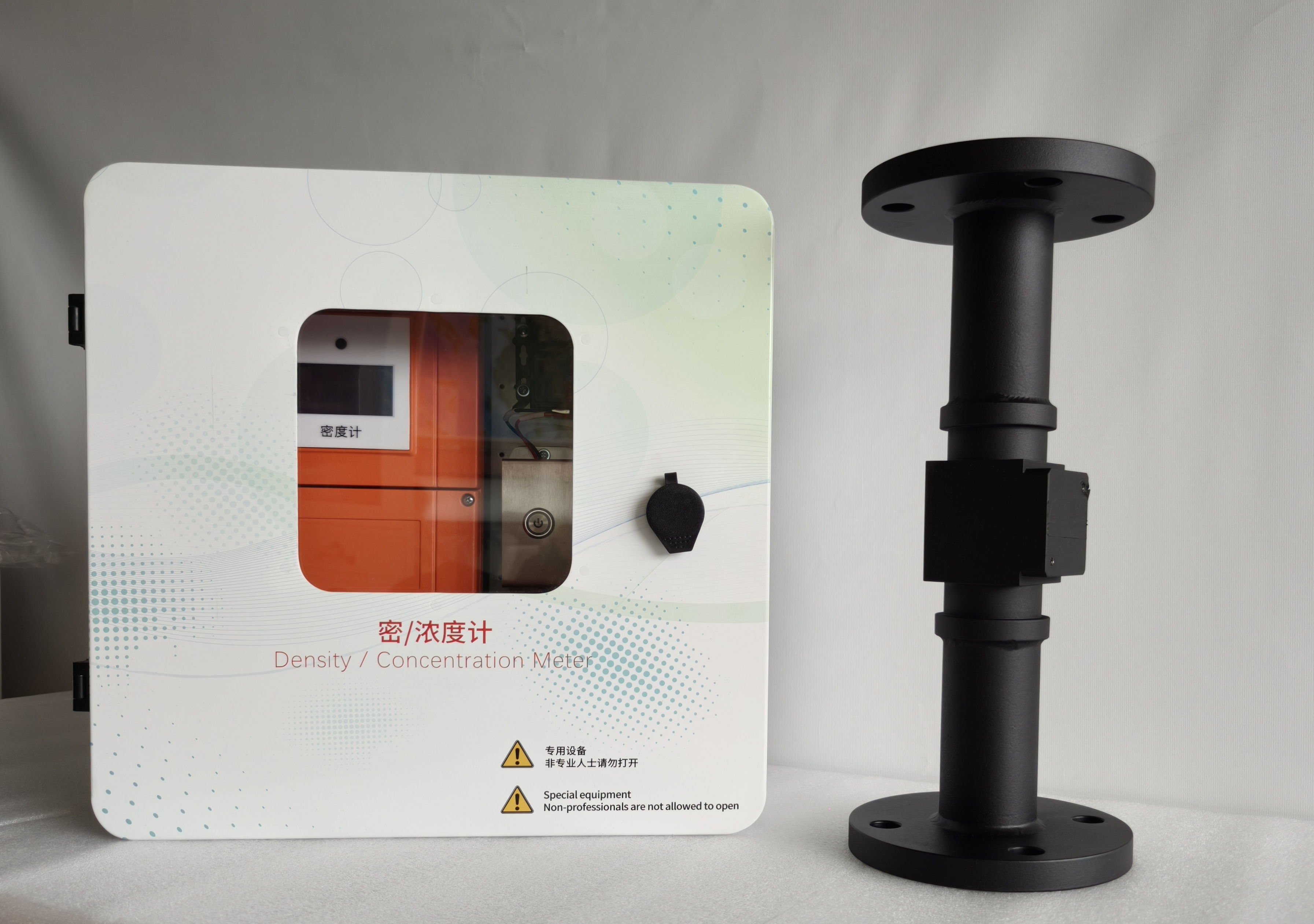
Acoustic attenuation
1 models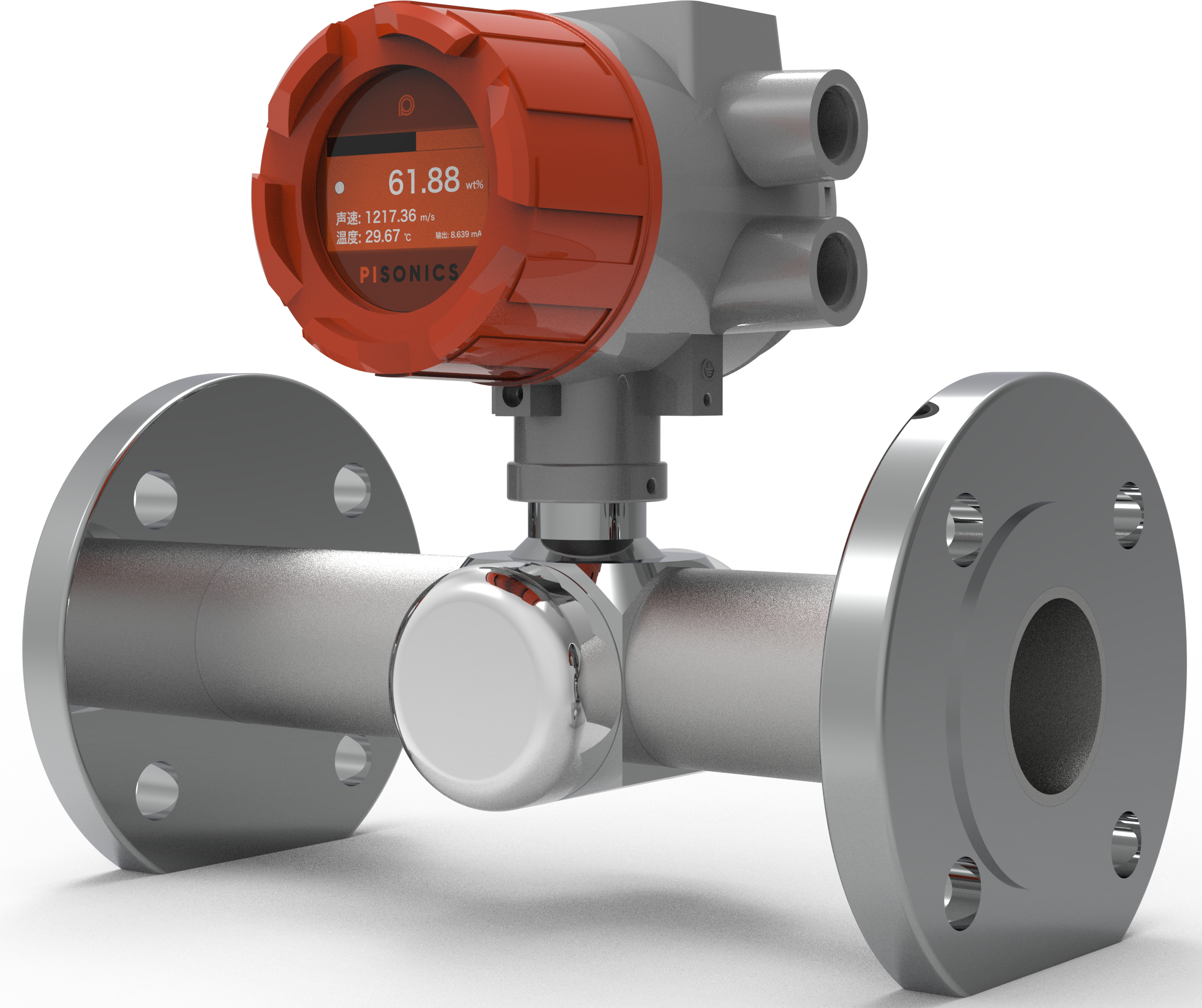
Common questions
How is dredge production (dry solids per hour) measured?
Can I measure dredge slurry density without a radioactive source?
What density meter should go on a cutter-suction dredger discharge line?
Is the PS7000 ultrasonic density meter a radiometric device? Does it need a radiation license?
The PS7000 is an acoustic-impedance ultrasonic density meter with no radioactive source whatsoever. No radiation license is required. It uses only piezoelectric transducers to send and receive ultrasonic signals — the same physical principle as medical and NDT ultrasound.
If you're currently using a Cs-137 / Co-60 source-based meter and want to remove the regulatory burden, PS7000 is a practical alternative; it installs differently, so check straight run and spool fit before a retrofit. A gamma gauge with an exempt-activity Na-22 source (< 1000 KBq) also needs no radiation license, but we no longer supply that class of instrument.
Can an ultrasonic concentration meter measure mine backfill slurry?
Can PS7000 really measure stably in bubbly mining slurries?
Yes, with one distinction.
The PS7000 employs a linear frequency-modulated (Chirp) acoustic impedance algorithm: after transmitting a broadband ultrasonic pulse, the host unit analyzes the echo in the frequency domain, and multiple-reflection interference from fine, dispersed bubbles is identified and suppressed. That is the main difference from conventional single-frequency reflective meters. The meter also outputs a 0–100 gas index and a bubble flag, so the DCS can tell a real change in concentration from a bubble-driven high reading.
Heavy free gas (pump suction drawing air, a falling stream entraining it, a point directly above an aeration header) or a continuous gas film over the sensor face pushes the reading high or stops it altogether. That is a limit of acoustic measurement: it is avoided by where the sensor goes, not corrected in calibration.
At the gypsum discharge line of an absorption tower in a thermal power plant in Inner Mongolia (under conditions of continuous air oxidation that generate dense bubbles), the PS7000 has been operating stably for several years after replacing the original tuning fork concentration meter.
Get a free field assessment
Tell us your medium, process and what you're measuring — we'll match the right principle and model.