PISONICS· Xi’an Pisonics
PS7400 Series
Online Tuning Fork Density/Concentration Meter
Piezoelectric Excitation · Tuning Fork Resonance · Plug-and-Play · Maintenance-Free
Application Case in the Petrochemical and Refined-Oil Long‑Distance Pipeline Industry
—— Online Detection of Multi‑Product Batch Interfaces · Automatic Valve Switching to Downstream Product Tanks ——
Replaces Nuclear Density Meters · Shortens Mixing Segments by 30%–50% · Significantly Reduces Annual Losses
【Key Measured Parameter: Gasoline/Jet Fuel/Diesel ρ at Operating Temperature】
Petrochemical and Refined-Oil Long-Distance Pipeline · PS7400 Tuning Fork Density Meter Solution
1. Process Background
China’s long-distance refined-oil pipeline network now exceeds 30,000 kilometers, serving as the backbone for transporting finished petroleum products from refineries to terminal storage areas, airports, and gas stations. To maximize pipeline utilization, a single line typically carries multiple oil grades in sequential batches—such as 95# gasoline, 92# gasoline, #3 jet fuel, and #0 diesel. Between successive batches, unavoidable “mixing slugs” form; the downstream portion must be downgraded and reprocessed, resulting in substantial economic losses: typically 5–20 tons of product lost per interface, multiplied by hundreds of interfaces annually, with annual losses reaching millions or even tens of millions of yuan.
The core of pipeline interface detection is determining “what type of oil is currently flowing” at a given point, enabling automatic switching of downstream receiving valves to route different products into their respective storage tanks. Since refined oils exhibit distinct densities—gasoline ≈ 0.72–0.75, jet fuel ≈ 0.78–0.81, diesel ≈ 0.82–0.86 g/cm³—an online density meter is the preferred and most cost-effective solution for interface detection. Moreover, density meters can also monitor real-time product quality compliance, identifying unintended contamination or quality deviations.
2. Pain Points of Traditional Density/Concentration Measurement Solutions
• Traditional manual sampling followed by laboratory analysis takes too long to meet the real-time decision-making needs of continuous pipeline operation, with results lagging behind the arrival of the interface.
• Nuclear density meters were once an industry standard, but managing radiation sources—including annual inspections, training, and decommissioning—entails heavy burdens; new pipeline projects generally no longer approve the use of radioactive sources.
• Differential-pressure or flow‑derived methods lack sufficient accuracy and are sensitive to pipeline fluctuations and gas entrainment, making it difficult to precisely identify narrow mixing segments.
• Oil pipelines fall within strict hazardous (explosion-proof) zones (Zone 1/Zone 2), requiring instruments to meet intrinsic safety standards such as Ex d ⅡC T6 Gb.
3. PS7400 Solution
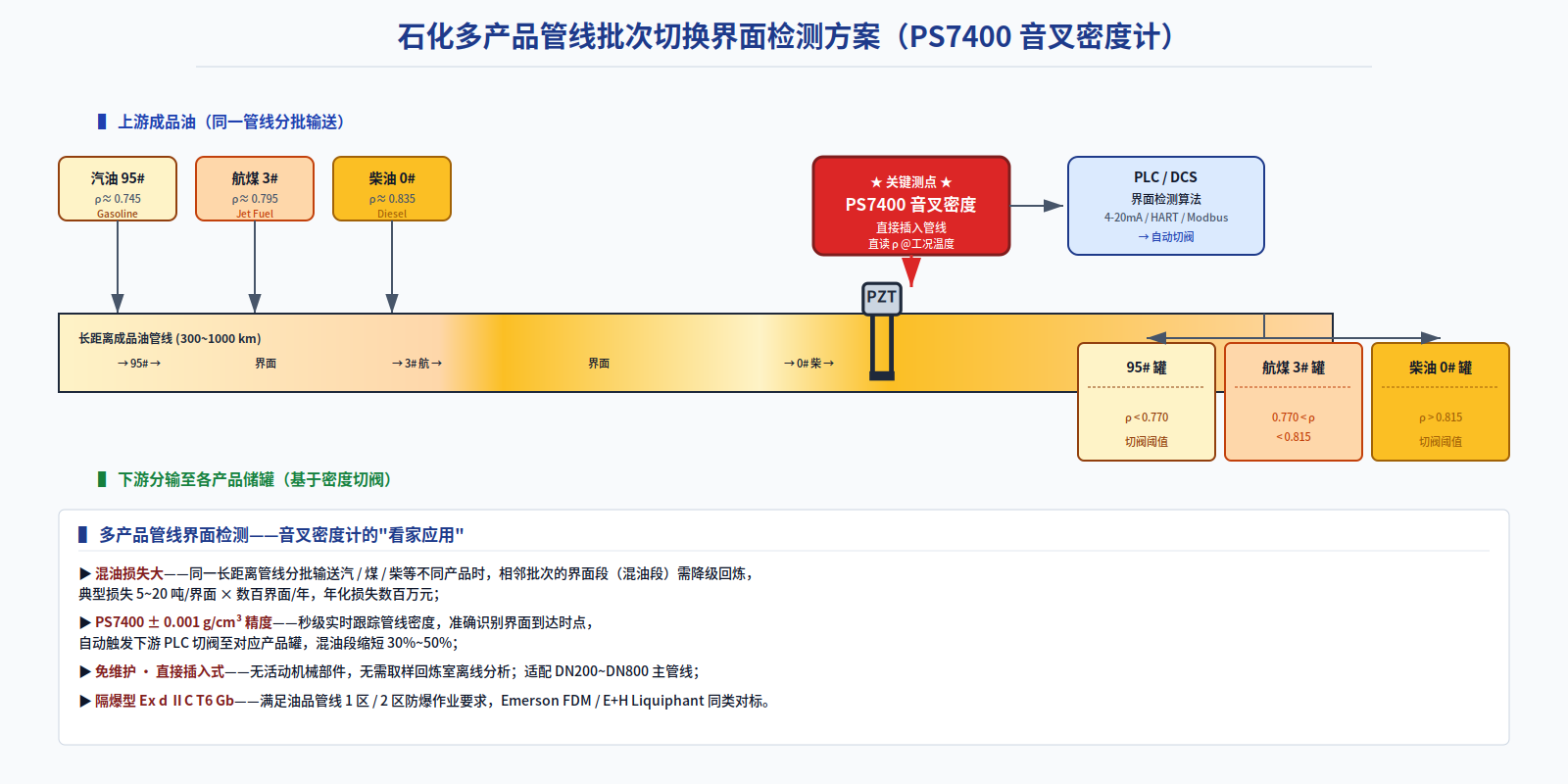
The PS7400 tuning fork density meter is installed via flange directly into the main pipeline of the refined-oil system (typically DN200–DN800). The tuning fork’s tines come into direct contact with the passing oil batches, and its resonant frequency changes are used to calculate the operating-density in real time. Coupled with PT1000 temperature compensation and outputs supporting 4–20 mA/HART/Modbus protocols, the PS7400 tracks in‑pipe density variations with sub‑second response. Downstream PLC/DCS systems, based on preset valve‑switching thresholds, automatically detect interface arrivals and route each batch accurately into the corresponding product tank.
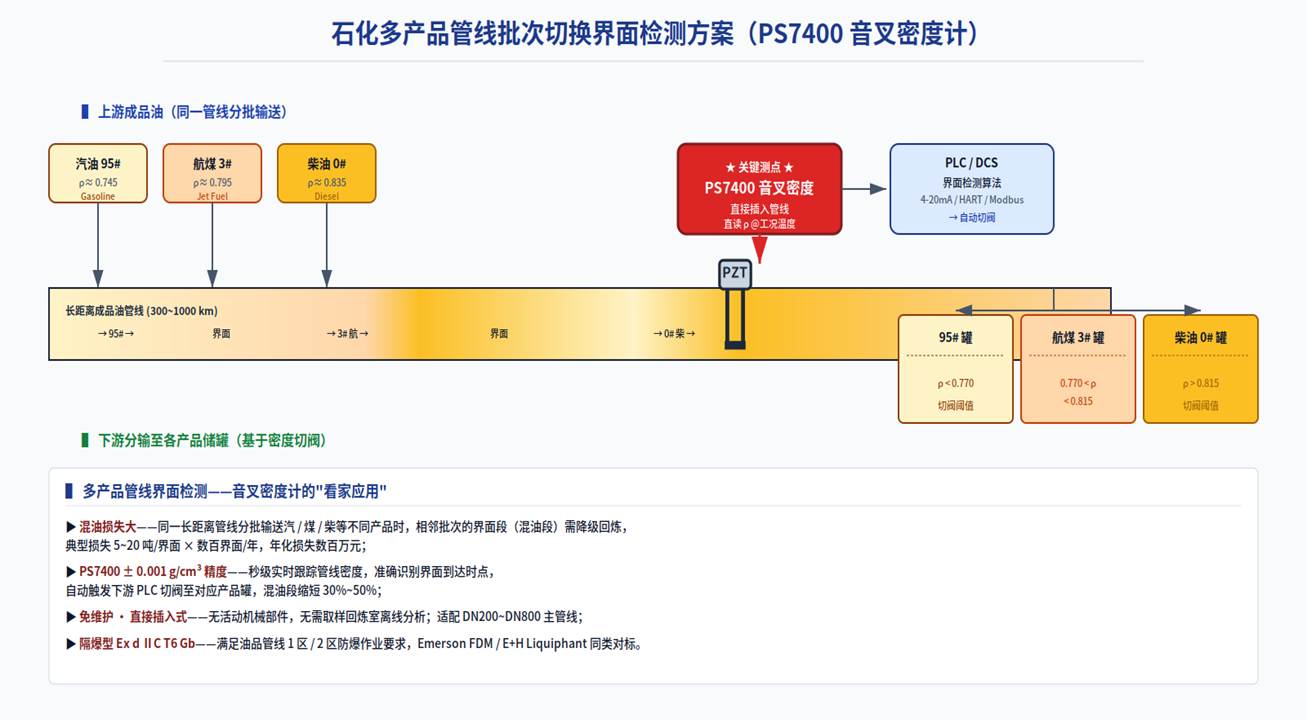
Figure 1: Online Interface Detection Scheme for Multiple Oil Grades in a Long-Distance Refined-Oil Pipeline
Core Technical Value of the PS7400 in Petrochemical/Finished-Oil Long‑Distance Pipeline Applications ▶ The PS7400 employs the tuning fork method, achieving an accuracy of ±0.001 g/cm³ and covering the entire density range of finished petroleum products, from gasoline at 0.72 to diesel at 0.86, with second‑level real‑time output; ▶ A built‑in PT1000 temperature sensor with a temperature coefficient of 20 ppm/°C automatically compensates for temperature fluctuations throughout the pipeline, eliminating their impact on density measurements; ▶ Flanged direct‑insertion installation combined with a completely non‑moving mechanical design ensures a maintenance‑free service life of at least five years, matching comparable products such as the Emerson Micro Motion FDM and the E+H Liquiphant; ▶ Ex d ⅡC T6 Gb explosion‑proof rating—fully compliant with Zone 1 and Zone 2 hazardous area requirements for finished‑oil long‑distance pipelines; ▶ Supports three communication protocols—4–20 mA, HART, and RS485—enabling seamless integration with SCADA and PLC systems in long‑distance pipeline operations; ▶ Serves as a replacement for nuclear density meters, eliminating the burden of radiation source management and ensuring smooth environmental approval for new pipeline projects. |
4. Customer Value
Comparison Dimensions | Original nuclear/differential pressure solution | PS7400 tuning fork method solution |
Radiation Safety | Gamma rays require license-based control | Completely non-nuclear-based · Inherently safe |
Interface identification accuracy | Differential pressure type struggles to distinguish narrow interfaces | ±0.001 g/cm³ · second-level |
Mixed-oil segment length | Baseline (conservative cut-off valve) | Reduced by 30%–50% |
Instrument service life | Differential pressure diaphragm < 1 year | tuning fork ≥ 5 years of maintenance-free operation |
Explosion-proof capability | Relies on remote sampling | Ex d ⅡC T6 Gb local |
Maintenance Burden | Sampling + laboratory analysis require continuous investment | Plug-and-play · No consumables |
At several intermediate distribution stations of a large domestic refined-oil long-distance pipeline project (designed throughput 15 million tons/year), the PS7400 replaced the original nuclear density meters at key transfer points along the main line. After one year of operation, the average length of mixing segments decreased from 280 meters to 120 meters—a reduction of approximately 57%. Annual losses due to product downgrading and reprocessing fell by more than 800 tons, translating into direct economic benefits of 6–8 million yuan. At the same time, the burden of annual inspections and decommissioning of radioactive sources was completely eliminated at multiple distribution sites. This solution has become the standard technical configuration for new long-distance pipeline projects among leading domestic operators.
Conclusion
Based on the PS7 series’ diverse density/concentration measurement principles—acoustic impedance (PS7000), sound velocity (PS7020), spectroscopy (PS7100), and tuning fork (PS7400)—Xi’an Pisonics has developed a comprehensive portfolio of industrial process measurement instruments, covering everything from solid-containing two-phase slurries to clean, homogeneous liquids, from single-component to multi-component applications, and ranging from economical to high‑precision models. Among these, the PS7400 tuning fork density meter—grounded in the well‑established physics of piezoelectric excitation and resonant frequency detection, and benchmarked against international leaders such as Emerson Micro Motion FDM and E+H Liquiphant—is an economical, plug‑and‑play, maintenance‑free choice for measuring the density/concentration of clean to mildly contaminated liquids.
Tailored to the specific process characteristics of the petrochemical and refined‑oil long‑distance pipeline industries, the PS7400 series of online tuning fork density/concentration meters offers full‑scale selection and customization across dimensions including wetted‑part materials (316L/Hastelloy/titanium/zirconium/PTFE), surface finishes (standard polishing/electropolishing/PTFE coating), process connections (flanges/chucks/threads), mounting accessories (F0–F6), explosion‑proof ratings, and communication protocols (4–20 mA/HART/RS485). For in‑depth discussions on your project’s specific conditions or to obtain a tailored selection proposal, please feel free to contact the technical engineering team at Xi’an Pisonics at any time.