PISONICS· Xi’an Pisonics
PS7300 Series
Differential-Pressure Density Meter
Dual-flange differential pressure · Integrated transmitter · Three installation options available
Application Case in the Petroleum Storage and Transportation / Large Tank Farm Industry
—— Online Monitoring of Crude Oil/Refined-Oil Tank Density + Oil–Water Interface ——
Replaces Nuclear Density Meters · Laboratory-Level Accuracy for Tall Liquid Columns · Automatic API Calculation · Automatic Bottom-Drainage of Oil–Water Mixtures
【Key Measured Parameters: Crude Oil/Refined-Oil Density + Oil–Water Interface Position】
【Installation Method: C-Side-Mounted · Dual Flanges】
Petroleum Storage and Transportation / Large Tank Farms · PS7300 Differential-Pressure Density Meter Solution
1. Process Background
Large tank farms are the core nodes of the petroleum storage and transportation system: a single facility typically houses dozens to hundreds of 5,000–10,000 m³ vertical tanks, handling the transshipment, blending, metering, and dispatch of crude oil, gasoline, diesel, jet fuel, and other refined products. The liquid column height in these tanks is usually 10–18 meters, and at the bottom, due to long-term sedimentation, water entrained during loading/unloading, and condensation from tank-top breathing, a dense bottom layer forms with a significantly higher density than the oil phase (ρ ≈ 1.00–1.02 g/cm³).
The two core parameters for tank metering and quality control—medium density (directly converted to API gravity, determining the tonnage invoiced for inbound/outbound operations) and oil–water interface position (dictating when to drain the tank bottom and preventing pump cavitation)—have long been “persistent challenges” addressed by manual sampling and offline laboratory analysis. International solutions such as E+H Deltabar FMD77 + Cerabar remote-diaphragm seals, and Emerson Rosemount 3051SAL + 1199 remote-diaphragm seals, have served as benchmark technologies for differential-pressure density measurement in large European and American tank farms for decades.
2. Pain Points of Traditional Density-Measurement Approaches
• Manual sampling combined with offline laboratory density-meter analysis takes 1–2 hours per cycle; each tank requires substantial effort per batch, with high safety risks (working at height on tank tops, health hazards from hydrocarbon vapors);
• While conventional nuclear density meters operate online, their operation entails heavy burdens in radiation-source management, annual inspections, training, and decommissioning; new tank-farm projects generally no longer approve the use of radioactive sources;
• No reliable online monitoring of the oil–water interface—operators must manually open the bottom drain valve “drain first, then oil” every shift, often resulting in either incomplete drainage (causing pump cavitation) or excessive discharge (leading to product loss);
• The tank farm spans a wide area under strict explosion-proof requirements—each large facility has hundreds of instrument points, making equipment selection, installation, and wiring extremely labor-intensive.
3. PS7300 Solution
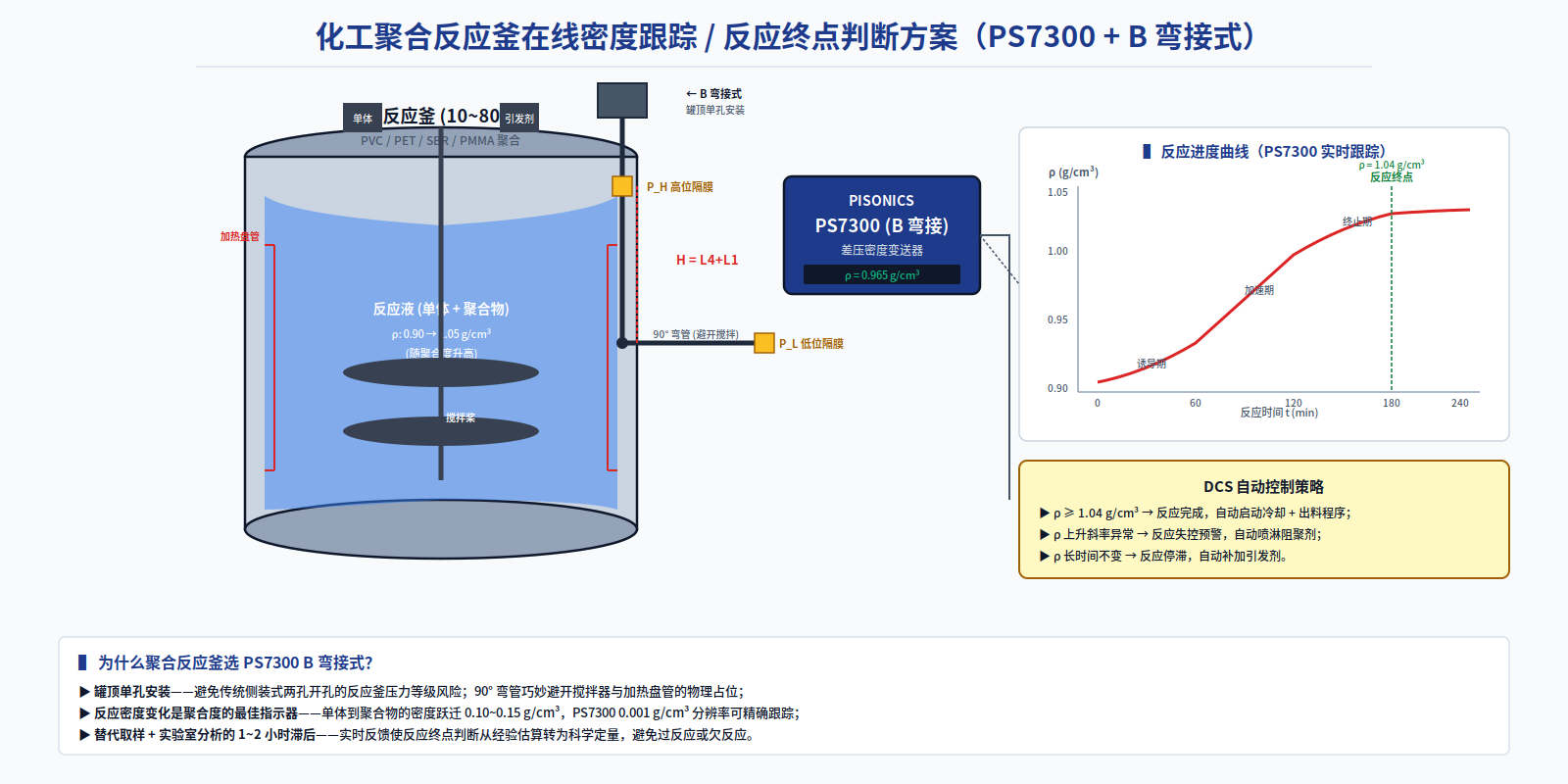
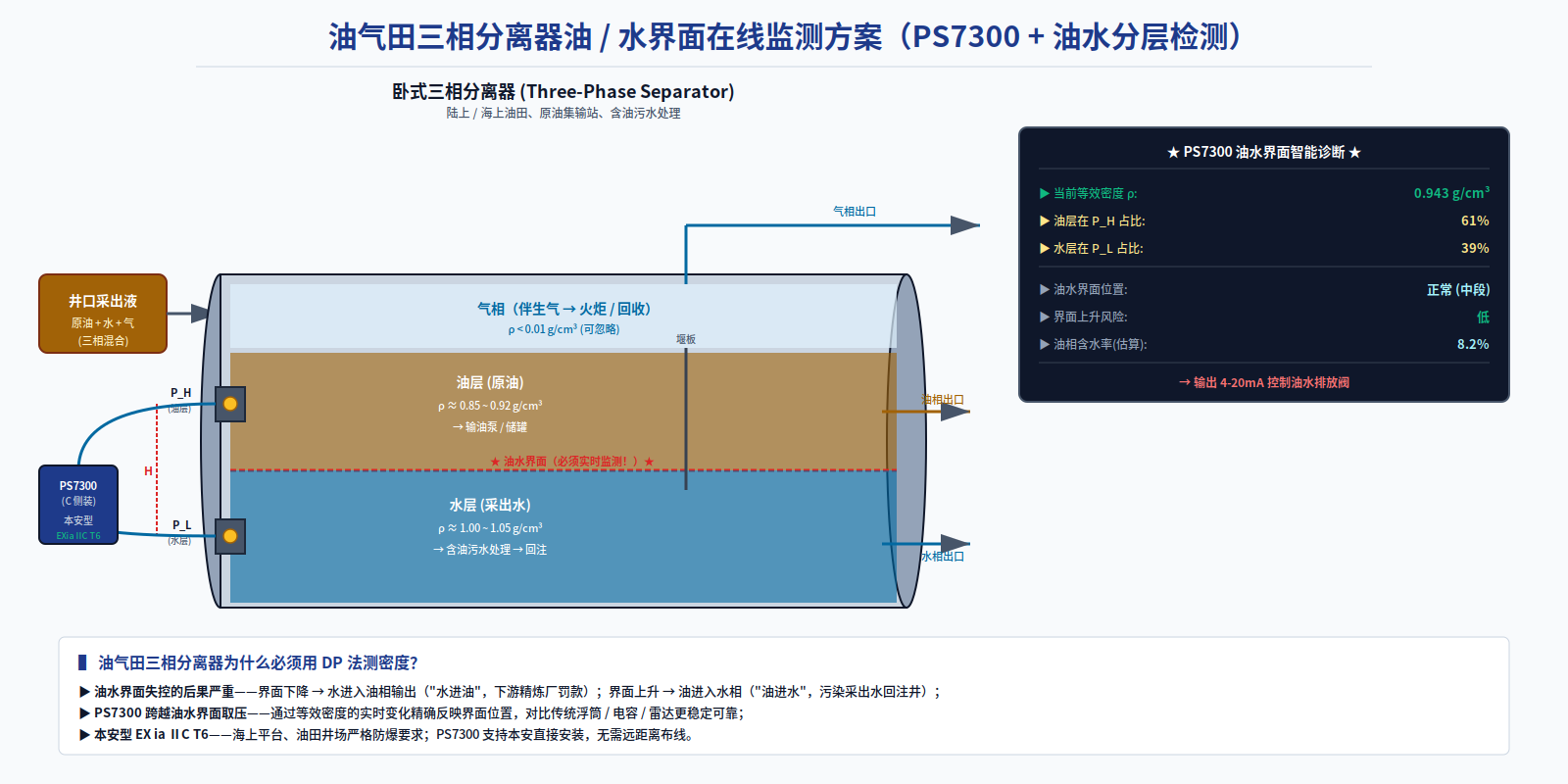
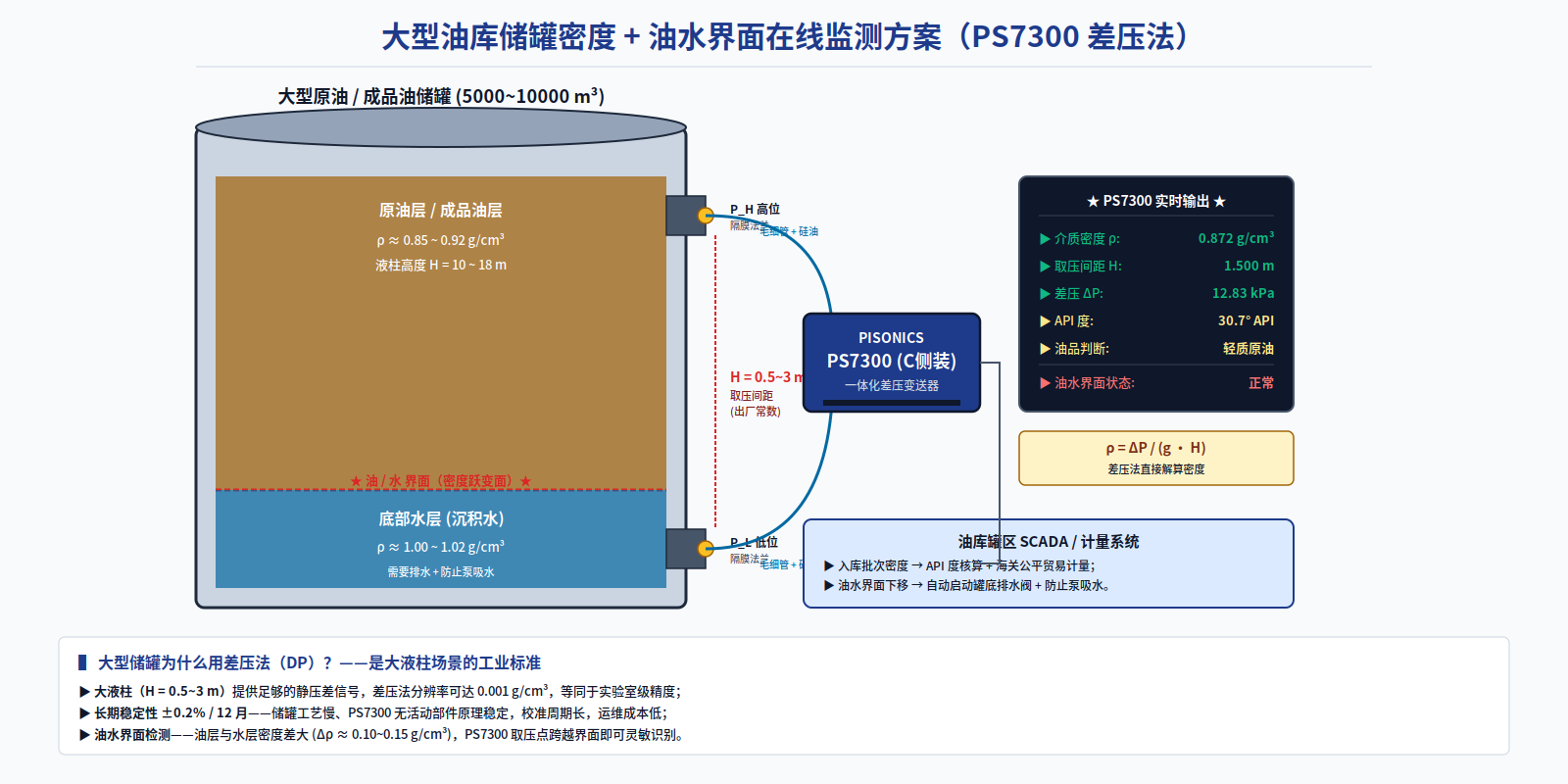
The PS7300 C-side-mounted (dual-flange) configuration is installed on the tank sidewall at two flange ports—one at the upper level P_H and one at the lower level P_L (standard DN80 openings). A silicone-filled capillary tube transmits the static pressure from both sides to an integrated differential-pressure transmitter, which directly calculates density using ρ = ΔP / (g · H), where H is a factory-set constant, typically 0.5–3 meters. The SCADA system integrates the density signal to automatically convert it to API gravity and detect changes in the oil–water interface position, enabling fully automated control of tank metering and drainage.
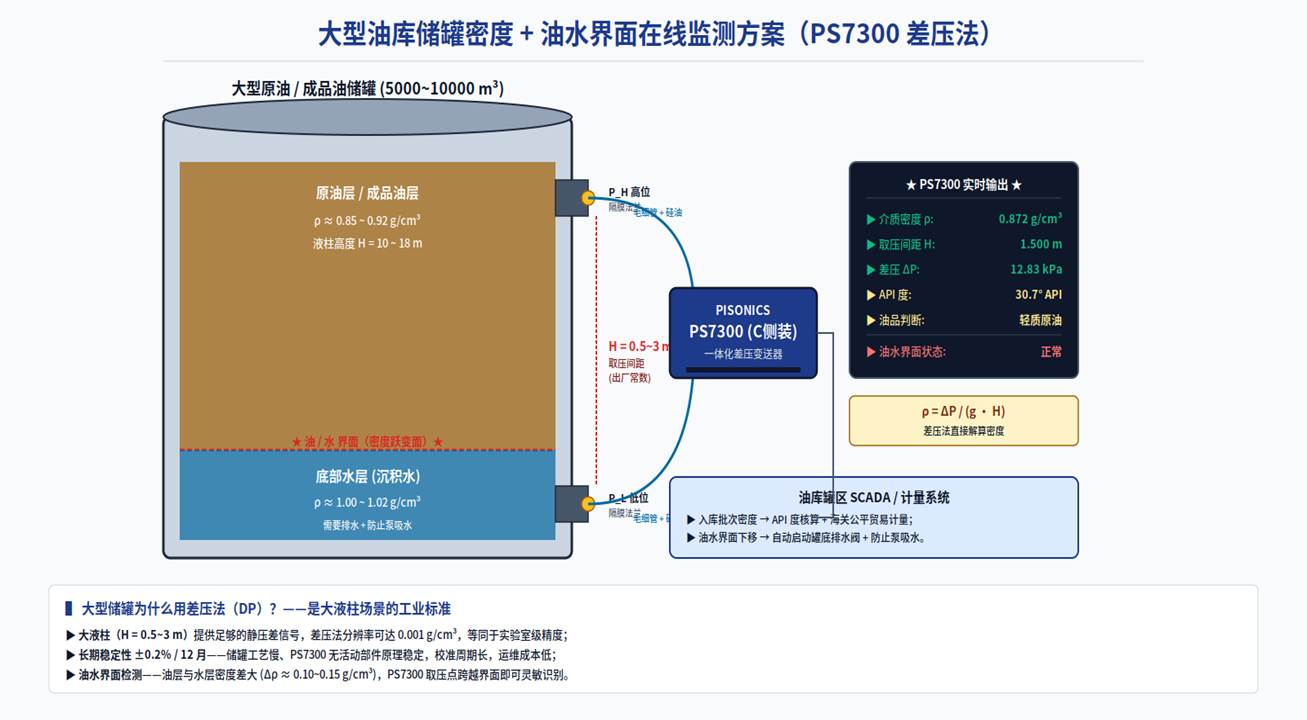
Figure 1: Online Monitoring Scheme for Tank Density and Oil–Water Interface in a Large Tank Farm
Core Technical Value of the PS7300 in Petroleum Storage and Transportation / Large Oil Depot Tank Farms ▶ Resolution of 0.001 g/cm³ · Long-term stability of ±0.2% / 12 months—due to the slow dynamics of large storage tanks, the PS7300’s non‑moving‑parts design ensures high stability, enabling extended calibration intervals and significantly lower annual operating costs compared with nuclear density meters; ▶ C‑side mounting allows for the most convenient on‑site installation and removal—occupying no internal tank space and enabling hole‑in‑the‑roof installation without disturbing the roof structure, making it particularly suitable for retrofitting existing tanks; ▶ The standard 316L diaphragm is compatible with all refined petroleum products, including crude oil, gasoline, diesel, and jet fuel, with a service life of at least 10 years; ▶ Intrinsically safe Ex ia ⅡC T6 or flameproof Ex d ⅡB T4 options are available—meeting the stringent explosion‑proof requirements of Zone 1 and Zone 2 in oil depot tank farms; ▶ Offers 4–20 mA, HART, and Modbus RS‑485 outputs—ensuring seamless integration with SCADA and TAS tank farm automation systems; ▶ Replaces nuclear concentration meters—eliminating the burden of radiation source management and ensuring smooth environmental approval for both new and retrofitted oil depot projects. |
4. Customer Value
Comparison Dimensions | Original nuclear / manual solution | PS7300 Differential Pressure Method Solution |
Radiation Safety | Gamma rays require license-based control | Completely non-nuclear-based · Inherently safe |
Response Time | Sampling lag of 1–2 hours | Second-level real-time (0.25 s) |
Density accuracy | Manual density meter ±0.0005 | 0.001 g/cm³ laboratory grade |
Long-term stability | Nuclear-source attenuation requires periodic calibration | ±0.2% / 12 months · minimal calibration |
oil–water interface | Manual judgment · unreliable | Real-time identification of density jumps |
Explosion-proof capability | The sampling method is not explosion-proof | Intrinsically safe / explosion-proof—dual selection |
Operational and Maintenance Costs | Radiation annual inspection + radiation protection training | Extremely low (no moving parts) |
In the overhaul project of the finished-oil tanks at a major petroleum storage-and-transportation company’s East China base (total tank capacity 800,000 m³, annual throughput 5 million tons), 36 units of the PS7300 C-side-mounted model replaced the original nuclear density meters and manual-sampling setup, deployed on the sidewalls of the main gasoline, diesel, and jet-fuel tanks. After one year of operation, statistics show that the time required to calculate the density for each inbound batch has been reduced from 90 minutes to within 5 minutes; the annual recovery of customs-trade discrepancies amounts to approximately RMB 12 million. Incidents of uncontrolled oil–water interface at the tank bottom have been eliminated, and downstream refining-plant quality-reimbursement claims caused by pump cavitation have dropped sharply. At the same time, the burden of annual inspections, protective training, and decommissioning associated with the 36 nuclear sources has been completely lifted. Benchmarked against international products such as Emerson Rosemount 3051SAL+1199 and E+H Deltabar FMD77, this solution provides domestic large tank farms with a localized, non-nuclear alternative for density measurement.
Conclusion
Based on the five density/concentration-measurement principles of the PS7 series (PS7000 acoustic impedance, PS7020 sound velocity, PS7100 spectroscopy, PS7300 differential pressure, and PS7400 tuning fork), Xi’an Pisonics (PISONICS) has built a comprehensive industrial-process instrumentation portfolio, covering everything from solid-containing two-phase slurries to clean, homogeneous liquids, from single-component to multi-component systems, and from inline process monitoring to large-tank metering. Among these, the PS7300 differential-pressure density meter—grounded in the classic physical principle ΔP = ρ · g · H and benchmarked against leading international brands such as E+H Deltabar PMD75/FMD77, Emerson Rosemount 3051SAL+1199 remote-diaphragm seals, and VEGA VEGADIF 65/85—is a “long-term stable, low-maintenance” industrial-standard solution for large tanks, tall liquid columns, and slow-process density monitoring.
Tailored to the process characteristics of the petroleum storage and transportation/large tank-farm sector, the PS7300 series offers full-dimensional selection and customization across installation methods (A straight-tube/B elbow/C side-mounted), wetted-material options (316L/Hastelloy/Monel/Tantalum/Titanium/PFA coating), process connections (HG/T20592/JIS/ASME/sanitary clamp), explosion-proof ratings (intrinsically safe ExiaIICT6/exothermically flameproof ExdIIBT4), and communication protocols (4–20 mA/HART/Modbus RS-485). For an in-depth discussion of your project’s specific conditions or to obtain a tailored selection proposal, please feel free to contact the technical-engineering team at Xi’an Pisonics at any time.