PISONICS· Xi’an Pisonics
PS7300 Series
Differential-Pressure Concentration Meter
Dual-flange differential pressure · Integrated transmitter · Three installation options available
MVR Evaporation and Crystallization / Chemical Concentration Industry Application Case
—— Industrial Wastewater Zero Liquid Discharge (ZLD) · Precise Concentration Control in Chemical Concentration/Crystallization Processes ——
PFA-coated for high-concentration brine resistance · Steam consumption reduced by 3–5% · Scale‑formation early warning · Byproduct purity improved
【Key Measured Parameter: Density of High-Concentration Brine / Chemical Concentrate (→ wt% Concentration)】
【Installation Type: C Side-Mounted · Hastelloy Alloy + PFA Coating】
MVR Evaporation and Crystallization / Chemical Concentration · PS7300 Differential-Pressure Concentration Meter Solution
1. Process Background
MVR (Mechanical Vapor Recompression) evaporation and crystallization technology is the mainstream equipment for industrial wastewater “zero liquid discharge (ZLD)” and chemical concentration processes: by mechanically recompressing and reusing the secondary steam generated during evaporation, the steam consumption per ton of water evaporated is reduced from 0.3–0.5 tons in conventional multi-effect evaporation to 0.05–0.10 tons, delivering significant energy savings. Typical applications include flue-gas desulfurization wastewater concentration in power plants, dyeing wastewater concentration, coal‑chemical wastewater concentration, leachate concentration, and the purification and crystallization of KCl, NaCl, and Na2SO4.
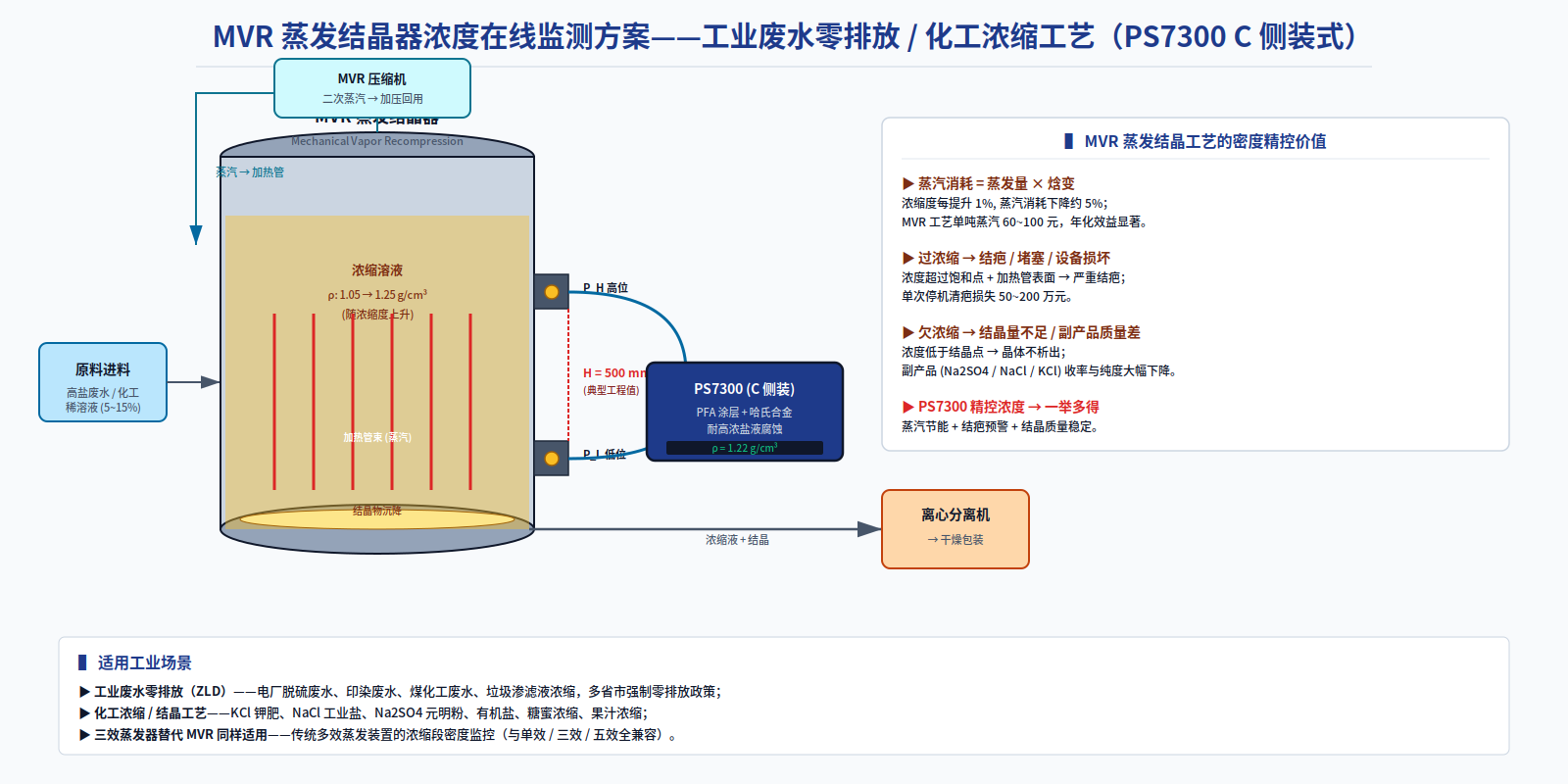
The liquid column height inside an MVR evaporator typically ranges from 1 to 3 meters. During the concentration process, the solution density rises steadily from approximately 1.05 g/cm³ in the feed to about 1.25 g/cm³ at the saturation crystallization point. The key to control lies in maintaining the concentration within the optimal range—overconcentration leads to scale formation that clogs the heating tubes, resulting in shutdowns and scale‑removal costs ranging from hundreds of thousands to millions of yuan; underconcentration yields insufficient crystal production, poor byproduct purity, and low recovery rates.
2. Pain Points of Traditional Density Measurement Solutions
• High‑concentration brines (containing Cl⁻ and various metal ions) are highly corrosive to wetted‑part materials; traditional stainless‑steel instruments suffer severe corrosion within 3–6 months;
• The evaporator features a tall liquid column, high temperatures (80–110°C), and suspended crystals—making the moving elements of conventional contact-type tuning‑fork or vibrating‑tube concentration metersis extremely prone to crystal-induced wear and seizure;
• Scale formation during overconcentration represents the greatest operational risk in MVR systems—once scale deposits on the heating tube surfaces, the heat transfer coefficient plummets, forcing a shutdown for cleaning; each cleaning costs 500,000 to 2 million yuan and requires specialized chemical cleaning agents;
• The purity and recovery rate of byproduct salts (KCl, Na2SO4, NaCl) depend critically on precise concentration control in the crystallization stage—underconcentration results in excessive valuable salts being carried away in the mother liquor, while overconcentration introduces impurity precipitates.
3. PS7300 Solution
The PS7300 C side‑mounted model (diaphragm: Hastelloy C‑276 with all‑fluorinated PFA coating) is installed on the side wall of the MVR evaporator, spanning the liquid column (typical height H = 500 mm) to monitor the concentrate’s density in real time. The instrument continuously feeds density signals back to the DCS, which, after comprehensive analysis, adjusts the steam supply and the discharge valve position to achieve closed‑loop precision control of the concentration level.
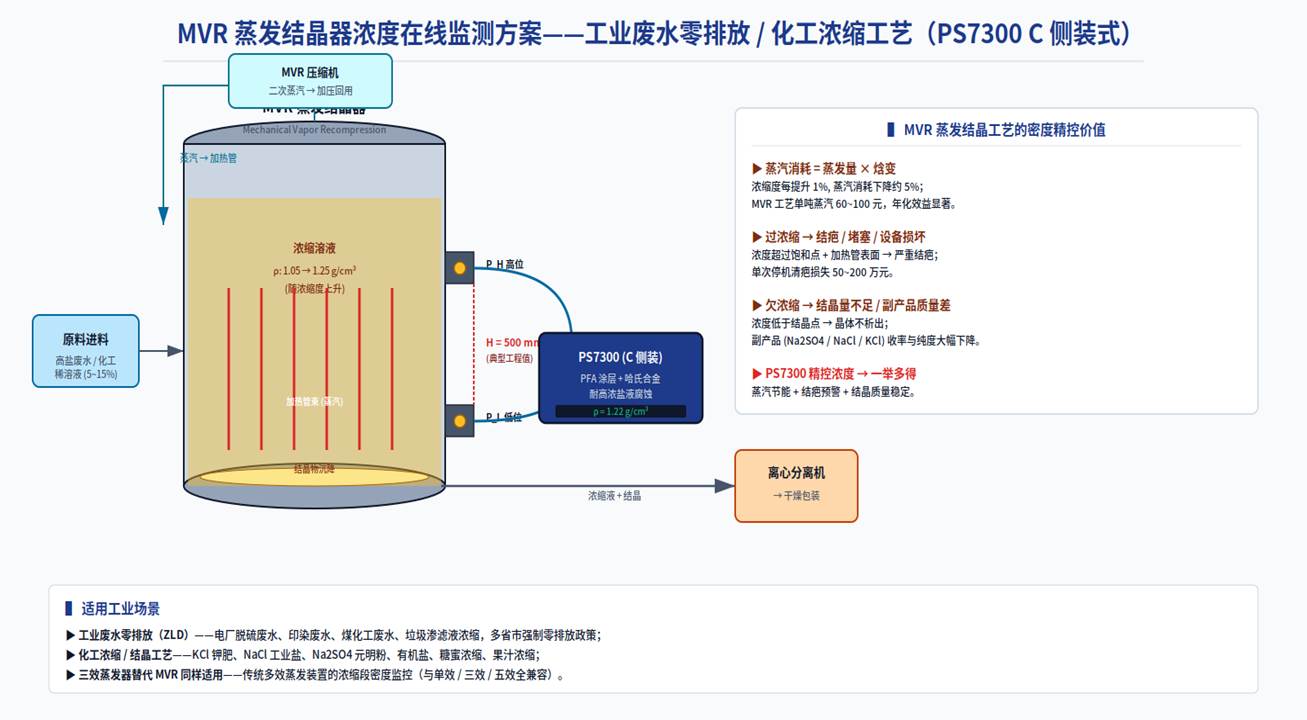
Figure 1: Online Concentration Monitoring Scheme for an MVR Evaporation and Crystallization Unit
Core Technical Value of the PS7300 in MVR Evaporation-Crystallization / Chemical Concentration ▶ Hastelloy C‑276 diaphragm + PFA perfluoropolymer coating (PFA coating available only for C‑side mounted models) — resistant to highly concentrated Cl⁻ and complex metal ion–induced composite corrosion, with a service life ≥ 5 years; ▶ Smooth diaphragm surface + no moving parts — immune to wear and jamming by crystalline deposits, unlike conventional tuning fork or vibrating‑tube solutions; ▶ Precise steam control — for every 1% increase in concentration, MVR steam consumption decreases by approximately 5%, yielding annual energy‑saving benefits of several million yuan; ▶ Scale‑up warning — when the concentration approaches saturation and the heating tube temperature becomes abnormal, the DCS automatically issues an alarm, preventing severe scale‑up–caused shutdowns; ▶ Improved byproduct purity — once the concentration in the crystallization section stabilizes, the recovery rates of byproduct salts such as KCl, Na₂SO₄, and NaCl increase by 3% to 8%; ▶ High‑temperature adaptation from −40 to 150°C — meeting the 80–110°C operating conditions at the top of MVR evaporators, with special customization possible up to 150°C. |
4. Customer Value
Comparison Dimensions | Original Conventional Solution | PS7300 + PFA Solution |
Corrosion-resistant | 316L < failed in June | Hastelloy + PFA ≥ 5 years |
Crystallization Adaptation | The tuning fork is prone to jamming | Smooth diaphragm · Zero interference |
Steam Consumption | Baseline | steam consumption reduced by 3–5% |
Scale formation accident | Sudden shutdown | Early warning to prevent |
By-product purity | fluctuation | Increase by 3–8% |
Operational and Maintenance Burden | Frequent cleaning / calibration | Maintenance-free for ≥ 5 years |
Applicable Operating Conditions | Limited | Full coverage of ZLD + chemical crystallization |
In the zero‑liquid‑discharge (ZLD) project for desulfurization wastewater at a large domestic coal‑fired power plant (two 660 MW ultra‑supercritical units), two PS7300 C side‑mounted units (Hastelloy alloy with PFA coating) were deployed in a 500‑ton‑per‑day MVR evaporation and crystallization system. After one year of operation, steam consumption in the MVR evaporator decreased by 4.2%, saving approximately 3.8 million yuan in annual steam costs; the recovery rate of the desulfurization wastewater crystallization products (a mixed salt of NaCl and Na2SO4) increased from 84% to 91%, and scale‑related shutdowns were eliminated. This solution has since been extended to ZLD of dyeing wastewater, concentration of coal‑chemical wastewater, leachate volume reduction, potassium chloride (KCl) crystallization, and refined sodium sulfate (Na2SO4) production, among many other industrial wastewater and chemical concentration scenarios, benchmarking against international counterparts such as VEGA VEGADIF 85 and E+H Deltabar FMD77.
Conclusion
Based on the five density/concentration measurement principles of the PS7 series (PS7000 acoustic impedance, PS7020 sound velocity method, PS7100 spectroscopy, PS7300 differential pressure, and PS7400 tuning fork), Xi’an Pisonics (PISONICS) has built a comprehensive portfolio of industrial process measurement instruments, covering everything from solid–liquid two‑phase slurries to clean, homogeneous liquids, from single‑component to multi‑component systems, and from inline process monitoring to large‑scale tank gauging. Among these, the PS7300 differential‑pressure concentration meter—grounded in the classic physical principle ΔP = ρ · g · H and benchmarked against international leaders such as E+H Deltabar PMD75/FMD77, Emerson Rosemount 3051SAL with 1199 remote‑diaphragm seal, and VEGA VEGADIF 65/85—is the long‑term, low‑maintenance industrial standard for monitoring large tanks, tall liquid columns, and slow‑process densities.
Specifically tailored to the process characteristics of MVR evaporation and crystallization and chemical concentration, the PS7300 series offers full‑dimensional selection and customization across installation types (A straight‑pipe, B elbow‑connected, C side‑mounted), wetted‑part materials (316L, Hastelloy, Monel, tantalum, titanium, PFA coating), process connections (HG/T20592, JIS, ASME, sanitary clamp fittings), explosion‑proof ratings (intrinsically safe ExiaIICT6, flameproof ExdIIBT4), and communication protocols (4–20 mA, HART, Modbus RS‑485). For an in‑depth discussion of your project’s specific conditions or to obtain a tailored selection proposal, please feel free to contact the technical engineering team at Xi’an Pisonics at any time.