PISONICS· Xi’an Pisonics
PS7300 Series
Differential-Pressure Density Meter
Dual-flange differential pressure · Integrated transmitter · Three installation options available
Application Case in the Fertilizer / Large Urea‑Solution Storage-Tank Industry
—— Online Concentration Monitoring of 40% / 50% Urea‑Solution Storage Tanks · Trade Billing Based on 100% Urea Equivalent ——
Real-time Verification Before Loading · SCR Reductant Compliance · Crystallization‑Prevention Alerts · Tank‑Farm Metering Automation
【Key Measured Parameter: Density of 40% / 50% Urea Solution (→ wt% Concentration)】
【Installation Type: Side Mount C · 316L Diaphragm】
Fertilizer / Large Urea‑Solution Storage Tanks · PS7300 Differential‑Pressure Density Meter Application Solution
1. Process Background
China is the world’s largest producer and consumer of urea, with an annual production capacity exceeding 70 million tons. In addition to traditional granular urea, liquid urea solutions (at two mainstream concentrations—40% and 50%) have become an important product form in modern fertilizer plants. A 40 wt% urea solution (ρ ≈ 1.110 g/cm³) primarily serves as the feedstock for automotive SCR reductants (AdBlue/DEF concentrate) and for NOx reduction in vehicles and ships. A 50 wt% urea solution (ρ ≈ 1.145 g/cm³), meanwhile, is used as a high‑concentration fertilizer raw material, an export commodity, or a direct‑supply product for industrial customers.
Large fertilizer plants typically arrange 4 to 12 storage tanks, each with a capacity of 1,000 to 5,000 m³, in their urea‑solution tank farms. These tanks buffer, blend, and prepare the plant’s urea output for loading onto trucks or ships. The core of tank‑farm metering lies in “100% equivalent” trade settlement—billing based on the mass of pure urea converted to a 100% basis. A 1 wt% deviation in concentration translates into a discrepancy of roughly 2.5% (for 40%) to 2% (for 50%) in the actual 100%‑equivalent invoice amount. Monthly shipments of tens of thousands of tons can result in trade discrepancies running into hundreds of thousands of yuan. Moreover, urea solutions are susceptible to crystallization: 40% solutions begin to crystallize at 0°C, while 50% solutions crystallize at 15°C, necessitating integrated monitoring of both concentration and temperature, along with heating and insulation.
2. Pain Points of Traditional Density‑Measurement Approaches
• Prior to truck or ship loading, reliance on manual sampling and laboratory analysis to verify concentration delays each batch by 1–2 hours, hampering shipping efficiency and frequently triggering customer retesting disputes;
• At ambient temperatures, 40% and 50% urea solutions gradually lose moisture through evaporation, causing their concentrations to drift; temperature compensation alone is insufficient to capture these real‑time changes;
• Crystallization risk—during northern winters, when the temperature in 50% tanks drops below 15°C, crystals precipitate, leading to sudden concentration shifts, pipeline blockages, and metering‑pump failures;
• Stringent compliance requirements for automotive AdBlue—ISO 22241 and GB 29518 standards mandate a concentration of 32.5% (typically achieved by diluting 40% stock solution). Any deviation can render downstream vehicle SCRs ineffective, exposing operators to regulatory penalties.
3. PS7300 Solution
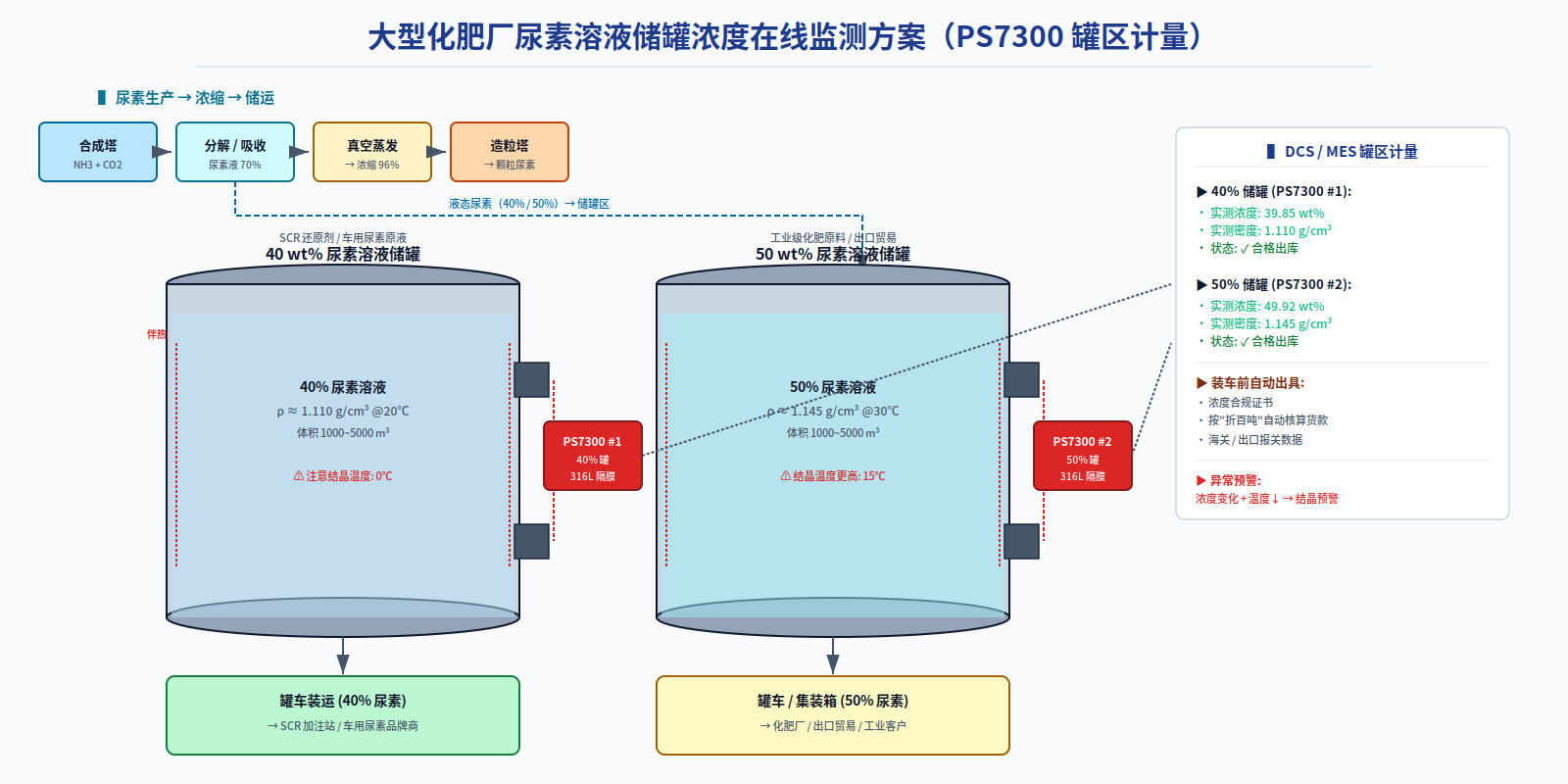
Two PS7300 meters, side‑mounted type C (with 316L diaphragms), are deployed: PS7300 #1 on the sidewall of a 40% urea tank (typical mounting height H = 2 m), and PS7300 #2 on the sidewall of a 50% urea tank (typical H = 2.5 m). The concentration data from both instruments are transmitted in real time to the DCS/MES tank‑farm metering system, automatically enabling three key functions: pre‑loading compliance verification, automated 100%‑equivalent trade accounting, and crystallization alerts.
Figure 1: Online Concentration Monitoring Scheme for Urea‑Solution Storage Tanks in a Large Fertilizer Plant
Core Technical Value of the PS7300 in Fertilizer / Large Urea Solution Storage Tanks ▶ C‑type side‑mounted installation + 316L diaphragm—withstanding immersion in 0–100% urea solution (urea is marked with a ☆ recommendation in the material compatibility table), with a service life ≥ 5 years; ▶ 0.001 g/cm³ resolution + long‑term stability of ±0.2%/12 months—corresponding to urea concentration accuracy better than ±0.1 wt% (far exceeding the manual density bottle’s ±0.5%); ▶ Real‑time verification before loading—reducing the time from 90 minutes for sampling and laboratory analysis to 5 minutes for direct reading, significantly improving shipment efficiency; ▶ Automatic billing for hundred‑ton transactions—allowing the MES system to automatically calculate the payment amount based on “measured concentration × loaded tonnage,” thereby eliminating customer disputes over retesting; ▶ Crystallization early warning—when concentration changes combined with tank temperature falling below the threshold (40% tank ≤ 5℃ / 50% tank ≤ 18℃), the DCS automatically activates trace heating to prevent crystallization incidents; ▶ Compliance of automotive urea AdBlue—meeting ISO 22241 / GB 29518 standards to ensure that the 40% mother liquor leaves the factory in compliance. |
4. Customer Value
Comparison Dimensions | Original Manual Sampling Scheme | PS7300 Online Solution |
Loading Efficiency | 90 minutes of manual verification | 5-minute automatic verification |
Concentration Accuracy | ±0.5 wt% | ±0.1 wt% |
Revenue per hundred tons of cargo | Monthly discrepancy amounts to several hundred thousand yuan | Differential zeroing |
Crystallization Accident | Frequent in winter | Early warning to prevent |
Customer Re-test Dispute | frequent | Essentially eliminated |
AdBlue Compliance | Sampling inspection risk | Online continuous verification |
Tank Farm Automation | Relying on laboratory analysts | MES closed loop |
At the urea‑solution tank farm of a major fertilizer enterprise in Northwest China (annual production of 800,000 tons of urea plus 300,000 tons of 40% and 50% liquid urea), six PS7300 side‑mounted units (316L diaphragm) were installed across three 40% tanks and three 50% tanks. After one year of operation: pre‑loading concentration verification time was reduced from an average of 90 minutes to just 5 minutes, boosting monthly shipment efficiency by approximately 25%; trade discrepancies based on 100% equivalent narrowed from about 4 million yuan per year to under 300,000 yuan annually; two crystallization alerts successfully prevented winter pipeline blockages (estimated cost savings of 800,000 yuan in maintenance and emergency repairs); and the concentration of the AdBlue feedstock remained 100% compliant in all annual spot checks. Compared with international solutions such as E+H Deltabar PMD75, Emerson Rosemount 3051SAL+1199, this domestically developed approach provides Chinese fertilizer producers with a localized tank‑farm metering automation solution.
Conclusion
Based on the five density/concentration measurement principles of the PS7 series (PS7000 acoustic impedance, PS7020 sound velocity, PS7100 spectroscopy, PS7300 differential pressure, and PS7400 tuning‑fork technology), Xi’an Pisonics (PISONICS) has built a comprehensive portfolio of industrial process‑measurement instruments, covering everything from solid–liquid two‑phase slurries to clean, homogeneous liquids, from single‑component to multi‑component systems, and from inline process monitoring to large‑tank metering. Among these, the PS7300 differential‑pressure density meter—grounded in the classic ΔP = ρ · g · H physical principle and benchmarked against international leaders such as E+H Deltabar PMD75/FMD77, Emerson Rosemount 3051SAL+1199 (remote‑diaphragm sealed design), and VEGA VEGADIF 65/85—is a long‑term, low‑maintenance industrial standard for large tanks, tall liquid columns, and slow‑process density monitoring.
Tailored to the specific characteristics of the fertilizer and large urea‑solution tank industries, the PS7300 series offers full‑scope selection and customization across installation types (A straight‑tubing, B elbow‑connected, C side‑mounted), wetted‑part materials (316L, Hastelloy, Monel, tantalum, titanium, PFA coating), process connections (HG/T20592, JIS, ASME, sanitary clamp fittings), explosion‑proof ratings (intrinsically safe ExiaIICT6, flameproof ExdIIBT4), and communication protocols (4–20 mA, HART, Modbus RS‑485). For a detailed discussion of your project’s specific conditions or to obtain a tailored selection proposal, please feel free to contact the technical engineering team at Xi’an Pisonics at any time.