PISONICS
PS7110 Series
Inline Process Refractometer
Critical-angle refractometry · sapphire prism · temperature compensation
Inline Concentration of Battery-Material Solutions
—— Lithium hydroxide crystallization · nickel sulfate refining · precursor feed ——
Key measurements: LiOH / NiSO₄ wt% / temperature °C
Battery-Material Solutions: Inline Lithium Hydroxide and Nickel Sulfate Concentration
1. What the inline value is for
Battery-grade lithium hydroxide monohydrate (China's GB/T 26008—2020) and refined nickel sulfate (GB/T 26524—2023) both crystallize out of solution, and the mixed nickel–cobalt–manganese sulfate feed for ternary precursor co-precipitation (for example T/CNIA 0210—2023, nickel–cobalt sulfate solution) is made up by concentration. Inline concentration covers three things here: the evaporation end point, the strength of dissolution and make-up, and the state of the mother liquor.
2. Lithium hydroxide: solubility changes little with temperature
LiOH dissolves to about 11 wt% at 25 °C (10.95 wt%) and only about 15 wt% at 100 °C. Because solubility changes so little with temperature, industry crystallizes it by evaporation rather than cooling. Liquor from causticization (lithium carbonate with lime) tops out at about 3.5 wt% LiOH (about 35 g/L); as the liquor is evaporated from a few per cent towards saturation, the inline concentration marks the end point.
| LiOH wt% | 0 | 2 | 4 | 6 | 8 | 10 |
|---|---|---|---|---|---|---|
| 20 °C, g/cm³ | 0.9982 | 1.0217 | 1.0437 | 1.0650 | 1.0862 | 1.1074 |
| 80 °C, g/cm³ | 0.9718 | 0.9973 | 1.0189 | 1.0397 | 1.0600 | 1.0803 |
Densities from the International Critical Tables, as reproduced in an LLNL report of 1976.
Estimated from the table: at 20 °C one wt% changes the density by about 0.011 g/cm³, and a 10 wt% solution changes by the equivalent of about 0.04 wt% per kelvin — temperature compensation is not optional. For refractive index, a saturated LiOH solution at 25 °C has nD = 1.3735 (published data); against water at 1.3325 that is roughly 0.004 per wt%, so the PS7110's ±0.0001 converts to the 0.03 wt% order — a unit conversion only; the real accuracy comes from calibration on the actual liquor.
The thing to guard against is scale: LiOH takes up CO₂ from air to form lithium carbonate, whose solubility falls as temperature rises, so it scales hot surfaces in evaporators and on sensors; crystallizer suppliers recommend CO₂-free water and nitrogen blanketing. For the instrument: a full, moving line, no cold spots, and regular checks of the detection face — a deposit shows only as a slow drift, not as a fault.
3. Nickel sulfate: colour is not the problem, crystallization and temperature are
NiSO₄ dissolves to about 27.5 wt% at 20 °C (27.3–27.7 %). The solid phase depends on temperature: the heptahydrate below 31.5 °C, the α-hexahydrate at 31.5–53.3 °C and the β form above 53.3 °C. Refining usually uses evaporative crystallization; in one published study the mother liquor rose from 99 to 138 g/kg nickel during evaporation under vacuum at 50 °C, and a comparable battery-grade cobalt sulfate process uses a discharge specific gravity of at least 1.50 as its end point — a physical-property criterion.
| NiSO₄ wt% (approx.) | 4.2 | 9.7 | 13.3 | 18.7 | 23.5 | 26.7 |
|---|---|---|---|---|---|---|
| 20 °C, g/cm³ | 1.0437 | 1.1065 | 1.1504 | 1.2217 | 1.2898 | 1.3390 |
| Ni g/L (approx.) | 17 | 41 | 58 | 87 | 115 | 136 |
Densities from Vielma et al. (2023, J. Solution Chem.); wt% and Ni g/L converted from mol/kg.
At 20 °C one wt% changes the density by about 0.011–0.015 g/cm³, more at higher concentration (calculated from the table).
Nickel sulfate solution is green. A critical-angle refractometer reads only the position of the light/dark boundary of total reflection; colour and suspended crystals do not move that boundary, they only weaken the signal, and in a slurry with crystals the refractometer reads the mother liquor. Sound velocity does not depend on colour either, but suspended crystals change the velocity and attenuate the signal, so it does not suit crystal slurries. Colour itself is not the issue; crystallization, scale and temperature compensation are.
4. Mixed Ni / Co / Mn feed: a single property gives the total only
In published work the mixed sulfate feed for co-precipitation carries 2.0 mol/L total metal, with 4.0 mol/L NaOH as precipitant and ammonia as complexing agent, at 55–60 °C.
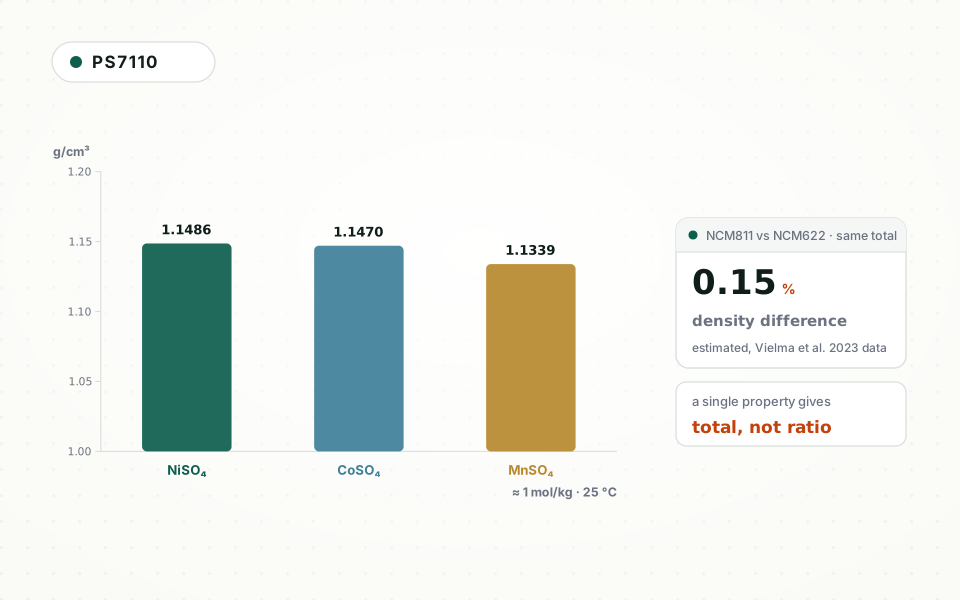
Nickel, cobalt and manganese sulfates have almost the same density at the same concentration: at about 1 mol/kg and 25 °C, NiSO₄ 1.1486, CoSO₄ 1.1470 and MnSO₄ 1.1339 g/cm³, and mixtures follow linear mixing closely. On those figures (at about 1 mol/kg), an NCM811 and an NCM622 feed at the same total concentration differ in density by only about 0.15 % — the same as a change of about 1 % in total concentration. Density, refractive index or sound velocity can therefore control the total (dissolution, dilution, make-up), not the Ni : Co : Mn ratio — that needs elemental analysis such as ICP.
The precipitant line is a single component: NaOH strength can be measured inline by sound velocity (PS7020), see NaOH storage tanks; for ammonia see ammonia water / urea solution.
5. Measuring points
| Point | Medium / temperature | Instrument | Watch for |
|---|---|---|---|
| LiOH evaporator feed / discharge | A few wt% up to near saturation | PS7110 (≤ 100 °C, grade C); clear liquor at 100–120 °C: PS7020 high-temperature version | Lithium carbonate scale; avoid cold spots |
| NiSO₄ dissolution / refined liquor / evaporation | Up to about 27 wt% (saturation at 20 °C), hotter in evaporation | PS7110 | Temperature compensation; hydrate transition temperatures in crystallization |
| Mixed-salt make-up tank outlet | About 2 mol/L total metal | PS7110 | Total concentration only |
| NaOH precipitant | About 4 mol/L | PS7020 | See the NaOH tank page |
| Grade | Prism | Process temp. | RI range | Factory scale | Fits |
|---|---|---|---|---|---|
| PS7110-A | High-strength optical glass | 0–60 °C | 1.33299–1.46510 | 0–70 %Brix | Dilute sulfate liquor up to 60 °C (for strong alkali such as LiOH use the sapphire grades B / C) |
| PS7110-B | Sapphire | 0–70 °C | 1.33299–1.51782 | 0–90 %Brix | Up to 70 °C |
| PS7110-C | Sapphire | −10–100 °C | 1.33299–1.57041 | 0–100 %Brix | Evaporator liquor at 70–100 °C |
6. Installation
- Never mount the detection face pointing down — deposits build up, and a deposit does not raise a fault; it shows only as a slow one-way drift
- On a vertical line the flow must be upward — a downcomer drains when the pump stops, the prism is no longer wetted and the reading means nothing
- On a horizontal line insert from below (face up) or from the side (face vertical); inserting from the top is not allowed
- A full, moving line with no cold spots or dead legs; keep the point above the saturation temperature for its concentration
- Downstream of dissolution or mixing points leave 10 D upstream and 5 D downstream (at least 5 D and 3 D)
- Where scaling is likely, settle the cleaning method at design stage
PS7110 key specifications
| Item | Specification (data sheet Rev. B) |
|---|---|
| Measured value | Refractive index nD; converted to concentration by a scale (%Brix, or a wt% scale built for the medium) |
| Accuracy | RI ±0.0001; Brix ±0.1 %; temperature ±0.5 °C |
| Resolution | RI 0.00001; Brix 0.01 %; temperature 0.1 °C |
| Measuring interval | 2–60 s, settable |
| Pressure rating | Detection surface ≤ 1.5 MPa |
| Cleaning temperature | 0–120 °C, CIP / SIP capable |
| Wetted materials | SS316L + prism; Hastelloy, titanium or tantalum optional on grades B / C |
| Process connection | Clamp (Ø77.5 mm ferrule); custom tee / cross, cross in DN25 / 50 / 65 / 80 |
| Outputs | 4–20 mA; RS485 (Modbus RTU) |
| Power / ambient | DC 24 V; −10 to 70 °C |
| Hazardous area | Ex ia IIC T6 Ga (intrinsically safe); for hot media the temperature class is set by the maximum medium temperature |
Before you order
- Composition: a single salt or a mixture; any ammonia, free acid or free alkali.
- Concentration range and temperature at each point, including the lowest temperature during cleaning or shutdown (crystallization).
- Crystals or suspended solids, and the tendency to scale.
- Line size, pressure and flow condition.
- Lab method (titration, ICP) and comparison frequency; hazardous area and required outputs.
What this page is: a method and selection note, not a case study. The PS7110 has no publishable operating data on this medium yet, so there are no unit counts, saving percentages or payback periods here — we do not invent those. The numbers on the page are of three kinds only: clauses of standards, published property data with the estimates derived from them (marked as estimates or calculations), and the instrument's own specification.
Conclusion
PISONICS covers six principle families (ultrasonic, tuning fork, Coriolis, optical, microwave, differential pressure) for inline density and concentration; the first step of any selection is to ask what quantity the process actually needs, and in which range. For battery-material solutions a single salt is measured directly through a physical property; a mixed salt can be controlled for its total only, and the ratio is left to elemental analysis. Further reading: optical concentration meters: refractometry or spectroscopy, optical concentration meters, ultrasonic density and concentration meters.


