PISONICS
PS7110 Series
Inline Process Refractometer
Critical angle · thin-layer interface · indifferent to colour and turbidity
Inline concentration monitoring for TCM extraction and alcohol precipitation
— TCM concentrate · alcohol extraction · alcohol precipitation —
Measured: Extract concentration / soluble solids / refractive index nD
Inline concentration monitoring for TCM extraction and alcohol precipitation
Process background
End-point judgement in TCM concentration has long relied on stopping to sample, measuring relative density, or experience. The method is not inaccurate; it is discrete. By the time a sample is measured the vessel has moved on, and late in a concentration the rate of change is accelerating — what happens between samples is exactly what matters.
Decoctions are dark, viscous and usually carry fine suspended matter, which rules out most transmission-based optical methods. Critical-angle refractometry is unaffected: the measurement happens in a layer about a micrometre thick at the prism face, and the light never passes through the liquid, so colour and turbidity never enter the optical path.
Alcohol extraction and precipitation are a different requirement: the alcohol addition ratio governs both precipitation and the yield of active constituents, and ethanol and water differ clearly in refractive index, so the ratio is plainly visible.
What the method can and cannot do here
What it can do:
- Dissolved-solids concentration through a concentration run — continuous, so the end point does not need a shutdown to sample
- Dark, viscous decoctions carrying fine solids — none of it affects the reading
- Alcohol-to-water ratio in extraction and precipitation — ethanol and water differ clearly in index
- Self-service modelling from laboratory data — a change of herb does not mean a trip back to the factory
What it cannot — stated here so nobody specifies it into the wrong duty:
- Active constituent content — refractometry reads total dissolved solids, not one compound. Assay still needs chromatography
- Distinguishing extracts of different herbs — the same index does not mean the same composition
- Separating components in a multi-component system — that is the PS7100 spectroscopic route
Selecting the PS7110
| Variant | Prism | Process temp. | RI range | Suits |
|---|---|---|---|---|
| PS7110-A | High-strength optical glass | 0 – 60 °C | 1.33299 – 1.51782 | Ambient, non-abrasive, span within 0–90 %Brix |
| PS7110-B | Sapphire | 0 – 70 °C | 1.33299 – 1.57041 | The default for most inline duties; 0–100 %Brix |
| PS7110-C | Sapphire | −10 – 100 °C | 1.33299 – 1.57041 | Vacuum concentration and hot extraction duties |
A GMP process takes the sanitary configuration: the PS7110-MT4 adapter or a sanitary tri-clamp, CIP and SIP capable, cleaning temperature −30 to 120 °C.
A vacuum concentration vessel goes to the C variant (−10 to 100 °C); precipitation vessels at ambient are fine on the A or B. Viscous extract coats surfaces, so the PS7110-CL1 ultrasonic cleaning unit is worth having. A vessel point can use the pumped-loop scheme — drawn out by pump and returned through a loop with the probe downstream of the pump, which gives the steadiest measuring conditions of the four mounting schemes. Mounted directly in the vessel wall instead, the liquid must keep circulating and the agitator must stay clear of the measuring window.
One thing to plan for: every herb and every product needs its own scale. That is not an inconvenience, it is what refractometry is — and the modelling can be done on site from your own sampled laboratory values, with multi-point temperature compensation alongside it.
General specification:
| Item | Specification |
|---|---|
| Measured quantity | Refractive index nD, converted to concentration through a scale (%Brix or wt% / vol%) |
| Accuracy | Concentration ±0.1 %; refractive index ±0.0001; temperature ±0.5 °C |
| Resolution | Concentration 0.01 %; refractive index 0.00001; temperature 0.1 °C |
| Pressure | ≤ 1.5 MPa at the prism face |
| Cleaning temperature | −30 – 120 °C; CIP and SIP capable |
| Wetted materials | SS316L plus prism; B / C accept PTFE / Hastelloy / titanium / tantalum |
| Outputs | 4–20 mA / RS485 / RS232 / USB |
| Hazardous area | Ex ia IIC T6 Ga (intrinsically safe) |
The scale has to be built for your medium
This is the most commonly misunderstood thing about refractometry, so it goes near the front.
What is calibrated at the factory is refractive index and temperature, unit by unit in standard units. That part is independent of the medium, so several instruments agree with one another. The concentration scale, however, belongs to the medium — the curve from index to concentration is a property of one liquid, and a scale built for one medium cannot be used for another.
In practice that is three things. One: tell us the medium and you get the matching scale. Two: a change of recipe, product or process stage means a change of scale, but not a trip back to the factory — RI verification, self-service modelling from sampled laboratory values and multi-point temperature compensation are all done on site. Three: be careful with multi-component systems — the same refractive index does not mean the same concentration. Two components that move the index the same way cannot be separated by refractometry, and that duty belongs to the PS7100 spectroscopic route.
Installation and upkeep
Refractometry reads a thin layer of liquid at the prism face, so a trustworthy reading rests on two things only: whether the face is always washed by liquid that represents the process, and whether it is clean.
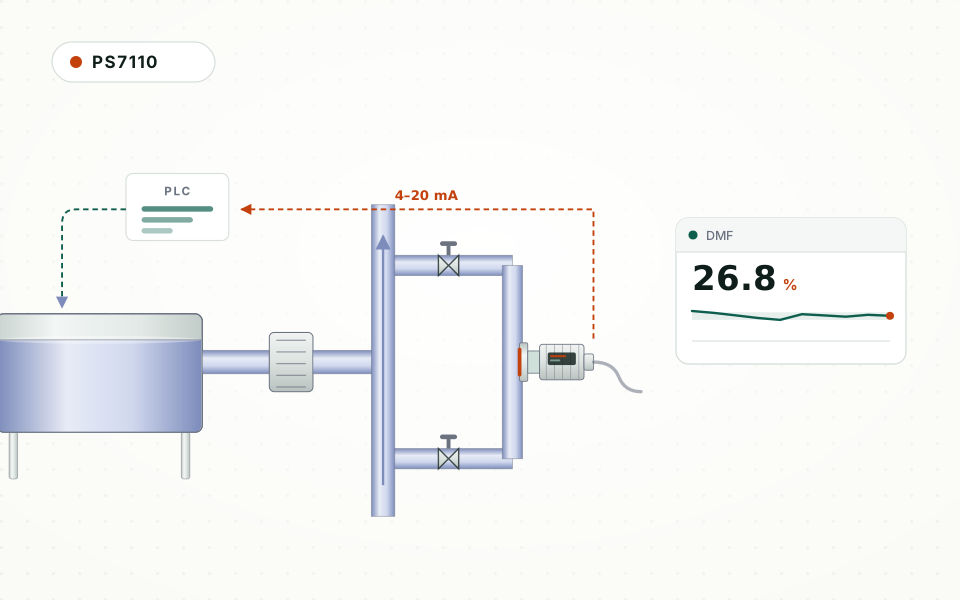
- The face must never point downward — a downward face collects deposit, and deposit raises no fault; it shows up only as a slow one-way drift
- In a vertical line the flow must run upward — a downward run drains when the pump stops, the prism is left uncovered, and the reading stops meaning anything
- On a horizontal line, entry from below (face up) or from the side (face vertical) are both fine; entry from the top is not permitted
- Four mounting schemes: valved bypass (recommended — service it without stopping the main line) / direct in-line (cheapest, service needs a shutdown) / pumped tank loop (steadiest conditions) / tank wall (simplest)
- 2″ and under takes the PS7110-MT1 small-bore adapter; where the face has to be inspected visually, the MT2 / MT3 tee and cross carry sight glasses
- Media that can carry grit or abrasive particles must be filtered upstream — the detection window is a wear part
The cleaning strategy belongs in the design, not in a response to a reading that has already drifted: sanitary processes use CIP and SIP directly; media that coat or film take the PS7110-CL1 ultrasonic unit for continuous cleaning; media that crystallise or deposit particles take the PS7110-CL2 high-pressure flushing unit on a timed cycle.
The instrument carries prism condition diagnostics: the position of the shadow line is the measurement, and its sharpness and contrast are a second quantity the same detector sees at the same time. A deposit blunts the edge before it shifts the position, so the instrument reports its condition before the reading is visibly wrong rather than quietly returning a plausible number. It does not replace looking at the face, though — putting that into the routine inspection is worth more than any coefficient correction applied afterwards.
Before you order
These are what decide the variant, the accessories and the scale. Sending them over is quicker than guessing from a datasheet.
- Herb and process stage (aqueous concentration / alcohol extraction / precipitation) — each needs its own scale
- Working concentration band and the end-point criterion
- Process temperature, particularly the real liquid temperature under vacuum
- Viscosity and how much it coats — this decides the CL1
- Vessel or pipe — this decides pumped loop / tank wall / bypass
- GMP documentation requirements (IQ / OQ, material traceability, surface roughness)
This page is a method and selection note, not a case study. The PS7110 has no publicly citable installed base in this industry yet, so there are no unit counts, saving percentages or payback periods here — we do not invent those. Give us the process conditions and you get a selection opinion you can check, which is worth more than a handsome case study.
In closing
The Pisonics PS7 range covers several measuring principles: acoustic impedance (PS7000), acoustic attenuation (PS7010), sound velocity (PS7020), spectroscopy (PS7100), refractometry (PS7110), Coriolis (PS7200), differential pressure (PS7300), tuning fork (PS7400) and microwave (PS7600). Different principles see different things, and selection always starts with what the duty actually needs measured.
The PS7110 series takes the critical-angle route: the measurement happens in a thin layer at the prism face, which is why colour, turbidity and bubbles do not interfere — and why the prism face has to be kept clean. The difficulty in TCM concentration was never accuracy, it was frequency. Replacing discrete sampling with a continuous reading is what gives the end-point judgement something to stand on.
For a non-standard span, special wetted materials, a hazardous-area version, or to have us build the concentration scale from your own sampled laboratory data, please get in touch with our engineering team.