PISONICS
PS7110 Series
Inline Process Refractometer
Critical angle · thin-layer interface · indifferent to colour and turbidity
Inline Concentration for DMF / DMAc / NMP Solvent Recovery
—— PU synthetic leather · fibre spinning · battery NMP recovery ——
【Measured: solvent wt% / refractive index nD】
Inline concentration for DMF / DMAc / NMP solvent recovery
1. Process background
DMF (N,N-dimethylformamide), DMAc (N,N-dimethylacetamide) and NMP (N-methyl-2-pyrrolidone) are three high-volume amide solvents: wet-process polyurethane synthetic leather uses DMF, aramid and spandex spinning use DMAc, and lithium-battery cathode slurry uses NMP. They are costly and their emissions are restricted, so almost every line has solvent recovery: the aqueous solvent stream goes to distillation, the lower-boiling water leaves overhead and the solvent is recovered at the bottom.
The points worth measuring inline are binary solvent–water solutions: solvent concentration in coagulation and wash baths, recovery column feed, and condensed or absorbed recovery liquor. Off-target concentration upstream affects film or fibre quality; downstream it affects distillation energy and recovery. These points have traditionally been controlled by laboratory samples; inline measurement turns a figure every few hours into a continuous one.
2. Why refractometry here
All three solvents have a refractive index well above that of water. In their binary aqueous solutions the refractive index rises monotonically with solvent content, with a full-range span of about 0.1:
| Substance | Refractive index nD (20 °C, approx.) | Difference from water |
|---|---|---|
| Water | 1.333 | — |
| DMF | 1.430 | about 0.097 |
| DMAc | 1.438 | about 0.105 |
| NMP | 1.470 | about 0.137 |
Pure-component indices are published property data; the index–concentration curve of a mixture is not a straight line, so the scale is built per medium.
Averaged over the full range, each 1 wt% of solvent moves the refractive index by roughly 0.001–0.0014. The PS7110's refractive-index accuracy of ±0.0001 therefore corresponds to the 0.1 wt% order — enough to control percent-level bath and recovery-liquor concentration.
The two other common routes need checking before use: amide solvents interact strongly with water, so the density and sound velocity of the mixtures depart markedly from linearity, flatten over parts of the range, and in some systems may pass through an extremum; if you consider density or sound velocity, confirm monotonicity and sensitivity over your actual range first. A refractometer reads a thin layer of liquid at the prism surface, so coloured or slightly turbid recovery liquor does not affect the reading.
3. What it can and cannot do here
It can:
- Track solvent concentration in coagulation and wash baths continuously, for water / solvent make-up control
- Measure recovery column feed and condensed or absorbed recovery liquor at percent level, to the 0.1 wt% order
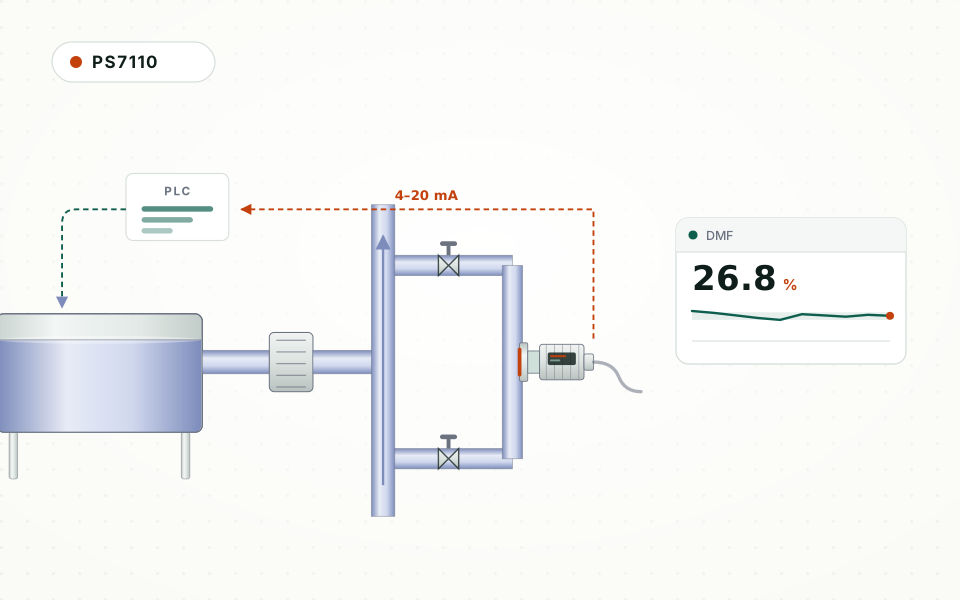
- Send 4–20 mA and RS485 (Modbus RTU) straight to the DCS or PLC
It cannot (stated here so nobody buys the wrong thing):
- ppm-level water in recovered solvent — the full-range index span is only about 0.1, and ppm-level water changes the index far less than the instrument's accuracy; use Karl Fischer titration or a NIR-type method
- Several solvents sharing one line in turn — a refractive index says how much, not which; with the wrong scale selected the reading still looks normal. For that duty see the PS7100 spectroscopic meter and the technical note Three solvents sharing one pipe
- A third component that varies — salts, additives and oligomers accumulating in a coagulation bath move the index too; check the scale against samples periodically
- Hot points such as the column bottoms — the PS7110 process limit is 100 °C (grade C); measure bottoms product after cooling
4. Selecting the PS7110
| Grade | Prism | Process temp. | RI range | Factory scale | Fits |
|---|---|---|---|---|---|
| PS7110-A | High-strength optical glass | 0–60 °C | 1.33299–1.46510 | 0–70 %Brix | Recovery liquor near ambient; the full concentration range of DMF and DMAc lies within this grade's RI range |
| PS7110-B | Sapphire | 0–70 °C | 1.33299–1.51782 | 0–90 %Brix | Default for most baths and recovery liquors; NMP close to pure solvent (about 1.470) exceeds the grade A limit, so start from grade B |
| PS7110-C | Sapphire | −10–100 °C | 1.33299–1.57041 | 0–100 %Brix | Warmer recovery liquor, or bottoms product after cooling |
%Brix is only the name of the factory scale; solvent concentration gets its own wt% scale built for the medium (section 5).
General specification:
| Item | Specification (data sheet Rev. B) |
|---|---|
| Measured value | Refractive index nD; converted to concentration by a scale (%Brix, or a wt% scale built for the medium) |
| Accuracy | RI ±0.0001; Brix ±0.1 %; temperature ±0.5 °C |
| Resolution | RI 0.00001; Brix 0.01 %; temperature 0.1 °C |
| Measuring interval | 2–60 s, settable |
| Pressure rating | Detection surface ≤ 1.5 MPa |
| Cleaning temperature | 0–120 °C, CIP / SIP capable |
| Wetted materials | SS316L + prism; Hastelloy, titanium or tantalum optional on grades B / C |
| Process connection | Clamp (Ø77.5 mm ferrule); custom tee / cross, cross in DN25 / 50 / 65 / 80 |
| Outputs | 4–20 mA; RS485 (Modbus RTU) |
| Power / ambient | DC 24 V; −10 to 70 °C |
| Hazardous area | Ex ia IIC T6 Ga (intrinsically safe) |
Solvents are harder on seals than on metal. Common fluoroelastomers (FKM) swell markedly in DMF and NMP; seals for these media are normally perfluoroelastomer (FFKM) or PTFE-based, confirmed against compatibility data and immersion testing. State the solvent, concentration and temperature at enquiry and we confirm the seal material for the medium.
5. The scale belongs to the medium
What the factory calibrates is refractive index and temperature, independent of the medium; the concentration scale is a property of one particular liquid, and a scale built for DMF–water cannot be used for NMP–water. On site the instrument supports RI calibration, self-built models from laboratory samples and multi-point temperature compensation, without returning it to the factory. If a third component varies in the process, check the scale against samples periodically.
6. Installation and upkeep
- Never mount the detection face pointing down — deposits build up, and a deposit does not raise a fault; it shows only as a slow one-way drift
- On a vertical line the flow must be upward — a downcomer drains when the pump stops, the prism is no longer wetted and the reading means nothing
- On a horizontal line insert from below (face up) or from the side (face vertical); inserting from the top is not allowed
- Prefer a bypass branch with a valve at each end, so the probe can be isolated without stopping the main line
- Leave straight run downstream of water or solvent make-up points — 10 D upstream and 5 D downstream (5 D / 3 D minimum) — so the liquid is mixed before it is measured
- Polymer residue in coagulation and wash baths films the prism: decide the cleaning at design stage — ultrasonic or high-pressure flushing units are available
- Solvent areas are often hazardous areas: the PS7110 is intrinsically safe, Ex ia IIC T6 Ga
7. Before you order
- Which solvent (DMF / DMAc / NMP / other), and whether two solvents share one line in turn.
- Measuring point: coagulation bath / wash bath / recovery column feed / condensed or absorbed recovery liquor / product solvent.
- Concentration range and control target; whether the specification is at percent or ppm level.
- Temperature range — it decides the grade; bottoms product must be cooled first.
- What else is in the liquid: salts, additives, polymer residue — this decides how often the scale is checked.
- Line size, pressure, hazardous-area classification; seal compatibility requirements.
- Whether a set of laboratory samples (concentration plus the temperature at the time) can be supplied to build the scale.
What this page is: a method and selection note, not a case study. The PS7110 has no publishable installed data in this industry yet, so there are no unit counts, saving percentages or payback periods here — we do not invent those. The numbers on the page are of two kinds only: the instrument's own specification, and published properties and standards, plus order-of-magnitude estimates derived from them.
Conclusion
PISONICS covers six principle families (ultrasonic, tuning fork, Coriolis, optical, microwave, differential pressure) for inline density and concentration. A binary solvent–water solution is the textbook use of refractometry; when the identity of the medium is uncertain, or trace impurities matter, move to spectroscopy. Further reading: Optical concentration meter principle: refractive index vs spectroscopic, methanol–water binary concentration monitoring, Three solvents sharing one pipe.


