PISONICS· Xi’an Pisonics
PS7400 Series
Online Tuning-Fork Density/Concentration Meter
Piezoelectric Excitation · Tuning-Fork Resonance · Plug-and-Play · Maintenance-Free
Marine Fuel / HFO·VLSFO·MGO Bunkering Metering Industry Application Case
—— Fuel Heater + Volumetric Flowmeter + PS7400 → Automatic Generation of BDN Document ——
ISO 8217 / ISO 91 / MARPOL Annex VI · Fair Settlement of Ship Supply Tonnage
【Key Measured Parameter: Density of HFO/VLSFO/MGO under High-Temperature Conditions】
Marine Fuel / HFO·VLSFO·MGO Bunkering Metering · PS7400 Tuning-Fork Density Meter Application Solution
1. Process Background
On January 1, 2020, the International Maritime Organization (IMO) mandated MARPOL Annex VI’s “Low-Sulfur Rule”—lowering the sulfur content limit for marine fuels from 3.5% to 0.5%, which gave rise to new fuel types such as VLSFO (Very Low Sulfur Fuel Oil, with sulfur ≤ 0.5%) and MGO (Marine Gas Oil, with sulfur ≤ 0.1%), alongside traditional HFO (Heavy Fuel Oil), forming the three major categories of marine fuels. Their densities differ significantly: HFO ≈ 0.99 g/cm³ @15℃, VLSFO ≈ 0.92 g/cm³, and MGO ≈ 0.85 g/cm³. During bunkering operations, it is essential to measure the actual on-site density in real time according to ISO 8217/ISO 91 and MARPOL Annex VI requirements, automatically generating a BDN (Bunker Delivery Note).
Ship fuel supply is settled by tonnage (each ocean-going vessel takes on 1,000–5,000 tons per refueling, worth $800,000 to $5 million), but billing is based on the flowmeter’s volume reading multiplied by the density at operating temperature. HFO must be heated to 80–95℃ to maintain fluidity (with sufficiently low viscosity), so the operating‑temperature density differs from the standard @15℃ density and must be measured in real time and corrected for temperature according to ISO 91—this is the corestep of the metering skid at the fuel‑supply terminal.
2. Pain Points of Traditional Density/Concentration Measurement Solutions
• Ship fuel is billed by tonnage—but bunkering is calculated from the flowmeter’s volume reading multiplied by the density at operating temperature, where the difference between operating and standard temperatures is significant;
• In HFO applications, operating temperatures range from 80 to 95℃; conventional contact-type instruments suffer from short seal and diaphragm lifetimes, and thermal expansion causes drift in readings;
• Manual sampling plus laboratory density‑bottle analysis results in a 1–2 hour lag, making it impossible to track the ship’s 30–90 minute bunkering window;
• The bunkering terminal is a strictly explosion‑proof zone, requiring instruments rated Ex d ⅡC T6 Gb for flameproof protection, while also enduring year‑round exposure to salt spray, high humidity, and vibration.
3. PS7400 Solution
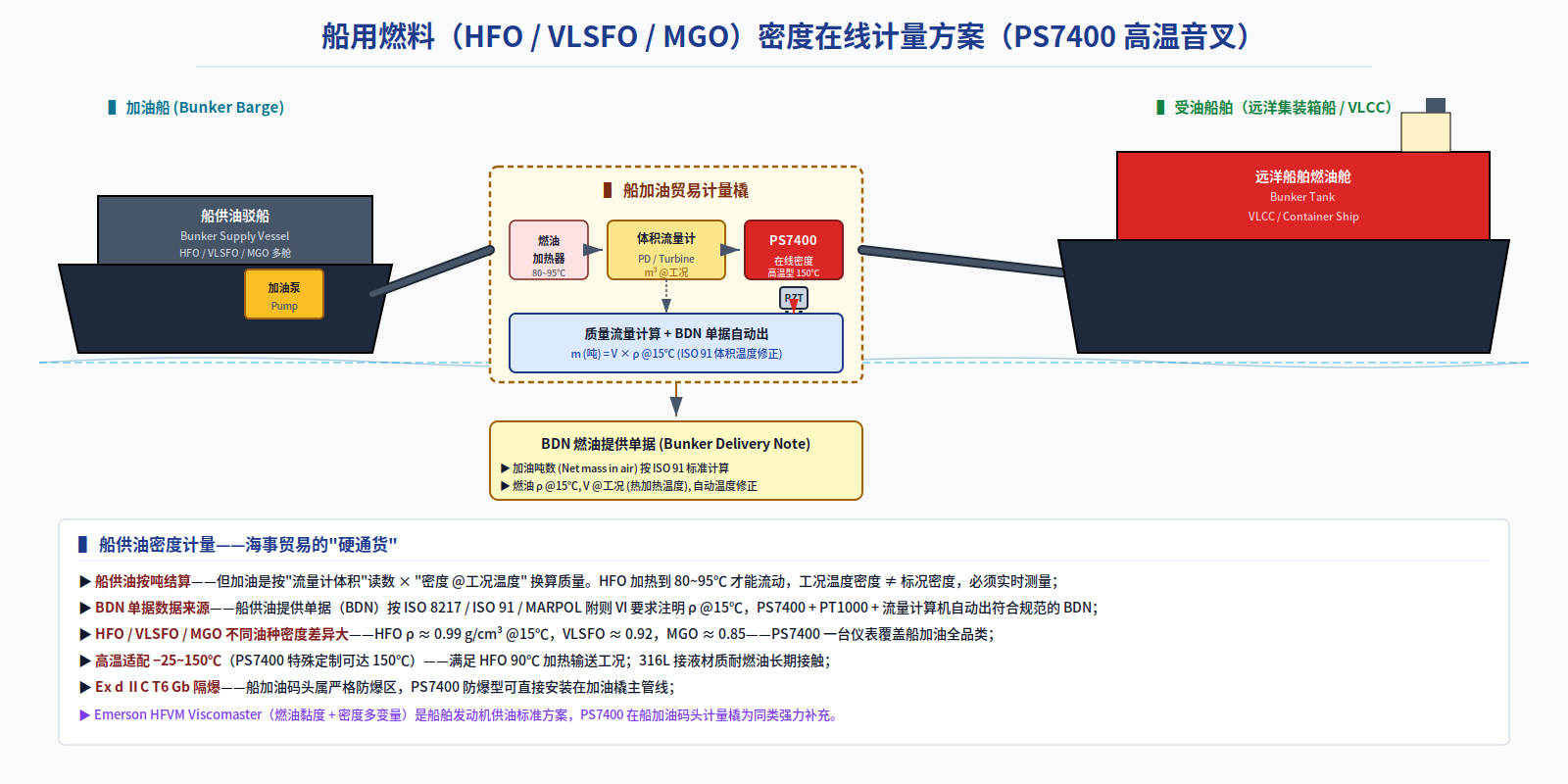
The PS7400 high‑temperature model (customized up to 150℃) is installed on the ship‑fuel trading metering skid (after the fuel heater and volumetric flowmeter), forming a complete ISO 8217/ISO 91/MARPOL Annex VI‑compliant metering system when paired with the flow calculation unit. The instrument measures the on‑site density of the heated fuel in real time and, with PT1000 temperature compensation, automatically converts it to the standard @15℃ density according to ISO 91, ultimately outputting tonnage reports that meet BDN specifications.
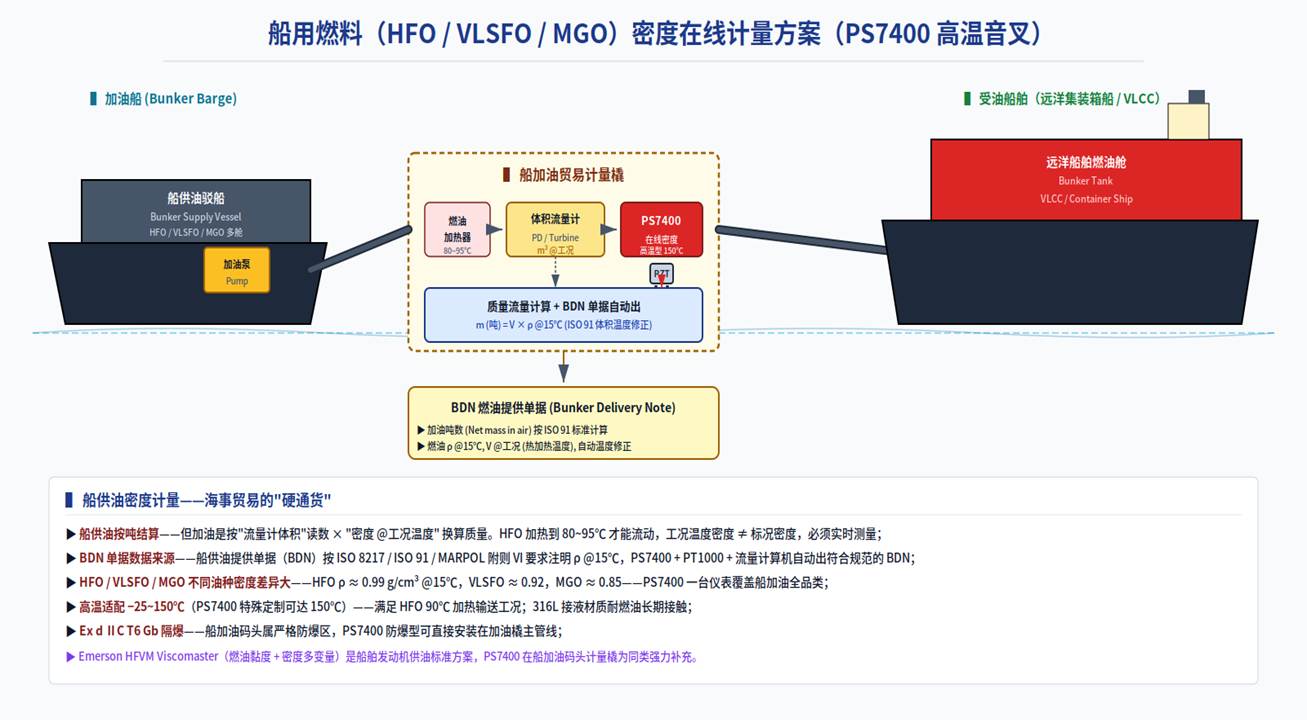
Figure 1 Online Density Metering Solution for Marine Fuels HFO/VLSFO/MGO
PS7400’s Core Technical Value in Marine Fuel/VLSFO/MGO Refueling Metering ▶ PS7400—high-temperature, specially customized to -25~150℃—meets the HFO heating requirement of 80~95℃, covering all VLSFO and MGO grades from ambient to medium temperatures; ▶ 316L wetted parts—resistant to long-term contact with marine fuels, with a service life ≥ 5 years; ▶ PT1000 automatic temperature compensation—real-time conversion to standard density at 15℃ according to ISO 91, ensuring compliance of BDN document data sources; ▶ Ex d ⅡC T6 Gb flameproof—on strictly explosion-proof ship refueling terminals, the PS7400 explosion-proof model can be directly installed on the main pipeline of the refueling skid; ▶ 4–20 mA + HART + RS485 multi-protocol—seamless integration with the fuel-supply terminal’s flow computer and the maritime bureau’s EDI customs declaration system; ▶ Emerson HFVM Viscomaster (multi‑variable measurement of fuel viscosity and density) is the standard solution for marine engine fuel supply; the PS7400 serves as a powerful complementary metering unit on ship refueling skids. |
4. Customer Value
Comparison Dimensions | Original Manual Sampling Scheme | PS7400 High-Temperature Tuning Fork Solution |
Response time | 1–2 hour lag | Second-level real-time tracking |
Process Temperature Adaptability | < 80℃ difficult to measure | −25~150℃ full coverage |
BDN Document Compliance | ISO 91 is difficult to measure precisely | PT1000 automatic conversion |
tonnage measurement accuracy | Estimated error ≥ 0.3% | < 0.05% (depending on the flow meter) |
Explosion-proof rating | The sampling method is not explosion-proof | Ex d ⅡC T6 Gb direct mounting |
Customer Re-test Dispute | frequent | Essentially eliminated |
At a coastal port’s ship‑fuel terminal (annual bunkering throughput of about 800,000 tons), the PS7400 high‑temperature, flameproof version replaced the original “sampling plus offline density bottle” approach and was deployed on the main bunkering skid line after the fuel heater. After one year of operation, the tonnage measurement accuracy improved from ±0.4% to within ±0.05% (limited by flowmeter precision), monthly disputes over recalculations by shipowners dropped from an average of 3–5 to 0–1, and the annual recovery of tonnage discrepancies amounted to roughly 1,500 tons (corresponding to trade differences worth several million yuan). This solution has become the standard configuration for bunkering at this port and has been extended to LPG bunkering, chemical‑cargo bunkering, and other marine metering scenarios.
Conclusion
Based on the PS7 series’ diverse density/concentration measurement principles (acoustic impedance PS7000, sound‑velocity method PS7020, spectroscopy PS7100, tuning‑fork method PS7400), Xi’an Pisonics has built a comprehensive portfolio of industrial process measurement instruments, covering everything from solid‑liquid two‑phase slurries to clean, homogeneous liquids, from single‑component to multi‑component systems, and ranging from cost‑effective to high‑precision models. Among these, the PS7400 tuning‑fork density meter—grounded in the mature physical principle of piezoelectric excitation and resonant frequency detection, benchmarked against international mainstream brands such as Emerson Micro Motion FDM and E+H Liquiphant—is an economical, plug‑and‑play, maintenance‑free choice for measuring the density/concentration of clean to mildly contaminated liquids.
For the specific process characteristics of marine fuel/bunkering metering (HFO/VLSFO/MGO), the PS7400 online tuning‑fork density/concentration meter offers full‑scale selection and customization across all dimensions: wetted‑part materials (316L/Hastelloy/titanium/zirconium/PTFE), surface finishes (standard polishing/electropolishing/PTFE coating), process connections (flanges/chucks/threaded fittings), mounting accessories (F0–F6), explosion‑proof ratings, and communication protocols (4–20mA/HART/RS485). For in‑depth discussions on your project’s specific conditions or to obtain a tailored selectionsolution, please feel free to contact the technical engineering team at Xi’an Pisonics at any time.