PISONICS
PS7110 Series
Inline Process Refractometer
Critical-angle refractometry · sapphire prism · temperature compensation
Inline NMMO Solvent Concentration in Lyocell Fibre Production
—— Spin bath · solvent recovery evaporation · recycled solvent ——
Key measurements: NMMO wt% / refractive index nD / temperature °C
Lyocell Fibre: Inline NMMO Solvent Concentration
1. Why the solvent concentration matters
The lyocell process dissolves cellulose directly in aqueous N-methylmorpholine N-oxide (NMMO): the spinning dope is roughly 76 : 10 : 14 NMMO, water and cellulose; the filaments enter the spin bath, the NMMO is washed out, purified and concentrated again by multi-effect evaporation for reuse. Commercial NMMO is usually a 50 wt% aqueous solution.
Almost all of the solvent circulates. A published patent estimates about 90 t of water evaporated per tonne of fibre; major producers report solvent recovery of about 99.7 % or higher. Make-up water to the spin bath, the discharge of each evaporator effect and the recycled solvent are all controlled by concentration measurement. According to the China Chemical Fibers Association, Chinese lyocell output passed 400,000 t in 2024, and China holds over 60 % of world capacity.
2. Refractive index is linear in NMMO concentration
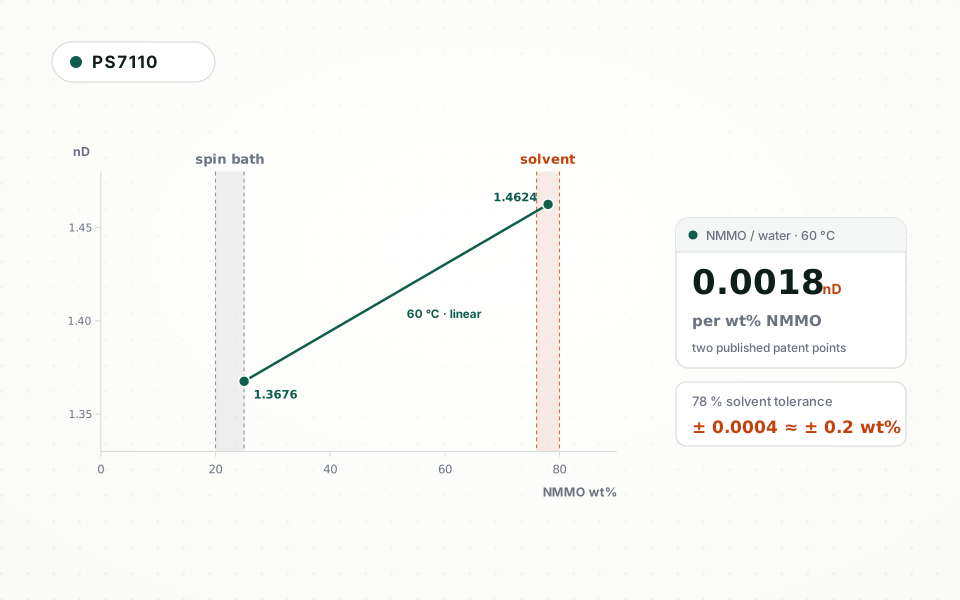
A published patent gives two points at 60 °C: 25 % aqueous NMMO at nD = 1.3676 and 78 % at 1.4624, linear in between. From these, at 60 °C one wt% of NMMO moves the refractive index by about 0.0018.
| System | Temp. | Refractive index nD | Source |
|---|---|---|---|
| NMMO / water 25 / 75 | 60 °C | 1.3676 | Published patent |
| NMMO / water 78 / 22 | 60 °C | 1.4624 (process tolerance 1.4620–1.4628) | Published patent |
| NMMO 50 % (commercial solution) | 20 °C | 1.4201 | Reagent product data |
| Dope: cellulose / water / NMMO = 15 / 9 / 76 | 60 °C | 1.4895 ± 0.0005 | Published patent |
The wavelength is not stated in the sources; refractive index changes with temperature, so inline measurement must be temperature-compensated.
Two things follow. The sensitivity is sufficient: the 78 % solvent tolerance of ±0.0004 is about ±0.2 wt%, and the PS7110's ±0.0001 in refractive index converts to about 0.06 wt% on that slope (a unit conversion only). And the scale has to be built for NMMO: the PS7110 leaves the factory with a %Brix scale, so a wt% scale for NMMO, with its temperature compensation, is built on the real liquid.
3. Measuring points and grades
| Point | Typical concentration / temperature (published) | What the inline value is for | Grade |
|---|---|---|---|
| Spin bath | Commonly 20–25 % (processes differ); bath at about 5–30 °C | Make-up water control | A |
| Dilute recovery liquor | Usually below 10 % | Recovery load | A |
| Evaporator effect discharge | Concentrated stage by stage to 50–55 %; effects from about 50 °C to 120 °C | Evaporation end point | B below 70 °C, C at 70–100 °C; effects above 100 °C are out of range |
| Recycled solvent | About 50–55 %, or concentrated further to 70–80 % | Check before reuse | B / C (concentrated solvent is close to the top of grade A) |
| Spinning dope | About 76 % NMMO with cellulose; often 90–120 °C | Degree of dissolution, for a fixed recipe | Grade C can be assessed up to 100 °C; see section 4 |
| Grade | Prism | Process temp. | RI range | Factory scale | Fits |
|---|---|---|---|---|---|
| PS7110-A | High-strength optical glass | 0–60 °C | 1.33299–1.46510 | 0–70 %Brix | Spin bath, dilute liquor |
| PS7110-B | Sapphire | 0–70 °C | 1.33299–1.51782 | 0–90 %Brix | Concentrated solvent below 70 °C |
| PS7110-C | Sapphire | −10–100 °C | 1.33299–1.57041 | 0–100 %Brix | Evaporator discharge and recycled solvent at 70–100 °C |
4. Three things to settle first
- Thermal safety and wetted materials. NMMO is thermally unstable: published work places accelerated degradation above 120 °C and possible runaway above 150 °C, and iron, copper and their salts lower the decomposition temperature markedly. A published patent holds that wetted surfaces should not contain copper, molybdenum, tungsten, cobalt and similar elements; the PS7110's standard 316L contains molybdenum (about 2–3 %), and so does Hastelloy. Where that restriction applies, grades B / C can be ordered with titanium wetted parts; confirm the final material with the process licensor. The instrument does not heat the medium.
- Crystallization. Concentrated NMMO crystallizes on cooling (the monohydrate melts at about 74 °C); crystals on the prism falsify the reading and can block sample lines. Trace and lag concentrated-solvent points and sample lines, and keep the point above the crystallization temperature.
- Impurities and the ternary dope. Recovered liquor carries degradation products such as NMM and morpholine (NMM at about 0.1–0.3 % in recovered concentrate), and they contribute to the refractive index too; colour from the stabilizer does not affect critical-angle refractometry. Compare the inline reading with titration or HPLC regularly. The dope is a ternary NMMO / water / cellulose system: refractive index alone shows the degree of dissolution for a fixed recipe, not the three proportions.
5. Installation
- Never mount the detection face pointing down — deposits build up, and a deposit does not raise a fault; it shows only as a slow one-way drift
- On a vertical line the flow must be upward — a downcomer drains when the pump stops, the prism is no longer wetted and the reading means nothing
- On a horizontal line insert from below (face up) or from the side (face vertical); inserting from the top is not allowed
- Downstream of a make-up water or solvent inlet, leave 10 D upstream and 5 D downstream (at least 5 D and 3 D) so the liquid is mixed before it is measured
- Prefer a bypass with valves at both ends, so the instrument can be isolated without stopping the main line
- Where the solvent area is a hazardous area: the PS7110 is intrinsically safe, Ex ia IIC T6 Ga; for hot media the temperature class is set by the maximum medium temperature
PS7110 key specifications
| Item | Specification (data sheet Rev. B) |
|---|---|
| Measured value | Refractive index nD; converted to concentration by a scale (%Brix, or a wt% scale built for the medium) |
| Accuracy | RI ±0.0001; Brix ±0.1 %; temperature ±0.5 °C |
| Resolution | RI 0.00001; Brix 0.01 %; temperature 0.1 °C |
| Measuring interval | 2–60 s, settable |
| Pressure rating | Detection surface ≤ 1.5 MPa |
| Cleaning temperature | 0–120 °C, CIP / SIP capable |
| Wetted materials | SS316L + prism; Hastelloy, titanium or tantalum optional on grades B / C |
| Process connection | Clamp (Ø77.5 mm ferrule); custom tee / cross, cross in DN25 / 50 / 65 / 80 |
| Outputs | 4–20 mA; RS485 (Modbus RTU) |
| Power / ambient | DC 24 V; −10 to 70 °C |
| Hazardous area | Ex ia IIC T6 Ga (intrinsically safe); for hot media the temperature class is set by the maximum medium temperature |
Before you order
- NMMO concentration range and temperature at each point, including the maximum during start-up, shutdown and cleaning.
- Whether the liquid carries cellulose, gel particles or precipitate.
- Line size, pressure and flow condition (running full or not).
- Current lab method (titration, HPLC or bench refractometer) and how often it is compared.
- Wetted-material restrictions (copper, molybdenum and the like), hazardous area, required outputs.
What this page is: a method and selection note, not a case study. The PS7110 has no publishable operating data on this medium yet, so there are no unit counts, saving percentages or payback periods here — we do not invent those. The numbers on the page are of three kinds only: clauses of standards, published property data with the estimates derived from them (marked as estimates or calculations), and the instrument's own specification.
Conclusion
PISONICS covers six principle families (ultrasonic, tuning fork, Coriolis, optical, microwave, differential pressure) for inline density and concentration; the first step of any selection is to ask what quantity the process actually needs, and in which range. Binary NMMO–water solutions are a textbook use of refractometry, in the same family as DMF and NMP in solvent recovery. Further reading: optical concentration meters: refractometry or spectroscopy, DMF / DMAc / NMP solvent recovery, optical concentration meters.


