PISONICS
PS7000 Series
Ultrasonic Slurry Density Meter
Acoustic impedance · non-nuclear · handles aerated slurry
Sodium–Calcium Dual-Alkali FGD — Density Monitoring on the Regeneration Side
—— Keep pH on the absorber; what is worth instrumenting online is density on the regeneration side ——
Key measurements: slurry density g/cm³ / solids content
How Dual-Alkali Works
Dual-alkali splits desulfurization in two: sodium alkali absorbs, lime regenerates it, and the sodium is recycled.
Absorption: 2 NaOH + SO₂ → Na₂SO₃ + H₂O; Na₂SO₃ + SO₂ + H₂O → 2 NaHSO₃
Regeneration: Na₂SO₃ + Ca(OH)₂ → 2 NaOH + CaSO₃↓ (partly oxidised to gypsum)
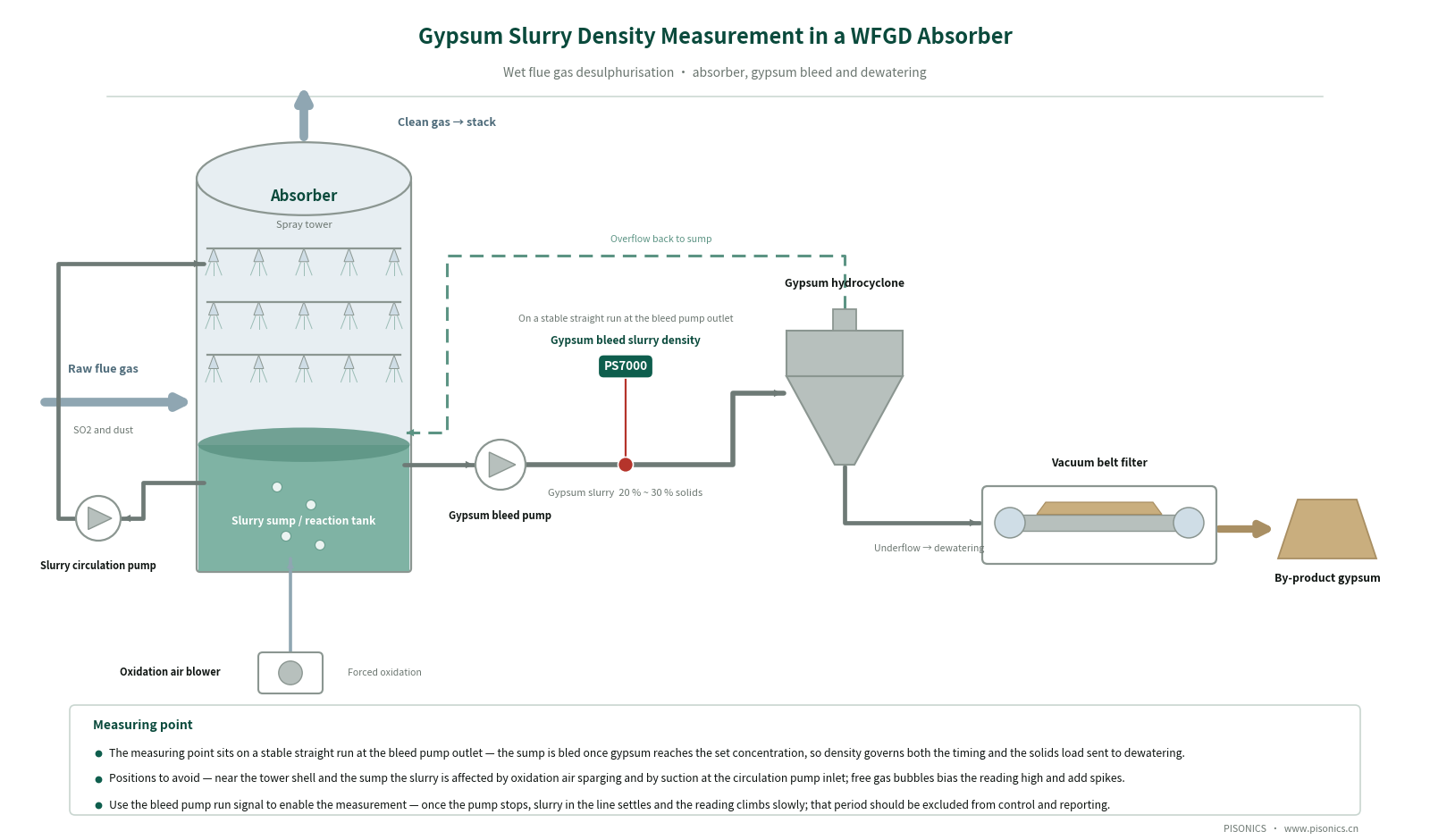
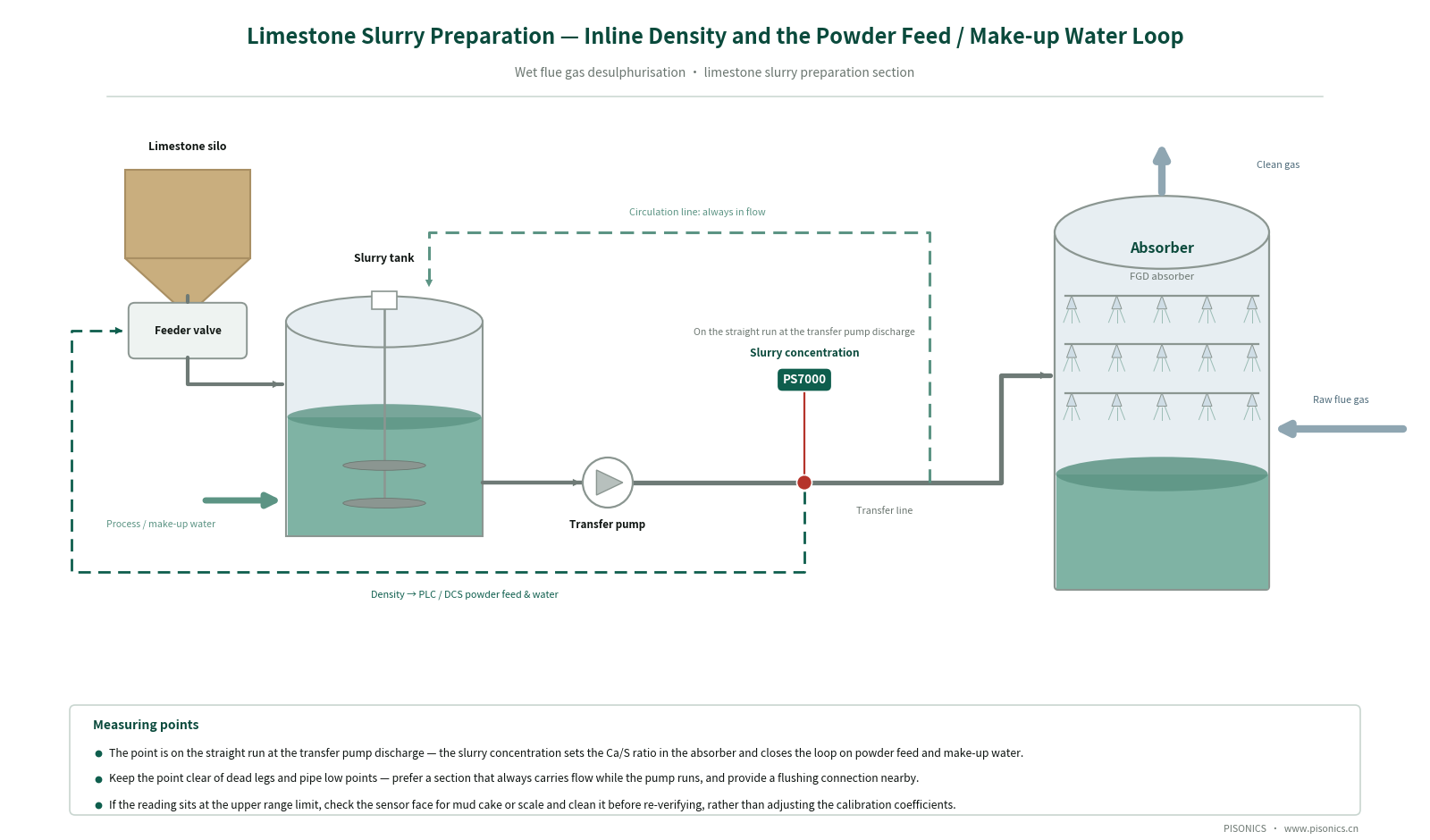
That is exactly where its advantage over limestone-gypsum lies: what circulates in the tower is a clear solution. Sodium salts are soluble, so nozzles and pipework do not scale and plug the way a limestone slurry does; all the solids move outside the tower into the regeneration basin. It also means the two systems need different things measured — for limestone-gypsum see absorber gypsum slurry density and limestone slurry preparation.
Something Against Our Own Interest, First
On the absorber side we do not recommend an online concentration meter. The circulating liquor holds NaOH, Na₂SO₃ and NaHSO₃ together, and the split between them is set by pH; meanwhile SO₂ load and caustic make-up vary on independent loops. This is not a system pinned to one dimension by stoichiometry, and a single sound-velocity reading cannot resolve it usefully. Plants control make-up on pH, that is the right call, and we have no reason to argue you out of a cheaper and more direct measurement.
What sound velocity can offer on the absorber side is an aggregate total-salt figure — useful for judging whether the system is accumulating salt and whether it is time to bleed, but a supplement to pH, not a replacement. Whether that earns its own instrument depends on what your bleed decision rests on today; if there is a working rule of thumb in place, leave it alone.
The Two Points Worth Instrumenting
| Point | Medium | Why it earns an instrument | Model |
|---|---|---|---|
| ① Lime slurry preparation | Ca(OH)₂ milk | Strength sets regeneration efficiency and lime consumption. Too rich wastes lime and plugs lines; too lean leaves regeneration incomplete, so alkali recovery falls and fresh caustic has to make up the difference | PS7000 |
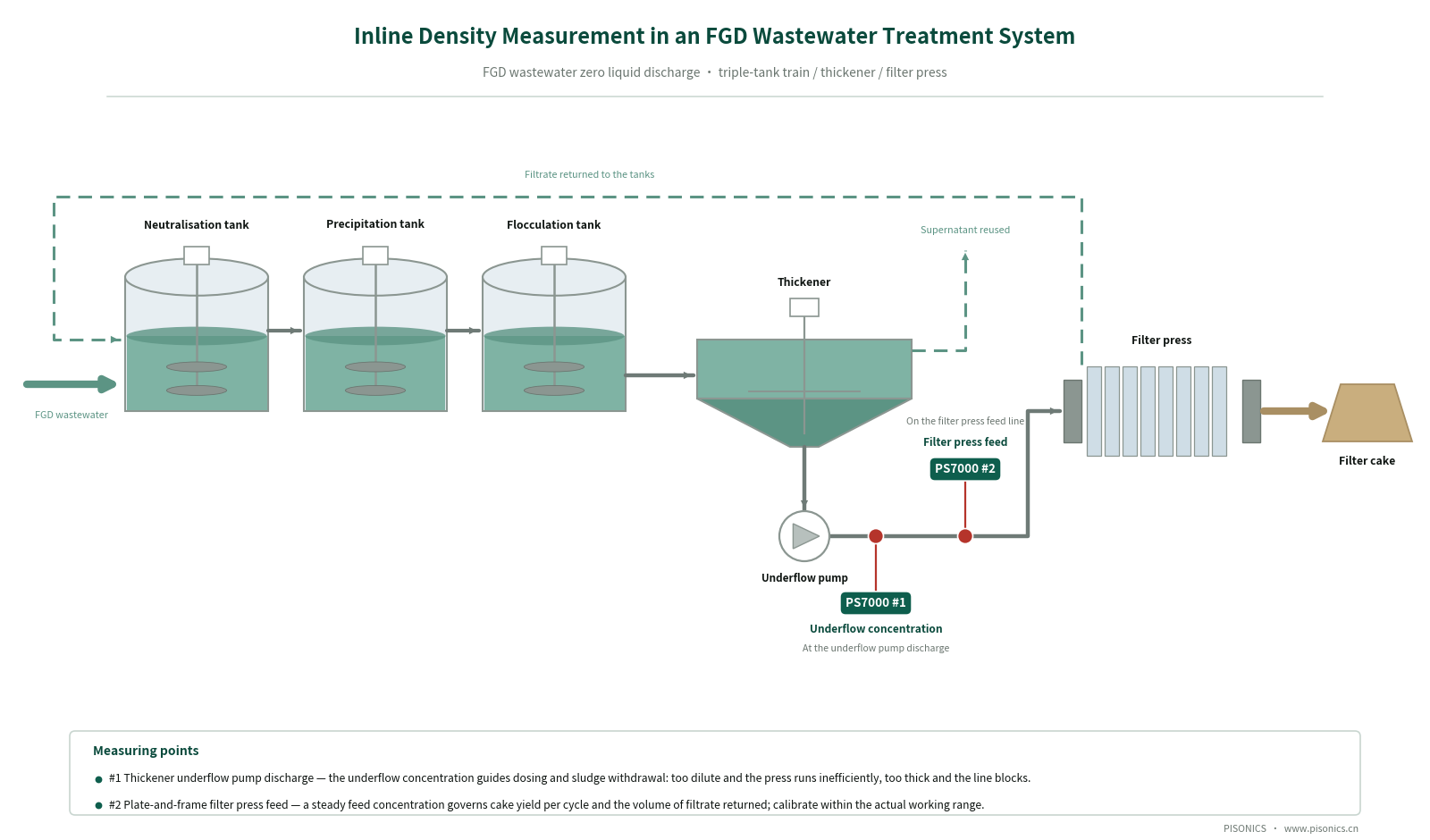
| ② Regeneration basin / settling | CaSO₃ + CaSO₄ slurry | Solids content sets when to draw sludge and how hard the dewatering plant works. Too early carries away water and usable alkali; too late fills the basin and regeneration capacity drops | PS7000 |
Both points are solids-bearing slurry, both opaque, both commonly aerated — which is the duty acoustic impedance was designed for. It does not need light through the sample and is indifferent to colour and opacity. Span and bore are confirmed against the site; see the PS7000 product page.
Why Not a Nuclear Gauge
Both points have historically used Cs-137 nuclear density gauges. There is nothing wrong with the measurement; the trouble is everything around it — licensing, annual inspection, source records, decommissioning, and one more thing on site that has to be managed. Acoustic impedance returns the same density figure without any of those obligations. We have written that comparison out in full at ultrasonic acoustic impedance vs Cs-137 nuclear density gauges.
Before We Quote
- Lime slurry strength range and how much it swings; continuous or batch preparation.
- Solids content range in the regeneration basin, and roughly the particle size.
- Bore, velocity, and whether a vertical full-bore run is available.
- Slurry temperature and abrasiveness (heavy abrasion needs a wear assessment).
- What the sludge-draw and caustic make-up decisions rest on today — that decides how the control logic changes once there is an instrument.
- The pH scheme on the absorber side, and what about it is not satisfying you.
What this page is: a method and selection note, not a case study. There are no unit counts, saving percentages or payback periods here — we do not invent those. Where the page says what the industry does, it cites something you can check for yourself (published vendor literature, granted patents) rather than implying we have installed base there. Send us the process conditions and you get a selection opinion you can check.