PISONICS· Xi’an Pisonics
PS7000 Series
Ultrasonic Acoustic Impedance Slurry Density Meter
Tunnel Boring Machine Construction / Slurry Balance Industry Application Case
—— Mud Supply/Discharge Density Comparison Measurement · Excavation Face Balance Control ——
Supply/Discharge Density Difference = Muck Volume · Blow‑Up/Collapse Early Warning · Urban Rail Transit Safety
Tunnel Boring Machine Construction / Slurry Balance · PS7000 Application Solution
1. Process Background
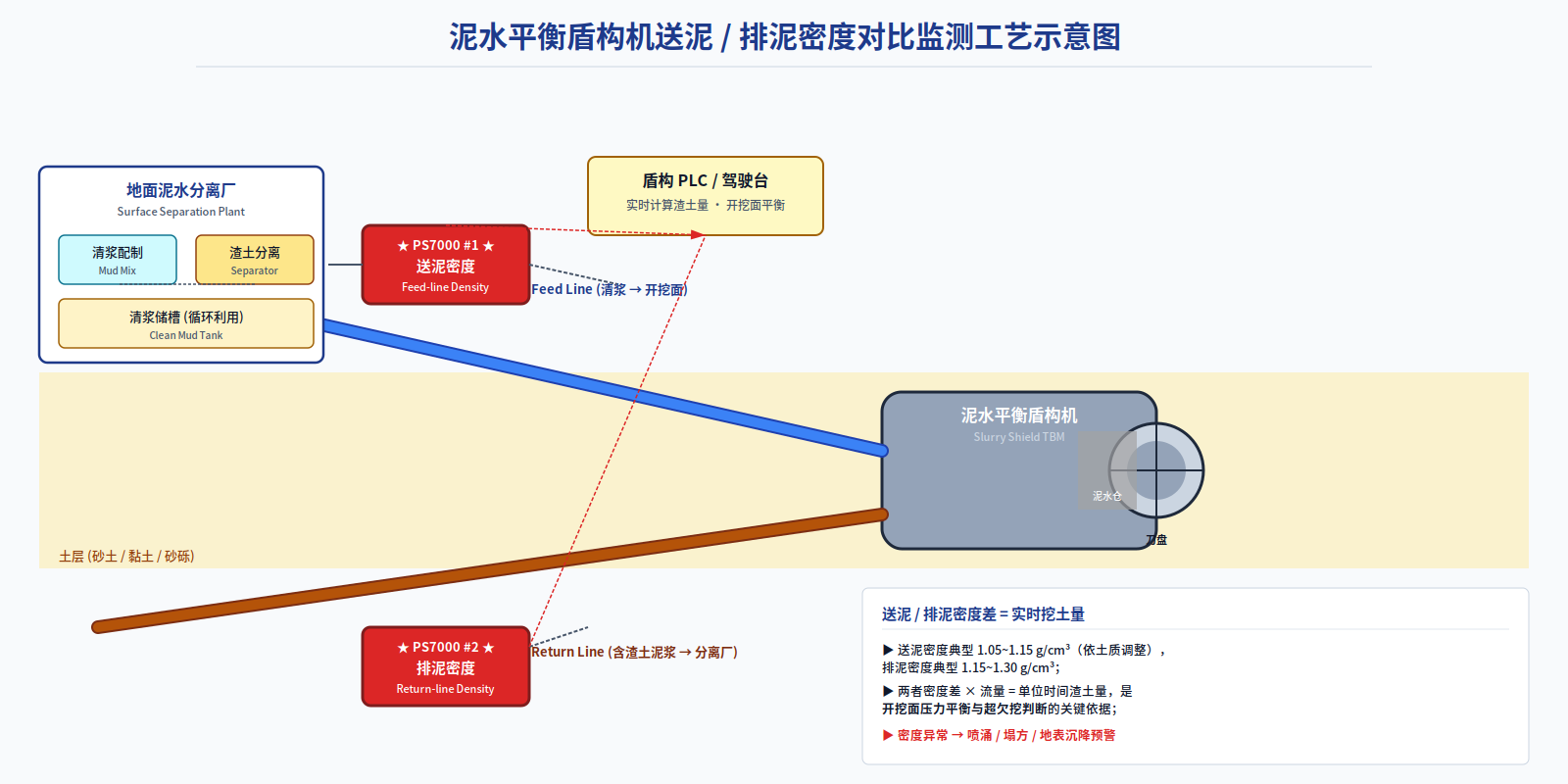
The slurry balance tunnel boring machine (Slurry Shield TBM) is a core piece of equipment for large-scale municipal infrastructure projects such as urban subways, cross‑river tunnels, and undersea tunnels. Its operating principle is as follows: At the surface, a mud‑water separation plant prepares “clean slurry” of a specified density, which is then pumped through the supply line to the slurry chamber behind the cutterhead, forming a support medium that balances the groundwater and soil pressure at the excavation face. Meanwhile, the muck cut by the cutterhead mixes with the clean slurry to form discharge slurry, which returns via the discharge line to the surface plant. After separating the muck, the clean slurry is recycled. The stable operation of this entire slurry circulation system directly affects tunneling efficiency, ground settlement control, and construction safety.
The difference between “supply slurry density” and “discharge slurry density,” multiplied by the slurry flow rate, equals the muck volume per unit time—this is the key indicator for determining whether the excavation face pressure is balanced, whether over‑excavation or under‑excavation has occurred, and whether to issue early warnings for blow‑up or collapse risks. Typical supply slurry density ranges from 1.05 to 1.15 g/cm³ (adjusted according to soil conditions), while typical discharge slurry density ranges from 1.15 to 1.30 g/cm³.
2. Pain Points of Traditional Density/Concentration Measurement Solutions
• The TBM construction site is compact, highly vibratory, and filled with moisture and dust, placing extremely high demands on instrument stability and protection ratings;
• Traditional differential pressure or tuning fork density meters wear out quickly and clog frequently in slurries containing sand and gravel, with an average service life of less than one TBM project;
• Gamma‑ray density meters, though capable of handling the harsh conditions, pose significant radiation safety management challenges when used in urban underground environments and densely populated TBM tunnels;
• The densities of the supply and discharge streams must be “strictly synchronized and compared”; accumulated errors in conventional instruments make it difficult to support precise muck volume calculations and excavation face balance control.
3. PS7000 Solution
Two PS7000 units are deployed: one on the supply line (PS7000 #1) and one on the discharge line (PS7000 #2). The density difference between the two instruments is sent directly to the TBM PLC, enabling real‑time calculation of muck volume and excavation face balance status. Flanged direct‑insertion installation covers pipe diameters from DN300 to DN800.
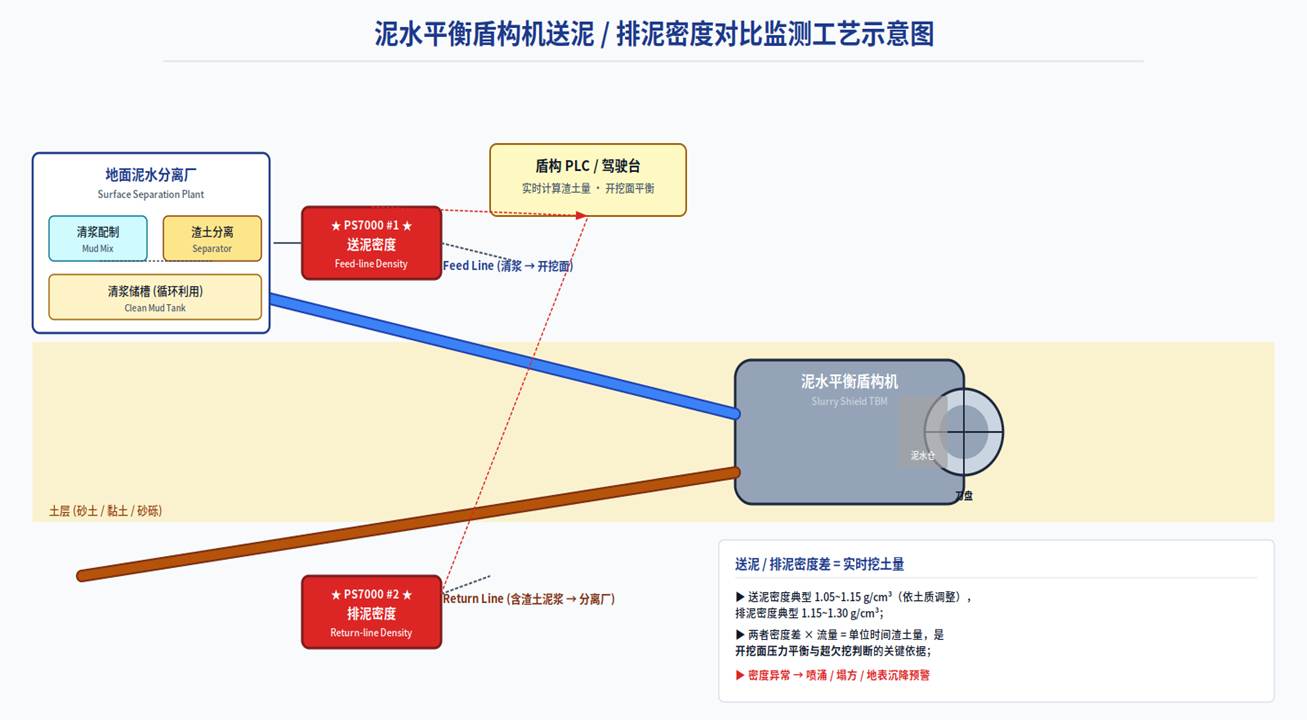
Figure 1 Schematic Diagram of Mud Supply/Discharge Density Monitoring in a Slurry Balance TBM
Core Technical Advantages of the PS7000 in Tunnel Boring Machine Construction and Slurry Shield Tunnelling ▶ Completely non‑nuclear — ensuring intrinsic safety in urban underground and tunnel environments, meeting the “zero radiation source” requirement for large‑scale municipal projects; ▶ Ceramic probe + erosion‑resistant design — capable of withstanding continuous erosion by mixed slurries containing sand and gravel, with zero maintenance required throughout an entire TBM project; ▶ Two independent PS7000 units — one for supply and one for discharge, both of the same model and calibrated identically — eliminating error accumulation common to traditional multi‑brand instrumentation, with density difference accuracy better than ±0.5%; ▶ Response time < 1 second — enabling immediate warning of mud discharge density spikes that may signal blow‑up or collapse risks, buying the operator valuable time for emergency response; ▶ IP65 rating plus vibration‑resistant enclosure — perfectly suited to the TBM machine room’s harsh environment of high humidity and intense vibration; ▶ Supports 4G and Modbus multi‑channel connectivity — allowing the tunneling group’s headquarters to remotely monitor real‑time tunnelling data from all ongoing projects. |
4. Customer Value
Comparison Dimensions | Original Conventional Solution | PS7000 Solution |
Radiation Safety | Gamma-ray · Tunnel Hazards | Completely non-nuclear |
Instrument service life | Differential pressure type · Single project write-off | Ceramic probe · Multi-engineering multiplexing |
Density difference accuracy | Error accumulation across different brands | Same model · ±0.5% accuracy |
Surge Warning | Post-accident passive response | Density jump · Real-time early warning |
Group Management | Local data · Distributed | 4G remote · centralized monitoring |
In a subway tunnel project in a major Chinese metropolis, two PS7000 units were simultaneously installed on the TBM’s supply and discharge lines. After commissioning across one tunnel section, muck volume calculations achieved accuracy better than ±2%, and no blow‑ups or collapses occurred throughout the process. Compared with the original nuclear density meter solution, the need for underground radioactive source approval and annual inspections was eliminated, allowing the time‑critical municipal project to proceed rapidly. This solution has since been adopted as a standard technical approach by several leading TBM construction groups.
Conclusion
Xi’an Pisonics (PISONICS) offers inline measurement instruments across six principle families (ultrasonic, tuning fork, Coriolis, optical, microwave and differential pressure), so a suitable instrument can be matched to each duty. Tailored to the process characteristics of tunnel boring and slurry balance applications, the PS7000 series ultrasonic acoustic impedance slurry density meters provide full‑cycle technical support, from instrument selection and installation/commissioning to long‑term operations and maintenance.
For an in‑depth discussion of your project’s specific conditions, customized selection proposals, or on‑site technical consultation, please feel free to contact the Xi’an Pisonics engineering team at any time.