PISONICS· Xi’an Pisonics
PS7100 Series
Spectroscopic Concentration/Mass‑Density Meter
UV–Vis–NIR Multi‑Channel Full Spectrum + MLR Multicomponent Intelligent Modeling
Application Case in the Agrochemical Intermediates/ Methyl Chloroformate Industry
—— Simultaneous Online Monitoring of Three Components: Methyl Chloroformate + Methanol + Dimethyl Carbonate ——
Highly Toxic—Zero Contact · Real‑Time Process Control of the Distillation Column · RMB 500,000 in Additional Revenue per Batch
【Key Measured Parameters: Methyl Chloroformate + Methanol + Dimethyl Carbonate】
Agrochemical Intermediates/Methyl Chloroformate · PS7100 Multicomponent Spectral Online Analysis Solution
1. Process Background
Methyl chloroformate (ClCO₂CH₃, MCF) is a critical raw material in the synthesis of herbicide, insecticide, pharmaceutical, and dye intermediates; its purity (typically ≥99.0%) is the primary indicator of product quality. Meanwhile, the residual methanol (MeOH) and the yield of dimethyl carbonate (DMC), a byproduct, are essential for assessing reaction conversion and determining subsequent distillation strategies.
In industrial production, methyl chloroformate is purified through a four‑stage cascaded distillation column (Columns 1–4): Stage 1 separates light components; Stage 2 removes low‑boiling impurities; Stage 3 performs main rectification; and Stage 4 provides final heavy‑component removal. At each stage, the effluent composition must be precisely analyzed for the concentrations of methyl chloroformate, methanol, and DMC to guide operational parameter adjustments and reflux ratio optimization.
2. Pain Points of Traditional Analysis Methods
• Methyl chloroformate is highly toxic and corrosive; manual sampling poses severe safety risks—direct contact can cause skin burns, respiratory damage, and even poisoning.
• Conventional analysis (gas chromatography, titration, refractometry) requires multiple instruments, with a total turnaround time of 3–4 hours from sampling to results, making real‑time on‑site guidance impossible.
• The workshop gas chromatograph and laboratory technicians face heavy workloads and high reagent consumption, while methyl chloroformate samples themselves require special hazardous‑waste disposal procedures.
• Operations rely heavily on lab personnel’s experience; delays occur when switching new formulations or encountering process disturbances, leading to fluctuating product quality and yields.
3. PS7100 Solution
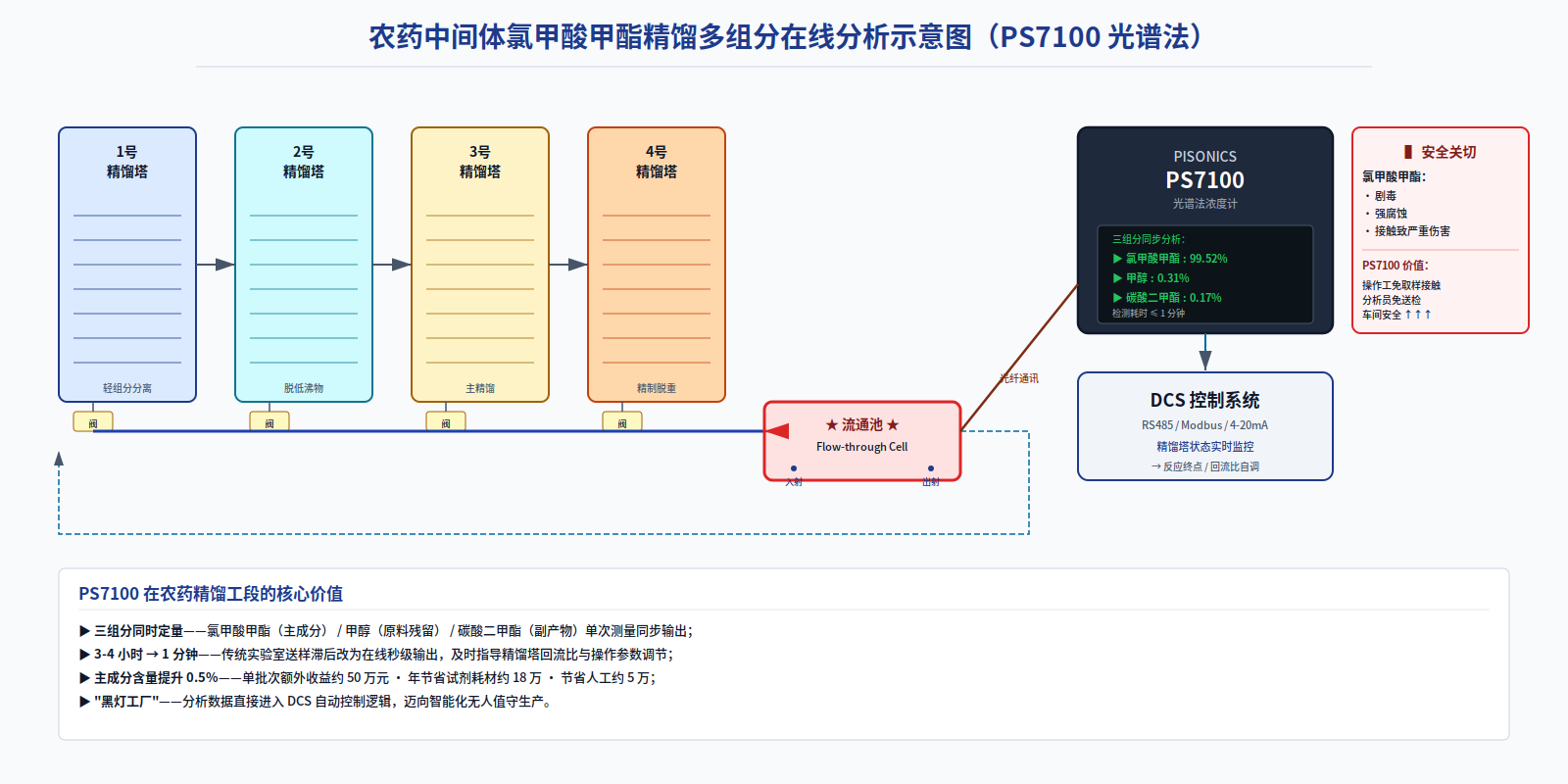
The PS7100 is installed on a bypass flow cell at the outlet of Distillation Column 4 (the final heavy‑component removal column). Using UV–Vis–NIR full‑spectrum acquisition combined with MLR multivariate modeling, it simultaneously outputs the real‑time concentrations of methyl chloroformate, methanol, and dimethyl carbonate in a single measurement. Measurement results are transmitted via RS485/4–20 mA to the DCS control system, enabling automatic adjustment of the distillation column’s reflux ratio and operating parameters.
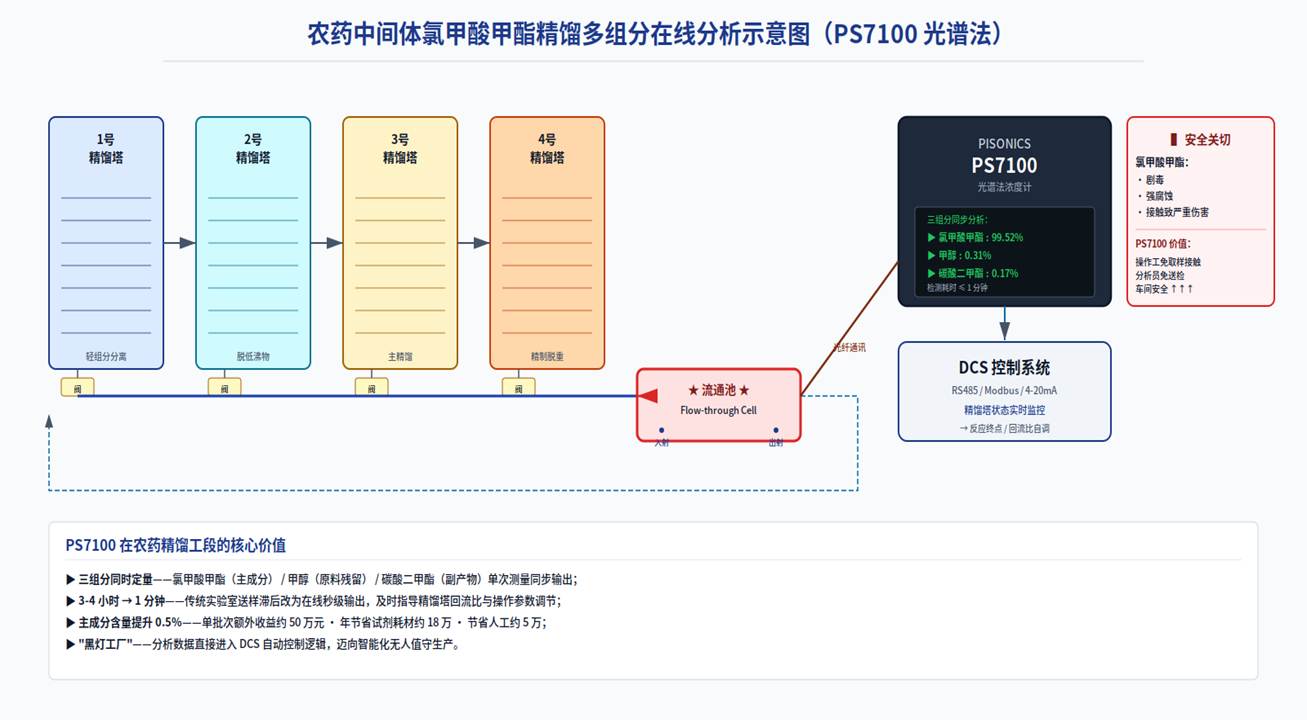
Figure 1: Online Multicomponent Analysis Solution for Methyl Chloroformate Distillation in the Agrochemical Intermediates Industry
The Core Technical Value of the PS7100 in Pesticide Intermediates/Methyl Chloroformate ▶ Simultaneous quantitative analysis of three components—methyl chloroformate (main component, SEC = 0.14, R² = 0.94) + methanol (raw material residue, SEC = 0.08) + DMC (byproduct, SEC = 0.11)—in a single run; ▶ Operators are spared from sampling and direct contact with highly toxic, strongly corrosive samples—eliminating health risks for both laboratory analysts and workshop personnel at the source; ▶ No chemical reagents or glassware required—completely removing the burden of hazardous-waste disposal and eliminating sources of chemical contamination in the workshop; ▶ Sapphire optical window + PFA perfluoroelastomer-lined flow cell—resistant to the strong corrosion of methyl chloroformate, requiring no maintenance over the long term; ▶ Detection time ≤ 1 minute, with an analytical cycle of 3–4 hours → second-level feedback, enabling real-time guidance of distillation-column operations; ▶ DCS integration → automated control logic realizes unmanned, “dark factory” production, accelerating the company’s digital transformation. |
4. Customer Value
Comparison Dimensions | Original chromatography + titration scheme | PS7100 Spectral Analysis Solution |
Response time | 3–4 hour lag | Real-time within 1 minute |
Operational Safety | Direct contact with highly toxic samples | completely non-contact |
Multicomponent Capability | Multiple devices are required | Single-unit, one-time quantitative measurement of three components |
Main component content | High fluctuation | Increase by 0.5% (batch value of 500,000) |
Annual reagent savings | Baseline | Approximately RMB 180,000 |
Annual labor cost savings | Baseline | Approximately RMB 50,000 |
Intelligent | Relying on laboratory technicians | DCS black‑light factory is feasible |
At a large domestic agrochemical company’s methyl chloroformate distillation unit, the PS7100 replaced the original “sampling + gas chromatography + chemical titration” workflow, achieving second‑level simultaneous analysis of the three components. Operational feedback indicates that the main component’s concentration has stabilized and increased by approximately 0.5% (generating roughly RMB 500,000 in additional revenue per batch), while annual savings amount to about RMB 180,000 in reagents and consumables and RMB 50,000 in lab labor costs. More importantly, plant operators and lab technicians have completely eliminated exposure to highly toxic samples. Similar solutions have been deployed in phosgene synthesis, chlorination, acyl chloride production, and other highly hazardous chemical processes.
Conclusion
Xi’an Pisonics (PISONICS) offers inline measurement instruments across six principle families (ultrasonic, tuning fork, Coriolis, optical, microwave and differential pressure), so a suitable instrument can be matched to each duty. Among these, the PS7100 spectroscopic concentration/mass‑density meter, equipped with a full‑band UV–Vis–NIR LED array, multi‑channel detectors, and an MLR intelligent modeling algorithm, uniquely enables “quantitative determination of multiple chemical component concentrations with a single instrument”—a capability unattainable by acoustic impedance or sound velocity methods.
For the agrochemical intermediates and methyl chloroformate industries, the PS7100 series offers end‑to‑end technical support—covering optical probe selection (wetted materials, optical path length, explosion‑proof rating), flow cell design (clamp, flange, PFA lining), MLR model calibration, and integration with DCS, MES, and LIMS systems. For detailed discussions on your specific process conditions, customized MLR calibration models, or on‑site commissioning services, please feel free to contact the Xi’an Pisonics technical team at any time.