PISONICS· Xi’an Pisonics
PS7100 Series
Spectroscopic Concentration/Mass‑Density Meter
UV-Vis-NIR Multi‑Channel Full Spectrum + MLR Multicomponent Intelligent Modeling
Pharmaceutical/Bioprocess PAT Industry Application Case
—— Online Analysis of Multiple Components: Substrate + Byproducts + Biomass + Target Product ——
Compliant with FDA PAT · Clamp‑Style Hygienic Design · CIP/SIP Compatible · Fermentation Cycle Reduced by 5–10%
【Key Measured Parameters: Glucose + Ethanol + Biomass (OD600) + Target Product + Byproducts】
Pharmaceutical/Bioprocess PAT · PS7100 Multicomponent Spectral Online Analysis Solution
1. Process Background
PAT (Process Analytical Technology) is a pharmaceutical quality management framework introduced by the FDA and EMA in 2004, requiring pharmaceutical companies to achieve a smart manufacturing transformation based on “Quality by Design (QbD)” through real‑time process monitoring, and to support “Real‑Time Release (RTR)” as a replacement for the traditional “batch‑after‑testing” model. In the biopharmaceutical sector (antibiotic fermentation, monoclonal antibody cell culture, enzyme preparations, vitamin fermentation, etc.), the core application of PAT lies in the real‑time quantification of multiple critical variables within the fermenter—substrate consumption (glucose), microbial growth (OD600/biomass), accumulation of metabolic byproducts (ethanol/lactic acid), and production of the target product (API/antibody).
Conventional fermentation control relies on offline sampling every 2–4 hours followed by laboratory analysis (HPLC/enzymatic assays/turbidimeters). This approach suffers from significant data lag and low sampling frequency, making it impossible to accurately capture the critical transition points between the logarithmic and stationary phases, resulting in prolonged fermentation cycles and substantial fluctuations in target product yield and consistency.
2. Pain Points of Traditional Analysis Solutions
• Offline sampling carries the risk of sterile contamination—each opening of the fermenter’s sampling valve increases the likelihood of microbial ingress, with single‑event losses potentially reaching hundreds of thousands of yuan;
• Multiple key variables require separate analytical methods—glucose/ethanol (enzymatic or HPLC), biomass (sampling OD600), target product (HPLC + UV)—leading to high costs and extended turnaround times;
• 21 CFR Part 11 and GMP impose strict data‑integrity requirements—manual recording and handling of offline analysis results are prone to audit deviations due to transcription errors, loss, or delayed archiving;
• The data‑point density of traditional offline analysis—once every 2–4 hours—is insufficient to detect rapid metabolic shifts during fermentation (such as the Crabtree effect at the end of the logarithmic phase), missing opportunities for process optimization.
3. The PS7100 Solution
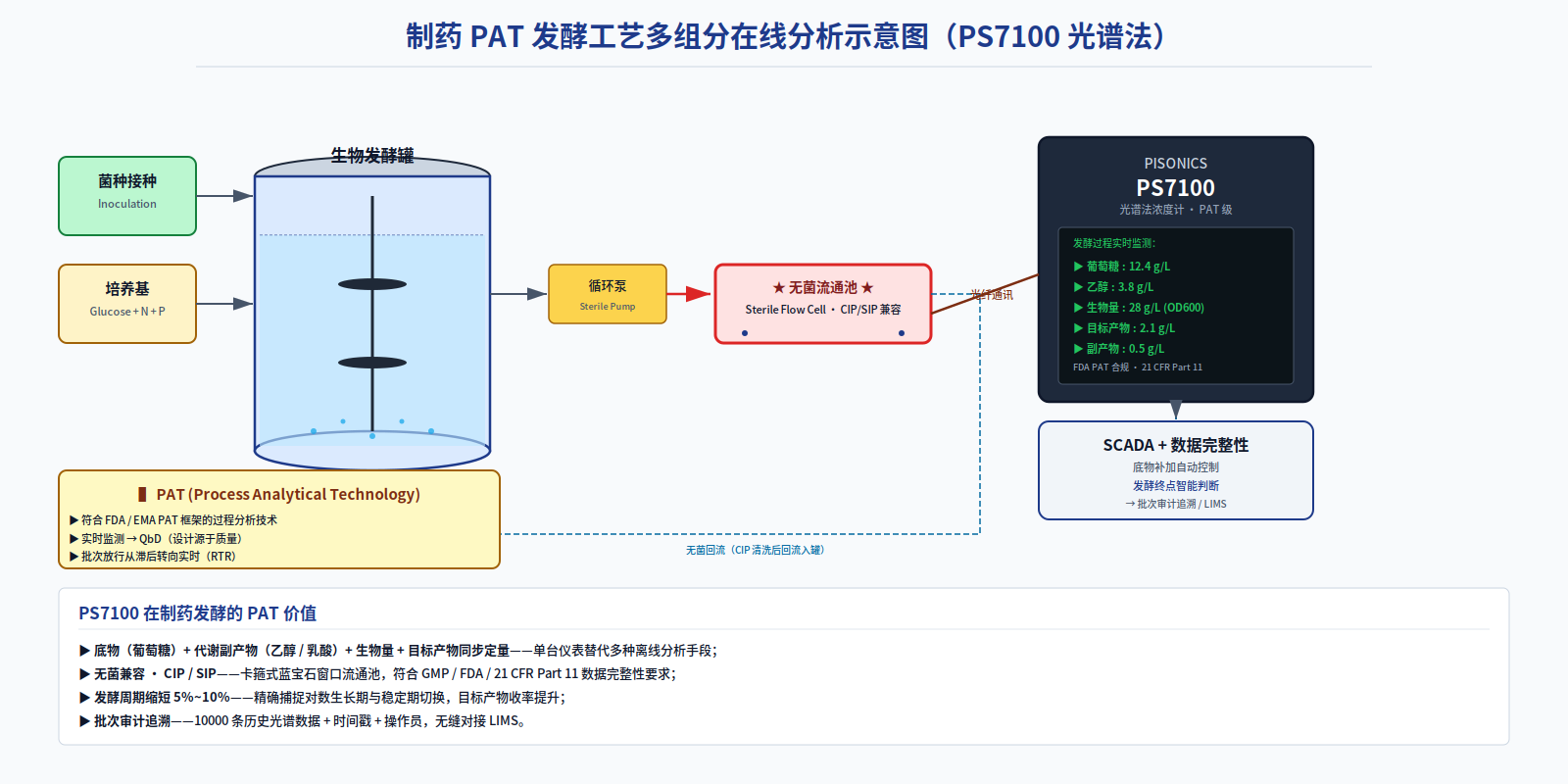
The PS7100 PAT‑grade model features a sterile clamp‑type (Tri‑Clamp/SMS) flow cell, with sapphire optical windows meeting GMP/FDA hygienic standards and full compatibility with the fermenter’s CIP/SIP high‑temperature cleaning and sterilization (steam up to 130°C). Utilizing UV‑Vis‑NIR full‑spectrum acquisition, it provides real‑time quantification of multiple critical process variables in the fermentation broth, including glucose, ethanol, biomass (estimated via combined scattering and absorption at OD600), the target product, and various byproducts.
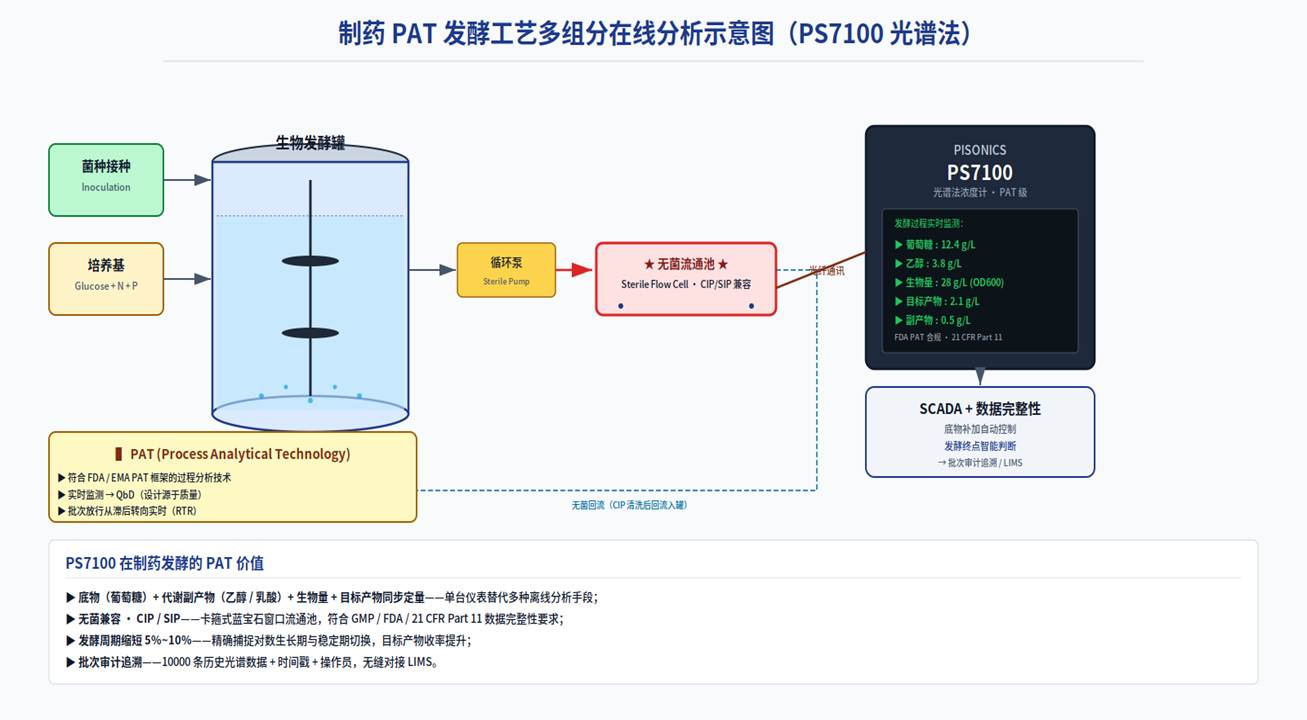
Figure 1: Multicomponent Online Analysis Solution for Pharmaceutical PAT Fermentation Processes
Core Technological Value of the PS7100 in Pharmaceutical/Bioprocess PAT ▶ Simultaneous quantification of five key variables—glucose (substrate) + ethanol/lactic acid (metabolic byproducts) + biomass + target product—replacing multiple offline analytical methods with a single instrument; ▶ Sterile clamp-type sanitary design (3A / SMS / DIN) + sapphire optical window—compliant with GMP, FDA, and 21 CFR Part 11 data-integrity requirements; ▶ CIP/SIP compatible—withstanding steam sterilization up to 130°C, enabling in-situ cleaning and sterilization without disassembly; ▶ Circular storage of 10,000 historical spectral data points, along with timestamps and operator logs—seamlessly interfaces with LIMS systems to support batch audit and traceability; ▶ Fermentation cycle shortened precisely by 5%–10%—by accurately detecting the transition between the logarithmic growth phase and the stationary phase, thereby avoiding “over-fermentation” or “premature termination”; ▶ Can be integrated with PAT control strategies—automatic substrate feed control, intelligent determination of fermentation endpoint, real-time monitoring of target-product yield. |
4. Customer Value
Comparison Dimensions | Original Offline Sampling and Analysis Scheme | PS7100 PAT Solution |
Sample contamination | Risk of contamination with each sampling | Completely sterile · Zero sampling |
Multivariable Capability | Multiple independent analyses are required | Single unit, quantitative measurement of 5+ components at a time |
Sampling frequency | Once every 2 to 4 hours | second-level continuous |
CIP/SIP compatible | Requires disassembly and recalibration | In-situ · 130℃ steam |
Regulatory Compliance | GMP / 21 CFR risks | Complies with the FDA PAT framework |
Fermentation Cycle | Baseline | reduce by 5%–10% |
Batch Traceability | Manual recording is prone to errors | Spectrum + Timestamp + LIMS |
In a retrofit project for a penicillin fermenter at a leading domestic biopharmaceutical company, the PS7100 PAT version was deployed in the 50 m³ fermenter’s circulation loop, enabling real‑time monitoring of glucose, ethanol, biomass, and the target antibiotic. After six months of operation, statistics showed that the average batch fermentation cycle was shortened from 142 hours to 131 hours (a 7.7% reduction), the average yield of the target product increased by approximately 3.5%, and the incidence of contamination dropped to zero (previously 2–3 cases per year), generating additional annual revenue of tens of millions of yuan. This solution has since been extended to other biopharmaceutical subsectors, including monoclonal antibody fermentation, enzyme production, and vitamin C fermentation, and has successfully passed an on‑site FDA audit conducted by a major overseas pharmaceutical company.
Conclusion
Xi’an Pisonics (PISONICS) offers inline measurement instruments across six principle families (ultrasonic, tuning fork, Coriolis, optical, microwave and differential pressure), so a suitable instrument can be matched to each duty. Among these, the PS7100 spectroscopic concentration/mass‑density meter, with its UV‑Vis‑NIR full‑band LED array, multi‑channel detectors, and MLR intelligent modeling algorithm, uniquely offers the capability to simultaneously quantify the concentrations of multiple chemical components—a feat unattainable by acoustic impedance or sound velocity methods.
Targeting the specific process characteristics of the pharmaceutical and bioprocessing PAT sectors, the PS7100 series spectroscopic concentration/mass‑density meters provide end‑to‑end technical support, from selecting the optical probe (wetted materials, light path length, explosion‑proof rating), designing the flow cell (clamp, flange, PFA lining), calibrating the MLR model, to integrating with DCS/MES/LIMS systems. For an in‑depth discussion of your project’s specific conditions, customized MLR calibration, or on‑site commissioning services, please feel free to contact the Xi’an Pisonics technical team at any time.