How Do You Measure Black Liquor Concentration On Line? Selection Essentials for 110℃ Strong Alkali Duty
Chirped ultrasonic acoustic-impedance measurement replacing gamma and differential pressure instruments in pulping and chemical recovery
Scope: kraft pulping and chemical recovery — black liquor evaporator outlet, white liquor causticiser outlet, high-consistency storage tower discharge and low-consistency feed to the paper machine
▍Project Snapshot / Process Conditions
Customer industry | Paper / pulp (kraft chemical recovery) |
Region | A major Chinese paper group, 800,000 t/a of printing and writing paper |
Measured medium | Heavy black liquor / white liquor / medium and low consistency pulp |
Medium temperature | Black liquor 80 ~ 110 ℃ — above the 0 ~ 80 ℃ limit of the standard version, so the high-temperature custom version is required |
Pipe size / installation | DN80 ~ DN200; measuring spool flanged into a straight run, non-intrusive sensor, lining and materials specified for the duty |
Range / accuracy | 0 ~ 80 % concentration by weight, ± 1 % FS (published in the datasheet as ± 1 % concentration by weight), calibrated separately on the medium of each section |
Field calibration | Gravimetric sampling method; on-line calibration with no shutdown; high-temperature points must be calibrated at the actual working temperature |
Replaces | Nucleonic (gamma) concentration gauge, differential pressure density meter |
Operating record | 12 months in service, 3 units running (as reported by the mill) |
1 Process Background and Measurement Challenges
▍1.1 Concentration runs through the whole material loop of pulping and chemical recovery
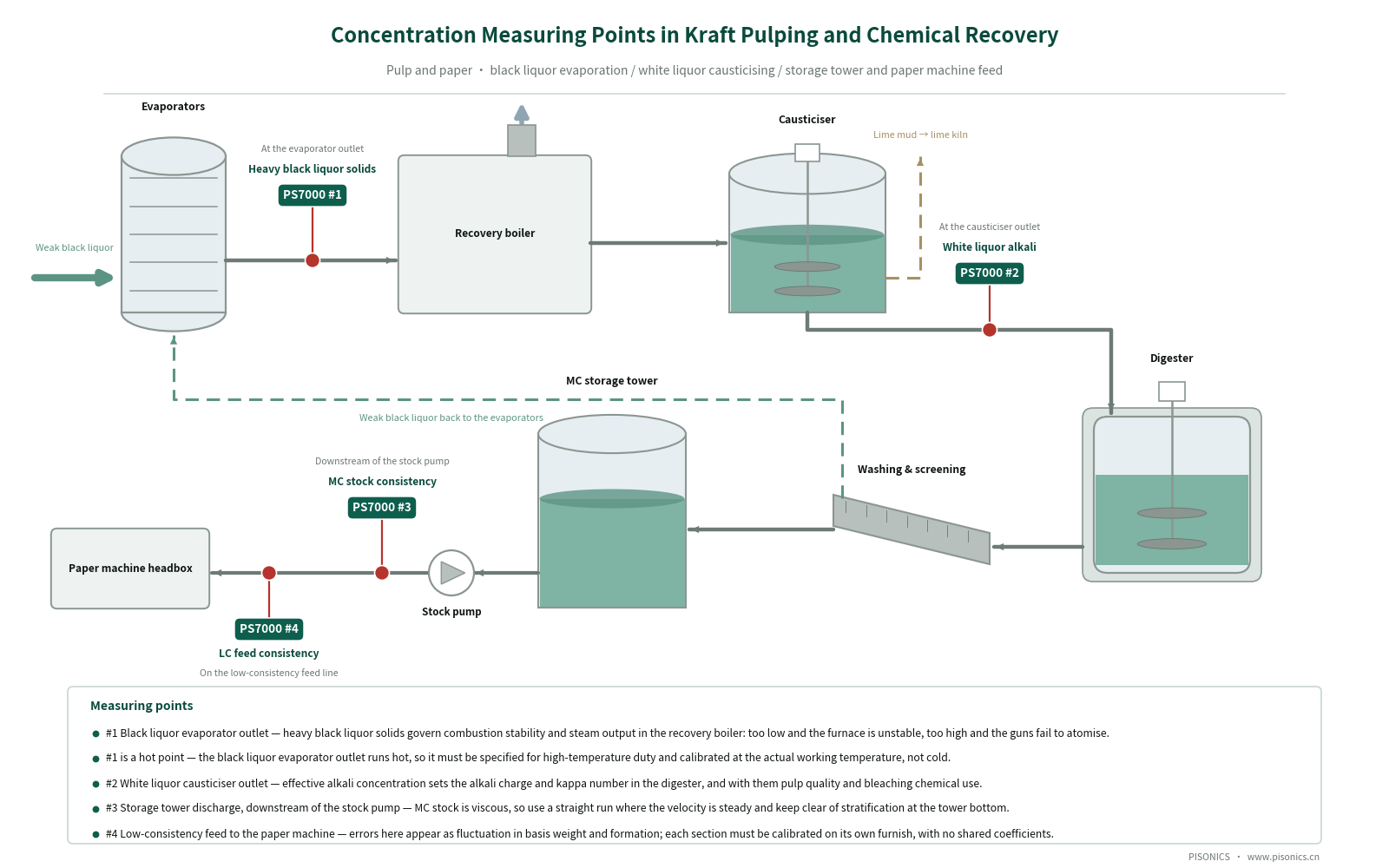
Pulping and chemical recovery in a modern paper mill form a closed chemical circuit. After the digester, pulp passes in turn through washing, screening, bleaching, storage and the paper machine, and by industry convention pulp consistency is divided into low consistency LC ≤ 6 %, medium consistency MC 6 ~ 15 % and high consistency HC ≥ 15 %. The spent cooking liquor (weak black liquor) is concentrated in multiple-effect evaporators to heavy black liquor of 65 % ~ 75 % solids and burned in the recovery boiler; the resulting green liquor is causticised into white liquor and returned to the digester. Concentration is a control variable at every node of this loop:
▪Heavy black liquor solids — determine combustion stability and steam output in the recovery boiler: too low and furnace combustion becomes unstable while the evaporation load rises; too high and viscosity climbs sharply, so gun atomisation deteriorates or the guns block;
▪White liquor effective alkali concentration — determines the alkali charge and kappa number in the digester, and with them pulp quality and bleaching chemical consumption downstream;
▪Medium consistency (MC) — determines the accuracy of storage tower discharge and stock blending, and is the linking parameter between pulping and papermaking;
▪Low consistency (LC) — feeds paper machine dilution and the headbox directly, where any error appears as fluctuation in basis weight and formation.
One thing has to be stated at the outset: the medium at the black liquor evaporator outlet is normally 80 ~ 110 ℃, above the 0 ~ 80 ℃ process temperature range of the standard PS7000, so that measuring point must use the high-temperature custom version, with the exact temperature limit confirmed point by point with Pisonics at the selection stage. This is not something that can be worked around during commissioning; it is a boundary that has to be settled when the instrument is selected.
▍1.2 Limitations of Existing Measurement Methods
▪Gamma (nuclear) concentration gauges: for years the mainstream solution for black liquor and pulp consistency in paper mills, accurate and reliable, but requiring a radiation safety licence, annual inspection, radiation-worker qualification and source decommissioning and disposal. Licence approval for new mill projects has tightened noticeably in recent years, and installed gauges also face decommissioning arrangements.
▪Differential pressure / diaphragm density meters: black liquor has pH ≥ 13, contains organic sulphur compounds and is viscous, so diaphragm corrosion and scaling occur together; the mill reports a diaphragm service life of 3 ~ 6 months, during which the zero drifts continuously and repeated shutdown calibrations are needed.
▪Insertion-type vibrating fork / rotor instruments: medium consistency stock wraps fibre into clumps around the fork tines and rotor roots very readily; the mill reports an average of 1 ~ 2 shutdown cleanings per month, with the consistency data interrupted while cleaning.
▪Intermittent sampling and laboratory analysis: corrosion is milder in the low-consistency and white liquor sections, but they rely on shift-based sampling, so the data interval is measured in hours and cannot provide a continuous input for chemical dosing or adaptive consistency control.
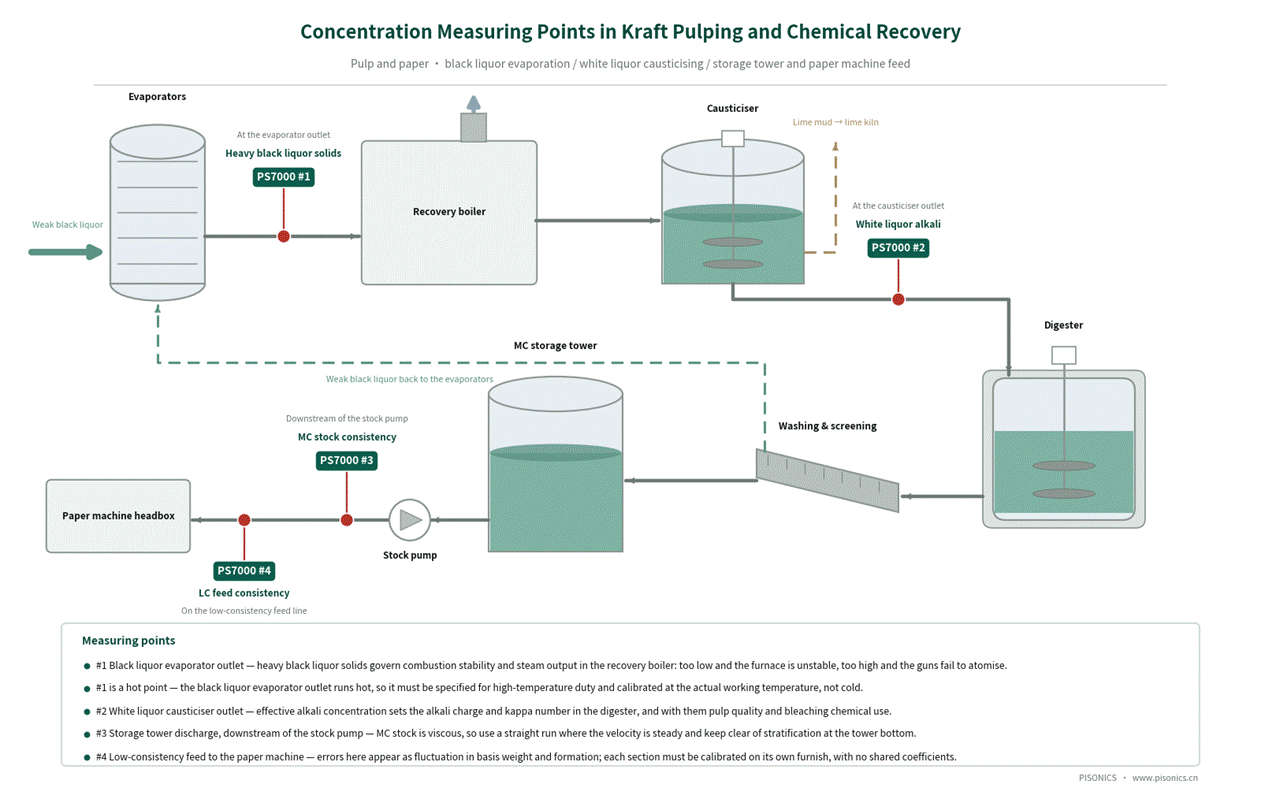
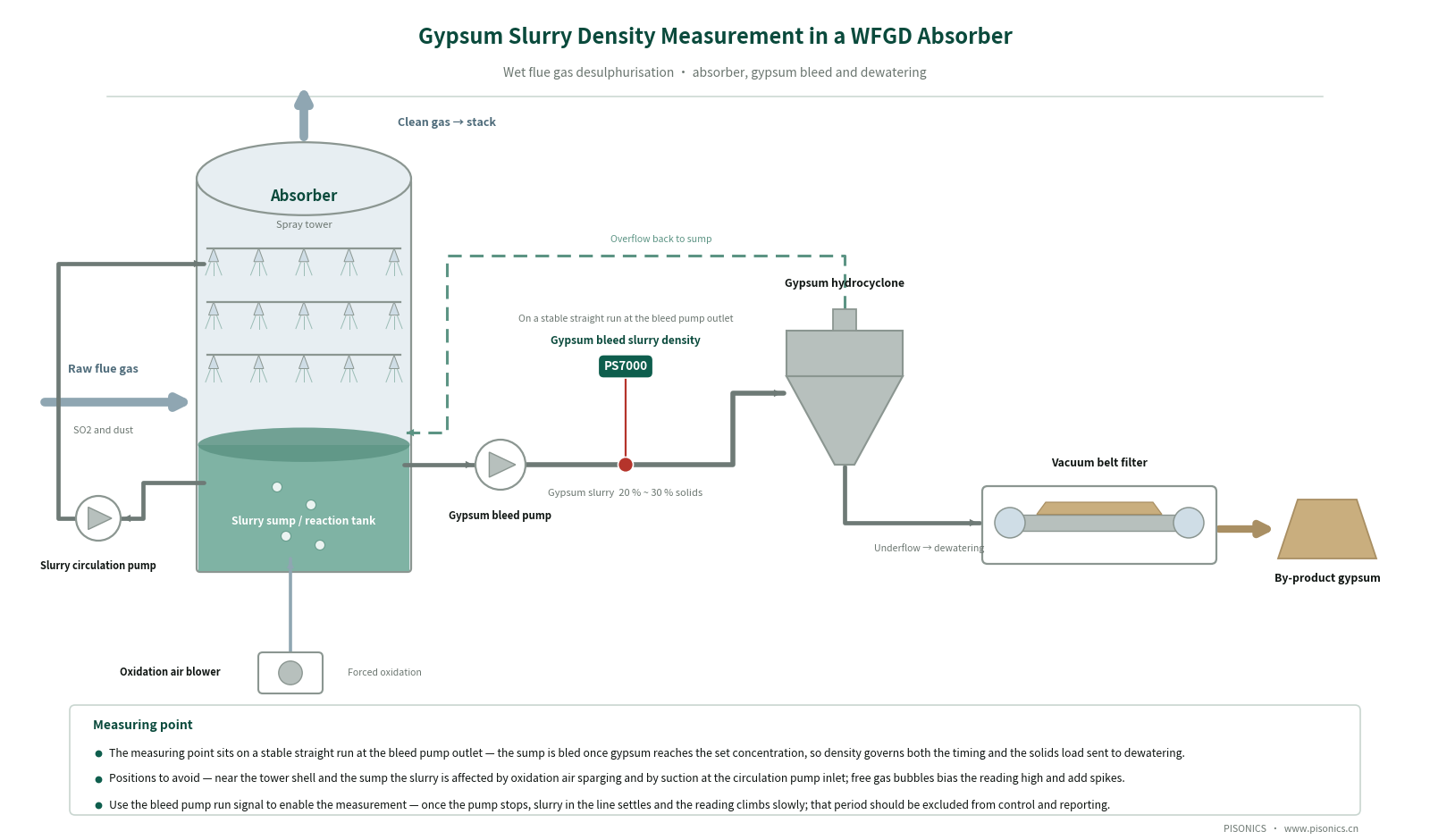
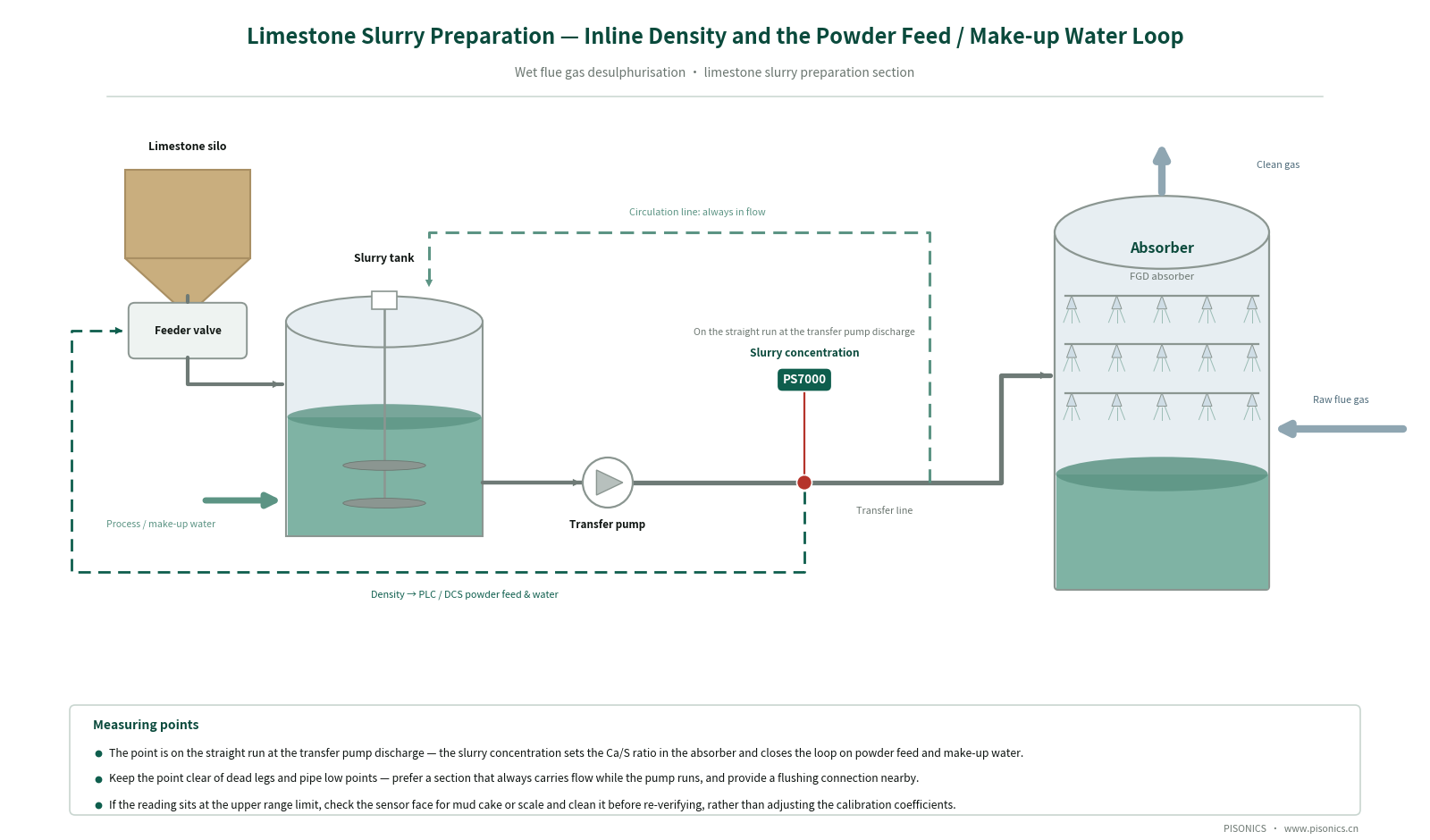
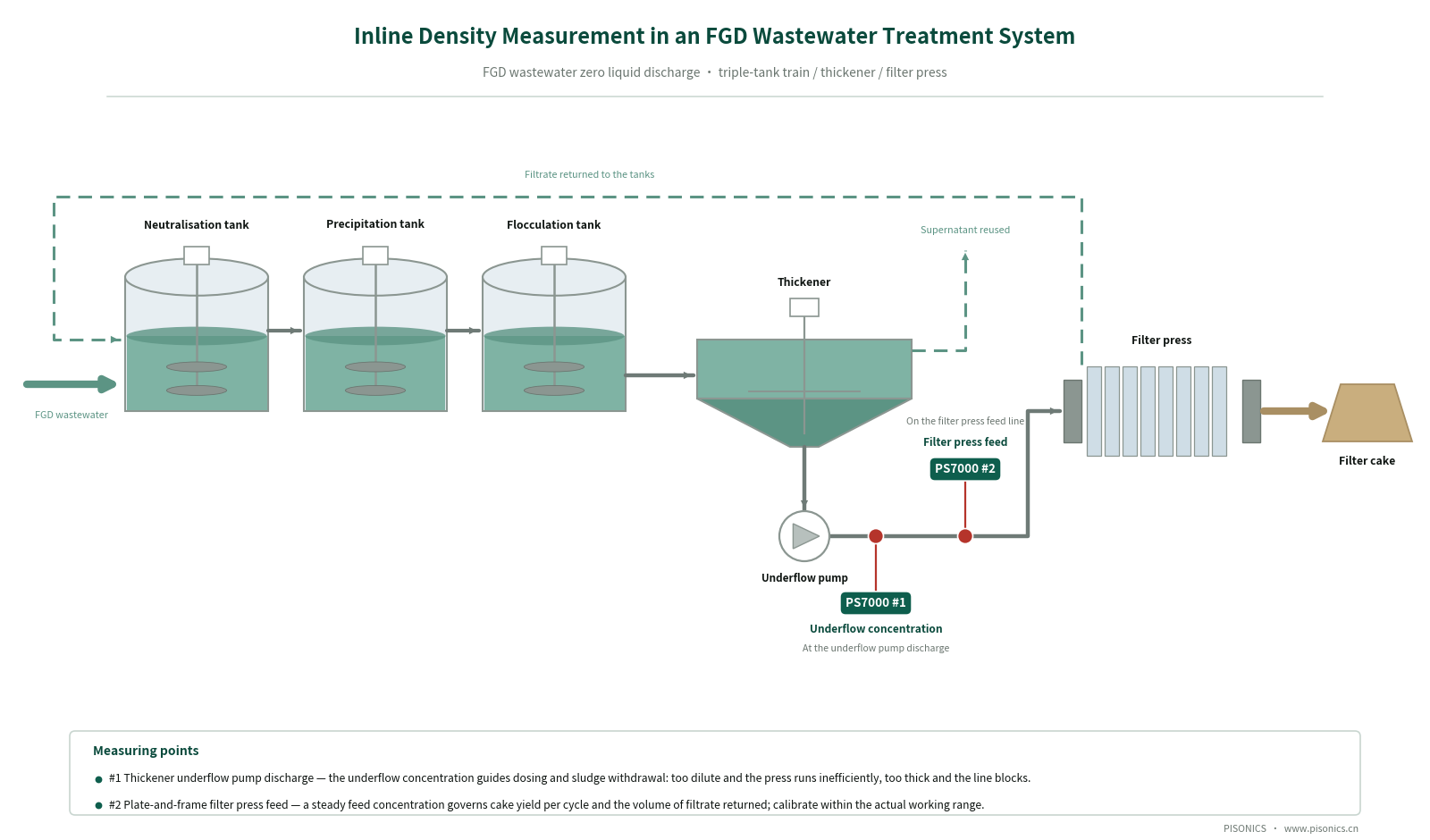
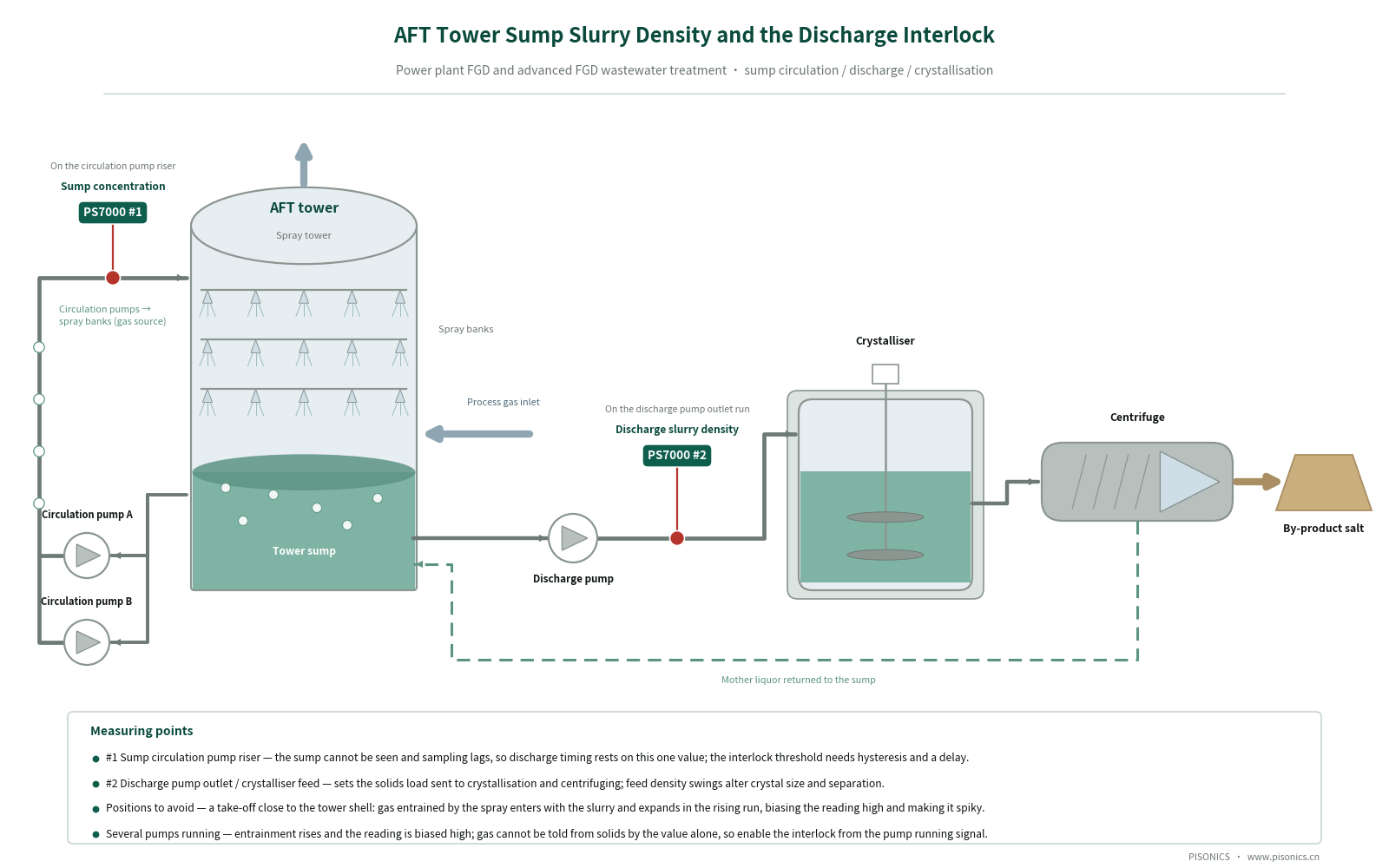
Figure 1 Concentration measuring points in the kraft pulping and chemical recovery process (black liquor evaporation / white liquor causticising / medium consistency storage tower / low consistency feed to the paper machine)
2 The PS7000 Technical Approach
▍2.1 Measuring principle: the chirped (linear frequency modulation) acoustic-impedance method
When an ultrasonic wave travelling in a medium meets a solid-liquid interface, the echo amplitude is determined by the difference in acoustic impedance across that interface, and acoustic impedance Z = medium density ρ × sound velocity c is directly related to the density of the medium. The PS7000 uses a single self-transmitting, self-receiving sensor that continuously emits chirped (linear frequency modulation) ultrasonic pulses and acquires the echoes in real time. The wide bandwidth of the chirp signal helps the pulse penetrate bubble layers and suppresses multiple-reflection interference, and the transmitter then resolves the acoustic-impedance signature of the echo to recover the density of the medium.
The fundamental difference from the gamma-ray method is that the PS7000 contains no radioactive source of any kind. It is a non-nuclear instrument: no radiation safety licence is required, and there is no annual source inspection, no radiation-worker qualification and no source decommissioning and disposal.
▍2.2 Non-intrusive measurement: the sensor is wetted but does not protrude into the flow path
The PS7000 measuring spool is flanged into a straight run of the process line and the ultrasonic sensor is mounted on the spool. This is the key structural difference from conventional insertion-type instruments, and the point most often misunderstood during selection, so it is set out here exactly as it is worded in the Operating Manual:
▪Non-intrusive (non-intrusive is not the same as non-contact): the sensor must be wetted by the medium in order to work, but it does not protrude into the flow path — there is nothing projecting into the bore. The manual is explicit on this point: for horizontal installation with the sensor on top of the pipe, a full pipe must be guaranteed, otherwise the sensor loses contact with the liquid and the measurement fails; for remote-mount horizontal installation the sensor should be placed on the underside of the pipe so that it stays wetted.
▪There is therefore none of the leading-edge erosion, build-up at the probe root or downstream flow disturbance associated with insertion probes, and no risk of blocking the line.
▪The acoustic window of the sensor is sapphire: a fine surface finish, wear-resistant and corrosion-resistant. The measuring spool can be supplied with a lining (PTFE / rubber / ceramic) to suit the duty.
▪Heavily scaling media should still be included in routine inspection — the manual lists "scaling on the sensor face" as one of the items to check when calibration fails, the remedy being to clean the sensor and recalibrate.
▪Applicability limits: bubbles in the medium are permitted; the medium should not, however, contain large quantities of suspended or settled coarse particles.
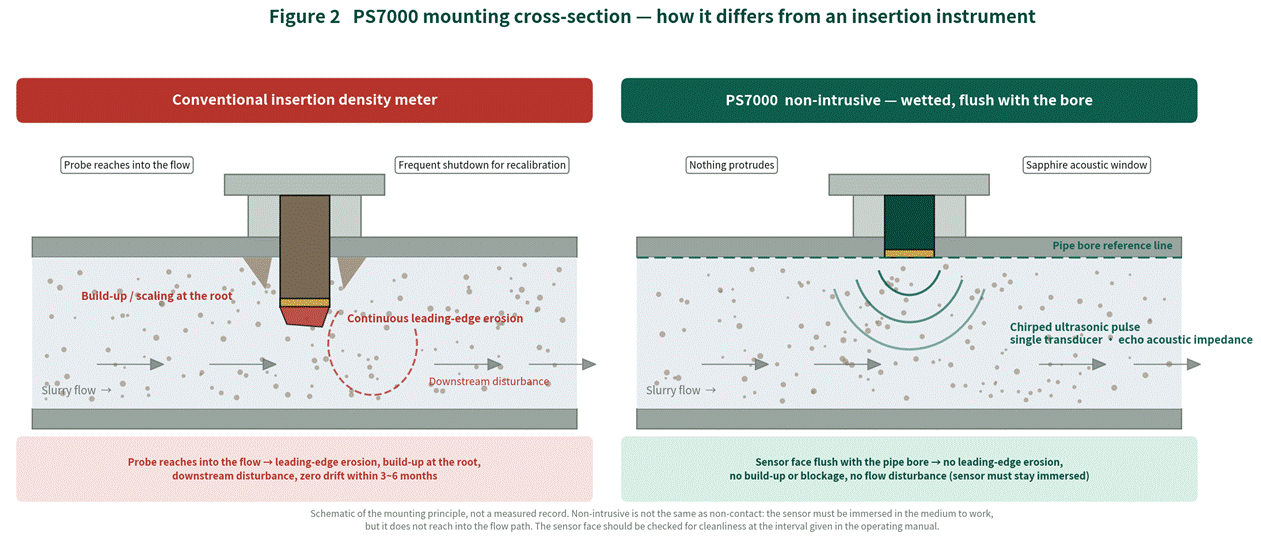
Figure 2 Sectional view of the PS7000 installation — the structural difference from conventional insertion types (schematic drawing of the principle, not a record of measured data)
▍2.3 Key Technical Specifications
Item | Specification | Item | Specification |
Measuring principle | Chirped ultrasonic acoustic-impedance method | Pipe diameter | DN50 ~ DN1000 |
Measuring range | 0 ~ 80 % concentration by weight / calibratable on the actual medium | Installation | Integral / remote-mount, flanged into a straight run |
Accuracy | ± 1 % FS (the published datasheet figure is ± 1 % concentration by weight) | Dimensions | 288 (W) × 190 (D) × 95 (H) mm |
Power supply | Standard AC220V (175 ~ 285V, 50/60Hz); DC24V optional | Weight | Approx. 2.5 kg |
Power consumption | ≤ 1 W | Display | OLED screen (bilingual Chinese / English menu) |
Ambient temperature | -30 ℃ ~ 60 ℃ | Analogue output | 4-20 mA, 2 channels |
Medium temperature | 0 ℃ ~ 80 ℃ | Digital interface | RS485 / Modbus RTU, approx. 500 m |
Humidity range | ≤ 98 %RH | Ingress protection | IP65 |
Data storage | 2000 real-time records + 400 daily records (customisable) | Remote transmission | Optional 4G module |
Field calibration | Gravimetric sampling method, performed online with no shutdown | Custom options | Lining, range, explosion protection, high temperature and similar options built to the duty |
※ The process temperature in this duty is above the 0 ~ 80 ℃ range of the standard version, so the high-temperature custom version must be used; please confirm the exact upper limit with Pisonics at the selection stage. Note also that heavy black liquor at 65 % ~ 75 % solids is already close to the 0 ~ 80 % upper range limit, and the lining of the measuring spool and the sensor material must equally be specified for strong alkali black liquor duty.
▍2.4 Selection and Installation Requirements (important)
The following conditions directly determine the stability of the measurement in the field. We recommend confirming them while the measuring point is still being designed; doing so avoids the great majority of post-commissioning disputes over deviation.
▪Vertical installation with upward flow is preferred. For horizontal installation, confirm that the medium is not stratified and that the measuring point is representative.
▪Flow velocity > 1 m/s; the higher the density of the solid phase, the higher the velocity required. Avoid low-velocity or stagnant duties, in which particle settling disturbs accuracy and stability.
▪Straight run requirement: the installation position should be well clear of pumps, valves, bends and other local resistances; for horizontal installation, 10D upstream / 5D downstream of straight run must be provided (5D upstream / 3D downstream as an absolute minimum).
▪Keep the sensor wetted: for integral horizontal installation with the sensor on top of the pipe, the pipe must run full; for remote-mount horizontal installation the sensor should be placed on the underside of the pipe. Where the pipe does not run full, the remote-mount version is preferred.
▪Avoid points where free gas bubbles accumulate. Aeration, twin-pump suction, negative-pressure inlets and similar conditions introduce large quantities of free gas bubbles; the bubbles raise the echo energy and bias the reading high. This is an inherent limitation of the acoustic method and must be handled by the choice of measuring point, not by compensating in calibration.
▪The comparison sampling point should be as close as possible to the measuring point. A sampling point far from the measuring point introduces transport lag, so the laboratory reference value and the displayed reading no longer refer to the same moment, and the difference is easily mistaken for instrument error.
▪A high-temperature measuring point must be specified as a custom version: the black liquor evaporator outlet at 80 ~ 110 ℃ is above the 0 ~ 80 ℃ process temperature range of the standard version, so the high-temperature custom version is required, and the exact upper limit, the sensor material and whether thermal isolation is needed must all be confirmed at the selection stage. Calibration must be carried out at the actual working temperature — temperature changes both the sound velocity of the medium and the signal characteristics, and coefficients obtained cold cannot be carried over to hot operation.
▪A medium consistency measuring point must first satisfy the velocity requirement: the manual requires a flow velocity > 1 m/s. Medium consistency stock (6 ~ 15 %) is viscous and the low-velocity section at the storage tower outlet stagnates easily, so the measuring point should be on a straight run at the stock pump discharge where the velocity is stable, and clear of any consistency stratification at the bottom of the tower.
▍2.5 Field calibration: the gravimetric sampling method, performed online
Calibration brings the displayed value into agreement with the true density of the medium: several pairs of "instrument reading + corresponding laboratory reference value" are collected and the instrument automatically regresses the correction coefficients. The whole procedure requires no shutdown and can be carried out online provided the process is steady and the sensor is clean.
Process conditions to be confirmed, item by item, before calibration:
Full pipe | The sensor must be completely immersed in the liquid |
Steady flow | Variation within ± 5 % |
No significant bubbles | No venting operation should be in progress in the line |
Steady temperature | A change in slurry temperature affects the measurement signal |
Clean sensor | No significant deposit or scaling; rinse with clean water if necessary |
The most common situation in the field is that only the process medium is available and clean water cannot be introduced temporarily. In that case two consecutive acquisitions are made on the same medium (about 2 minutes each, about 4 minutes in total): the two measured points plus the virtual zero point added automatically by the system form three regression points, and the instrument uses the goodness of fit r² to cross-check the consistency of the two signals. If bubbles, a step change in flow or an abnormal valve movement during acquisition make the two data sets inconsistent, the system rejects the calibration outright rather than returning an incorrect coefficient. This is the key mechanism that prevents a calibration that looks successful but is in fact wrong.
Recommended calibration interval: calibrate a newly installed instrument once within the first 12 ~ 24 hours of operation; once operation is stable, verify every 6 ~ 12 months; verify every 1 ~ 3 months at measuring points with demanding accuracy requirements; recalibrate immediately after changing the sensor or the medium.
3 Before / After Comparison
Aspect | Original gamma-ray / differential pressure solution | PS7000 solution |
Radiation compliance | The radioactive source requires a licence, annual inspection, personnel qualification and decommissioning and disposal, and approval is difficult to obtain for new projects | A non-nuclear instrument, with no radiation-related approvals or source decommissioning |
Black liquor corrosion resistance | The diaphragm corrodes and fails within 3 ~ 6 months, with continuous zero drift in the meantime | The non-intrusive sensor does not protrude into the flow path, so there is no leading-edge erosion; lining and materials are specified for black liquor duty, and routine inspection is still required in service |
High-temperature section | — | The standard version covers a process temperature of 0 ~ 80 ℃; black liquor at 80 ~ 110 ℃ requires the high-temperature custom version, with the upper limit confirmed at the selection stage |
Fibre wrapping | Inserted fork tines / rotor need 1 ~ 2 shutdown cleanings per month | Nothing protrudes into the flow path, so there is no root for fibre to wrap around; the measuring spool is flanged into the line and does not change the flow field |
Entrained gas | Air entrained in the washing and bleaching sections makes the reading jump | Broadband chirp analysis penetrates a bubble layer; where free gas bubbles are abundant, the measuring point must still be chosen to avoid them as described in Section 2.4 |
System integration | Usually a single analogue output only | 4-20 mA × 2 + MODBUS-RTU into the DCS / QCS, optional 4G |
4 Field Verification and Operating Record
On the chemical recovery upgrade project of a major Chinese paper group (800,000 t/a of printing and writing paper), three PS7000 units were installed on the heavy black liquor line to the boiler, the white liquor line to the digester and the high-consistency storage tower outlet, replacing the existing nucleonic concentration gauges and differential pressure instruments. The black liquor point was specified as the high-temperature custom version, while the white liquor and consistency points are standard versions; all three points were calibrated separately on the medium of their own section, with no shared coefficients.
After 12 months in service the mill reports that the fluctuation band of heavy black liquor concentration narrowed from ± 2.5 % before the retrofit to ± 0.5 % (according to the mill's DCS statistics), with a corresponding improvement in the stability of recovery boiler feed; and that once white liquor concentration was stable, alkali consumption in the digester fell by about 3 % against the pre-retrofit figure (according to the mill's operating reports, not verified by a third party). Field comparison used the gravimetric sampling method, and over several rounds the meter readings and the laboratory reference values agreed within a deviation acceptable to the process.
A Note on Comparison Methodology The gravimetric sampling method itself carries method error: the physical distance between the sampling point and the measuring point introduces transport lag, and the representativeness of the sampling operation together with the weighing and drying accuracy in the laboratory also contribute to the deviation. We therefore avoid expressions such as "in complete agreement", and recommend instead that acceptance be based on the mean deviation and the trend consistency across several consecutive comparison sets, with the sampling rules stated explicitly in an annex to the contract. Pisonics can provide a standard field comparison and acceptance procedure. |
▍Verifiable Benefits for the Customer
▪Three nucleonic concentration gauges have been taken out of service, reducing the mill's inventory of radioactive sources and the associated decommissioning burden.
▪The measuring point at the medium consistency storage tower outlet no longer has to be shut down for cleaning because of fibre wrapping, and the consistency data are continuously available.
▪With black liquor concentration in the DCS, recovery boiler feed concentration now has a stable input for closed-loop control.
▪White liquor effective alkali concentration has moved from shift-based sampling to continuous on-line tracking, so the basis for adjusting the alkali charge has shifted from after-the-fact laboratory results to process monitoring.
5 Frequently Asked Questions
Q1 Black liquor is at 110 ℃ — can the standard version be made to do?
A No. The manual gives the standard version a process temperature range of 0 ~ 80 ℃; 110 ℃ is above that limit, so the high-temperature custom version must be used and the exact upper limit confirmed at the selection stage — we will not quote a temperature rating that has not been confirmed. Two further points must be raised in advance for high-temperature duty. First, temperature changes the sound velocity of the medium and the signal characteristics, so calibration must be carried out at the actual working temperature and coefficients obtained cold cannot be carried over. Second, black liquor temperature fluctuates as the evaporator load changes, and the manual lists a stable temperature as one of the preconditions for calibration, so calibration should be scheduled for a steady period and re-checked after any large change in load.
Q2 Can medium consistency stock be measured? What about high consistency?
A Medium consistency stock (6 ~ 15 %) can be measured, provided the measuring point meets the velocity requirement in the manual (> 1 m/s), is on a stable straight run at the stock pump discharge, and is calibrated on site with the mill's own furnish — stock from different chip sources and at different freeness levels has different acoustic properties, and coefficients cannot be borrowed from another mill. High consistency stock (≥ 15 %) we do not recommend applying directly: it is viscous and often moves in plug flow, so neither velocity nor uniformity readily meets the installation conditions in the manual, and duties of this kind have to be assessed case by case against the specific process data. It is better to state clearly at the selection stage that a duty is unsuitable than to argue about it after commissioning.
Q3 Black liquor is strongly alkaline at pH ≥ 13 and contains organic sulphur — how long will the sensor last?
A We do not promise a specific service life; we can only explain the mechanism. A non-intrusive sensor does not protrude into the flow path, so there is none of the wear by which the leading edge of an inserted probe is continuously abraded, and that is a clear advantage in fibre-bearing and solids-bearing stock. Corrosion, however, is a question of material rather than of structure — black liquor is strongly alkaline and contains organic sulphur compounds, so the lining of the measuring spool and the sensor material must be specified for the duty and confirmed at the selection stage. Routine inspection is still required in service: the manual lists "scaling or deposits on the sensor face" as one of the items to check when calibration fails, and the remedy is to clean the sensor and then re-calibrate.
Q4 Does the sensor actually touch the medium? Will it be worn away?
A It does touch it. The manual's formal wording is "non-intrusive", not "non-contact" — the sensor has to be wetted by the medium to work (with horizontal installation and the sensor on top, the pipe must run full or the measurement fails), but it does not protrude into the flow path and there is nothing projecting into the bore, so the main wear mechanism of insertion probes, the leading edge being continuously scoured by fast-moving solids, does not exist. Please note that some material in circulation describes this arrangement as "non-contact", which is not accurate. Within the Pisonics range, the products that genuinely do not touch the medium are the PS7010 clamp-on type (acoustic attenuation method) and the nuclear gamma-ray density gauge.
Q5 How is it calibrated in the field? Is a shutdown needed? How often?
A By the gravimetric sampling method, carried out from the handheld remote menu, with no shutdown — calibration can be done online provided the pipe is full, flow variation is within ± 5 %, no venting is in progress, the temperature is steady and the sensor is clean. Where only one medium is available on site, two consecutive acquisitions are made on that medium (about 4 minutes in total) and the system cross-checks the consistency of the two signals with r², rejecting the calibration outright if they disagree. Interval: first calibration within 12 ~ 24 hours of installation, verification every 6 ~ 12 months once stable, every 1 ~ 3 months for high-accuracy points, and immediate recalibration after changing the sensor or the medium.
Q6 Should the PS7000 or another model be selected for a given measuring point?
A The PS7000 (ultrasonic acoustic impedance) is aimed at the density of bubble-laden, high-solids slurries. If the pipe cannot be tapped, or an ageing line is being retrofitted, choose the PS7010 clamp-on type (acoustic attenuation); for concentration analysis of clean liquids choose the PS7020 (sound velocity); for scaling-prone acids and alkalis in chemical service choose the PS7400 (vibrating fork); for large-bore mains above DN200 the PS7300 (differential pressure) is an option; for custody-transfer accuracy choose the PS7200 (Coriolis); for multi-component concentration analysis choose the PS7100 / 7110 (spectral / refractometric); for aqueous suspensions the PS7600 (microwave) is available. If the selection is not clear-cut, send us the process data and we will work it out for you.
About Pisonics
Xi'an Pisonics Information Technology Co., Ltd. (PISONICS) specialises in industrial online density and concentration measurement. Its product range covers ultrasonic acoustic impedance, ultrasonic sound velocity, clamp-on acoustic attenuation, spectral, refractometric, vibrating fork, differential pressure, Coriolis and microwave measuring principles, so that a suitable solution can be matched to each duty. The PS7000 Series Ultrasonic Slurry Density Meter is the company's own non-nuclear inline slurry density monitor, and is in service in power plant desulphurisation, non-ferrous and ferrous mineral processing, coal preparation, salt lake chemicals, dredging, municipal sludge and other industries.
Inline Density & Concentration Measurement
Company | Xi'an Pisonics Information Technology Co., Ltd.PISONICS |
Address | Room 15B016, Block A, Olympic Building, North Chang'an Road, Beilin District, Xi'an, Shaanxi, China |
Tel | +86 159-0293-2017 |
info@pisonics.com | |
Web | Chinese site www.pisonics.cn | English site www.pisonics.com |
※The process data and operating records in this case study are compiled from an actual project; Figures 1 and 2 are schematic diagrams of the principle and the layout, not curves recorded from measurement. The technical specifications of the instrument and its installation and calibration requirements are as stated in the Pisonics Ultrasonic Density Meter Operating Manual supplied with the goods, and are subject to change without notice.