Pisonics PS7000 Enters Service in a Coal-Fired Plant's FGD System: Limestone Slurry Density on Three Absorber Feed Lines
At a coal-fired power plant in southwest China, three Pisonics PS7000 ultrasonic slurry density meters have entered service in the wet FGD system, one on the limestone slurry feed line of each of three absorbers, measuring the density of the slurry going into the absorbers without a radioactive source. Each meter was calibrated on limestone slurry at multiple concentrations and temperatures before shipment, and all three were commissioned on site in July 2025.

Three Pisonics PS7000 ultrasonic slurry density meters have entered service in the wet flue gas desulfurization (FGD) system of a coal-fired power plant in southwest China. One meter sits on the limestone slurry feed line of each of three absorbers, measuring online the density of the slurry going into the absorber, with no radioactive source. All three were commissioned on site in July 2025.
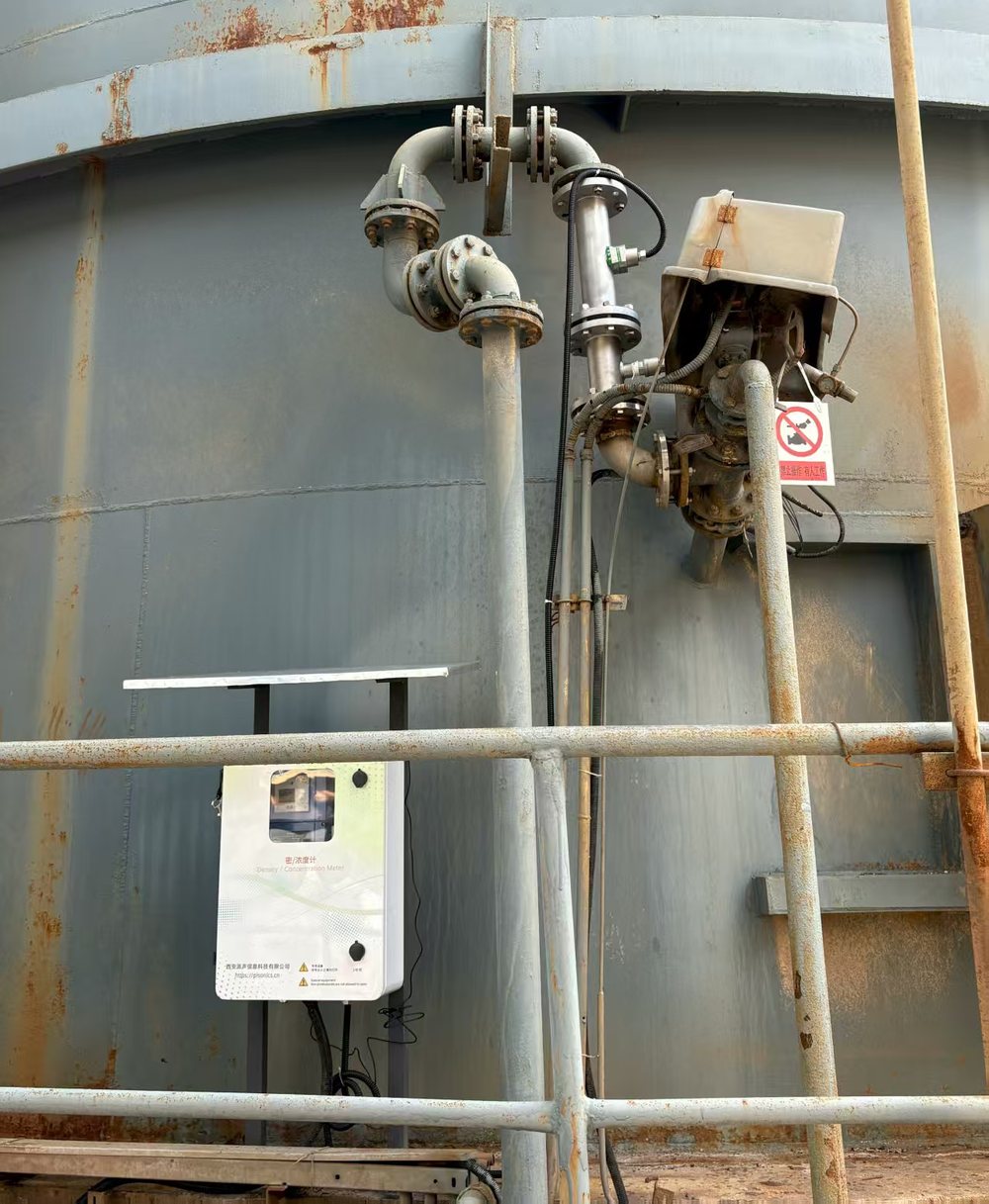
The measuring point beside an absorber: the measuring spool stands vertically on the feed line into the tower, and the Pisonics transmitter enclosure sits on a stand next to it under a sunshade.
Conditions at the measuring points
Item | Details |
|---|---|
System | Limestone wet FGD at a coal-fired power plant |
Measuring points | Limestone slurry feed lines of three absorbers, one meter each |
Medium | Limestone slurry |
Temperature | Probe temperatures logged on site: about 17–55 °C |
Mounting | Flanged measuring spool made of two sections, a measuring tube and a sampling tube; the two shown here are on the vertical riser just before the absorber inlet |
Transmitter | Remote-mounted on a stand beside the absorber, with a sunshade |
Output | Density (g/cm³); 4–20 mA, ready for the DCS |
Commissioning | July 2025 |
Why measure feed slurry density online
Wet FGD removes sulfur dioxide from the flue gas with limestone slurry. Feed pumps send the prepared slurry into the absorber, and the feed rate is adjusted to unit load and absorber slurry pH. What the pipe delivers is a volume of slurry, but what reacts is the calcium carbonate in it: at the same feed rate, a slightly higher or lower concentration changes how much limestone actually goes into the absorber.
The concentration itself drifts. The powder-to-water ratio at slurry preparation, top-up water and agitation in the slurry tank all make the slurry thicker or thinner. Without an inline instrument, the only source for this number is periodic sampling and weighing, which lags behind the process, so the feed has to carry an extra margin based on experience. Too much limestone wastes reagent and leaves more unreacted calcium carbonate in the gypsum; too little makes it harder to hold removal efficiency and absorber pH.
Inline slurry density has traditionally been measured with nuclear density gauges, which need a radioactive source licence, radiation protection and periodic inspection, and the source has to be disposed of at the end of its life. PS7000 measures ultrasonically, so none of these steps apply.
What makes these measuring points difficult
- Wide temperature swings. The measuring points sit right next to the absorbers, and the slurry temperature changes with operation and season: logged probe temperatures range from the high teens to the mid-fifties (°C). The same slurry behaves differently, acoustically, at different temperatures, so the reading depends on sound temperature compensation.
- Feed that starts and stops. The feed rate follows load and pH control. When the feed stops, the slurry in the line sits still and settles, and readings from that period do not represent the slurry going into the absorber.
- Wear and scaling. Limestone particles abrade the pipe wall and the measuring face, and once the face scales up or is covered by a cake, the reading goes wrong.
- Outdoors. Both the measuring points and the transmitters are outdoors beside the absorbers, exposed to sun and rain.
How PS7000 is installed and how it measures
- Measuring spool with a sampling tube. Each meter comes with a flanged measuring spool made of two sections. The sensor sits in the wall of the measuring tube with its face flush with the bore, not protruding into the flow; the sampling tube carries a sampling port with a ball valve. The two installations shown here are on the vertical riser just before the absorber inlet, so the slurry flows upward past the sensor first and then past the sampling port — a sample is the slurry that has just been measured.
- Factory calibration on limestone. Before shipment, each meter went through a calibration test on limestone slurry: 12 concentration levels from 0 to 30.6 % by weight, each measured at 11 temperature points between about 15 and 54 °C, broadly covering the concentration and temperature range on site.
- Single-sensor, reflective measurement. PS7000 uses a linear frequency-modulated (chirp) acoustic impedance method: one sensor transmits and receives, and the measurement takes place at the interface between the sensor face and the slurry. The acoustic window is sapphire, for wear and corrosion resistance.
- Bubble interference made visible. The wide-band chirp signal helps suppress multiple reflections caused by bubbles, and the meter also outputs a 0–100 aeration index and a bubble flag, so bubble interference can be told apart from a genuine change in density.
- Adjustable on site. Every meter has Bluetooth, so readings and calibration are available on a phone app close by, as well as through the infrared remote or the PC software. Since commissioning, the zero has been corrected on site against sample results, and in March 2026 one of the meters was recalibrated with two points, clean water and slurry.
- No radioactive source, remote transmitter. No source licence is needed. The transmitter enclosure sits on a stand beside the absorber under a sunshade, and a window in the door lets operators read the display without opening it.
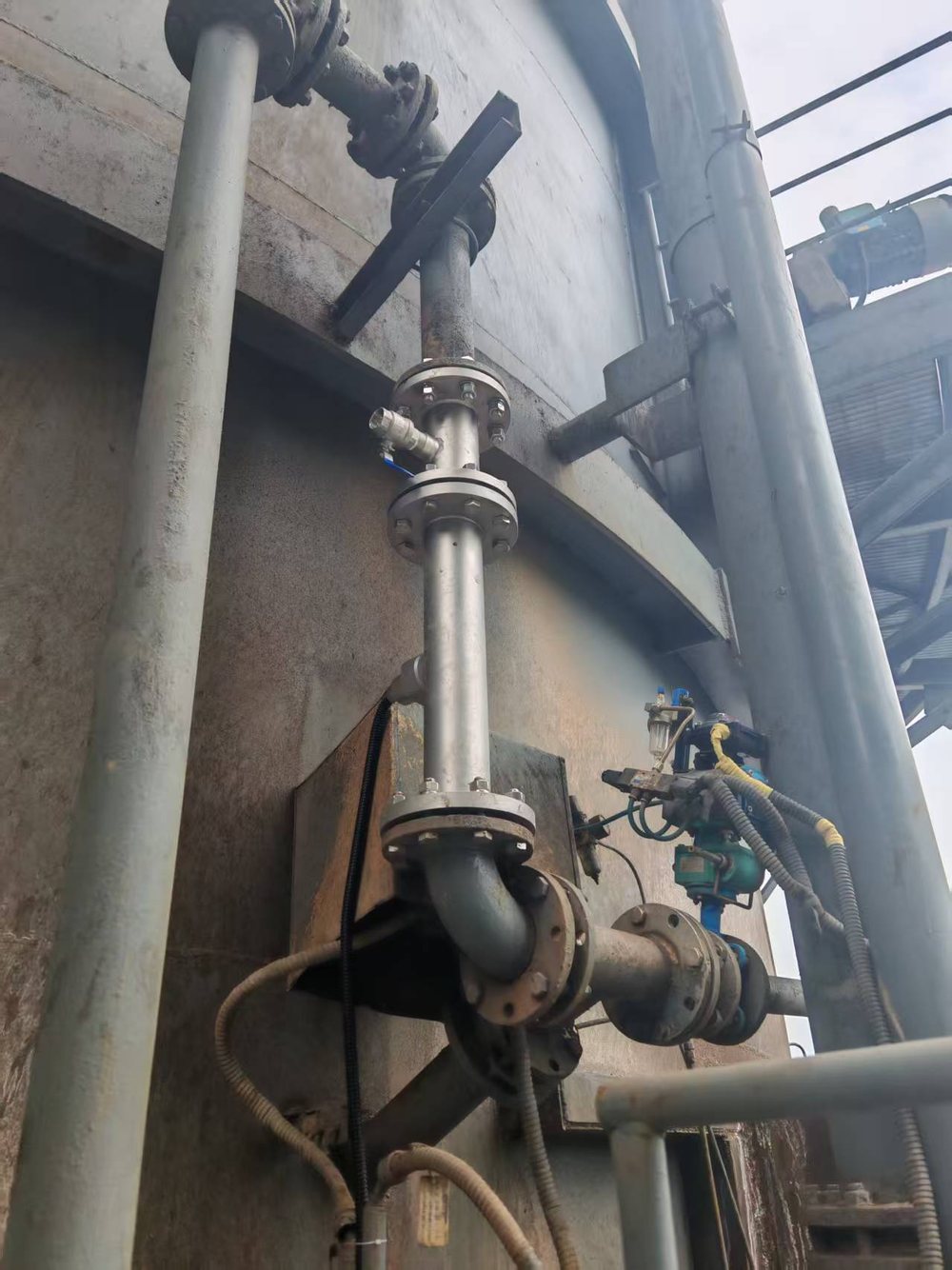
The measuring spool up close: the lower section is the measuring tube, with the sensor in its side wall; the upper section is the sampling tube, with a blue-handled sampling ball valve. Below the spool, ahead of the elbow, is a pneumatic valve.
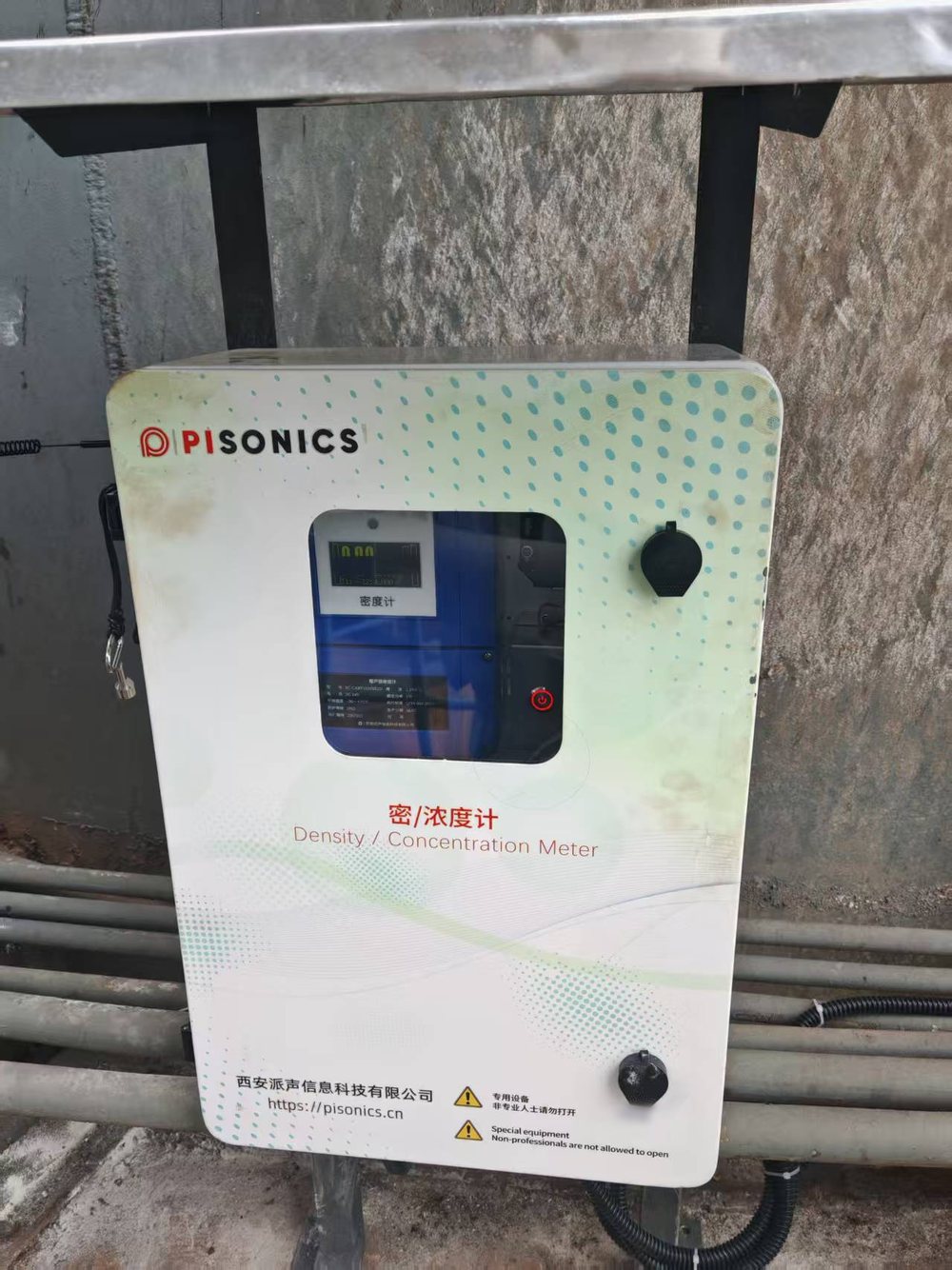
The Pisonics transmitter enclosure, with a viewing window in the door and a sunshade frame above.
Notes for similar FGD feed-line measuring points
- Prefer a vertical riser. With the slurry flowing upward past the sensor, it is less likely to stratify; on a horizontal run, make sure the pipe runs full and the slurry does not stratify.
- Sample right next to the sensor. For comparisons, take the sample from the port on the measuring spool and compare it with the reading at the same moment. With a distant sampling point and a changing process, a deviation may not come from the meter at all (see Low One Day, High the Next — Why Bidirectional Deviation Proves the Meter Right).
- Skip the no-feed periods. While the feed is stopped and the slurry sits still, do not compare and do not adjust the zero; where possible, bring in the run signal of the feed pump or feed valve as the enable condition for the measurement.
- Calibrate across the temperatures you see. Where the temperature at the measuring point varies widely, the calibration should cover the actual range, and the probe temperature should be logged with every comparison.
- Put the sensor face on the inspection list. Check the sensor face during shutdowns; if the comparison deviation suddenly grows, check the face for scale before changing any coefficients.
About Pisonics
Pisonics specializes in industrial-grade online density and concentration measurement, delivering sensor-to-cloud solutions for mining, energy, chemicals, pharmaceuticals, new energy, municipal and other sectors.
Contact: service@pisonics.com
Related reading