PS7000 Enters Service on Red Mud Dealkalization Washer Underflow at an Alumina Refinery
How thick the first washer runs its underflow has a direct bearing on washing efficiency. Following the red mud filter-press feed installation reported in September, another alumina refinery in south-west China has put a Pisonics PS7000 on the first-washer underflow line of its red mud dealkalization step. The slurry is close to 80 °C and the pipe is insulated; the sensor is side-mounted on a horizontal run with its face flush with the pipe wall, reading underflow density inline — no radioactive source.
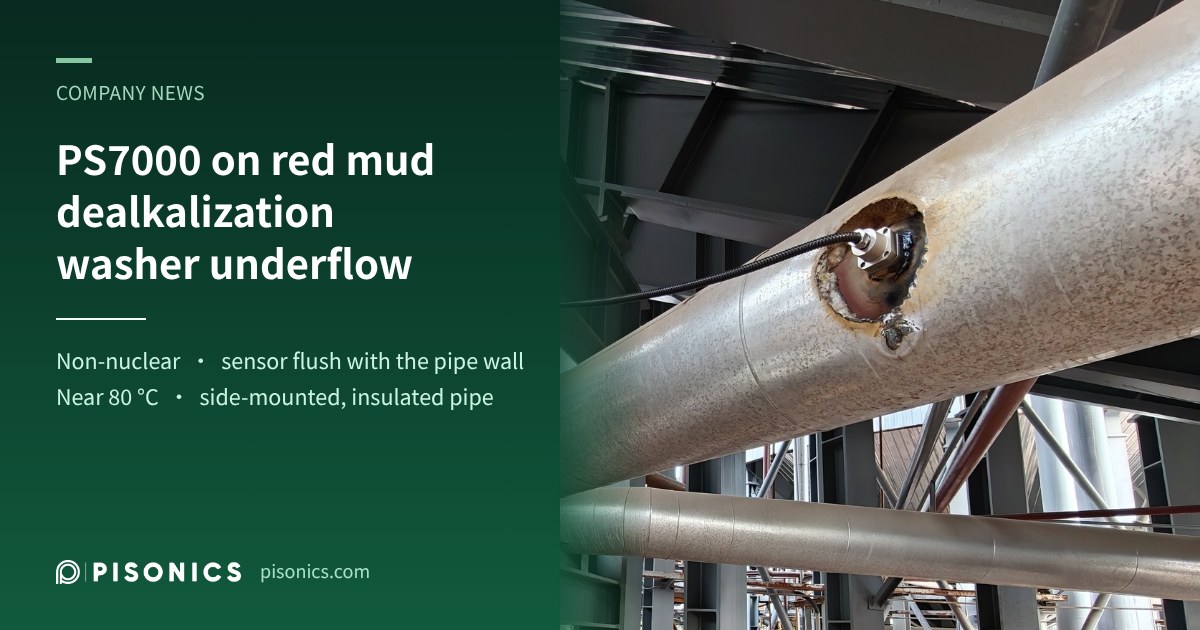
A Pisonics PS7000 ultrasonic slurry density meter entered service in early October at another alumina refinery in south-west China. Following the red mud filter-press feed installation reported in September, this is PS7000's next red mud measuring point in the alumina industry: it sits on the underflow line of the first washer in the plant's red mud dealkalization step, where the slurry runs close to 80 °C and the pipe is insulated. PS7000 is mounted on the side of a horizontal run and measures the density of the first-washer underflow inline. It has run continuously since commissioning, with readings uploaded to the Pisonics cloud platform every five minutes.
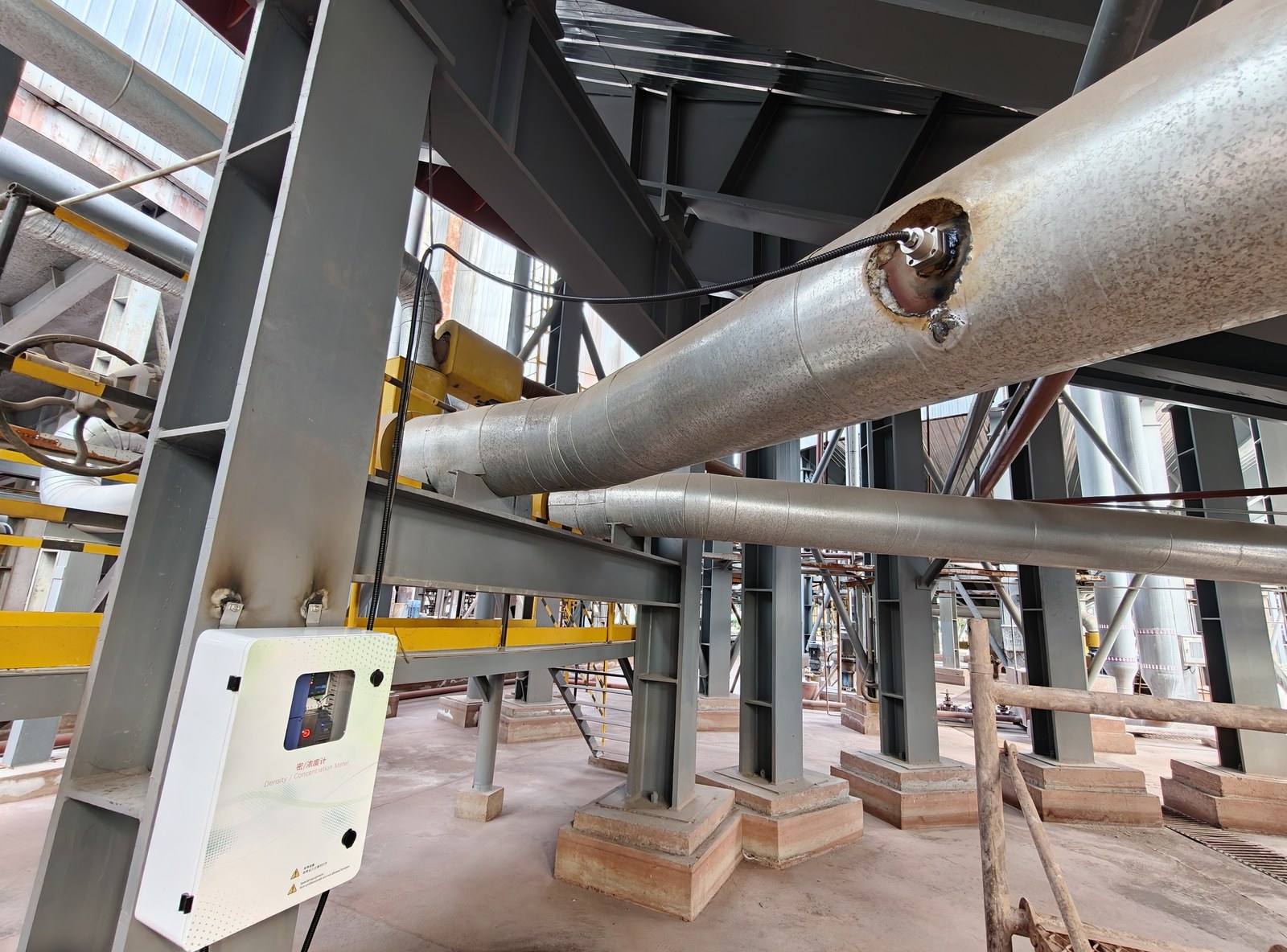
The underflow line runs horizontally beneath the steelwork (shot from below, so the pipe appears to slope). The sensor is on the side of the pipe, where a window has been opened in the insulation; the transmitter is mounted separately on the column nearby, and the sensor cable comes across in armoured conduit.
Where the measuring point sits
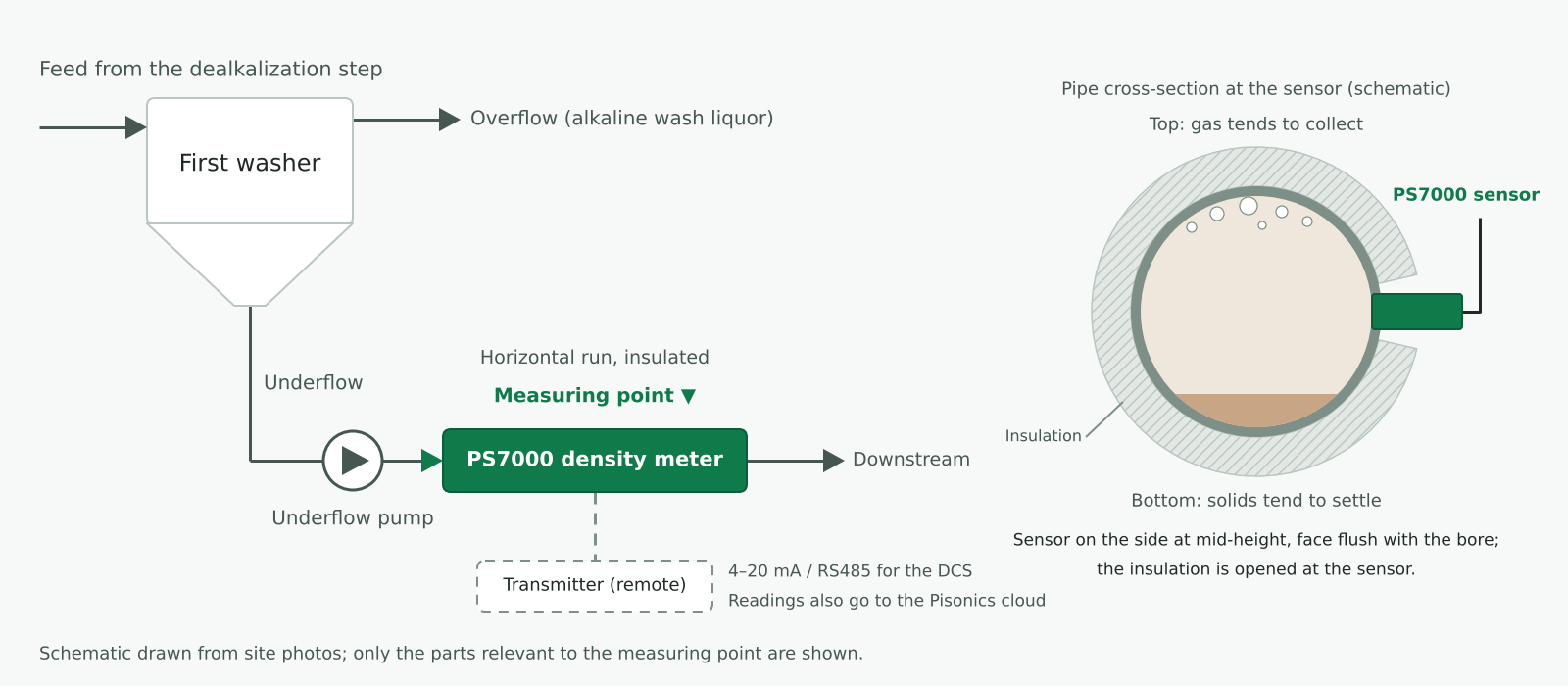
First-washer underflow and the measuring point (schematic, drawn from site photos); on the right, the pipe cross-section at the sensor.
Red mud dealkalization removes more of the alkali left in the red mud and recovers it, lowering the alkali content of the mud that leaves the plant. In this step the red mud is washed in several stages, and the first washer is the first of them: the slurry settles in the washer, alkaline wash liquor overflows at the top, and the thickened slurry at the bottom — the first-washer underflow — is drawn off by the underflow pump and sent on downstream. PS7000 sits on a horizontal run downstream of the underflow pump, so it reads the underflow as it leaves the first washer.
Why measure here
How thick the first washer runs its underflow has a direct bearing on how well the washing works. Run it too thin and more liquor is carried downstream with the mud, taking its alkali with it, so the later stages need more water to wash it out; run it too thick and the underflow pump and line work harder and are more prone to settling and blockage. Settlers and washers are usually run by adjusting the underflow draw-off against underflow density. Until now this point's density came from periodic sampling and lab analysis, and whatever happened between two samples went unseen; with an inline reading, it is visible at any time whether the underflow is running thick or thin.
What makes this measuring point difficult
- Slurry near 80 °C on an insulated pipe. The probe reads the slurry at 75–81 °C. The sensor has to reach the pipe wall through the insulation, so the insulation has to be opened. Temperature itself also changes the slurry's acoustic impedance, which is why calibration on the medium has to be done on site, under running conditions.
- The carrier liquid is alkaline wash liquor. The liquid phase is not water but wash liquor carrying alkali, and its concentration moves as the washing is adjusted. An acoustic impedance meter measures the impedance of the slurry as a whole, so when the liquor concentration changes, the same solids content no longer gives the same reading.
- Red mud settles fast, and a horizontal pipe stratifies. If the velocity drops, the slurry in a horizontal pipe turns thin at the top and dense at the bottom, and gas can collect at the crown. Where the sensor sits on the pipe's cross-section decides whether the layer it "sees" is representative.
- The burden of a radioactive source. Underflow points like this are often served by gamma density gauges, which bring licensing, annual inspection, qualified personnel and decommissioning with them.
How PS7000 is installed and how it measures
- On the side of the horizontal run. A Ø60 mm hole is cut in the existing pipe and a boss welded on; the sensor is clamped onto the boss with its face flush with the pipe wall — immersed in the medium, but not protruding into the flow. On a horizontal pipe the sensor goes on the side at mid-height, clear of settled solids at the bottom and gas at the crown — which is also what the PS7000 specification requires for horizontal pipes.
- Insulation opened, transmitter remote. A window has been opened in the insulation at the sensor; as standard, the transmitter is mounted separately — here on the column nearby — with the sensor cable run across in armoured conduit.
- Linear frequency-modulated (chirp) acoustic impedance, single sensor, pulse-echo. No radioactive source, so no source licence, no annual inspection and no decommissioning.
- Built-in temperature measurement. The sensor carries a PT1000, and slurry temperature is output alongside density.
- Aeration index and bubble flag. Alongside density the meter outputs an aeration index (0–100) and a bubble flag, so a moving reading can first be sorted into process change or bubble interference.
- Self-cleaning sensor face. The sensor face has an on-line self-cleaning function that works while the meter stays in service, with no shutdown and no need to pull the sensor. How that is done is Pisonics' own technology and is not detailed here.
- Outputs. Two 4–20 mA channels (NAMUR NE43 compliant) and RS485 Modbus-RTU for connection to the DCS; this meter's readings are also uploaded to the Pisonics cloud platform, so the trend can be checked remotely.
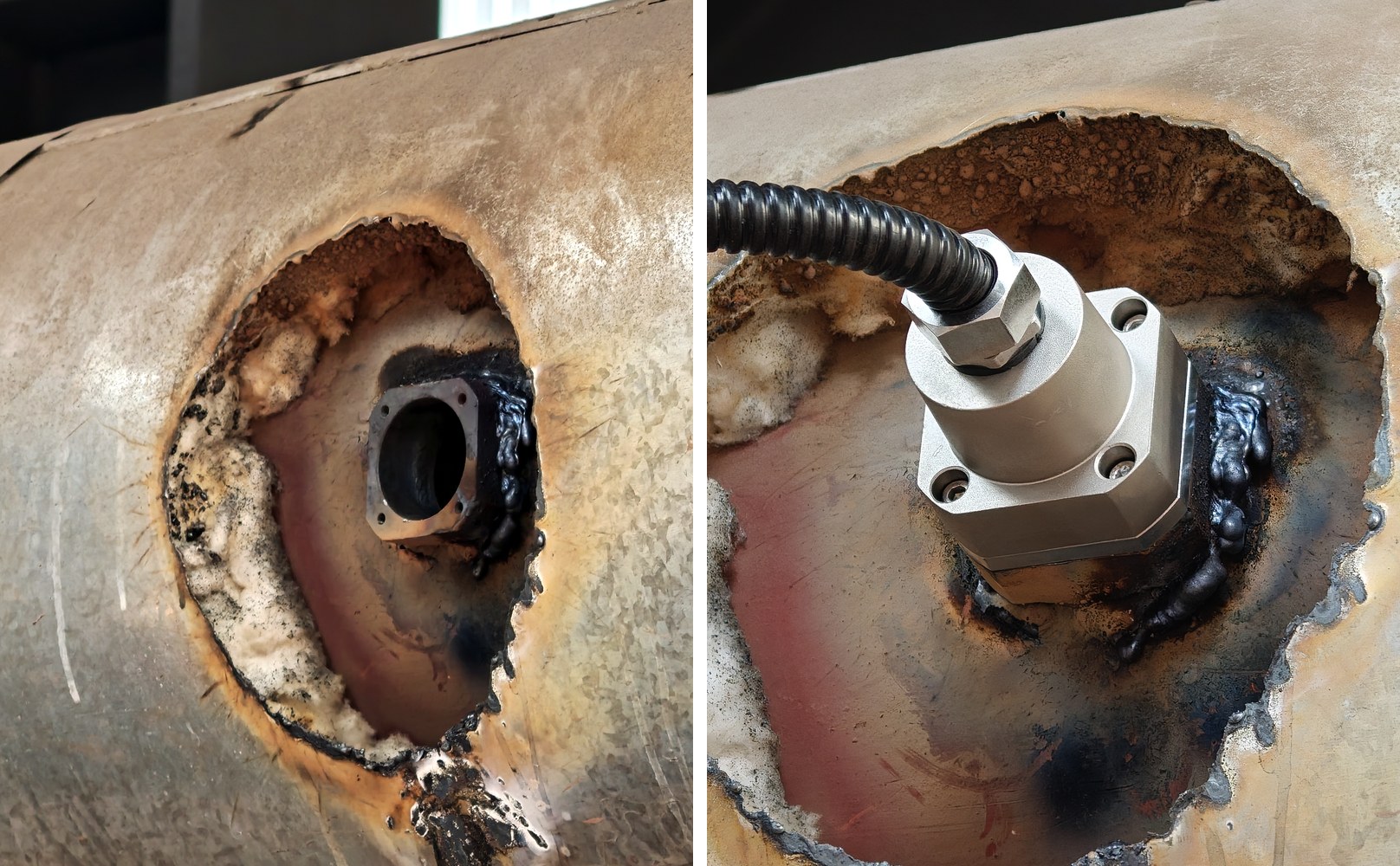
Left: with the insulation opened, the boss welded onto the pipe wall. Right: the finished sensor clamped onto the boss, its cable led out in armoured conduit.
Calibration and upkeep: three things an underflow point teaches
- Keep the sample point next to the meter, and agree the method first. The sample point used for calibration and comparison should sit right next to the sensor and draw from the same stream; agree how samples are taken and measured, and compare while the process is steady. If the sample point is further away, transport lag and stratification in the pipe both end up counted as meter error (see Low One Day, High the Next — Why Bidirectional Deviation Proves the Meter Right).
- Leave out readings taken while the pump is stopped. When the underflow pump stops, the slurry in the line settles where it stands and the reading creeps up while looking unusually steady; that stretch does not represent the process. Where the reading goes to the DCS, the pump's run signal can be used to enable it.
- Put the diagnostics on the inspection round. Red mud is abrasive and alumina duty tends to scale, and the meter does not raise a fault when the face is covered. Put diagnostics such as echo energy and signal quality on the routine round, and when their trend or the calibration looks wrong, inspect the face at the next shutdown.
About Pisonics
Xi'an Pisonics offers inline density and concentration measurement across six principle families — ultrasonic, tuning fork, Coriolis, optical, microwave and differential pressure — so a suitable instrument can be matched to each duty.
Contact: service@pisonics.com
Related reading