PS7000 Enters Service on Red Mud Filter-Press Feed at an Alumina Refinery
Red mud is abrasive, alkaline and prone to scaling, and the feed density to the filter presses is trimmed by recycling filtrate back into the line. An alumina refinery in south-west China put a Pisonics PS7000 on the slurry pipe between the buffer tank and the distributor to measure that feed density inline — no radioactive source, and nothing protruding into the flow.

A Pisonics PS7000 ultrasonic slurry density meter has recently entered service at an alumina refinery in south-west China. It sits on the pipe between the red mud buffer tank and the filter-press distributor, and measures the density of the slurry going to the presses. The site reports stable operation since commissioning.
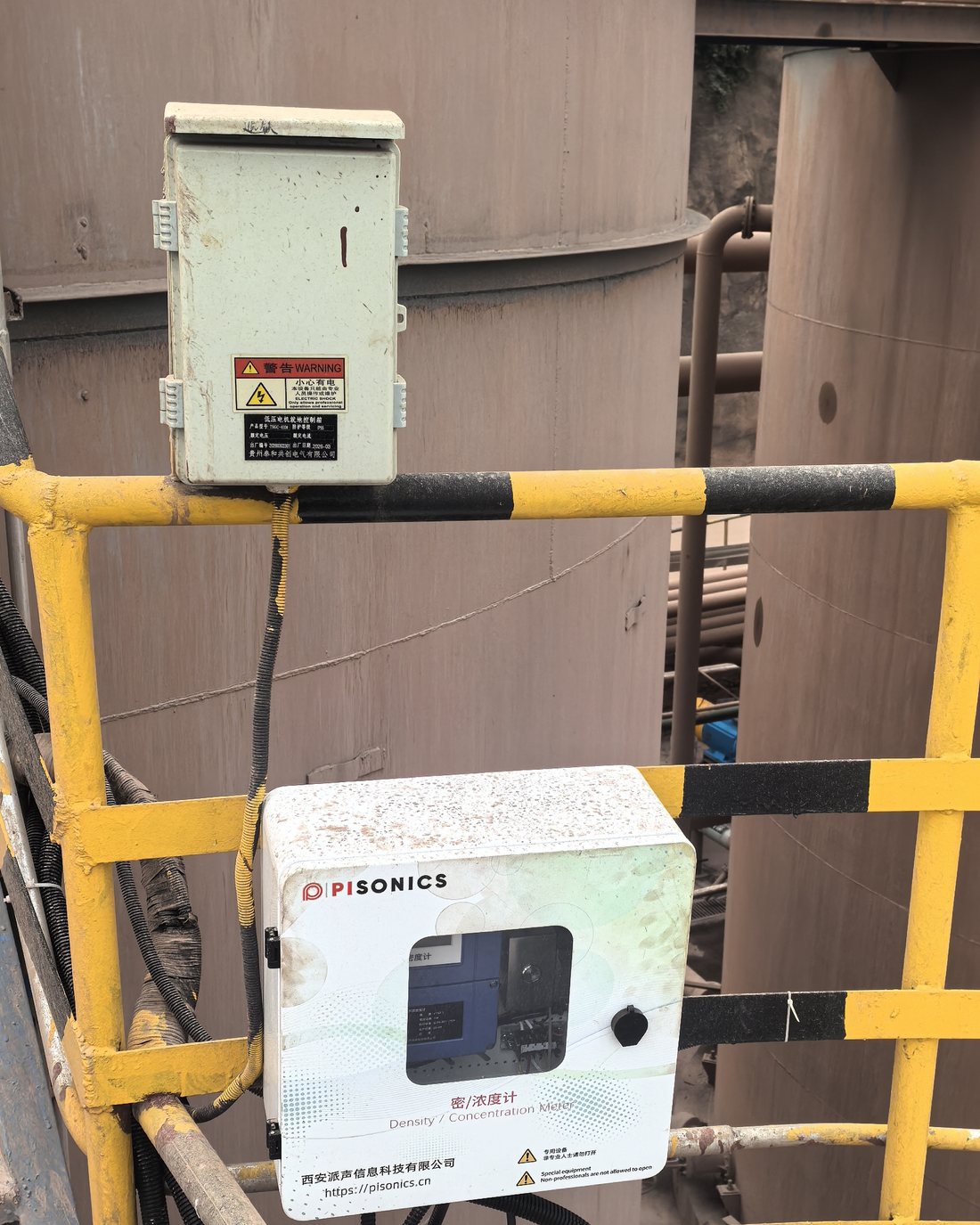
The transmitter is mounted on the handrail beside the measuring point, with the sensor cable run in along the pipe supports. Red mud dust is part of daily life in this area.
Where the measuring point sits
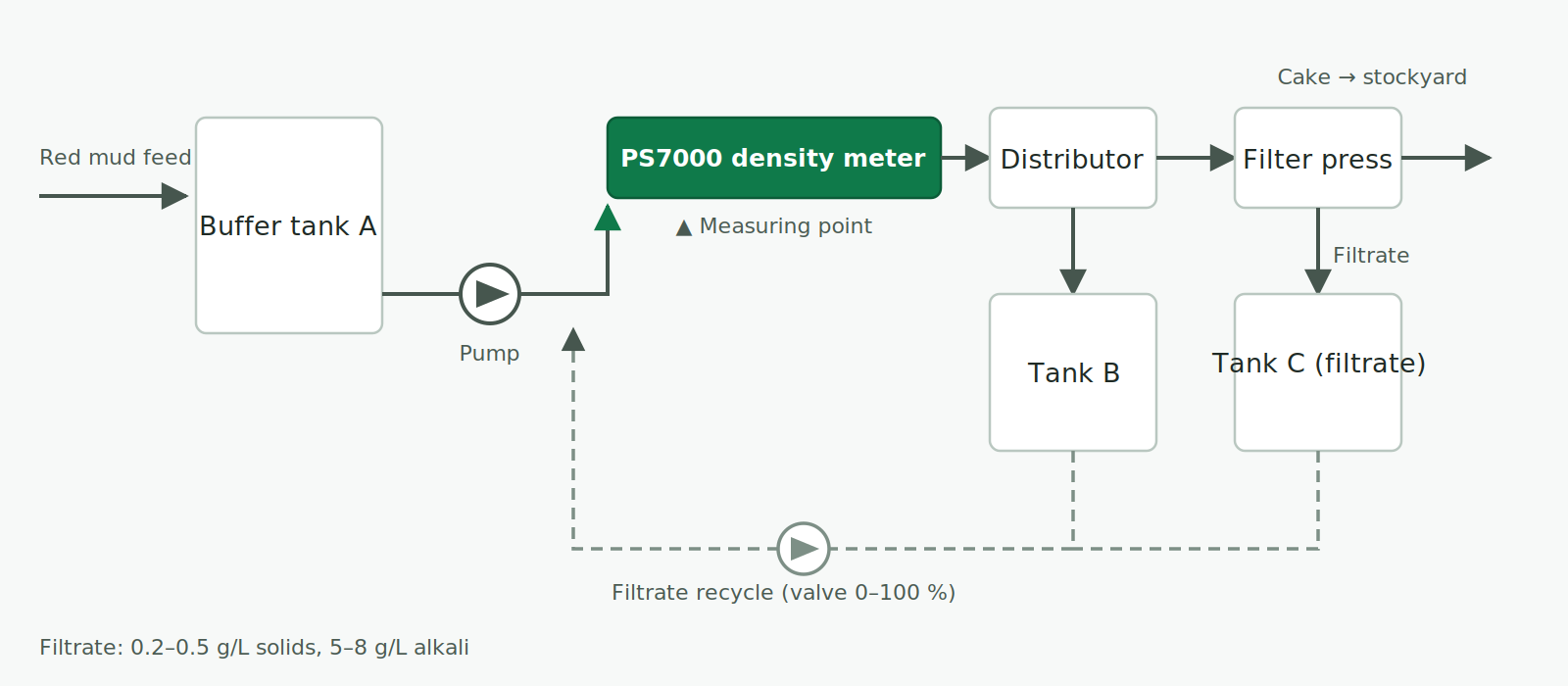
The red mud filtration circuit and the measuring point, drawn from the process sketch supplied by the site.
Red mud from settling and washing enters buffer tank A and is pumped to the distributor and on to the filter presses. The cake goes to the stockyard; the filtrate collects in tank C and is recycled into the suction side of the line, where it trims the feed density — the site adjusts it with a recycle valve from 0 to 100 %. PS7000 is installed downstream of the pump and upstream of the distributor, so it reads the slurry that actually goes to the presses.
Filtrate data supplied by the site: 0.2–0.5 g/L solids, 5–8 g/L alkali.
Why measure here
Feed density drives filtration cycle time, cake moisture and throughput. On this plant the control handle is the filtrate recycle, and moving that valve from fully shut to fully open changes the feed density by only about 0.05 g/cm³ — a loop that periodic manual sampling cannot follow. With an inline reading, the recycle can be trimmed against density instead of waiting for the next sample.
What makes this measuring point difficult
- Abrasion plus a tendency to scale. Red mud particles are abrasive and Bayer duty scales readily, which is hard on anything that reaches into the flow or has moving parts.
- The carrier liquid is not water. It is Bayer liquor (the site's filtrate runs 5–8 g/L alkali), so the same density change does not produce the same acoustic impedance change as in a water-based system: a clean-water point does not necessarily sit on the slurry's calibration line.
- The span to resolve is small. Fully shut to fully open is only about 0.05 g/cm³, so both the meter and the sampling method have to be consistent.
- The burden of a radioactive source. Slurry points like this are often served by gamma density gauges, which bring licensing, annual inspection, qualified personnel and decommissioning with them.
How PS7000 is installed and how it measures
- Mounted on the existing pipe. Unlined metal pipe takes the weld-in mount (a Ø60 mm hole cut in the pipe and a boss welded on); lined pipe takes a custom measuring spool. The sensor face sits flush with the pipe wall — immersed in the medium, but not protruding into the flow. The transmitter is mounted separately on the handrail nearby.
- Linear frequency-modulated (chirp) acoustic impedance, single sensor, pulse-echo. No radioactive source, so no source licence, no annual inspection and no decommissioning.
- Aeration index and bubble flag. Alongside density the meter outputs an aeration index (0–100) and a bubble flag, so a moving reading can first be sorted into process change or bubble interference.
- Self-cleaning sensor face. The sensor face has an on-line self-cleaning function, and it is enabled at this measuring point: it works while the meter stays in service, with no shutdown and no need to pull the sensor. How that is done is Pisonics' own technology and is not detailed here.
- Outputs. Two 4–20 mA channels (NAMUR NE43 compliant) and RS485 Modbus-RTU for connection to the DCS.
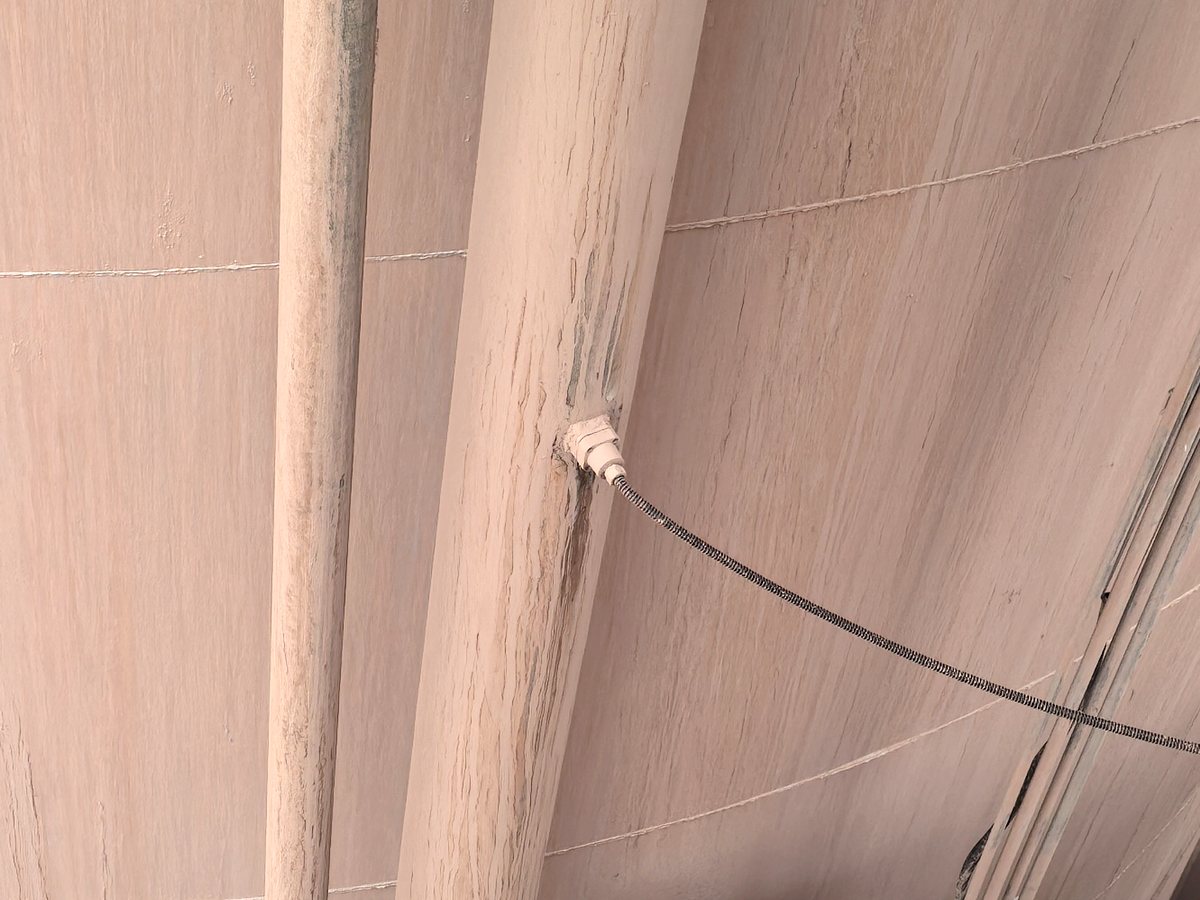
The sensor on the red mud pipe, face flush with the bore; outside, only the cable gland and the armoured conduit are visible.
Calibration and upkeep: three things red mud teaches
- Do not calibrate on clean water. Where the carrier liquid is process liquor, clean water is for a function check only. Calibrate on the actual slurry: at least three points of genuinely different density taken by sampling and weighing, with r² ≥ 0.8 on the regression. A slope derived from a clean-water zero usually lands off the slurry line.
- Agree the sampling method first. Same vessel, volume checked with clean water and tare deducted, sample point as close to the meter as possible, comparison taken in steady operation. When the whole span is a few per cent of density, an inconsistent sampling routine produces a bigger deviation than the meter does (see Low One Day, High the Next — Why Bidirectional Deviation Proves the Meter Right).
- Put the sensor face on the inspection round. Bayer duty scales, and the meter does not raise a fault when the face is covered. Include the face in routine inspection, check it first when calibration looks wrong, and tune the self-cleaning to the scaling actually seen.
About Pisonics
Xi'an Pisonics offers inline density and concentration measurement across six principle families — ultrasonic, tuning fork, Coriolis, optical, microwave and differential pressure — so a suitable instrument can be matched to each duty.
Contact: service@pisonics.com
Related reading