PS7000 Enters Service on the Flotation Feed at a Coal Preparation Plant
Flotation feed carries only tens of grams to just over a hundred grams of solids per litre, and coal solids are far lighter than mineral ore — yet reagents are dosed against dry solids. On the middlings upgrading line of a coal preparation plant in south-west China, a Pisonics PS7000 now sits on the vertical riser after the flotation feed pump, on the same pipe as an electromagnetic flow meter, and reads the feed concentration inline — nothing protruding into the flow, and no radioactive source.
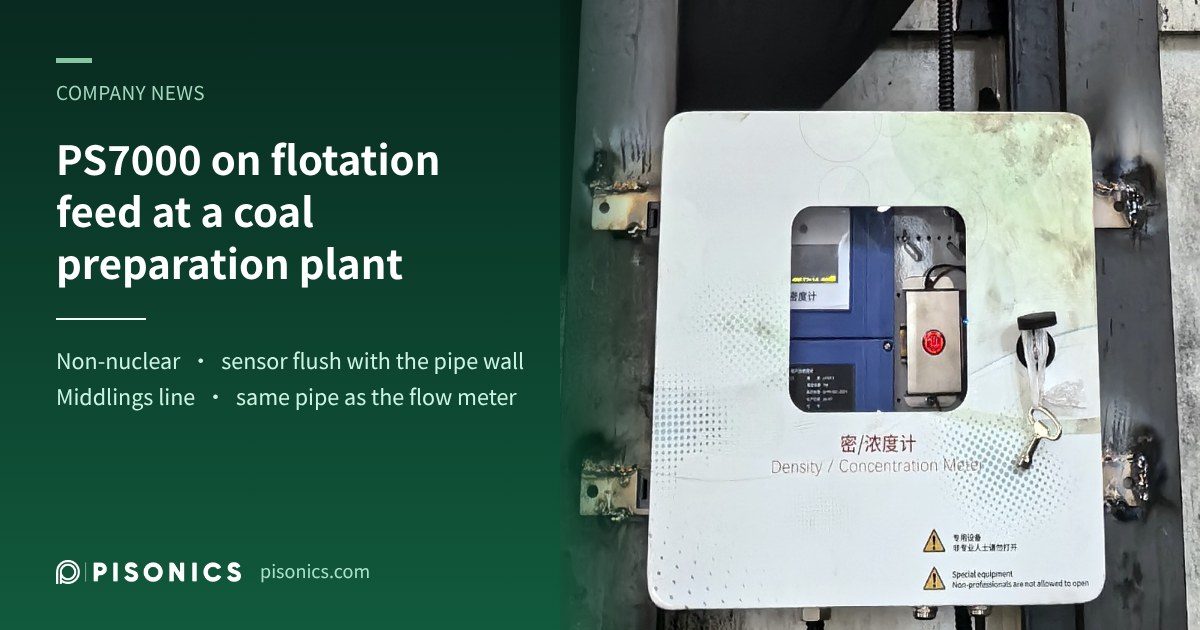
A Pisonics PS7000 ultrasonic slurry density meter entered service in August at a coal preparation plant in south-west China. The plant's middlings upgrading line crushes middlings to liberate the coal locked in them and re-treats them together with the slimes. PS7000 sits on the vertical riser after the flotation feed pump and measures the rougher feed concentration inline, reported in g/L. The site reports stable operation since commissioning.
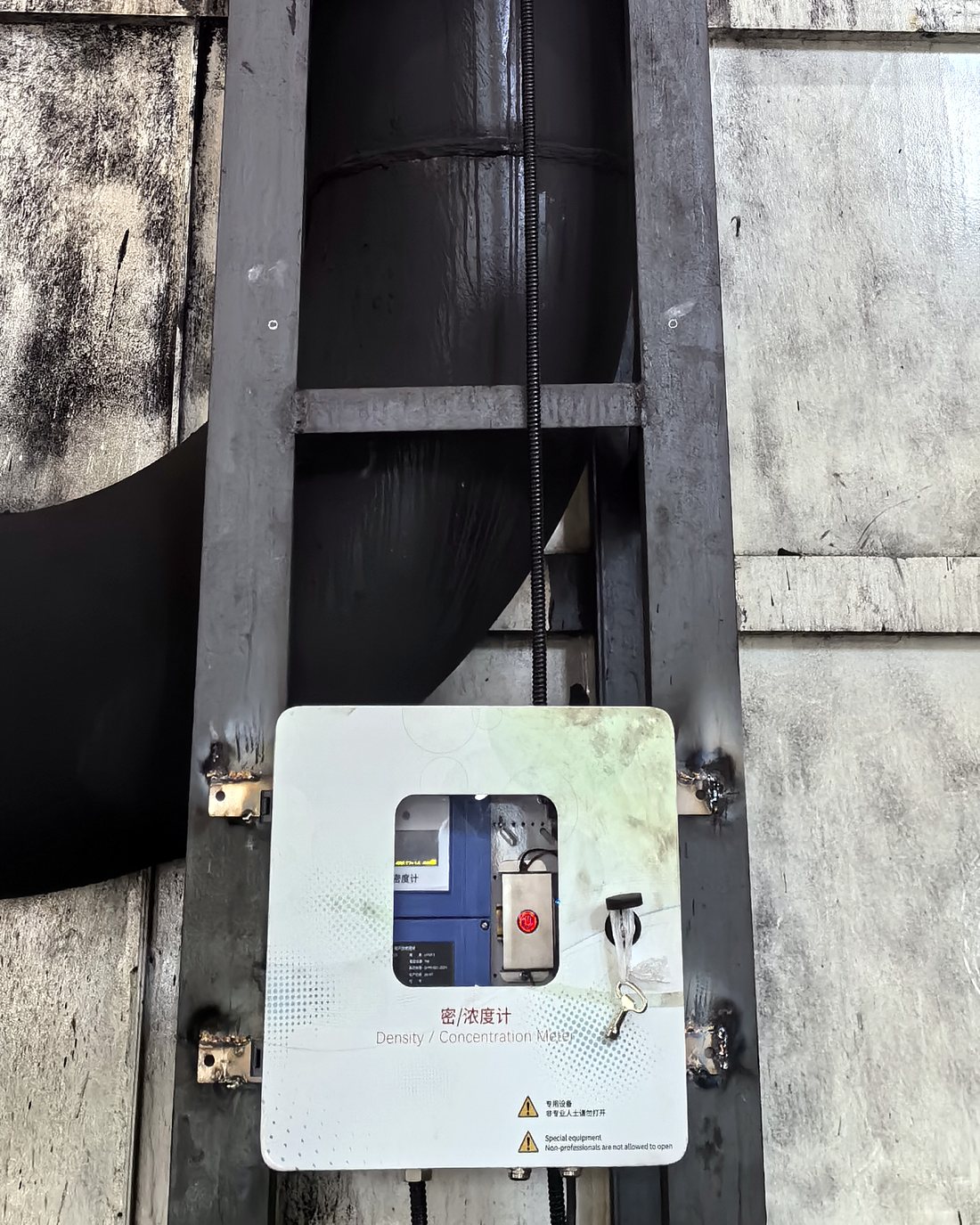
The transmitter is mounted separately on the steel frame beside the feed riser, and the sensor cable comes down the riser in armoured conduit. The bend on the left is the feed pump discharge turning upward.
Where the measuring point sits
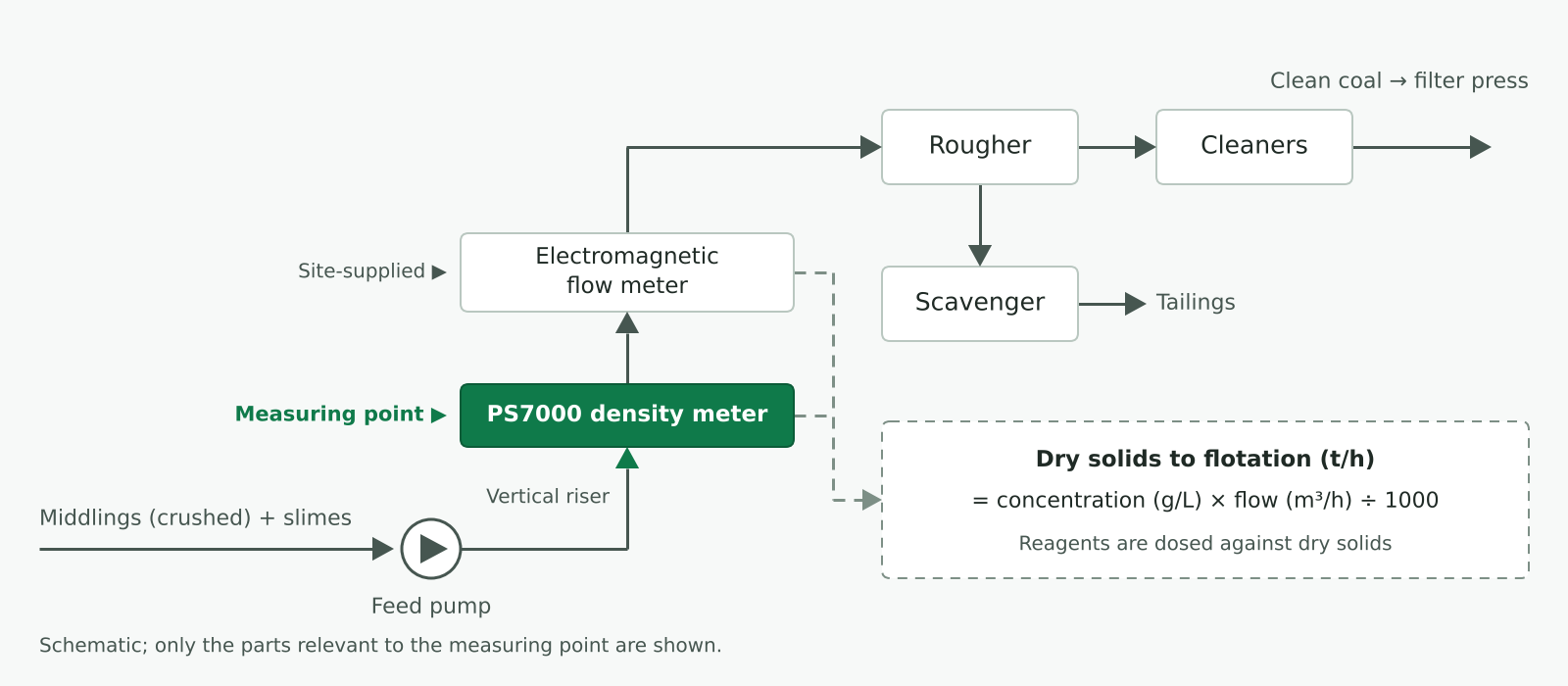
Flotation feed and the measuring point (schematic, drawn from site photos).
The flotation feed draws on crushed middlings and slimes. The feed pump sends it up a vertical riser to the rougher; rougher concentrate is cleaned to clean coal and goes on to the filter presses, and rougher tailings go to the scavenger. PS7000 sits on that riser, directly below the site's electromagnetic flow meter — concentration and flow are measured on the same length of pipe, on the same stream.
Why measure here
Flotation reagents are dosed against the dry solids going to flotation: dry solids (t/h) = feed concentration (g/L) × feed flow (m³/h) ÷ 1000. The flow meter supplies flow continuously, but concentration used to come only from periodic manual samples, and whatever happened between two samples went unseen. On this line the feed draws on middlings crushing on one side and slimes on the other, and a change on either side changes the feed concentration. With an inline concentration, dry solids can be computed as continuously as flow, and dosing need not wait for the lab.
What makes this measuring point difficult
- Dilute feed, small density contrast. Flotation feed typically runs at 50–120 g/L, and coal solids are far lighter than mineral ore, so the slurry is only 19–53 kg/m³ denser than clean water — about 0.4 kg/m³ per g/L. The meter has to resolve changes of a few thousandths of a g/cm³.
- Temperature and ash both impersonate concentration. The density of clean water alone shifts by the equivalent of 9–11 g/L of feed solids between 10 and 30 °C; for an acoustic impedance meter the speed of sound in water also moves with temperature, and that effect is larger still. When the feed ash changes, so does the solids density, so the same slurry density does not always mean the same g/L.
- An unsteady feed. The amounts of crushed middlings and slimes move with production, and during start-up re-washing the feed arrives alternately dense and dilute. A manual sample speaks only for the moment it was taken.
- Bubbles and reagents. Residual frother returning with the circulating water, or air drawn in at the pump suction, can carry bubbles into the feed, and free gas makes the reading high; oily collectors may also leave a film on the sensor face.
How PS7000 is installed and how it measures
- On the vertical riser. A Ø60 mm hole is cut in the existing pipe and a boss welded on; the sensor is clamped onto the boss with its face flush with the pipe wall — immersed in the medium, but not protruding into the flow. A vertical upward section runs full and resists settling, which makes it the recommended location on flotation feed. The transmitter is mounted separately on the steel frame beside the riser.
- On the same pipe as the flow meter. The electromagnetic flow meter sits directly above the sensor, so the two instruments see the same stream and the dry-solids figure they produce actually adds up.
- Linear frequency-modulated (chirp) acoustic impedance, single sensor, pulse-echo. No radioactive source, so no source licence, no annual inspection and no decommissioning.
- Output in g/L. The meter can report feed concentration directly in g/L. Calibration on the process slurry is always done on site (PS7000 leaves the factory calibrated on clean water only). A temperature sensor is built into the probe; where the feed temperature moves with the season or the shift, temperature compensation should be enabled and confirmed during calibration.
- Aeration index and bubble flag. Alongside concentration the meter outputs an aeration index (0–100) and a bubble flag; once the reading feeds a dosing loop, these can freeze it through bubbly spells and hold the last valid value.
- Self-cleaning sensor face. The sensor face has an on-line self-cleaning function that works while the meter stays in service, with no shutdown and no need to pull the sensor. How that is done is Pisonics' own technology and is not detailed here.
- Outputs. Two 4–20 mA channels (NAMUR NE43 compliant) and RS485 Modbus-RTU for connection to the DCS; this meter's readings are also uploaded to the Pisonics cloud platform, so the trend can be checked remotely.
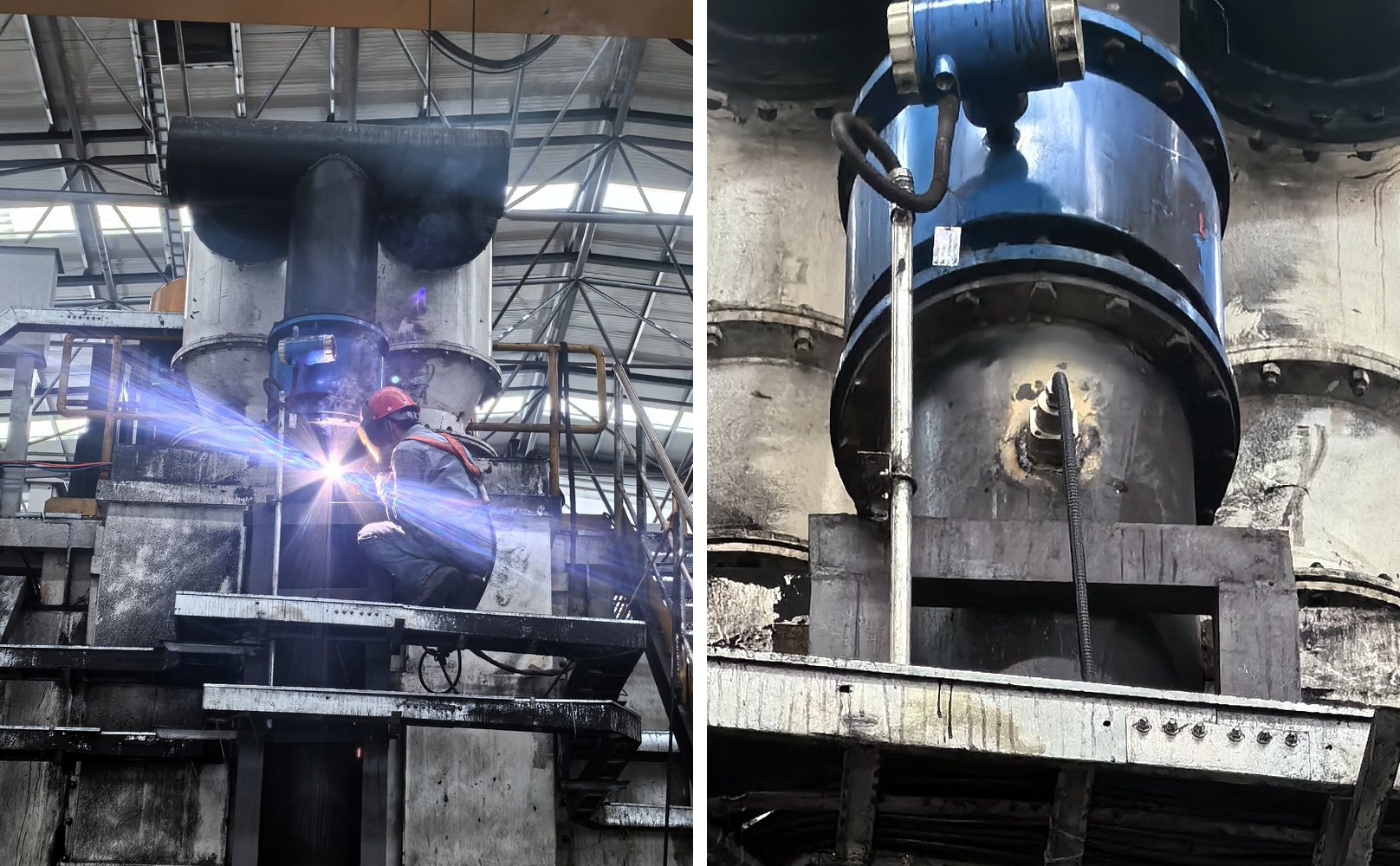
Left: during installation, a hole is cut in the existing pipe and the boss welded on, just below the flow meter. Right: the finished sensor, face flush with the bore; outside, only the cable gland shows, and the cable runs down the riser in armoured conduit.
Calibration and upkeep: three things flotation feed teaches
- Use oven-dried samples as the reference. For calibration and comparison, take a measured volume, filter it, dry it and weigh the solids, and make sure the calibration points cover the everyday concentration range. Acceptance on a feed point is agreed in advance by both sides, based on the deviation from oven-dried comparisons.
- Agree the sampling method first. Sample as close to the meter as possible, from the same stream, and compare while the feed is steady. Flotation feed spans only a few tens of g/L, so an inconsistent sampling routine produces a bigger deviation than the meter does (see Low One Day, High the Next — Why Bidirectional Deviation Proves the Meter Right).
- Put the sensor face on the inspection round. The meter does not raise a fault when the face is covered by an oil film or fines. Include the face in routine inspection and check it first when calibration looks wrong.
About Pisonics
Xi'an Pisonics offers inline density and concentration measurement across six principle families — ultrasonic, tuning fork, Coriolis, optical, microwave and differential pressure — so a suitable instrument can be matched to each duty.
Contact: service@pisonics.com
Related reading