PISONICS
PS7020 Series
Ultrasonic Concentration Meter (sound velocity)
Sound velocity · temperature element in the acoustic path · concentration–velocity–temperature matrix
Inline Concentration of 92–98 % Sulfuric Acid
—— Drying and absorption circulating acid · dilution · product acid ——
【Measured: H₂SO₄ wt% / temperature °C】
Inline concentration of 92–98 % sulfuric acid
1. Why density and conductivity fail in concentrated acid
The commonest inline concentration points on a sulfuric acid plant — circulating acid in the drying and absorption towers, acid after water dilution, and product acid — almost all sit above 90 %. That is exactly where the two most familiar physical properties stop working.
| Method | Behaviour above 85 wt% H₂SO₄ | Verdict |
|---|---|---|
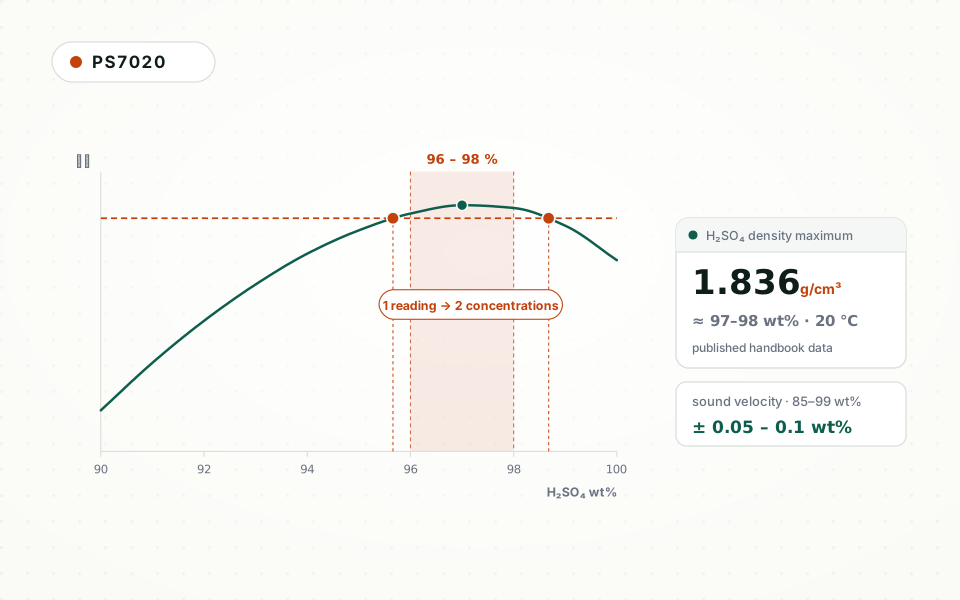
| Density | Rises to a maximum near 98 wt%: about 1.836 g/cm³ at 20 °C, and about 1.831 g/cm³ at 100 %. Between 96 % and 98 % it moves on average only about 0.3 kg/m³ per wt%, and either side of the maximum one density maps to two concentrations | Not usable here |
| Conductivity | Passes through a maximum in the low nineties, so above 90 % one reading again maps to two concentrations | Not usable here |
| Refractive index PS7110 | Single-valued, but the slope flattens in the concentrated region | Usable, lower sensitivity |
| Sound velocity PS7020 | Single-valued and steep; ±0.05–0.1 wt% measured against titration at 85–99 % | Recommended |
Density values are published handbook data at 20 °C, shown for the trend.
2. Measured accuracy by concentration band
The table below comes from PS7020 calibration against titrated standards, and it is the basis on which we accept or decline a sulfuric acid duty. Accuracy is stated as an absolute figure in wt%.
| Concentration band | Measured accuracy (wt%) | Remarks |
|---|---|---|
| 85–99 % | ±0.05–0.1 | Best-performing region: the velocity curve is single-valued and steep |
| 80–85 % | ±0.1 | Single-valued; slope still strong |
| 75–80 % | ±0.3 | Slope begins to flatten |
| 45–75 % | ±1 | Usable for trend and control, not for custody-grade concentration |
| 35–45 % | Not measurable | Turning point of the velocity curve: no sensitivity to concentration, double-valued across it; a calibrated span must not cross this band |
| 15–35 % | ±0.4 | Single-valued on the dilute branch |
| 5–15 % | ±1 |
The concentrated-region calibration covers 20–95 °C. The dilute region is covered over a narrower temperature window; state the process temperature at enquiry so that the relevant part of the matrix can be confirmed. The binding figure for a delivered instrument is the calibration matrix built for your own acid over your own operating envelope — see section 7.
A correction on the turning point. Some published material places the turning point of the sulfuric acid velocity curve below about 90 %, and our own material quoted it until September 2026. Our titration-referenced calibration data does not support it: the insensitive region is 35–45 wt%. The measured figure stands; the earlier statement is withdrawn.
This decides how a span is set: a calibrated span must not cross 35–45 %. Where the process passes through that band — at start-up, shutdown or flushing — it needs a second configuration or a second physical quantity to disambiguate; widening the span does not solve it.
3. The constraint is temperature, not velocity resolution
Concentrated sulfuric acid behaves as an associated liquid with a negative temperature coefficient of a few m/s per kelvin. Across a few wt% in the concentrated region, the sound velocity changes by an amount of the same order as it changes across a 70 K temperature swing — at any moment the instrument is separating two effects of similar size.
The accuracy actually delivered is therefore decided by the density of the calibration grid in the temperature direction and by how well the medium temperature is measured in the acoustic path. Velocity resolution (of the order of 0.01 m/s) is not the bottleneck.
- Define the operating envelope per point. A measuring point usually runs in a much narrower window than the plant's full range — for example 97.5–98.5 wt% at 75–85 °C in an absorption circuit. A matrix fitted to that window outperforms a global fit by a wide margin; it is the single most effective step.
- Measure temperature in the acoustic path. A fast element thermally coupled to the wetted body, not a separate thermowell elsewhere in the line, so that temperature ramps do not produce a transient concentration offset.
- Do not span across 35–45 wt%. See section 2.
4. Measuring points and what they control
| Point | What the inline concentration controls | Watch |
|---|---|---|
| Absorption tower circulating acid | The water (or cross-fed dilute acid) addition that holds the circulating acid in its window | Hot; specify materials for the lowest concentration at the highest temperature |
| Drying tower circulating acid | Drying-acid strength, together with the acid cross-flow between the drying and absorption systems | Weaker than absorption acid; give it its own envelope |
| Dilution / blending | Acid strength after water addition | At least 10 pipe diameters of straight run after the mixing point |
| Product acid | Strength before dispatch | Compare with titration in pairs; use as the acceptance basis |
5. Wetted materials: the lowest concentration at the highest temperature
Corrosion resistance in sulfuric acid is strongly concentration-dependent: for most alloys the corrosion rate is lowest close to 98–99 %, and it rises sharply as concentration drops toward the low nineties and as temperature rises. The governing case is therefore not the nominal 98 % but the lowest concentration this point can see at the highest temperature it can see. State at enquiry whether those two conditions can occur together.
| Material | Assessment |
|---|---|
| Hastelloy C-2000 / C-276 | Baseline recommendation, including the low-90s / high-temperature corner |
| Tantalum (clad) | Upgrade option; excellent across the whole concentration range to roughly 150 °C. Not suitable if oleum or free SO₃ is present, nor with fluoride |
| Alloy 20 | Acceptable in this band; check acid velocity, as protective-film alloys are velocity-sensitive |
| 316L | Not recommended: adequate in concentrated acid near ambient only; corrosion rate rises steeply above roughly 40–50 °C |
| Titanium, Nickel 200, Monel 400 | Not recommended in oxidizing concentrated sulfuric acid |
| Zirconium 702 | Not recommended above approximately 70 wt% |
The usual failure mode for probes in hot concentrated acid is velocity-assisted attack on the passive film rather than general corrosion, so please give the acid flow velocity in the line as well.
6. Installation
- Full pipe, no gas pocket: a vertical upward-flowing run is preferred; in a horizontal run mount at 3 or 9 o'clock, not at the top.
- In the flowing stream, not in a stagnant nozzle — otherwise the reading lags the process and the temperature element does not see the medium.
- Mixing length after any dilution or blending point: at least 10 pipe diameters, more where the two streams differ strongly in temperature; unmixed streaks passing the sensor show up as noise. For ordinary points: 10 D upstream and 5 D downstream (5 D / 3 D minimum).
- Avoid dead legs: stagnant acid next to the sensor slows the response and aggravates local corrosion.
7. Calibration and acceptance
- Factory calibration: titrated H₂SO₄ standards across the confirmed concentration span at several temperature levels spanning the operating range, giving the concentration–velocity–temperature matrix loaded into the instrument.
- Site adjustment: a one- or two-point offset against plant titration at the actual working concentration and temperature, after commissioning.
- Acceptance: define accuracy as the standard deviation of instrument reading minus titration over an agreed number of paired samples within an agreed envelope, and write it into the calibration certificate. That gives a figure that can be demonstrated on the plant rather than asserted in a data sheet, and makes a comparison with an incumbent instrument like-for-like.
Displayed decimals are not accuracy. An instrument stated at ±0.05 wt% that displays three decimals shows a last digit already below its own uncertainty; it only looks finer.
PS7020 key specifications
| Item | Specification |
|---|---|
| Measuring principle | Ultrasonic sound velocity: transit time → velocity → concentration / density |
| Measured values | Concentration, density, sound velocity and temperature, output together |
| Velocity resolution | 0.01 m/s |
| Temperature | Resolution 0.01 °C; element integrated in the sensor body, in the acoustic path |
| Medium temperature | −20 to +80 °C standard; −20 to +120 °C high-temperature version (choose it for absorption-circuit acid around 80 °C); 150 / 180 / 200 °C on request |
| Working pressure | ≤ 2.0 MPa standard; PN16 / PN40 / PN64 / PN100 / PN250 optional |
| Analog output | 4–20 mA × 2 |
| Digital communication | RS485 Modbus RTU (32-bit float); Profibus DP, HART, relay outputs optional |
| Power | DC 24 V or AC 220 V |
| Protection | IP65; Ex d IIC T6 Gb optional |
| Calibration | Factory concentration–velocity–temperature matrix from titrated or gravimetric standards; 1–2 point site adjustment |
| Wetted materials | For sulfuric acid, per section 5; for other media, assessed against concentration, temperature and impurities |
Before you order
- Concentration operating range per point — normal value and excursion limits, not only the display scale.
- Process temperature per point, normal and excursion. This is the single most useful figure for the accuracy question.
- Can the process pass through 35–45 wt% at any time, including start-up, shutdown or flushing?
- Is oleum or free SO₃ present? It affects both the concentration relationship and the wetted material.
- Line size, pressure, acid flow velocity and process connection standard.
- Required accuracy, and whether it is stated as absolute wt%, % of span or % of reading.
- Hazardous-area classification and required protection type.
- Required signal outputs and the control system they connect to.
- Reference method used for verification, and whether titrated samples of the actual acid can be supplied for factory calibration.
What this page is: the band accuracies come from PS7020 calibration against titrated standards (Sulfuric Acid Application Note Rev. B, September 2026); the binding figure for a delivery is the calibration matrix built for your acid and your operating envelope. There are no unit counts, saving percentages or payback periods here — we do not invent those.
Conclusion
PISONICS covers six principle families (ultrasonic, tuning fork, Coriolis, optical, microwave, differential pressure) for inline density and concentration; the first step of any selection is to ask what quantity the process actually needs, and in which range.
Sulfuric acid is the textbook case of choosing the method by concentration band: sound velocity above 85 %; for dilute acid around 30–40 %, density is single-valued and steep enough that a tuning fork is the better fit (see 37 wt% dilute sulfuric acid feed control); and 35–45 % is the band where sound velocity does not work. More media in the acid and alkali selection guide; why temperature is the constraint, in the technical note Measuring 92–98 % sulphuric acid.