PISONICS· Xi’an Pisonics
PS7000 Series
Ultrasonic Acoustic Impedance Slurry Density Meter
Application Case in the Lithium‑Battery Copper Foil / Electrolyte Industry
—— Online Monitoring of Copper Sulfate + Sulfuric Acid + Additive Electrolyte Concentration ——
Corrosion Resistance · Sub‑second Response · Automatic Mixing · Enhanced Foil Uniformity
Lithium‑Battery Copper Foil / Electrolyte · PS7000 Application Solution
1. Process Background
Copper foil for lithium‑ion batteries is a critical base material serving as the current collector on the negative electrode. Its production primarily employs an electroplating process: high‑purity copper is dissolved in sulfuric acid to form a copper sulfate electrolyte (typically Cu²⁺ 70–110 g/L, H₂SO₄ 80–120 g/L). Various organic additives—such as leveling agents, brighteners, and smoothing agents—are introduced to regulate grain growth. Within an electrolytic cell featuring large titanium anodes and a rotating cathode roller, copper ions are reduced and deposited onto the cathode surface, then peeled off to produce ultra‑thin copper foil with a thickness of 4.5–12 μm.
The precision of the electrolyte’s concentration directly affects the foil’s uniformity, mechanical properties, and battery consistency: a 1% deviation in CuSO₄ concentration can widen the foil thickness tolerance by more than 0.5 μm, significantly degrading the capacity uniformity of an entire batch; meanwhile, sulfuric acid concentration influences conductivity, deposition rate, and crystal structure. The lithium‑battery industry’s stringent requirements for foil consistency have made real‑time, high‑precision monitoring of electrolyte density an indispensable component of production line intelligence.
2. Pain Points of Traditional Density/Concentration Measurement Solutions
• The electrolyte is highly corrosive—concentrated sulfuric acid, copper sulfate, and chloride ions create a synergistic corrosive environment. Standard 316L instruments have short lifespans, and diaphragm perforation can contaminate and scrap entire electrolyte batches;
• Traditional offline titration, colorimetry, and refractometry methods suffer from analysis lags of 0.5–2 hours, making it impossible to track rapid concentration changes in the electrolytic cell (high current densities lead to swift concentration drifts);
• The strong electromagnetic fields, high‑frequency vibrations, and acidic mist within the electrolytic cell place extremely demanding requirements on the instrument’s interference resistance and sealing integrity;
• Organic additive degradation and decomposition alter the electrolyte’s density, yet conventional single‑point measurements cannot disentangle the concentration changes of CuSO₄, H₂SO₄, and the additives.
3. PS7000 Solution
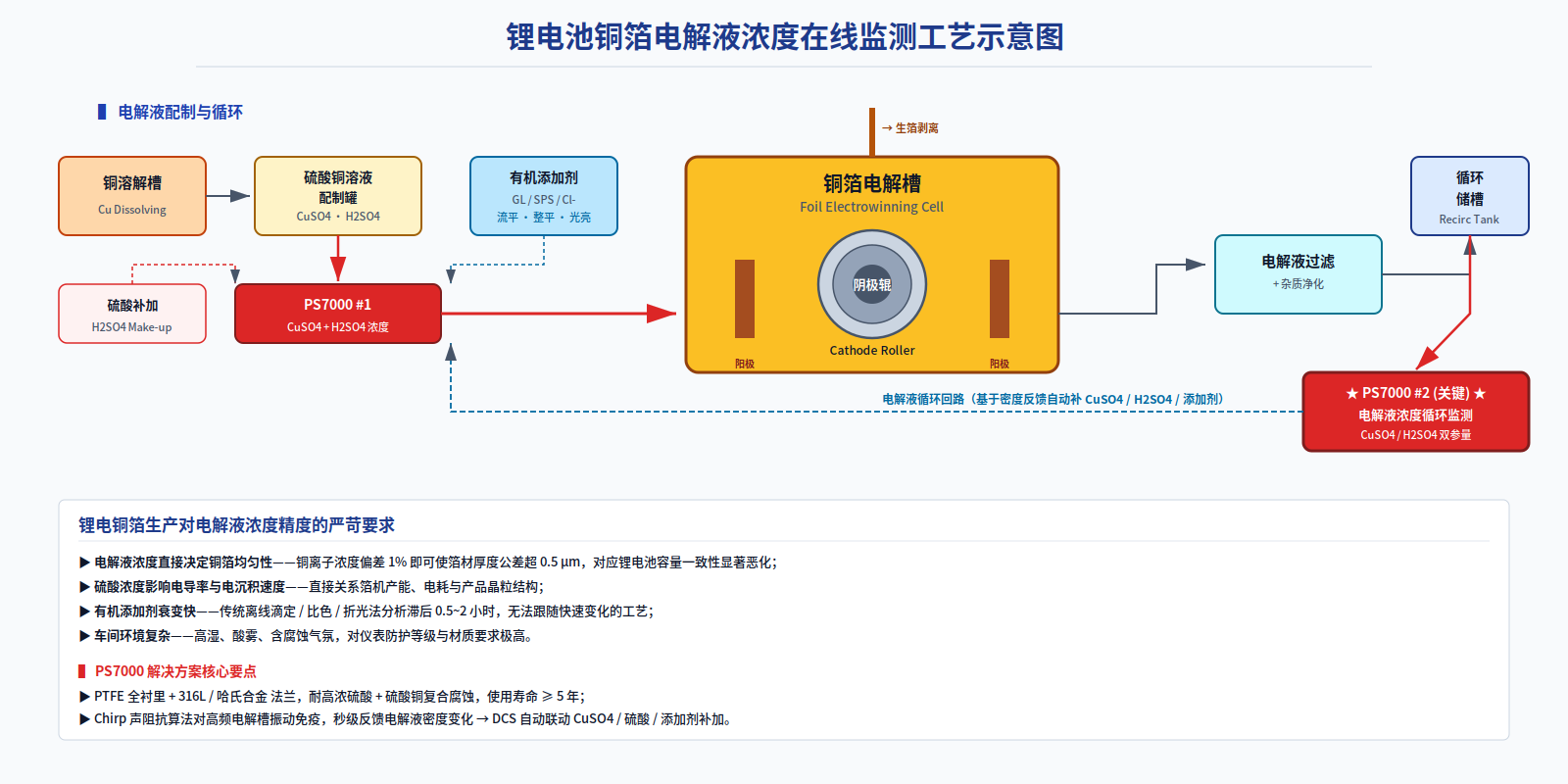
PS7000 is deployed at two measurement points—the dosing tank outlet and the electrolyte circulation storage tank—providing real‑time feedback on density variations. This data, combined with temperature, current, and voltage signals, is automatically integrated by the DCS system to control the addition of CuSO₄, sulfuric acid, and additives, enabling 24‑hour unattended, precision‑based electrolyte preparation.
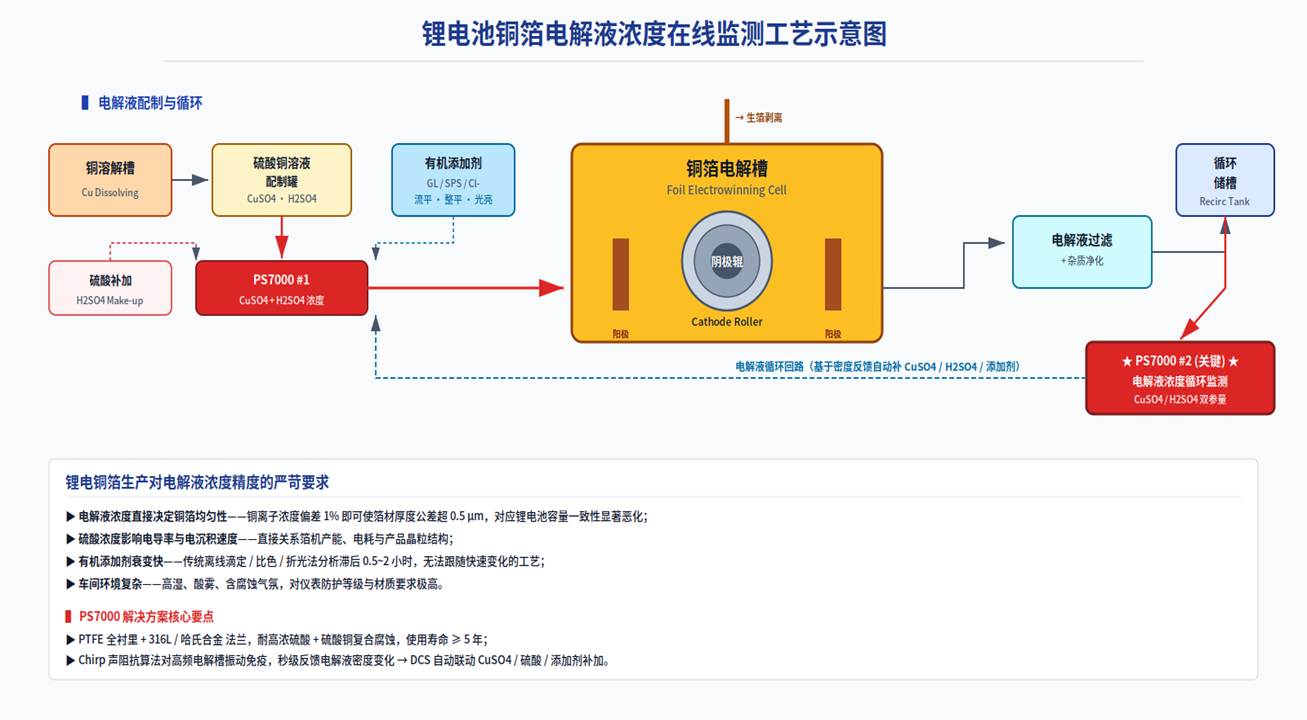
Figure 1: Schematic Diagram of On‑line Concentration Monitoring for Lithium‑Battery Copper Foil Electrolyte
Core Technical Advantages of the PS7000 in the Lithium‑Battery Copper Foil and Electrolyte Industries ▶ All‑PTFE lining combined with a Hastelloy/316L flange—resistant to highly concentrated sulfuric acid, copper sulfate, and chloride‑induced corrosive environments, with a service life ≥ 5 years; ▶ Non‑contact ultrasonic measurement—completely eliminates the risk of contamination to electrolyte purity posed by traditional contact instruments; ▶ Chirp acoustic impedance algorithm—immune to high‑frequency vibrations and electromagnetic interference in electrolytic cells, ensuring stable and reliable output; ▶ Sub‑second response—changes in electrolyte density are immediately fed back to the DCS, enabling automatic on‑demand replenishment and putting an end to “experience‑based formulation”; ▶ IP65 protection plus a corrosion‑resistant acid‑mist‑proof enclosure—suited to the high‑humidity, acid‑mist environment of lithium‑battery copper foil workshops; ▶ Optional 4G module—enables centralized monitoring of multiple production lines, supporting the smart manufacturing upgrade of the lithium‑battery industry. |
4. Customer Value
Comparison Dimensions | Original Offline Analysis Solution | PS7000 Solution |
Response speed | 0.5 to 2 hours lag | Second-level real time |
Corrosion-resistant instrument | Conventional 316L is prone to perforation | PTFE + Hastelloy ≥ 5 years |
Solution Preparation Accuracy | Add based on experience | Density feedback · Automatic and precise |
Foil Material Uniformity | Large thickness tolerance | Electrolyte stability · Tolerance ↓ |
Labor Costs | Analysts take samples frequently | Unattended · 24h Continuous |
In the retrofit project of a high‑end lithium‑battery copper foil production line (designed capacity 15,000 tons/year) at a leading domestic new‑energy materials enterprise, PS7000 replaced the original differential pressure density meter at the electrolyte circulation storage tank. After commissioning, CuSO₄ concentration fluctuations were narrowed from ±2.5 g/L to within ±0.5 g/L, with synchronous fine control of sulfuric acid concentration. Foil thickness tolerance compliance improved from 91% to over 97%, resulting in a significant year‑round enhancement of overall plant efficiency.
Additional Selection Notes ▶ Note: Electrolyte is a clean, homogeneous liquid. If higher accuracy is required (on the order of ±0.0005 g/cm³), the PS7020 sound-velocity‑based solution can also be selected, paired with multi‑parameter calibration curves for CuSO4, sulfuric acid, and additives. |
Conclusion
Xi’an Pisonics (PISONICS) offers inline measurement instruments across six principle families (ultrasonic, tuning fork, Coriolis, optical, microwave and differential pressure), so a suitable instrument can be matched to each duty. Tailored to the process characteristics of the lithium‑battery copper foil and electrolyte industries, the PS7000 ultrasonic acoustic impedance slurry density meter provides end‑to‑end technical support—from instrument selection and installation/commissioning to long‑term operation and maintenance.
If you would like to discuss your project’s specific operating conditions in greater depth, obtain a customized selection plan, or arrange on‑site technical consultation, please feel free to contact the Xi’an Pisonics engineering team at any time.