PISONICS· Xi’an Pisonics
PS7020 Series
Ultrasonic Sound‑Velocity Method Concentration/Density Meter
Application Case in the Food/Brewing/Sugar‑Making Industries
—— Brix °Brix · Wort °P · Alcohol Content Online Non‑Nuclear Measurement Solution ——
Sound Velocity Equals Concentration · ±0.0005 g/cm³ High Accuracy · Sanitary Clamp‑Type Quick Connect · CIP/SIP Compatible
Food/Brewing/Sugar‑Making · PS7020 Application Solution
1. Process Background
Brix (°Brix), original wort gravity (°Plato, abbreviated as °P), and alcohol content are core quality parameters in the food, beverage, brewing, and sugar‑making industries. Throughout the entire beer‑brewing process—mashing, filtration, boiling, and fermentation—precise monitoring of wort concentration directly determines batch‑to‑batch consistency in product flavor; °Brix in beverages and juices is the internationally recognized standard for sweetness; alcohol‑content accuracy in distilled spirits production affects automatic cut‑off, product grading, and tax measurement; and syrup concentration in sugar refining dictates crystallization yield and energy consumption.
Unlike slurries, wort, juices, syrups, and electrolytes are clean, homogeneous liquids with extremely stringent accuracy requirements for density/concentration measurement—typically ±0.001 g/cm³ or better. At the same time, the food and brewing sectors are governed by GMP/HACCP hygiene standards, requiring instruments to support CIP/SIP cleaning, employ sanitary clamp‑type quick connects (3A/SMS/DIN), and allow tool‑free disassembly for easy cleaning.
2. Pain Points of Traditional Density/Concentration Measurement Solutions
• Manual sampling plus refractometer/baume hydrometer: measurement lags by 0.5–2 hours, precluding real‑time feedback to the batch control system; operators face high workload and risk sample contamination;
• Online density meters (tuning fork/vibrating tube): due to the high solubility of CO2/nitrogen in wort, beer, and wine, the vibrating fork is severely disrupted by bubbles, resulting in erratic output;
• Optical refractometers: heavily affected by liquid color (dark beers, stouts, coffee extracts), they are virtually ineffective on turbid fluids during fermentation;
• Traditional instruments often use flanged connections without sanitary clamp‑type quick couplings, making it difficult to meet the high‑temperature CIP/SIP cleaning and sterilization requirements.
3. The PS7020 Solution
The PS7020 series employs the sound‑velocity measurement principle, precisely measuring the propagation time of ultrasonic waves in a liquid to calculate the sound velocity, then consulting a built‑in three‑dimensional calibration curve linking concentration, sound velocity, and temperature to determine the medium’s current concentration or density. The physical nature of the sound‑velocity method ensures that the PS7020 is completely unaffected by liquid color, transparency, bubbles, vibration, or noise, and can deliver stable readings even under bubbly operating conditions.
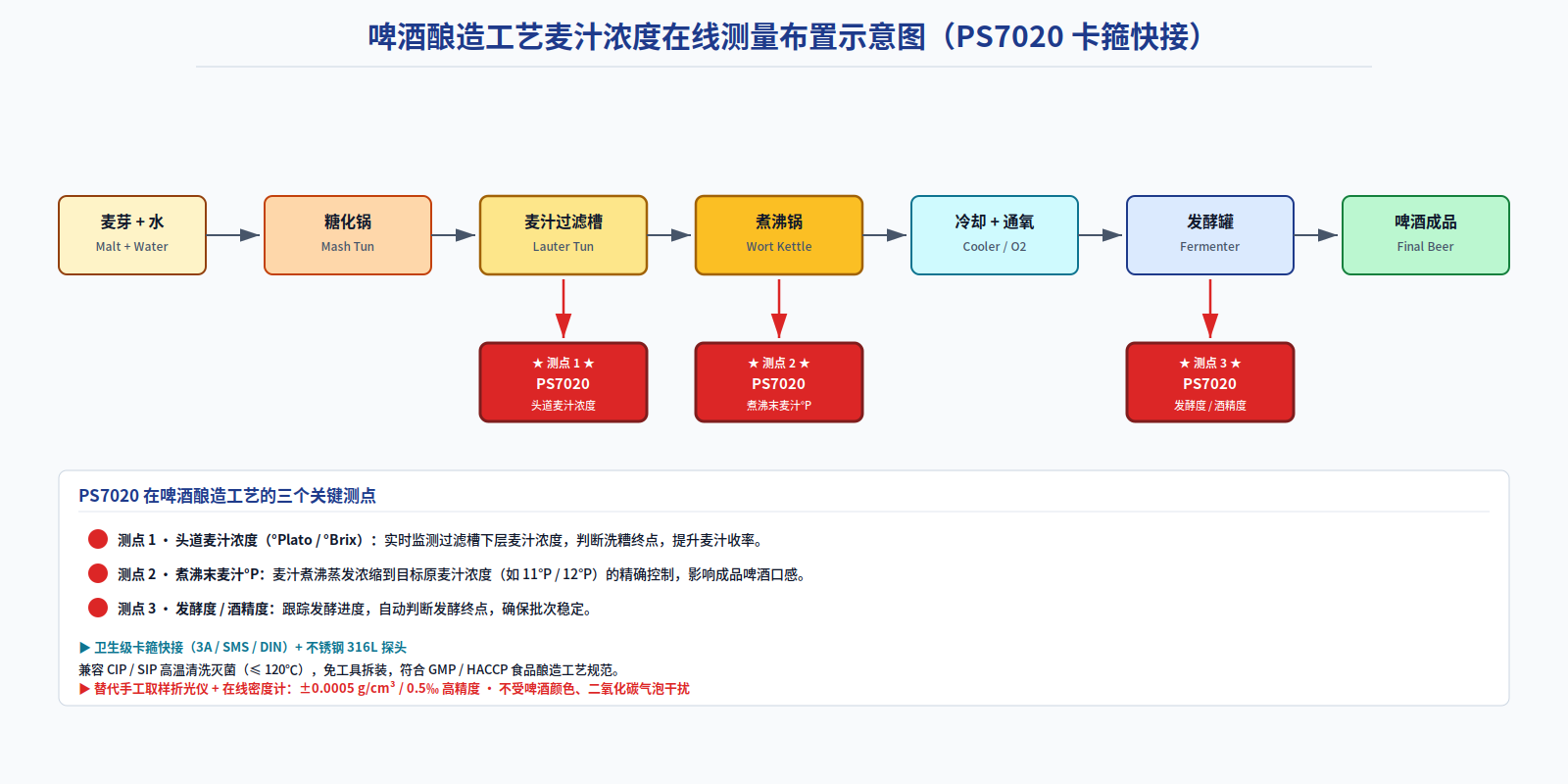
Figure 1 Schematic Layout for Online Measurement of Wort Concentration and Fermentation Degree in Beer Brewing
Core Technical Advantages of the PS7020 in the Food/Brewing/Sugar-Refining Industries ▶ Density accuracy ±0.0005 g/cm³ · Concentration accuracy 0.5‰—significantly higher than that of conventional online concentration meters, offering laboratory-grade precision that can replace manual sampling; ▶ Unaffected by liquid color, transparency, or electrical conductivity—deep‑colored beer, wine, and coffee extracts can all be measured with stable results; ▶ Proprietary high‑frequency acoustic wave technology—delivers stable output even in bubbly process conditions, eliminating the need for degassing; ▶ Hygienic clamp‑type quick‑connect fittings (3A/SMS/DIN) plus a 316L stainless‑steel probe; the entire assembly complies with food and brewing CIP/SIP standards and allows tool‑free disassembly; ▶ Simultaneously outputs three parameters: concentration, sound velocity, and temperature, facilitating multidimensional process monitoring and recipe‑data traceability; ▶ Features a local OLED display, Bluetooth 5.3, and Modbus/Profibus/dual 4–20 mA interfaces, enabling seamless integration with MES and laboratory LIMS systems. |
4. Customer Value
Comparison Dimensions | Original conventional solution (refractometer/manual) | PS7020 Solution |
Response Speed | 0.5 to 2 hours lag | Second-level real-time output |
Measurement accuracy | Large operational error | ±0.0005 g/cm³ · laboratory-grade |
Color / Bubbles | Dark-colored or gas-containing liquids cannot be measured | Completely immune to interference |
Hygiene Compliance | Flange-type, difficult to CIP | Clamp quick coupling · CIP/SIP compatible |
Batch Traceability | Manual recording is prone to errors | 10,000 historical records + MES cloud migration |
In a well‑known domestic beer group, the PS7020 replaced the original manual‑sampling refractometer, being installed at the outlet of the wort filtration tank, the boiling kettle, and the discharge line of the fermentation tanks. After commissioning, “zero manual sampling” was achieved, with wort concentration data from mashing and fermentation fully automated into the MES system. Batch fluctuations in original wort gravity narrowed from ±0.3°P to within ±0.1°P, significantly improving product taste stability. Similar solutions have also been successfully deployed in various food‑brewing sub‑segments, including juice sweetness (°Brix), wine alcohol content, baijiu distillation cut‑off control, and dairy solids monitoring.
Conclusion
Xi’an Pisonics (PISONICS) offers inline measurement instruments across six principle families (ultrasonic, tuning fork, Coriolis, optical, microwave and differential pressure), so a suitable instrument can be matched to each duty. Tailored to the process characteristics of the food, brewing, and sugar‑making industries, the PS7020 series ultrasonic sound‑velocity concentration/density meter provides end‑to‑end technical support spanning instrument selection, installation and commissioning, and long‑term operation and maintenance.
For an in‑depth discussion of your project’s specific operating conditions, customized selection proposals, or on‑site technical consultation, please feel free to contact the Xi’an Pisonics engineering team at any time.