PISONICS
PS7020 Series
Ultrasonic Concentration Meter (sound velocity)
Sound velocity · temperature element in the acoustic path · concentration–velocity–temperature matrix
Inline KOH Electrolyte Concentration in Alkaline Water Electrolysis
—— Stack feed · lye circulation · lye make-up ——
Key measurements: KOH wt% / temperature °C
Alkaline Water Electrolysis: Inline KOH Electrolyte Concentration
1. Where the electrolyte concentration sits
The electrolyte of an alkaline (ALK) electrolyzer is aqueous potassium hydroxide. The Chinese group standard T/CASMES 517—2025, table 3, gives an electrolyte concentration of 27–32 % with carbonate (CO₃²⁻) below 100 mg/L; clause 5.1.1 gives a working temperature of 75–95 °C. The literature commonly quotes 20–30 wt% and 50–80 °C. Away from the design range the specific energy consumption rises, so the concentration has to be watched; the traditional way is periodic sampling and titration.
T/CASMES 517—2025 was issued by the China Association of Small and Medium Enterprises (31 March 2025). The design value of a given electrolyzer comes from its manufacturer.
2. Why conductivity is the wrong tool in this band
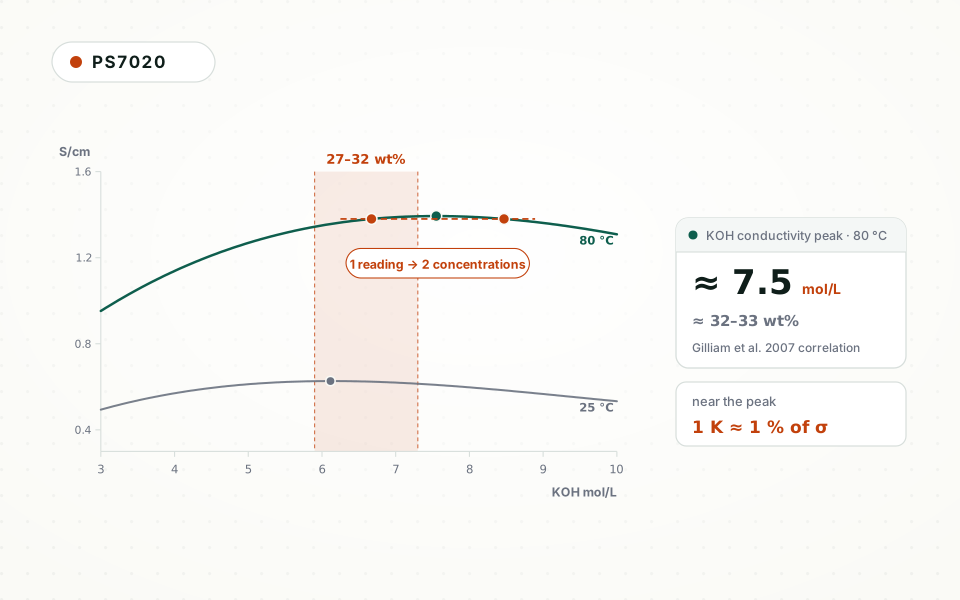
The conductivity of KOH solution first rises and then falls with concentration, with a maximum in between — and the maximum moves with temperature: the hotter the solution, the higher the concentration at the peak. From the correlation of Gilliam et al. (2007), valid for 0–12 mol/L and 0–100 °C with a maximum deviation of ±6 %:
| Temperature | Concentration at the conductivity peak | Peak conductivity | Band within 99 % of the peak |
|---|---|---|---|
| 25 °C | about 6.1 mol/L (about 27 wt%) | 0.63 S/cm | 5.4–6.9 mol/L |
| 50 °C | about 7.0 mol/L | 0.95 S/cm | 6.1–7.9 mol/L |
| 80 °C | about 7.5 mol/L (about 32–33 wt%) | 1.39 S/cm | 6.7–8.5 mol/L |
Calculated from the Gilliam et al. (2007) correlation; mol/L–wt% conversion uses an estimated solution density and is indicative only.
The 27–32 % operating band of an electrolyzer sits close to that peak. By the same correlation, at 80 °C a 6.7 mol/L (about 30 wt%) and an 8.4 mol/L (about 36 wt%) solution both conduct about 1.38 S/cm — one reading, two concentrations; around 6.7 mol/L a change of 1 mol/L (about 3.5 percentage points) moves the conductivity by only about 2 % — some 0.6 % per percentage point — while 1 K moves it by about 1.1 %. One more point is easy to miss: the same 30 % lye sits on the right of the peak at 25 °C (concentration up, conductivity down) and on the left at 80 °C (concentration up, conductivity up) — the response flips sign between cold and hot.
On an electrolyzer, then, a conductivity meter can show that the lye is there and whether it is changing, but it is not a concentration meter. Caustic soda has the same trap: the conductivity extremum of NaOH lies around 15–20 %, see how to measure caustic strength in an emergency chlorine absorber.
3. Density, sound velocity, refractometry: single-valued, with conditions
| Method | Behaviour in 25–35 % KOH | Watch for |
|---|---|---|
| Density | Rises monotonically; around 30 % one wt% changes the density by about 0.0105 g/cm³ (calculated from published handbook data) | Bubbles enter the reading directly: by mixture density, 1 vol% of gas is worth about 1.2 wt% |
| Sound velocity PS7020 | Published measurements up to 8 mol/L show velocity rising monotonically with concentration, with a slight change of slope near 4.2 mol/L; strongly temperature-dependent, so a concentration–velocity–temperature matrix is needed | Fine bubbles disturb the velocity signal; measure after gas separation |
| Refractive index PS7110 | Rises monotonically | Choose the PS7110-C grade for process temperature (−10 to 100 °C) |
| Conductivity | See section 2 | Indicator only |
The PS7020 has not yet been calibrated on KOH electrolyte; on NaOH, another strong caustic, we have measured against gravimetrically prepared standards. The velocity–concentration relationship differs from medium to medium and cannot be carried over from NaOH, so KOH needs its own calibration matrix on the real liquid.
4. Potassium carbonate: the usual reason inline and lab disagree
Lye in contact with air (make-up, water top-up, maintenance) absorbs CO₂: CO₂ + 2 KOH → K₂CO₃ + H₂O. Free KOH is consumed and the carbonate stays in solution. T/CASMES 517—2025 limits carbonate in the electrolyte to below 100 mg/L.
For inline measurement, carbonate turns a binary system into a ternary one: a single property — density, sound velocity or refractive index — responds to the total solute and cannot tell KOH from K₂CO₃. As carbonate builds up, the inline reading drifts away from the lab's free-KOH value, normally reading high.
- The lab method must separate the two: precipitate the carbonate with barium chloride, then titrate with hydrochloric acid to the phenolphthalein end point for free KOH; sample quickly so the sample does not take up CO₂ itself.
- Compare in pairs: log inline and lab values together; if the difference keeps growing in one direction, check carbonate first.
5. Where to measure: after separation, before the stack
Lye leaving the stack carries large amounts of hydrogen and oxygen bubbles. It is separated in the gas–liquid separators and returns through the cooler, filter and circulation pump. The inline meter belongs on a full pipe after separation and before the stack, where there is least gas:
- Preferred: the full pipe between the lye circulation pump discharge and the stack inlet; downstream of the filter where there is one.
- Separate circuits: the cathode (hydrogen) side consumes water and concentrates, so the two sides differ — measure each, or mix them as the process requires.
- Not in a separator or on the two-phase stack outlet.
- Straight pipe normally 10 D upstream and 5 D downstream (at least 5 D and 3 D); the temperature element sits in the acoustic path, so the compensation uses the liquid temperature at the point.
- Selection: electrolyte at 75–95 °C is above the standard version's 80 °C; choose the PS7020 high-temperature version (−20 to +120 °C).
- Hazardous area: hydrogen is group IIC; the PS7020 is available in Ex d IIC flameproof form, with the temperature class set by the maximum medium temperature.
PS7020 key specifications
| Item | Specification (PS7020 product page) |
|---|---|
| Principle | Ultrasonic time of flight (TOF), two sensors in through-transmission: sound velocity → concentration / density |
| Outputs | Mass concentration, density, sound velocity, temperature; diagnostics include received signal energy, signal quality and a fault status word |
| Accuracy | Three classes, 0.5 ‰ / 1 ‰ / 5 ‰, corresponding to ±0.0005 / ±0.001 / ±0.005 g/cm³ in density; the classes are functions of the calibration conditions, and the class used for acceptance is agreed at order |
| Medium temperature | Standard −20 to +80 °C; high-temperature version −20 to +120 °C (specified at order) |
| Operating pressure | ≤ 2.0 MPa |
| Installation | Spool piece (flanged, DN25 / DN50), tri-clamp, insertion |
| Signals | 2 × 4–20 mA (NAMUR NE43); RS485 Modbus-RTU; HART 5 |
| Protection | IP65; Ex d IIC T6 Gb optional (for hot media the temperature class is set by the maximum medium temperature) |
| Factory calibration | 40 calibration sets, each up to 16 concentration points × 15 temperature points |
| Wetted materials | 316L stainless steel with sapphire windows; for hot caustic, confirmed for concentration and temperature |
Before you order
- Electrolyte design concentration; normal and maximum operating temperature, including heat-up and cool-down.
- Whether the hydrogen-side and oxygen-side circuits are separate; line size and pressure at the point.
- Current lab method and frequency, and whether carbonate is measured separately.
- Hazardous-area classification; required signal outputs and the control system they connect to.
- Whether a set of sampled lab results (concentration plus the temperature at the time) can be provided to check the scale.
What this page is: a method and selection note, not a case study. The PS7020 has no publishable operating data on this medium yet, so there are no unit counts, saving percentages or payback periods here — we do not invent those. The numbers on the page are of three kinds only: clauses of standards, published property data with the estimates derived from them (marked as estimates or calculations), and the instrument's own specification.
Conclusion
PISONICS covers six principle families (ultrasonic, tuning fork, Coriolis, optical, microwave, differential pressure) for inline density and concentration; the first step of any selection is to ask what quantity the process actually needs, and in which range. KOH electrolyte sits on the conductivity peak, so it has to be measured through a quantity that stays single-valued there. Further reading: 32 % / 48 % NaOH storage tanks, ultrasonic density and concentration meters, acid and alkali selection guide.