Overview of the Flue‑Gas Desulfurization Process
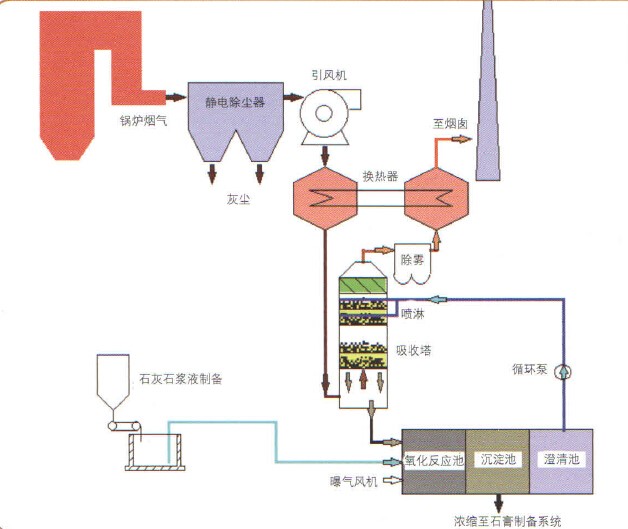
In power plants, flue gas drawn from the main flue downstream of the boiler’s induced draft fan is pressurized by a booster fan and fed into the absorption tower. The gas enters the tower from the bottom and comes into countercurrent contact with limestone slurry sprayed from the top, where it is cooled to saturation temperature. Sulfur dioxide (SO2) and sulfur trioxide (SO3) in the flue gas react with the limestone in the slurry to form calcium sulfite and calcium sulfate. Air is blown into the absorption tower to oxidize the calcium sulfite into calcium sulfate, which then crystallizes as gypsum (CaSO4·2H2O). The gypsum is dewatered by a filter to produce the final product.
After being washed by the spray, the saturated clean flue gas passes through a mist eliminator to remove entrained droplets before being discharged into the atmosphere via the chimney.
The reaction equations are as follows:
SO2 + H2O→ H2SO3 — Absorption
2CaCO3 + H2SO3 → CaSO3 + CO2 + H2O — Neutralization
3CaSO3 + 1/2 O2 → CaSO4 — Oxidation
4CaSO3 + 1/2 H2O → CaSO3·1/2H2O; CaSO4 + 2H2O → CaSO4·2H2O — Crystallization
6CaSO3 + H2SO3 → Ca(HSO3)2 — pH Control
Drawing on years of field experience, Pisonics’ acoustic impedance density meter PS7000 effectively meets power plant customers’ needs for slurry quality control. The PS7000 employs the acoustic impedance principle, offering advantages such as no clogging, zero pressure loss, wear‑free operation, measurement stability, long service life, and straightforward installation. It can typically be installed directly on the discharge line or return line of the slurry pump in the preparation tank; in the desulfurization tower, it can be mounted on the discharge side of the circulating slurry pump or on the tower’s overflow pipe. Depending on site conditions, the PS7000 can be installed inline, in a bypass configuration, or on a branch line, providing strong versatility and adaptability.
Pisonics brings deep industrial design expertise and a team of professional sales personnel, capable of offering customers tailored solutions to ensure optimal on‑site performance.
Density meters, concentration meters, ultrasonic density meters, acoustic impedance density meters, acoustic attenuation density meters, sound velocity density meters, tuning fork density meters, Coriolis mass flow density meters, optical concentration meters, differential pressure density meters, Na22 density/concentration meters, microwave density meters/moisture analyzers, conductivity density meters, and clamp‑on density meters—please contact Xi’an Pisonics Information Technology Co., Ltd. Our website: https://www.pisonics.cn; our English website: https://www.pisonics.com/
Contact: Manager Cui; Phone: 15902932017; Email: info@pisonics.com