First, get the citation right
The earlier version of this article — along with a great deal of material circulating online — attributed the following requirement to AQ 3062—2025:
the concentration and temperature of the absorbing solution shall be monitored online; make-up caustic 15–20 % NaOH by mass, at not more than 45 °C.
The requirement is real; the standard was wrong. It comes from GB 11984—2024, Technical code for chlorine safety in chemical enterprises, clause 6.1.3 d) — issued 2024-11-28, in force 2025-08-01, replacing GB 11984—2008, a mandatory national standard applying to chemical enterprises that produce or use chlorine. The clause as written is more specific than the paraphrase:
Sodium hydroxide in the circulating absorption liquor shall be 15–20 %, and its temperature leaving the tower not more than 45 °C. Facilities for online monitoring of the circulating liquor's sodium hydroxide concentration and temperature shall be provided; periodic laboratory analysis shall be carried out; the liquor shall be replaced or renewed before the sodium hydroxide falls below 5 %.
The difference is not only the standard number. Four points of wording are worth more than the paraphrase:
- it concerns the circulating absorption liquor, not the make-up caustic — the measuring point is on the loop, not the make-up line;
- the 45 °C applies leaving the tower, not at make-up;
- it explicitly requires online monitoring facilities, for concentration and temperature, as two quantities;
- and it gives a change-out threshold: replace or renew before the caustic falls below 5 % — before, not at.
We also read AQ 3062—2025, the safety management code for fine-chemical enterprises, end to end (clauses 1 to 11, Annex A, Annex B, 33 pages): that standard does not contain this clause. What it governs on an absorption system is materials, emergency power and redundancy, not liquid-phase concentration. Both standards apply; each governs a different part. Do not conflate them when citing.
What GB 11984—2024 requires of this system
| Clause | As written | How to read it |
|---|---|---|
| 6.1.3 d) emergency chlorine absorption, liquid chlorine storage | Sodium hydroxide in the circulating absorption liquor shall be 15–20 %, and its temperature leaving the tower not more than 45 °C. Facilities for online monitoring of concentration and temperature shall be provided; periodic laboratory analysis shall be carried out; the liquor shall be replaced or renewed before the sodium hydroxide falls below 5 %. | Online monitoring of concentration and temperature is mandatory, and the clause requires laboratory analysis in addition to the instrument — the instrument holds the trend and the early warning, the laboratory holds the absolute value; neither replaces the other |
| 5.2.3 electrolysis | On abnormal operation at full load or emergency shutdown, the emergency chlorine absorption system shall absorb for not less than 30 min; sodium hydroxide concentration shall be monitored online; a chlorine detector shall be fitted at the vent. | The same online mandate on the electrolysis side |
| 5.2.3 unit separation | The electrolysis unit's emergency chlorine absorption system and the chlorine compressor's seal-gas absorption system shall not be combined with the sodium hypochlorite production unit. | The standard itself separates the emergency absorber from hypochlorite production — the two need different things measured, as set out below |
| 6.1.3 a) c) g) | Independently installed, two-stage absorption; capable of 24 h continuous operation, with caustic circulation tanks able to be switched, held in standby and made up; circulation pumps and emergency chlorine fans provided with spares, on the most critical class of primary electrical load. | The system is designed to be available at all times; instrument availability has to match |
| 5.3.1 | Chlorine scrubbing towers shall have tower-top chlorine outlet temperature monitoring with high alarm, circulating liquor flow monitoring with low alarm, circulating liquor cooling temperature monitoring with high alarm, and tower level monitoring with high and low alarms. | The tower's own control points; the concentration measurement sits alongside them |
| 5.1.1 a) b) | Liquid chlorine systems shall have nitrogen trichloride discharge and treatment facilities; discharge frequency set by keeping NCl₃ below 0.5 % by mass; sodium hydroxide in the treatment facility 5–20 %. | Another caustic measuring point on the same site, over a similar span |
State the boundary precisely. Clause 6.1.3 governs the emergency chlorine absorption system for liquid chlorine storage; 5.2.3 the one on the electrolysis unit. A purely process tail-gas tower carrying no emergency duty does not fall directly under either. In most chlorine-using fine-chemical plants the tower does both, though — clause 4.10 requires chlorine capture systems serving liquid chlorine storage buildings, cylinder stores, filling areas and vaporiser rooms to be connected to the emergency absorption system. Where it does both, 6.1.3 applies.
AQ 3062—2025 governs a different part: materials and availability
On the same tower, AQ 3062—2025 (Ministry of Emergency Management, in force 2025-10-18, all technical content mandatory) is not concerned with liquid-phase concentration but with these — and its two materials clauses settle the wetted-material argument that appears on so many enquiries:
| Clause | As written | How to read it |
|---|---|---|
| A.2.11 | Equipment in direct contact with wet chlorine or chlorine water shall use metals resistant to chloride stress-corrosion — titanium-palladium alloy, duplex stainless, Hastelloy — or non-metallics such as CPVC and PVDF verified against chloride permeation; austenitic stainless steel shall not be used. | 316L is austenitic stainless and is ruled out by name; Hastelloy C-276, which buyers routinely specify, is one of the three families the standard names |
| A.2.10 | Equipment in direct contact with dry chlorine shall not use titanium or titanium alloys. | Titanium is not a universal answer. This corroborates GB 11984—2024 clause 5.3.4: titanium equipment and pipework shall have temperature monitoring to prevent wet chlorine turning dry and reacting with the titanium |
| 7.5.5 / A.3.11 | Absorbent supply pumps, absorbent circulation pumps and tail-gas fans shall have emergency power; extraction and treatment capacity shall match the leak rate, with the caustic circulation pump and tail-gas fan one duty / one standby. | Same direction as GB 11984—2024 clause 6.1.3 g) |
| A.2.1 | Chlorination processes shall fit online monitoring with remote recording and over-limit alarms for reactor temperature, pressure, agitator current, chlorinating-agent feed rate and charge ratio. | What this standard mandates online is reactor parameters; the liquor side is GB 11984's business |
“Absorbing solution” is not one kind of liquid
From a measurement standpoint the term covers at least three systems. Choosing wrong does not cost a little accuracy — it either makes the method invalid or spends money that buys nothing.
| System | Typical duty | Degrees of freedom | Method | Model |
|---|---|---|---|---|
| Binary | Make-up caustic: NaOH + water; acid and alkali dilution | One | Ultrasonic sound velocity | PS7020 |
| One-dimensional reaction path | Chlorine tail-gas scrubbing liquor: residual NaOH + NaOCl + by-product NaCl | One (pinned by stoichiometry) | Ultrasonic sound velocity | PS7020 |
| Genuinely multi-component | HF + H₂SO₄ + H₃PO₄ baths; a hypochlorite production tower holding available chlorine and free alkali | Two or more, each independent | Spectroscopic (UV-Vis-NIR) | PS7100 |
First: the make-up side
Sound velocity in caustic soda varies monotonically with concentration over a wide span, so an ultrasonic meter calibrated across a narrow window is more than adequate, with no moving parts and nothing to consume. This side never sees chlorine, so chloride stress-corrosion does not arise and 316L wetted parts are fine. For the storage-tank version see online concentration monitoring of 32 % / 48 % caustic tanks.
Second: scrubbing liquor — three components, one dimension
There is one reaction in the tower:
Cl₂ + 2 NaOH → NaOCl + NaCl + H₂O
Every 2 mol of caustic consumed yields exactly 1 mol of hypochlorite and 1 mol of chloride. Stoichiometry pins all three concentrations to a single reaction path, so the composition is one-parameter: fix how far the reaction has gone and all three follow. One sound-velocity reading locates it; no multi-component method is required.
The same arithmetic gives a conversion worth having: available chlorine of 10 wt% is residual alkali of 6.7 wt%. The two switch-out criteria plants use are one criterion under two names.
The full method and selection note is at online residual-alkali monitoring on a chlorine tail-gas caustic scrubber.
Third: genuinely multi-component — where spectroscopy belongs
When two or more components move independently, no single scalar separates them however precise it is. Two cases are typical: etching and pickling baths such as HF + H₂SO₄ + H₃PO₄ tank solutions, where each component changes with drag-out and top-up separately; and a hypochlorite production tower — see simultaneous analysis of available chlorine and free alkali — where chlorine and caustic are dosed independently and the product is accepted on both numbers.
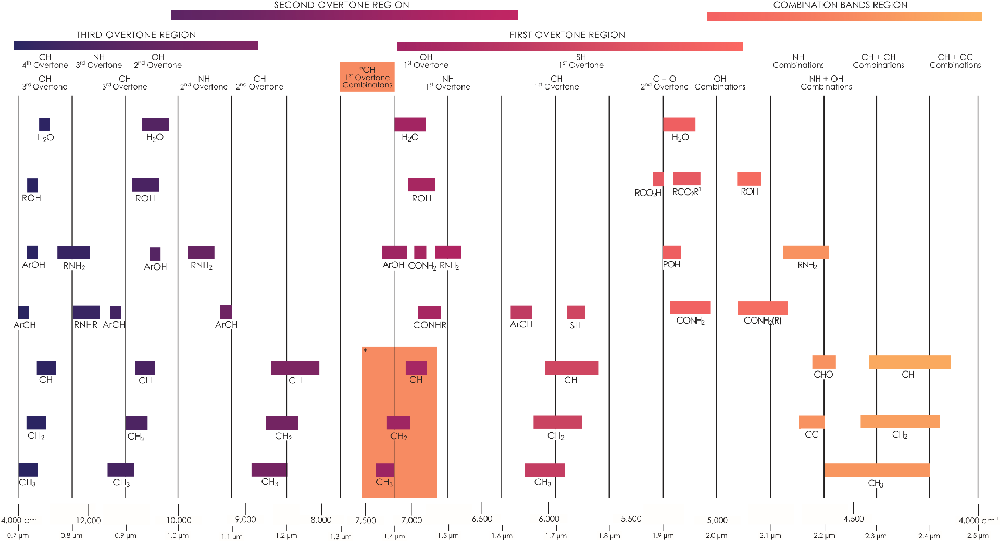
A spectroscopic meter collects a full spectrum in the near-infrared and UV-visible bands and uses a multivariate model to separate the components' characteristic responses, returning several concentrations at once. The cost is a higher instrument price, the modelling work behind it, and more demanding maintenance.
If an enquiry says “dual-parameter concentration meter” and it is not clear which route is meant, see what that term actually means.
Why we do not recommend fitting spectroscopy everywhere
This part works against selling the expensive instrument, and it still needs saying:
- The first two systems cannot use what spectroscopy offers. Putting a multi-component method on a one-degree-of-freedom problem buys no extra information for the extra money.
- Modelling is not free. A spectroscopic method trains its multivariate model on real liquid. Where those samples come from, who maintains them, and who rebuilds them when the process changes are invisible at contract signature and very visible six months after commissioning.
- Budget spent here is often budget not spent on a point that should have been instrumented. Two sound-velocity meters on a scrubber — make-up and circulating liquor — are worth more than one spectroscopic meter on a single point.
The converse holds too: put sound velocity on a genuinely multi-component bath and the saving comes back another way. The method follows the system — not the budget, and not our price list.
Materials: the standard names three families and prohibits one
On this duty wetted materials decide the outcome more often than the measuring principle does, and A.2.11 and A.2.10 have already drawn the boundaries:
- Excluded: austenitic stainless steel, 316L included — not to be used in direct contact with wet chlorine or chlorine water (AQ 3062—2025 A.2.11);
- Available: titanium-palladium alloy, duplex stainless, Hastelloy, or CPVC and PVDF verified against chloride permeation (same clause);
- Prohibited: titanium and titanium alloys in contact with dry chlorine (A.2.10) — so “we use titanium on this unit” is not a statement that holds unit-wide; it has to be said side by side;
- Attendant control: where titanium is used, GB 11984—2024 clause 5.3.4 requires temperature monitoring to prevent wet chlorine turning dry and reacting with it, and humidification on the inlet where a titanium fan boosts wet chlorine. Clause 6.1.2 e) of the same standard also bars titanium local level gauges on liquid chlorine storage.
Which of the three to choose depends on what else is in the stream: residual free chlorine, pH, chloride level, temperature, and whether the design has crevices. Hypochlorite gets markedly more aggressive on the acid side, so that one is worth pinning down.
Before we quote
- Is this point the make-up side, the circulating liquor, or the product outlet?
- How many components move independently, and what moves them?
- Is the gas composition stable — in tail-gas absorption the Cl₂ to HCl ratio matters most?
- Temperature swing, and whether there is circulation cooling.
- Wetted-material and hazardous-area requirements — discussed against the three families above.
- Any laboratory results from field samples. The scale is ultimately built from those.
Send us the process conditions and we will judge whether the method is feasible before proposing anything. If the answer is that the point does not need an online instrument, or that we cannot measure the system, we will say so.