Edible oil refining — oil / wash-water phase detection after neutralisation

Food · Oils and fats

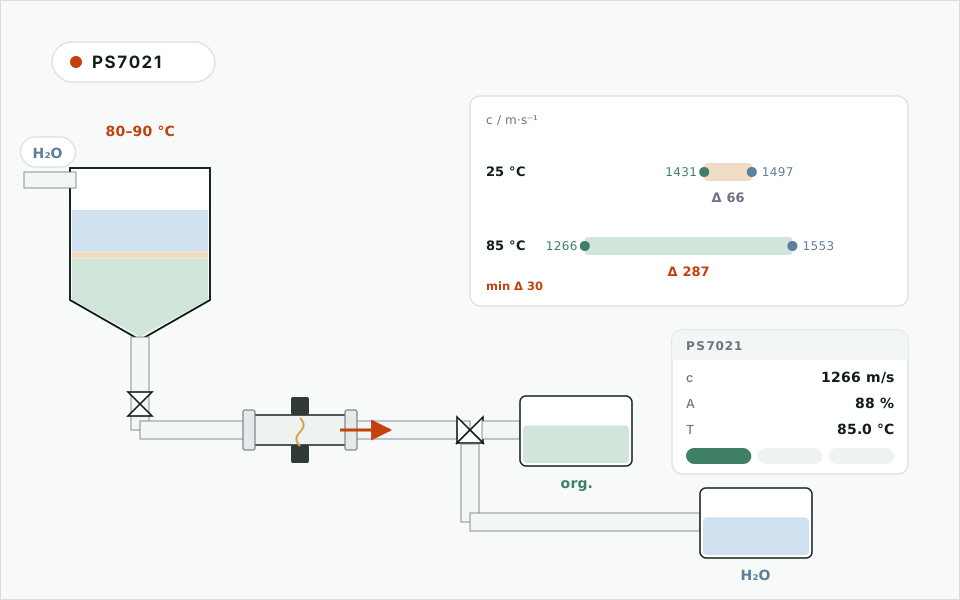
Oil-water discrimination on the 80-90 °C wash stage after alkali neutralisation. Temperature is the lever: the phases are 66 m/s apart at ambient and 287 m/s apart at 85 °C, because oil's coefficient is negative and water's is positive. Hot is both the natural state of this duty and the state with the most margin. The page also covers how fouling shows in the amplitude baseline first, and why a sanitary execution has to be confirmed separately.

Applicable industries
Edible oil refining — oil / wash-water phase detection after neutralisation

PISONICS | 西安派声

PS7021 series

Inline Ultrasonic Phase Separation Detector

Sound velocity + amplitude · integral spool

Edible oil refining — oil / wash-water phase detection after neutralisation

—— 66 m/s apart cold, 287 m/s apart at 85 °C ——

【Discriminator: the two bands at working temperature】

The Duty

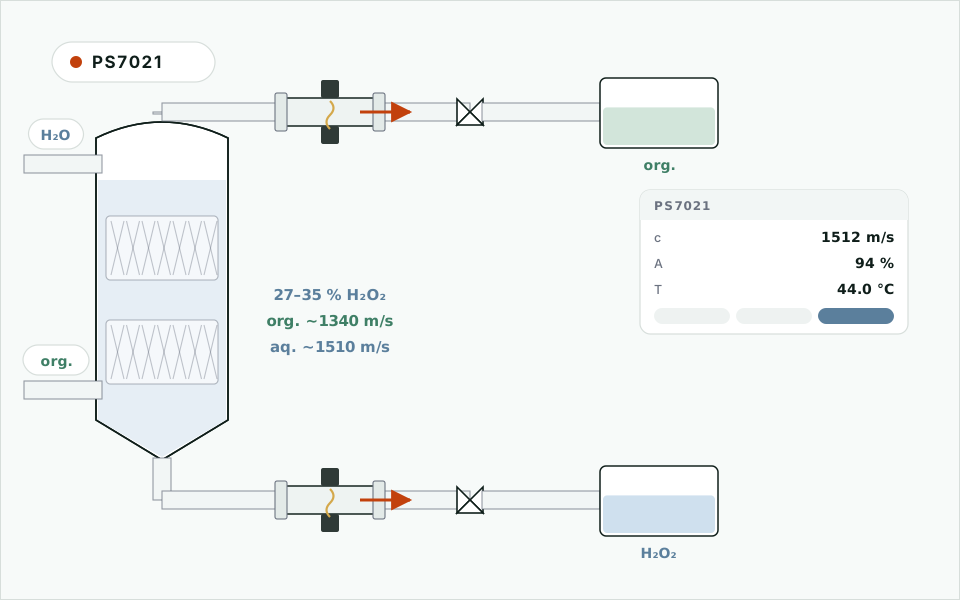
Refining runs degumming → alkali neutralisation → water washing → bleaching → deodorising. After neutralisation the soapstock is centrifuged out and the oil is washed two or three times with 80 to 90 °C soft water to carry away residual soap and free alkali. Every wash ends at a centrifuge or separator outlet where oil and water have to be told apart. Call it early and water goes to bleaching; call it late and oil leaves with the effluent — yield lost twice, once as product and once as effluent COD.

Temperature Is the Lever

Edible oil and water sit close together at room temperature, which is why the method gets dismissed on instinct. But washing is a hot duty, and hot is exactly where the bands are furthest apart:

TemperatureOil (olive-oil handbook value), m/sAqueous phase, m/sGap, m/s
25 °C1431149766
60 °C13351551216
85 °C12661553287

Oils have a negative coefficient (olive −2.75, castor −3.6 m/s per °C) and water is positive below 74 °C, so they move apart: 66 m/s at 25 °C, barely past the 30 m/s floor, against 287 m/s at 85 °C. The practical conclusion: install on the hot wash outlet, not on a cooled storage line.

The oil column uses the published olive-oil figures (1431 m/s at 25 °C, −2.75 m/s per °C) as a same-order reference and the water column comes from the Marczak equation. Soybean, rapeseed and palm oil each differ in absolute value; commissioning measures the real pair.

Fouling Shows Up in the Amplitude First

Soap, phosphatides and wax film the window — routine on this duty. The film does not move the velocity reading at first, but it pushes the amplitude baseline down, so amplitude is not only the rag-layer discriminator: it doubles as a clean-me trend.

  • Baseline drifting down over days → deposit; schedule CIP
  • Amplitude dropping sharply while velocity stays in band → an emulsion slug, not deposit
  • Sapphire is smooth and dense; a hot caustic CIP restores it without pulling the sensor

Sanitary Execution

Plainly: the standard PS7021 spool is industrial, flanged. Tri-clamp connections, polished bore and fully drainable geometry are a custom build with their own lead time and price. Most refinery wash sections are industrial pipework and take the standard spool; if your measuring point sits inside a sanitary zone, say so at selection and we will confirm a sanitary execution separately.

Where It Does Not Belong

  • A stable emulsion — soapstock-in-oil emulsion is a centrifuge and recipe problem; the instrument can only tell you it is still there
  • Bleaching — clay slurry is a solids measurement, which is PS7000 territory
  • Cooled product tankage — at ambient the two phases are only tens of m/s apart, too thin a margin

To quote this duty we need: oil type (soybean, rapeseed, palm, rice bran…), wash temperature and number of stages, separation equipment (centrifuge or separator), line size and material, whether a sanitary execution is required, and the distance to the diverter. Send 500 mL of oil and of wash water and we will measure both bands at your wash temperature.
FAQ

Dichloromethane is far denser than water — why not use a density or acoustic-impedance meter?

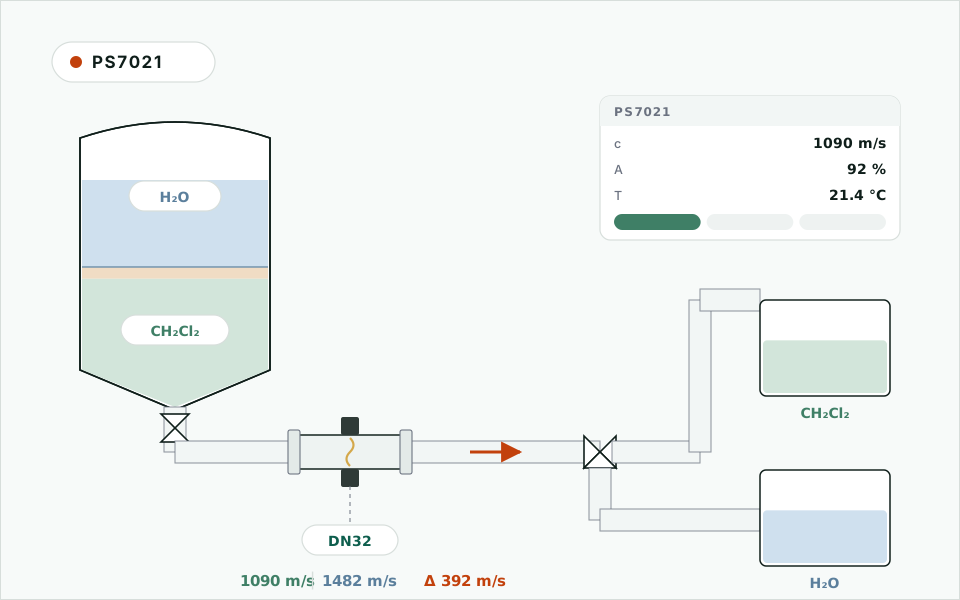
Because an ultrasonic density meter reads acoustic impedance, Z = ρ × c, not density, and dichloromethane happens to be dense and acoustically slow, so the two factors cancel. At 20 °C water is 1.48 MRayl and DCM about 1.45 MRayl, and between roughly 15 and 20 °C they coincide — which is where most plants separate. Inferred against water's velocity, DCM reads about 0.98 g/cm³: lighter than water, the wrong way round.

The same pair differs by 390 m/s in sound velocity (1482 against 1090 m/s, about 26 %), with opposite temperature coefficients, so warming widens the gap. That is why this duty takes the sound-velocity model (PS7021) rather than the impedance one (PS7000). DP and Coriolis meters do read true density and can separate the pair in principle, but they cannot keep up with a draining batch.

How is the rag layer handled — can it be mistaken for the aqueous phase and let through?

The rag layer is a third state, not a grey zone between two. Two quantities catch it.

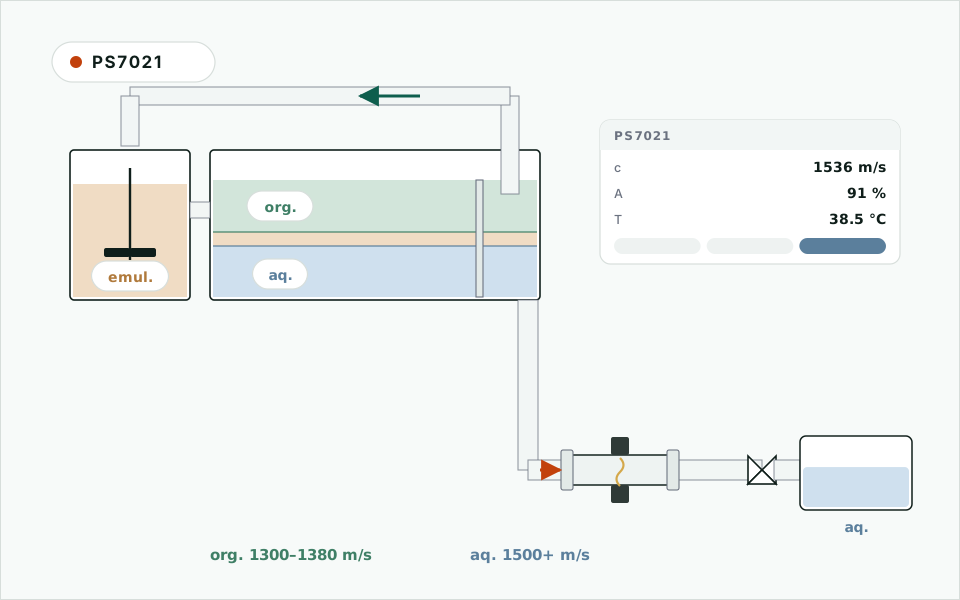
First, velocity: a dispersion falls between the two bands (Wood's equation, first order, puts 30 vol% DCM near 1338 m/s and 50 vol% near 1256 m/s), and anything outside the clear-phase bands is not reported as a clear phase. Second, and more decisively, amplitude: droplet scattering weakens the echo, and 6 dB below the clear-phase baseline is reported as emulsion / not-decidable by default.

The interlock direction is fixed: on emulsion the instrument holds the valve and raises an alarm rather than switching. It will stop and wait for an operator before it lets a rag layer pass as either phase. The emulsion itself is a separation problem; what the instrument can do is refuse to wave it through.

Our line is DN32 and PTFE-lined — can this be fitted, and what happens at the liner?

Yes. DN32 is one of the standard bores (DN25 / DN32 / DN50). The lined build is a steel shell with a PTFE/PFA liner and sapphire windows that pass through the liner and wet the process.

Measuring through the liner is not an option: PTFE is 2.97 MRayl and strongly attenuating, and the bond between liner and shell changes with temperature and permeation — that turns a fixed acoustic path into a drifting one.

Two ordinary lined-pipe rules also apply. Wetted seals are PTFE or FFKM; ordinary FKM rates only fair against methylene chloride. And the shell's vent holes must stay clear — chlorinated solvents permeate fluoropolymer liners slowly, and trapped permeate lifts the liner off the wall.

Against conductivity and photoelectric (sight-glass) detectors — when should each be chosen?

Choose by whether the premise holds; each method rests on one.

Conductivity assumes the aqueous phase conducts, the organic does not, and an electrode may wet the process. Where that holds it is the cheapest answer. Pure-water washes, wet organics and lined pipe that is awkward to tap all soften it.

Photoelectric / sight glass assumes an optical difference. Turbidity- and colour-based units fail outright on dichloromethane and water — both are clear and colourless — while a refractive-index unit does work (1.424 against 1.333). Both share one weakness: a fouled window.

Sound velocity (PS7021) rests on two conditions only: the phases differ by at least 30 m/s, and the pipe runs full. It is independent of colour, turbidity, conductivity and density, which is why it holds where both phases are clear, both are non-conducting, or the aqueous conductivity moves. The price is a two-phase calibration on site, repeated at product changeover — five minutes, but somebody has to do it.

The item-by-item comparison is here.

Does commissioning need a shutdown, and how are the samples taken?

No shutdown. Calibration needs two velocity bands, and both samples come out of a normal batch: one while the light phase is running steady, one while the heavy phase is, 200 mL or more each. The instrument reads them itself — nothing goes to a lab. It usually fits inside one batch.

Three cautions: sample at process temperature (velocity is temperature sensitive, organics run −3 to −4 m/s per °C); draw the sample near the measuring point; and take the aqueous phase at its real salinity — clean water is not a substitute.

What you end up with is a velocity-versus-temperature table for both phases, delivered with the instrument. If the process temperature changes later, the thresholds shift along that table without a service visit.

How do the three relays drive a diverter valve, and which way does it fail?

Three volt-free contacts carry heavy, emulsion and light. The usual wiring: heavy closed → diverter to the heavy receiver; light closed → light receiver; emulsion closed → hold the current position and alarm for an operator to confirm.

The failure direction is the first thing to settle. Gas, flashing and window film all push the instrument toward not-decidable rather than toward the other phase, so making not-decidable mean stay put runs with the grain of the disturbances. Defaulting it to either phase turns every disturbance into a carry-over incident.

Keep the manual mode and the existing sight glass: the instrument supplies the judgement, not the valve. 4-20 mA trends velocity in the DCS; RS485 exposes phase, velocity, amplitude and temperature for the batch record.

How is it accepted on site — what do you compare it against?

The output is a phase decision, not a concentration you can compare against a titration, so acceptance looks different from a concentration meter's. Three workable tests:

1. Timing against the operator. Run a number of batches and align the instrument's switch instant with the operator's call at the sight glass. The site sets the tolerance; what usually matters is whether the instrument is ever late, since late means carry-over.

2. Sampling around the cut. Draw a sample either side of the instrument's switch instant and check that carry-over sits inside process limits.

3. The velocity itself. Measured band values should match the calibration table, and batch-to-batch drift in one phase should stay within the repeatability seen at calibration (±0.2 m/s). This is the test that separates "the instrument drifted" from "the material changed".

Can it measure how thick the rag layer is, or where the interface sits in a tank?

No — those are different instruments. PS7021 is an inline spool and knows only what is crossing its acoustic path right now: heavy, emulsion or light.

Interface height in a tank or settler belongs to an interface level instrument (magnetostrictive, radar, ultrasonic level, capacitance), mounted on the vessel rather than in the line. Rag layer thickness is the same question.

There is a useful indirect answer, though: time the instrument spends in the emulsion state during a drain, multiplied by flow, gives the volume of rag in that batch. It is not an interface height, but as a trend for how well the break worked or whether settling time is enough, it is often the more direct number.

Does it need a straight run? Can it go right after a pump or a control valve?

No straight run is required. The path length is fixed by the spool and the discriminators are velocity and amplitude, which do not care about the flow profile — unlike DP, vortex or magnetic meters, which live on it.

The position still matters, but for a different reason: phase and gas. Pump discharges, the downstream side of control valves and other throttling points generate gas or flashing continuously, which holds the amplitude down and degrades three-state discrimination. Mount upstream of them, or further downstream where the flow has settled.

Three other rules: a full line is not negotiable; on horizontal runs put the path across the horizontal (3 and 9 o'clock), away from gas at the top and solids at the bottom; and keep the measuring point close to the diverter, because that hold-up is the mixed volume every batch pays.

What about high temperature, sanitary execution and CIP?

Temperature: −20 to +80 °C standard, −20 to +120 °C for the high-temperature variant. Heat actually helps the discrimination: organic velocity falls with temperature while water rises below 74 °C, so the bands spread. Edible oil washing at 80-90 °C is the textbook case.

Sanitary: the standard spool is industrial and flanged. Tri-clamp, polished bore and drainable geometry are a custom build with their own lead time and price — say so at selection rather than assuming the standard spool can enter a sanitary zone.

CIP: the sapphire window is dense and smooth, so hot caustic, hot water or solvent all clean it in place. Compare the amplitude baseline before and after and you know whether the clean worked — far easier than scheduled teardown.

Can it still work if the line carries solids or crystals?

It depends on the load. A light suspension does not move the velocity reading but scatters sound and lowers the echo amplitude — and amplitude is what catches the rag layer, so with heavy solids three-state discrimination degrades to two: light and heavy still separate, emulsion and "solids present" no longer do.

In practice: put the point after settling, filtration or a steady pump; at commissioning re-baseline the amplitude against the real solids-bearing fluid rather than against clear liquid; and if solids content is itself the quantity you want, that is another instrument — PS7000 and the acoustic-impedance method.

Crystals add one more wrinkle: they grow a film on the window. The film shows in the amplitude baseline first, which makes that baseline a useful clean-me reminder.

How wide does the velocity gap have to be, and can it be estimated first?

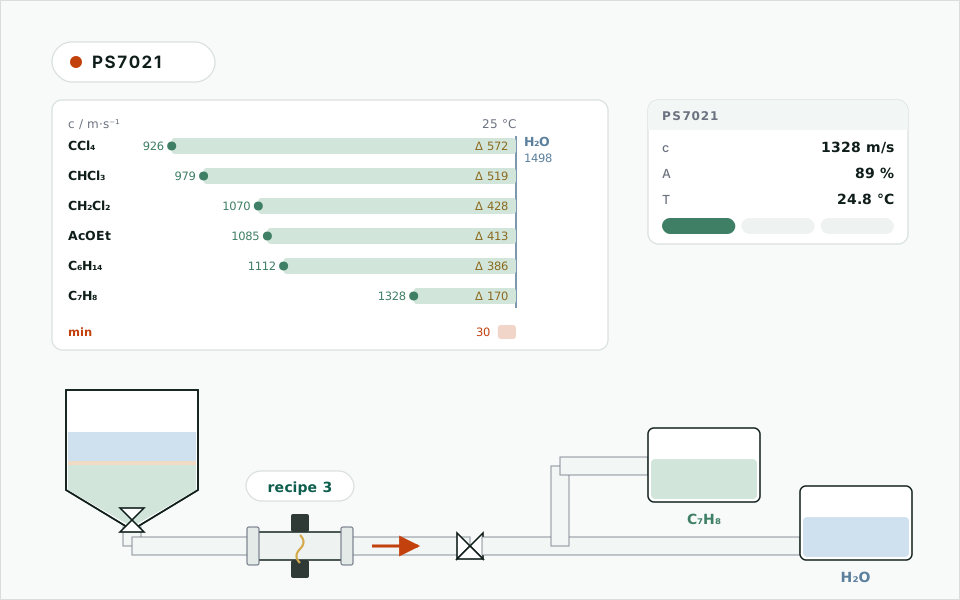
The floor is 30 m/s at working temperature. Common organic-against-water pairs are far above it: carbon tetrachloride is 572 m/s from water, dichloromethane 428, ethyl acetate 413, toluene 170, m-xylene 155 (handbook values at 25 °C). For those the gap is never the constraint.

Three cases do need arithmetic first: oil against oil (diesel and kerosene are 74 m/s apart), oil against water at ambient (edible oil and water, about 66), and formulated fluids — peroxide working solution, SX organic, a demulsified waste oil.

How to estimate: take handbook values at 25 °C, carry both to working temperature with their coefficients (organics −2.7 to −4.9 m/s per °C, water about +2.4 below 74 °C), then add salt on the aqueous side (roughly +11 m/s per wt% NaCl). Above 100 m/s you are safe; 30 to 100 needs a measurement; below 30, don't.

How many products can one instrument cover, and does a changeover need recalibration?

Eight recipes as standard, each holding a pair of velocity bands and its amplitude threshold; the list extends. Switch from the panel, or let the DCS write a Modbus register — the second follows the batch instruction and removes the "nobody switched it" class of incident.

A product that has never been calibrated needs one pass: two samples, two readings, one stored pair — five minutes, no return-to-factory sampling. Coming back to a known product just recalls its recipe.

When to redo an existing recipe: the composition of that phase moved (water content, salt, product concentration), the temperature band shifted, or acceptance found measured velocity off the stored band by more than the repeatability. Every recalibration records its time and both velocities for the batch record.

How often does the sapphire window need cleaning, and how do you know?

No fixed interval — it depends on the duty. What actually helps: the instrument tells you.

As film, crystal or oil builds on the window, the velocity reading does not move at first, but the amplitude baseline drifts down. Trend the clear-phase baseline: a slow decline means clean it; a sharp drop with velocity still in band is an emulsion slug passing, not deposit. The two shapes are easy to tell apart on a trend.

How to clean: sapphire is dense and smooth, so hot caustic, hot water or a normal solvent will do it, usually in place. On duties that will certainly film — edible oil, spent emulsions — put it on the CIP schedule. Afterwards check whether the amplitude baseline came back: that is the acceptance test for the clean.