PISONICS
PS7020 Series
Ultrasonic Concentration Meter (sound velocity)
Sound velocity · temperature element in the acoustic path · concentration–velocity–temperature matrix
Inline Concentration of Ammonium Nitrate Solution
—— Storage tanks · transfer lines · concentrator discharge ——
Key measurements: NH₄NO₃ wt% / temperature °C
Inline Concentration of Ammonium Nitrate Solution
1. Two limits in the Chinese standard
Tanks and transfer lines at an ammonium nitrate producer have more than one limit to respect. China's mandatory standard GB 44022—2024 (Safety Technical Specification for Ammonium Nitrate, in force from 1 November 2024), clause 6.3.3, sets the storage temperature of ammonium nitrate solution at no more than 145 °C, the heating steam at no more than 160 °C with an over-temperature interlock, and the solution concentration at no more than 93 % by mass. Clause 6.3.4 requires pH and concentration to be checked at least every 8 h; clause 6.3.2 requires tank level, temperature and similar parameters to be connected to the control system with alarms and interlocks.
An inline concentration meter covers the hours between two lab checks: concentration creeping towards the 93 % limit, or too much dilution water, shows within minutes. It does not replace the lab — the 6.3.4 checks go on, and the inline reading is compared with them regularly.
GB 44022—2024 covers production, storage and emergency handling at ammonium nitrate producers; it excludes port operations, civil explosives and defence research and production. Which standard a plant follows is for the plant to determine.
2. The higher the concentration, the narrower the temperature window
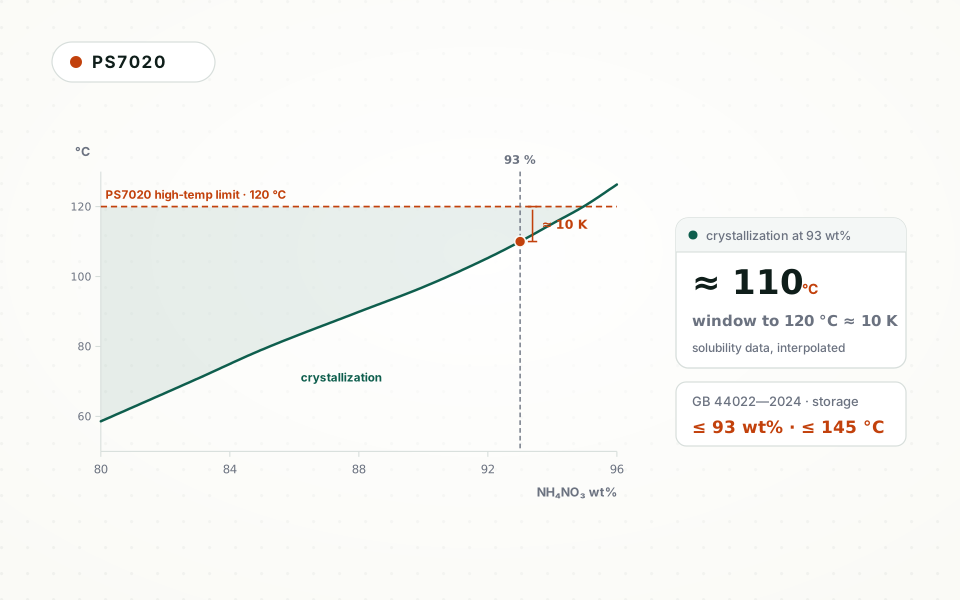
The crystallization temperature of ammonium nitrate solution rises steeply with concentration. The table is interpolated from published solubility data; sources differ by 2–4 °C:
| Concentration, wt% | 80 | 85 | 88 | 90 | 92 | 93 | 94 | 95 |
|---|---|---|---|---|---|---|---|---|
| Crystallization, approx. °C | 59 | 79 | 90 | 97 | 105 | 110 | 115 | 120 |
A 93 % solution starts to crystallize at about 110 °C, so the measuring point must be hotter than that — and every instrument has an upper process temperature. Between the two, at 92–93 % the measuring point has a window of only some ten to fifteen kelvin. The first question for ammonium nitrate is therefore: how hot does the measuring point get at its worst — start-up, shutdown, cleaning, steam purging, temperature-control overshoot?
3. Choose the method by the maximum temperature at the point
| Max. temperature at the point | Method / model | Notes |
|---|---|---|
| ≤ 120 °C | Sound velocity, PS7020 high-temperature version (−20 to +120 °C) | In the line or a circulation loop. At 92–93 % it runs close to its limit; no condition at the sensor may exceed 120 °C |
| ≤ 150 °C, on the tank | Tuning-fork density meter PS7400 (−25 to +120 °C standard, custom to 150 °C, confirmed at order) | Inserted through the tank roof or wall, where there is no circulation line and the tank is the only place to mount |
| > 120 °C, in the line | Vibrating straight-tube density meter PS7220 (maximum medium temperature by grade, chosen for the point: A 150 / B 250 / C 350 / D 400 °C, specified at order) | In line; the measuring tube must run full and free of bubbles; for deposit-prone media mount it vertically, flow upward |
None of the three measures concentration directly: sound velocity in one case, density in the other two, converted to concentration through a calibration. Ammonium nitrate solution is a binary system of NH₄NO₃ and water, and with few impurities that conversion is well defined. Sound velocity on ammonium nitrate solution is described in published vendor application material in the fertilizer industry abroad; we have not yet calibrated on this medium ourselves.
For density, the sensitivity can be estimated first. With the Laliberté (2009) density model, 1 wt% changes the density by 0.0063–0.0067 g/cm³ at 75–78 %, and by roughly 0.0067–0.0083 g/cm³ extrapolated to 80–95 %. On that slope the PS7220's ±0.001 g/cm³, for example, corresponds to about ±0.12–0.15 percentage points. This is a unit conversion, not an accuracy claim; above 80 % the model is extrapolated.
The built-in two-component conversion of the straight-tube meter is linear in component density and does not suit ammonium nitrate; fit density to concentration from paired lab data in the DCS / PLC.
4. Calibration without samples
In China ammonium nitrate is managed as a civil explosive (State Council General Office notice Guobanfa [2002] No. 52): its sale, purchase and use require approval, and it may be sold only to designated civil-explosives producers, to producers such as pharmaceutical and refrigerant makers, and to relevant teaching and research institutions. We are not among the permitted buyers, and a plant may not pass ammonium nitrate — solution samples included — on to us. The usual factory calibration on the real liquid therefore has to be done differently:
- Measure a few concentrations, each at several temperatures, with our instrument in the plant laboratory or at a teaching or research institution permitted to buy ammonium nitrate; we supply the test procedure.
- Use the lab result for each concentration as the calibration value (formaldehyde method, for example), not the weighed-in value — ammonium nitrate is hygroscopic, and weighing errors can exceed 0.1 percentage point. Calibrate and accept with the same lab method.
- At 92–93 % the points can only be taken above the crystallization temperature and below the instrument limit.
- Then compare on the tank or line; the number of instruments is decided once the comparison passes.
The PS7020 has three accuracy classes, 0.5 ‰ / 1 ‰ / 5 ‰ (±0.0005 / ±0.001 / ±0.005 g/cm³ in density), and they are functions of the calibration conditions: the top class needs a span of no more than 10 percentage points, at least 5 concentrations × 3 temperatures calibrated on the real liquid, medium temperature within ±5 °C and no bubbles. A tank usually runs narrower than the whole process; whether the top class applies is confirmed in writing after the test.
5. Installation
- Tanks: an insertion sensor must reach into moving liquid, clear of the dead zone in the nozzle; where the tank contents barely move, measure on the circulation line instead.
- Away from heat: keep the point away from heating coils, and do not let steam heat the nozzle or flange directly — local overheating makes the reading unrepresentative of the tank and can push the sensor past its limit.
- Tracing: only enough to prevent crystallization, never above the instrument limit; do not lag over the transmitter.
- Straight pipe: straight pipe normally 10 D upstream and 5 D downstream (at least 5 D and 3 D).
- Materials and cleanliness: wetted materials confirmed for the duty; no copper, zinc or their alloys, and keep grease and organics out — clause 6.3.5 of GB 44022—2024 also requires cleanliness of tanks, pumps and pipework.
- Hazardous area: flameproof (Ex d) available; the temperature class is set by the maximum medium temperature.
PS7020 key specifications
| Item | Specification (PS7020 product page) |
|---|---|
| Principle | Ultrasonic time of flight (TOF), two sensors in through-transmission: sound velocity → concentration / density |
| Outputs | Mass concentration, density, sound velocity, temperature; diagnostics include received signal energy, signal quality and a fault status word |
| Accuracy | Three classes, 0.5 ‰ / 1 ‰ / 5 ‰, corresponding to ±0.0005 / ±0.001 / ±0.005 g/cm³ in density; the classes are functions of the calibration conditions, and the class used for acceptance is agreed at order |
| Medium temperature | Standard −20 to +80 °C; high-temperature version −20 to +120 °C (specified at order) |
| Operating pressure | ≤ 2.0 MPa |
| Installation | Spool piece (flanged, DN25 / DN50), tri-clamp, insertion |
| Signals | 2 × 4–20 mA (NAMUR NE43); RS485 Modbus-RTU; HART 5 |
| Protection | IP65; Ex d IIC T6 Gb optional (for hot media the temperature class is set by the maximum medium temperature) |
| Factory calibration | 40 calibration sets, each up to 16 concentration points × 15 temperature points |
| Wetted materials | 316L stainless steel with sapphire windows; confirmed for the duty, no copper, zinc or their alloys |
Before you order
- Type of plant (ammonium nitrate producer or civil-explosives maker) and the standard it follows.
- Normal concentration and temperature at each point, and the maximum temperature during start-up, cleaning and purging; existing alarm and interlock settings.
- Whether the tank has a circulation line; if only the tank is available, the nozzle position, size and allowed insertion depth.
- Current lab method (standard number and allowed difference between duplicates) and how often it is run.
- Hazardous-area classification; required signal outputs and the control system they connect to.
What this page is: a method and selection note, not a case study. The PS7020 has no publishable operating data on this medium yet, so there are no unit counts, saving percentages or payback periods here — we do not invent those. The numbers on the page are of three kinds only: clauses of standards, published property data with the estimates derived from them (marked as estimates or calculations), and the instrument's own specification.
Conclusion
PISONICS covers six principle families (ultrasonic, tuning fork, Coriolis, optical, microwave, differential pressure) for inline density and concentration; the first step of any selection is to ask what quantity the process actually needs, and in which range. For ammonium nitrate the first question is temperature, then the principle: sound velocity up to 120 °C, a tuning fork on hot tanks, a straight vibrating tube on hot lines. Further reading: ultrasonic density and concentration meters, Coriolis (vibrating-tube) density meters, tuning-fork density meters, acid and alkali selection guide.