Type: Field case slug: pump-start-dense-plug
A phosphate concentrator in south-western China, thickener underflow, inline density meter mounted on a vertical riser about 7 m above grade on the pump discharge.
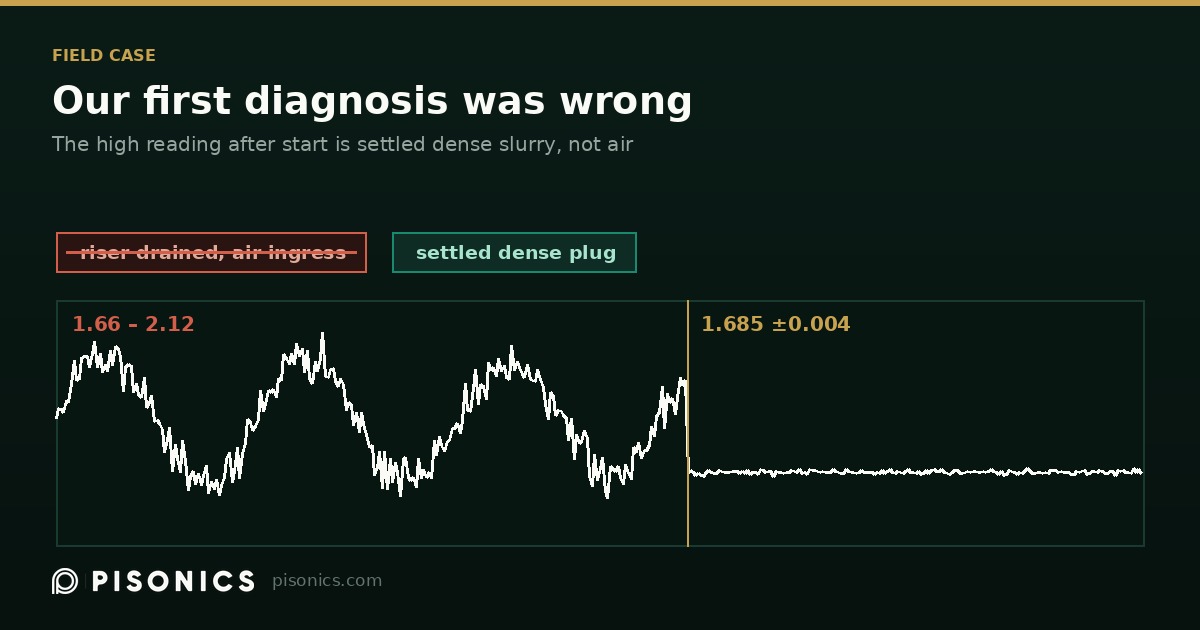
The symptom: for more than three hours after pump start, specific gravity swung between 1.66 and 2.12 and read clearly high. Only after a second pump start did it lock at about 1.685 with ±0.004 of variation.
Our first diagnosis was wrong
The first analysis proposed that the riser drained during shutdown and residual air produced false readings on restart, and recommended fitting a check valve.
The customer rejected it outright, because their actual operating practice never lets the line drain:
- Short stop: close the discharge valve first, then stop the pump — slurry stays sealed in a full line
- Long stop: flush the pump suction with water, then close the discharge valve and stop — the line holds full water
- Even if the line did empty, restarting on slurry clears the air in under a minute
The observed anomaly lasted over three hours — two orders of magnitude longer. The air hypothesis does not survive contact with the facts.
The check-valve recommendation went with it: if the line is sealed full by the discharge valve, there is nothing to drain.
The revised mechanism: settling during standstill
Having eliminated air, we eliminated water too. Residual clean water would show as high echo energy with low density near 1.0. What was actually observed was low energy with high density — the opposite direction.
That leaves one family of explanations: what the pump delivers on restart is genuinely dense, non-representative slurry.
- Slurry sealed in the riser or a low point settles into a dense plug, which gets pushed past the sensor as a slug on restart
- If the storage tank has no agitation, settled material at the bottom gets drawn out
- Scale or a mud cake forms on the probe face during standstill
All three share one property: the reading is genuinely high because the slurry is genuinely dense. The instrument is not being fooled. Recovery takes minutes to hours, matching the observed timescale. The first start is the dirtiest and swings most; by the second start the line has been cleared, so it locks in.
This reclassification has practical consequences. Call it "an air artefact" and the customer goes looking at seals and venting. Call it "genuinely non-representative dense slurry" and the customer looks at tank agitation and pre-start circulation. Completely different directions.
A second finding: the sampling point is 15 m upstream of the pump
Overall bias against the shift log was +0.053, but almost all of it came from transient points — the 22 steady-state points showed only +0.022 bias with MAE 0.050, consistent with historical performance.
Same root cause: the sampling point is on the pump suction side while the meter sits 7 m up the discharge riser, with a pump in between. Under steady state the difference averages out; during transients it is amplified.
Recommendations
- Add tank agitation, or circulate briefly before start, to avoid drawing settled bottom material
- Run a short circulation or flush after start to clear settled plugs from the riser
- Inspect the probe face for scale
- Gate the reading on the pump-running signal in the DCS and mark all start-up data non-representative
The transferable lesson
When the customer's operating facts contradict your mechanism, revise the mechanism — not the facts. Our first conclusion was overturned by a single sentence from the customer: "we seal the line full with the discharge valve." Because it was overturned early, the final remedy pointed in the right direction.
Pisonics — Xi'an Pisonics Information Technology Co., Ltd.
Room 15B016, 16F, Block A, Olympic Building, No.14 Chang'an North Road,
Beilin District, Xi'an, Shaanxi 710061, China
+86 159 0293 2017 | info@pisonics.com | www.pisonics.com
Send us pipe size, velocity, particle size distribution and whether the line
carries entrained air, and we will tell you which principle fits your line —
including the cases where ours does not.