A water-based inkjet ink user performs incoming inspection on five colours (C/M/Y/K/W), checking batch-to-batch consistency and screening for dilution with water. This is benchtop sample-cup measurement, not inline.
Why sound velocity
Sound velocity in a liquid is a fingerprint of the whole formulation — solvent ratio, resin content, pigment loading, additive proportions. Change any one of them and the velocity moves.
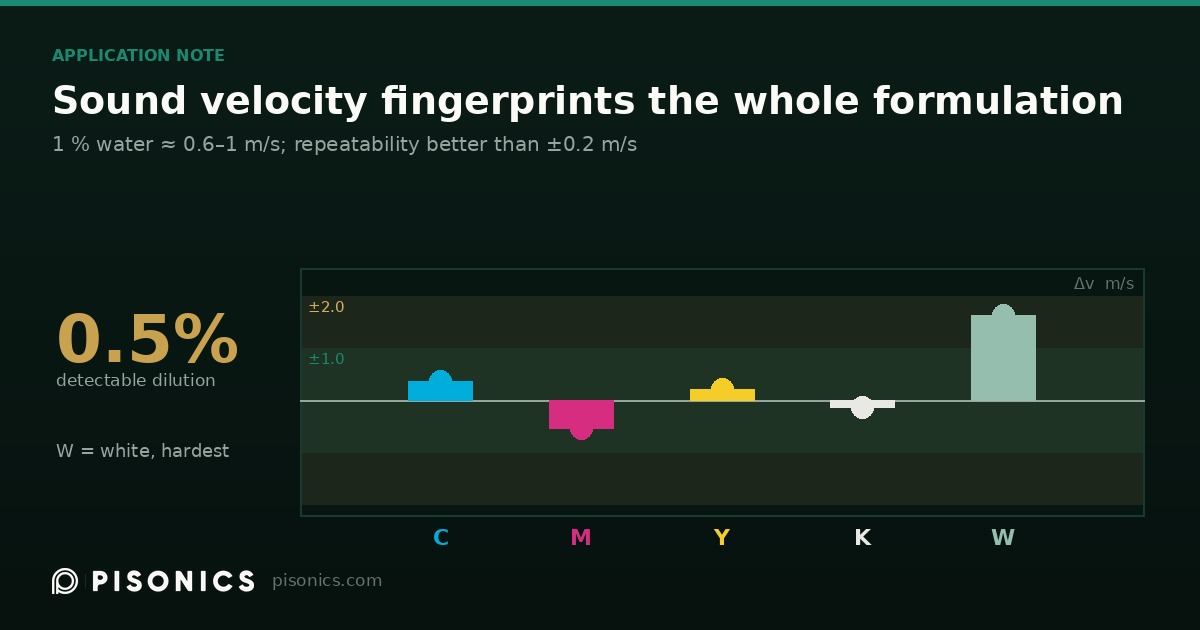
For the specific question of water dilution, the sensitivity works out as follows: 1 % added water corresponds to roughly 0.6–1 m/s of velocity change. Instrument repeatability is better than ±0.2 m/s, so 0.5 % dilution is identifiable.
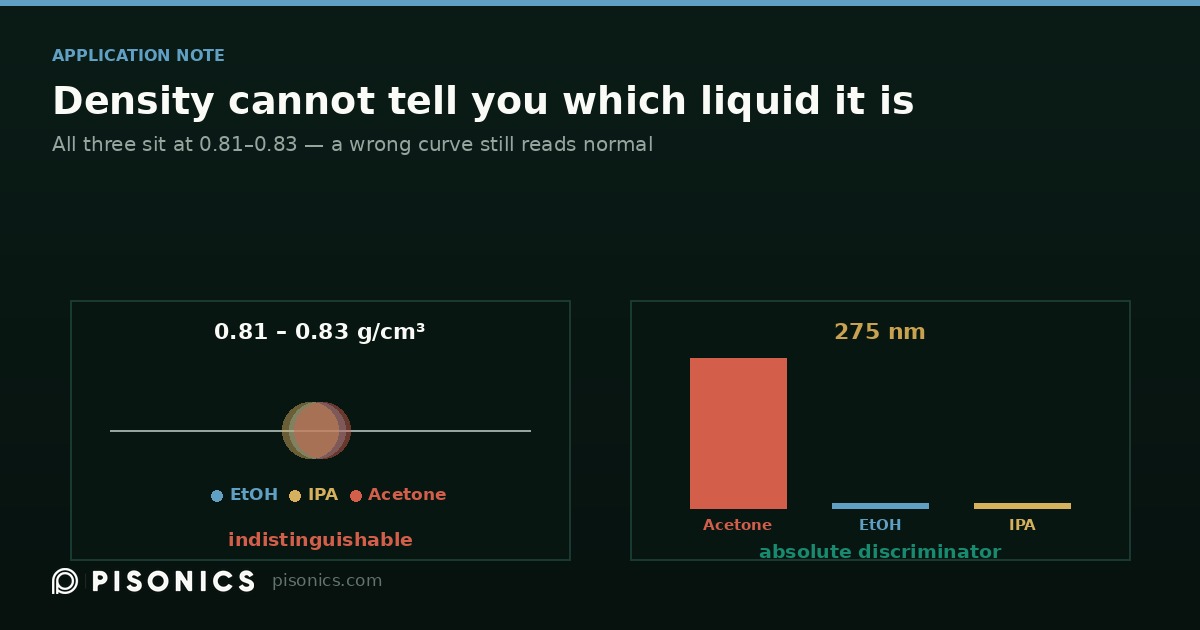
For comparison, the same dilution produces a density change small enough to be swamped by temperature drift.
How the judgement is made
Establish a baseline and ±3σ band from known-good batches, then band the deviation. Illustrative tolerances are of this order:
Velocity deviation from baseline | Verdict |
|---|---|
≤ 1.0 m/s | Pass |
1.0 – 2.0 m/s | Retest |
> 2.0 m/s | Fail |
Actual tolerances must be derived from the customer's own known-good batch data — do not adopt the table above directly.
Two boundaries that have to be stated
One: sound velocity gives a whole-formulation fingerprint, not a pigment percentage. It answers "is this batch the same as the reference?" It does not directly answer "what is the pigment content?" If the latter is what you need, this is the wrong method.
Two: white is the hardest colour. Titanium dioxide particles are large and dense, so they settle quickly and attenuate strongly. Measurement stability is noticeably lower than for the other four, and sampling and handling procedure needs to be designed around it.
Separately, bubbles are the number one interference. Surfactants in ink foam readily, and careless cup filling introduces microbubbles that read velocity low. Allowing the sample to stand and de-gas before measurement is a required step.
Where it fits and where it does not
Suits: incoming batch consistency, dilution screening, supplier variability monitoring.