Case Study: Non-Nuclear Density & Production Monitoring on an Overseas Cutter-Suction Dredger

Case study

How an overseas reclamation contractor replaced a nuclear gauge with a non-nuclear PS7000 + flow + production-monitor system on a CSD discharge line — real-time dry-solids output, no radiation licence.

Applicable industries
Case Study: Non-Nuclear Density & Production Monitoring on an Overseas Cutter-Suction Dredger

Background

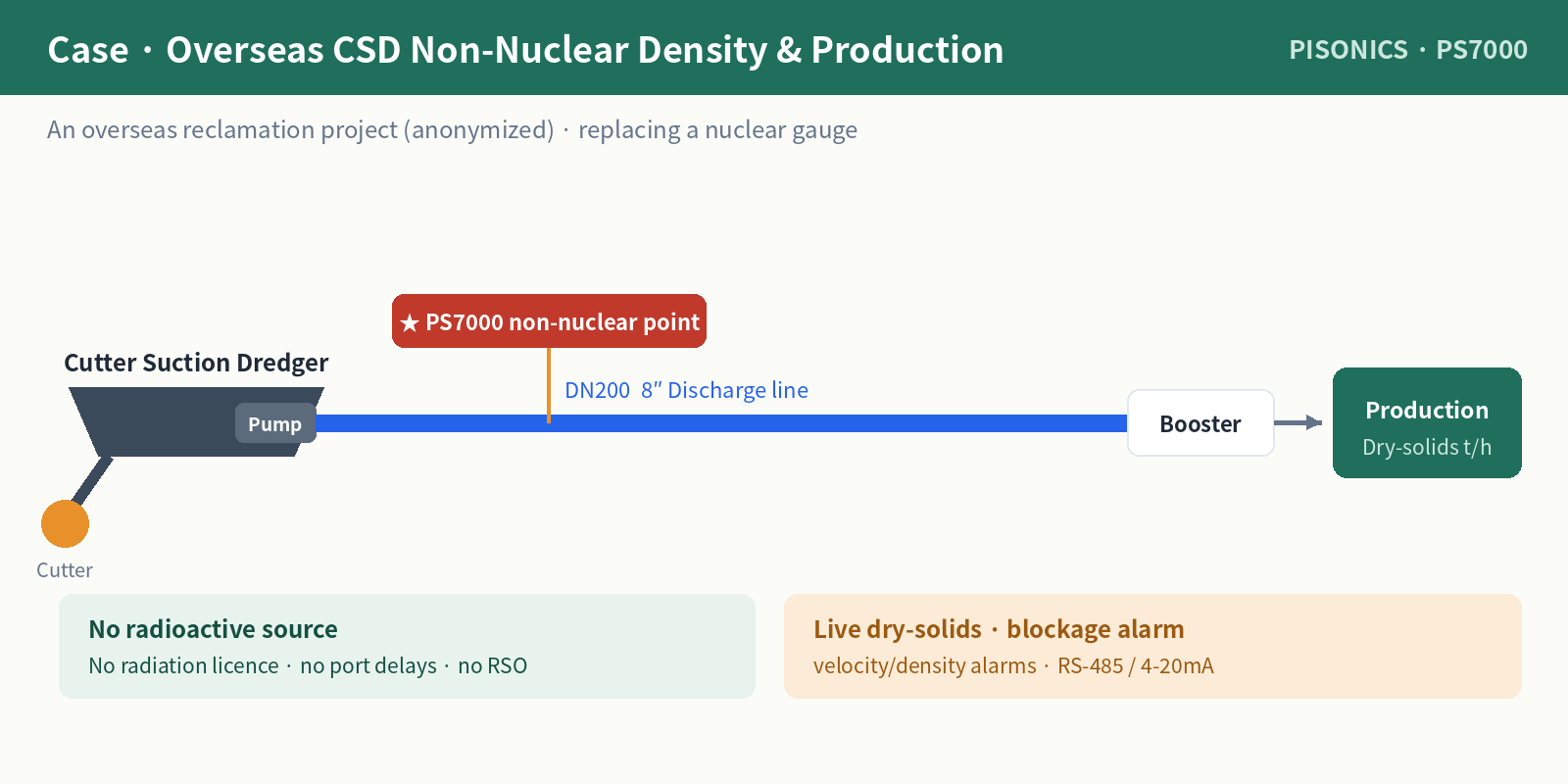
An overseas dredging & reclamation contractor running cutter-suction dredgers (CSD) needed real-time discharge-line density and production without the burden of a radioactive gauge — shipboard radiation licensing, cross-border port inspection and a dedicated radiation-safety officer were slowing mobilisation between projects. (Client and commercial terms withheld.)

Requirement

  • Non-nuclear density on the DN200 (8″) discharge line, abrasion-tolerant.
  • Live dry-solids production (t/h) and line velocity, not just density.
  • Robust to entrained air, vessel motion and temperature swings.
  • Standard signals into the vessel system (RS-485 / Modbus, 4-20 mA).

Solution delivered

A PS7000 ultrasonic acoustic-impedance density meter on the discharge line, an electromagnetic flow meter, and the Dredge Production Monitor software fusing the two to compute Cv, dry-solids Pdry, Cw, SG and line velocity every second — dashboard, shift totals and CSV history. DC24V / RS-485 field wiring, 8-inch (DN200) install kit.

Outcome

  • No radioactive source — mobilisation freed from radiation licensing and port-inspection delays.
  • Production visibility — crews trim to the concentration/velocity sweet spot and see t/h live.
  • Blockage protection — velocity + density-gradient alarms to the pump interlock.

More: dredging industry · non-nuclear density for dredgers · PS7000 vs Cs-137. Discuss your dredger.
Selection support

Voices from users of this product

"Our original tuning fork and differential pressure meters on the absorber gypsum discharge main had recurring problems with bubbles and scaling — we had to shut down weekly to clean them. After switching to PS7000, both problems disappeared. Basically maintenance-free now, accuracy is stable, and it fully meets our FGD process control needs."

Thermal Control Foreman Wang
Thermal Control Specialist
A certain thermal power plant in Inner Mongolia

"After switching to the PS7000, our overflow density readings finally stabilized — we stopped tuning reagent dosing by feel. The unexpected win was not having to clean the sensor weekly; our previous radiometric meter needed window-wiping almost daily in the scaling slurry."

Director Li
Mineral Processing Workshop Director
A certain copper mining enterprise

"Our potash blending tank is a harsh environment — KCl near saturation, 30~40% crystal content, temperature swinging 5~20°C. Traditional density meters can't hold up here. After two weeks of PS7000 service, the deviation from manual lab samples stayed in the 0.5~0.8% range, even during concentration peaks. No anomalies."

Director Xie
Process Engineer
A potash fertilizer plant in Qinghai

FAQ

How is dredge production (dry solids per hour) measured?

You cannot get it from density alone. Dry-solids production P_dry (t/h) = Q x Cv x rho_s, where Q is the volumetric flow (from a flow meter), Cv = (rho_m - rho_w)/(rho_s - rho_w) is the volumetric concentration from the mixture density rho_m (from an inline density meter such as the PS7000), and rho_s is the dry-solids density. The Pisonics Dredge Production Monitor reads the density and flow meters over Modbus and computes this every second, with dashboard and shift totals. See /guides/dredge-production-calculation-density-flow.

Can I measure dredge slurry density without a radioactive source?

Yes. An ultrasonic acoustic-impedance meter (PS7000) reads discharge-line slurry density to +/-0.005 g/cm3 with no radioactive source, so there is no shipboard radiation licence, no port-inspection delay and no radiation-safety officer. A clamp-on option (PS7010) allows no-hot-work retrofit. See /guides/non-nuclear-density-meter-for-dredgers.

What density meter should go on a cutter-suction dredger discharge line?

A PS7000 ultrasonic acoustic-impedance meter suits CSD discharge lines (DN50-DN1000): flush sapphire window for abrasion, Chirp wideband to reject entrained air, non-nuclear. For no-cut retrofit use the clamp-on PS7010. Pair with a flow meter and the Dredge Production Monitor to also get dry-solids t/h. See /industries/dredging.

Is the PS7000 ultrasonic density meter a radiometric device? Does it need a radiation license?

The PS7000 is an acoustic-impedance ultrasonic density meter with no radioactive source whatsoever. No radiation license is required. It uses only piezoelectric transducers to send and receive ultrasonic signals — the same physical principle as medical and NDT ultrasound.

If you're currently using a Cs-137 / Co-60 source-based meter and want to remove the regulatory burden, PS7000 is a drop-in alternative. We also offer the PS7500 gamma meter, which uses an exempt-activity Na-22 source (< 1000 KBq) — also requires no radiation license.

Can an ultrasonic concentration meter measure mine backfill slurry?

Yes. Ultrasonic acoustic-impedance meters (PS7000) are well suited to online concentration/density of high-solids, abrasive mine backfill (tailings / paste-fill) slurry: the flush sapphire window resists wear with no protruding parts, and Chirp wideband processing rejects entrained-air scatter. It is a non-nuclear alternative to Cs-137 gauges — see /industries/mining.

Can PS7000 really measure stably in bubbly mining slurries?

Yes.

The PS7000 employs a linear frequency-modulated (Chirp) acoustic impedance algorithm—after transmitting a broadband ultrasonic pulse, the host unit analyzes the echo signal in the frequency domain, and multiple-reflection interference caused by bubbles is identified and eliminated by the algorithm. This is the core difference between the PS7000 and conventional reflective ultrasonic density meters: traditional single-frequency reflection is highly sensitive to bubbles, whereas the PS7000’s Chirp algorithm is virtually immune to them.

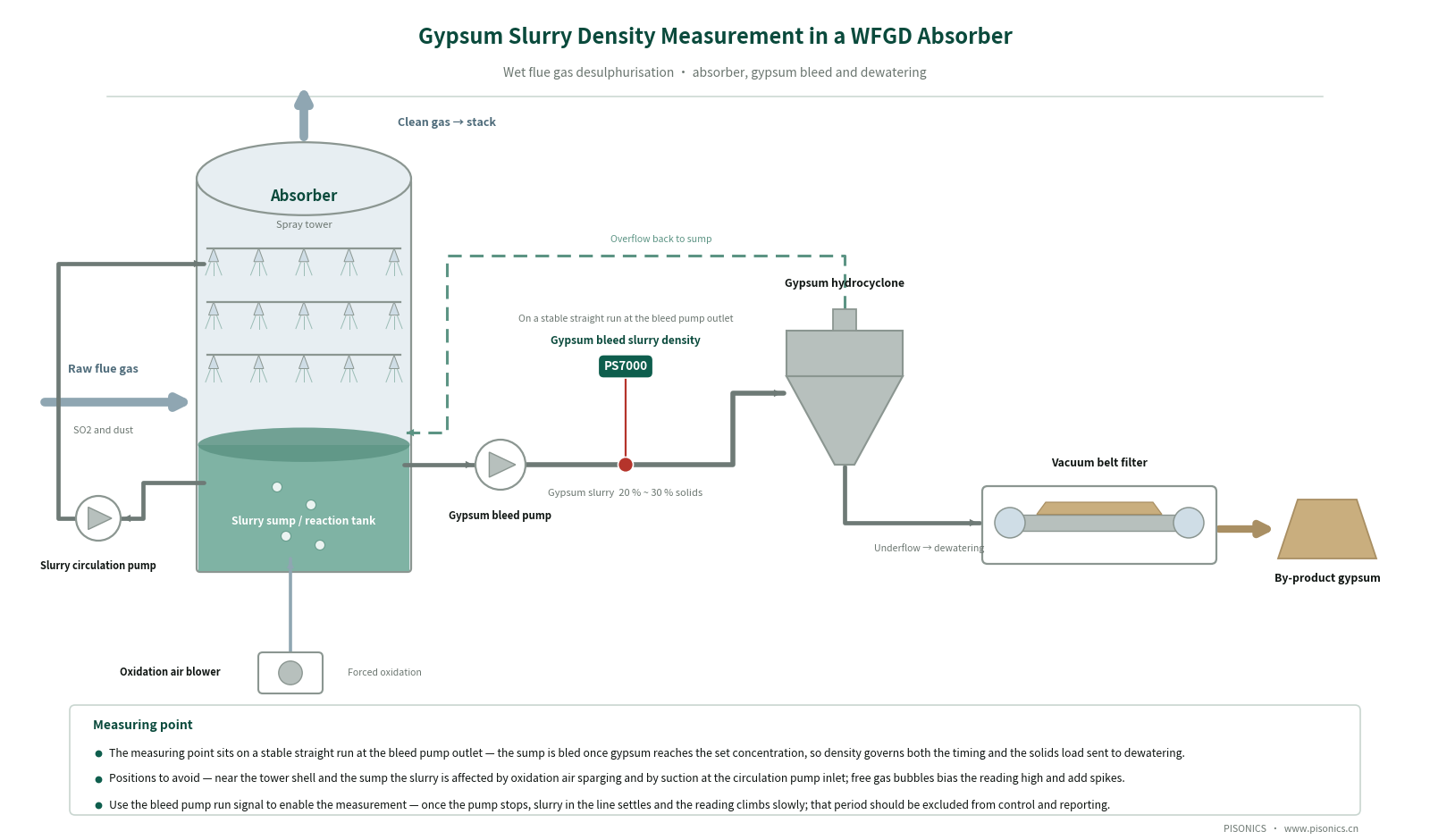
At the gypsum discharge line of an absorption tower in a thermal power plant in Inner Mongolia (under conditions of continuous air oxidation that generate dense bubbles), the PS7000 has been operating stably for several years after replacing the original tuning fork concentration meter.

What installation requirements does the PS7000 have?

The installation requirements for the PS7000 flanged direct-insertion type are as follows:

  1. Straight-run pipe sections: ≥5D (upstream) + 2D (downstream), where D is the nominal pipe diameter;
  2. The installation point must operate with a full pipe to avoid stratification of gas and liquid phases;
  3. The applicable pipe sizes range from DN50 to DN1000 (larger sizes can be customized);
  4. The flanges are compatible with ANSI/DIN/JIS standards;
  5. In highly abrasive conditions, it is recommended to use a 316L probe with special ceramics or a 2205 duplex stainless steel probe;
  6. In strongly corrosive environments, a PTFE-lined option is available.

If the pipeline does not allow for tapping, please consider the PS7010 clamp-on type instead.

PS7000 vs nuclear density gauges: which costs less over the life cycle?

On purchase price alone, ultrasonic and nuclear gauges sit in a similar bracket. The gap opens over 5 to 10 years of ownership.

Hidden cost list of a Cs-137 / Co-60 nuclear gauge:

  • Radiation safety licensing and annual reviews, plus operator training and certification;
  • Licensed transport and installation filing for the source;
  • Dose monitoring and record keeping during service;
  • Source replacement as activity decays (purchase, transport, commissioning, return of the old source);
  • End-of-life disposal of the spent source — often the single largest bill.

PS7000 acoustic-impedance ultrasonic gauge: no radioactive source and no permits of any kind; non-contact sensor with zero wear and zero clogging, sensor life of 5 years or more, virtually maintenance free with no consumables. Power plant, potash and iron ore sites have run 2+ years at near zero maintenance.

Bottom line: on a 5-year basis the total cost of ownership of the PS7000 is typically far below a nuclear gauge. Where a nuclear principle is genuinely required (such as dense-medium coal washing), the PS7500 with an exempt-activity Na-22 source needs no license, though the roughly 2.6-year half-life still implies periodic source renewal.