Science Corner | What Unit Is Used for Acoustic Impedance? Starting with the “Rayl,” Let’s Explore the Physics Behind Density Measurement
Preface: In the field of online slurry density measurement, the “acoustic impedance method” is increasingly replacing traditional nuclear-source density meters. Yet many front-line engineers, though familiar with the term “acoustic impedance,” often struggle to answer the simple question: “What are its units?” In this installment, Pisonics from Xi’an will begin with a fundamental—yet frequently overlooked—question: What unit is used for acoustic impedance?
I. Getting to Know the Physical Quantity of Acoustic Impedance
When sound propagates through a medium, it sets the particles within that medium into oscillatory motion. The extent to which the medium “cooperates” with—or resists—this vibration is described by a physical quantity known as acoustic impedance (Z).
In simpler terms, acoustic impedance quantifies how much a medium either “impedes” or “matches” the propagation of sound waves—making it a useful analogy to electrical resistance or impedance: just as voltage relates to current, so does sound pressure relate to particle velocity.
For plane sound waves, the characteristic acoustic impedance of a medium can be expressed very succinctly:
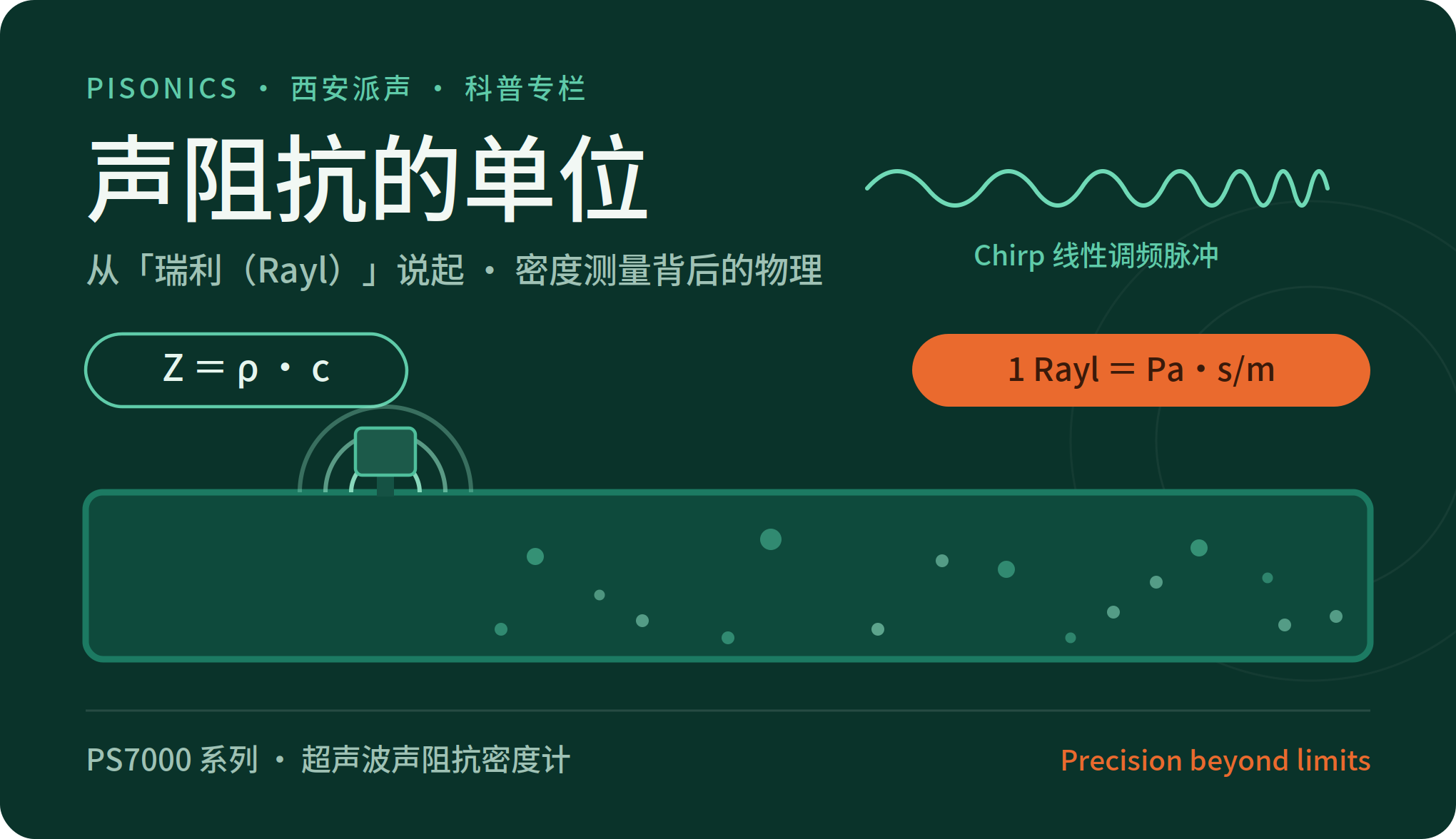
Z = ρ × c
where ρ is the medium’s density (kg/m³) and c is the speed of sound in that medium (m/s).
Note that this formula includes density ρ—the very foundation that enables the acoustic impedance method to measure density. As density changes, so does acoustic impedance; accurately measuring acoustic impedance, therefore, amounts to indirectly determining density.
II. The Star of This Issue: The Units of Acoustic Impedance
If we substitute the units of the two quantities in Z = ρ × c:
- Density ρ: kg/m³
- Sound speed c: m/s
The resulting unit is kg/(m²·s), which can also be expressed as pascal-seconds per meter (Pa·s/m). This is the SI unit for acoustic impedance (more precisely, for “specific acoustic impedance” or “characteristic acoustic impedance”).
A Name All Its Own: the Rayl
To simplify notation and communication, the physics community has assigned a special name to Pa·s/m: the rayl (symbol Rayl). In other words:
1 Rayl = 1 Pa·s/m = 1 kg/(m²·s)
This unit honors the British physicist John William Strutt, 3rd Baron Rayleigh (1842–1919), who made outstanding contributions to acoustics and authored the classic treatise “The Theory of Sound.” His title, “Rayleigh,” was later adopted to name this acoustic unit. (Incidentally, “rayl” is pronounced ray-lee; it sounds similar to the English term “rayleigh,” which denotes photon flux, but the two are entirely distinct—so don’t confuse them.)
A Common Pitfall: MKS Rayls vs. CGS Rayls
Historically, there have been two definitions of the rayl, corresponding to different systems of units:
System | Definition | Equivalent Relationship |
|---|---|---|
MKS Rayleigh (meter–kilogram–second system) | 1 Pa·s/m = 1 kg/(m²·s) | Common in modern engineering |
CGS Rayleigh (centimeter–gram–second system) | 1 dyn·s/cm³ = 1 g/(cm²·s) | Appears in older literature |
These are not equivalent: 1 CGS rayl equals 10 MKS rayls. When consulting older references, failing to account for the unit system can lead to errors of an entire order of magnitude. In modern engineering practice, we uniformly recommend using MKS rayls (i.e., Pa·s/m) to avoid confusion.
Distinguishing Another Pair of “Cousins”: Specific Acoustic Impedance vs. Acoustic Impedance
Strictly speaking, acoustics recognizes two related but distinct quantities, each with its own unit, often conflated:
- Specific acoustic impedance / Characteristic acoustic impedance (sound pressure divided by particle velocity): measured in Pa·s/m, or rayls. This is an intrinsic property of the medium itself; Z = ρc describes this quantity.
- Acoustic impedance (sound pressure divided by volumetric flow rate): measured in Pa·s/m³, known as acoustic ohms, and tied to specific geometries (such as a particular section of pipe).
In density measurement, it is the former—the characteristic acoustic impedance (rayls)—that truly matters and directly correlates with density ρ.
III. Some Intuitive Numbers: Grasping the “Order of Magnitude” of Acoustic Impedance
Simply knowing the units isn’t enough; let’s look at the acoustic impedances of several common media to get a sense of their scale (all values are in MKS rayls):
- Air: approximately 400 Rayl
- Water (20°C): about 1.48 × 10⁶ Rayl, or roughly 1.48 MRayl (megarayls)
- Steel: around 45 MRayl
We can see that air and water differ in acoustic impedance by several thousand times. It is precisely this vast impedance mismatch that causes strong reflections when sound encounters the boundary between these two media—explaining why medical B-ultrasound machines require coupling gel and why industrial ultrasonic applications demand meticulous design.
In slurry measurement, solid-phase particles (minerals, crystals, fly ash) and the liquid phase likewise exhibit differences in acoustic impedance: the denser and more concentrated the slurry, the higher its acoustic impedance, and the more pronounced the echo characteristics at the solid–liquid interface. This provides a clear, stable physical signal for inferring density from acoustic impedance.
IV. From the Rayl to the PS7000: How the Acoustic Impedance Method Measures Density
With an understanding of acoustic impedance and its units, the operating principle of the PS7000 series ultrasonic acoustic impedance density meters becomes readily apparent.
The PS7000 employs a single-probe, self-transmit‑self‑receive design: the probe continuously emits chirp ultrasonic pulses into the pipeline and实时captures the returning echoes. As the ultrasonic waves propagate through the slurry and encounter solid–liquid interfaces, the strength of the echo depends on the acoustic impedance difference across those boundaries—and since acoustic impedance Z = ρc is directly linked to slurry density, the host controller uses an innovative chirp acoustic impedance analysis algorithm to reconstruct the echo’s impedance signature and thereby calculate the slurry’s true density with high accuracy.
The broadband nature of the chirp signal allows it to penetrate bubble layers and eliminate interference from multiple reflections, overcoming the measurement blind spots of conventional reflective ultrasonic instruments in complex conditions such as bubbly slurries, severe corrosion, and high abrasion. Across the full range of 0–80% mass concentration (0–3,000 kg/m³), the PS7000 achieves continuous measurement with ±1% FS accuracy.
More importantly, the entire measurement process requires no radioactive source, fundamentally eliminating the radiation safety risks and cumbersome environmental approvals associated with gamma-ray density meters; the non-contact probe ensures zero wear, zero clogging, and long-term, maintenance-free operation—today, the PS7000 has already demonstrated years of “zero-maintenance” service at numerous thermal power plants, mines, and salt‑processing facilities.
Conclusion
A seemingly unassuming unit, the rayl (Pa·s/m), underpins a complete chain of acoustic-physics principles linking sound pressure, density, sound speed, and interfacial reflection—precisely the theoretical foundation that enables the PS7000 to deliver on its promises of “non-nuclear, bubble-resistant, maintenance-free” performance.
Understand the units of acoustic impedance, and you’ll understand why this density meter can “see through” slurry.
Pisonics (Xi’an) specializes in industrial inline density and concentration measurement. Its PS7000 ultrasonic acoustic-impedance density meters are widely deployed in nonferrous metallurgy, thermal power generation, coal washing, steelmaking, potash fertilizer production, and mine tailings processing. For customized non-standard ranges, special linings, explosion‑proof models, or detailed selection guidance, please contact Pisonics’ technical engineers in Xi’an.
Precision Beyond Limits.