1 Overview
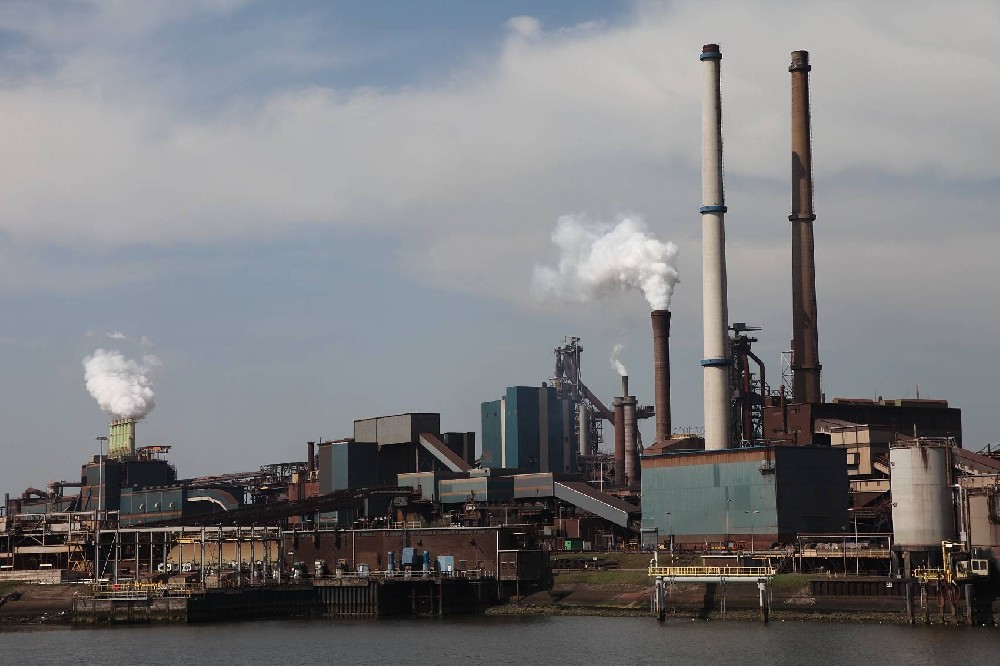
In the steelmaking process, operations such as sintering, pelletizing, and coking generate large volumes of flue gas containing sulfur dioxide (SO₂). To meet increasingly stringent environmental emission standards, steel plants commonly employ the limestone–gypsum wet flue-gas desulfurization process, with the desulfurization absorption tower as its core equipment. In the operational control of the absorption tower, the density of the circulating slurry is one of the key parameters reflecting desulfurization efficiency and absorbent activity. Excessively high density indicates gypsum oversaturation and precipitation, which can lead to scaling and blockages; too low a density suggests insufficient absorbent concentration and reduced desulfurization performance. Therefore, precise, continuous, real-time monitoring of slurry density is of great engineering significance.
The acoustic impedance density meter, a novel online density measurement instrument based on ultrasonic principles, has been successfully deployed in desulfurization systems across the steel industry, thanks to its non-contact, high-precision, corrosion-resistant, and maintenance-free characteristics. This report provides a detailed discussion of its measurement principles, operational challenges, solutions, installation guidelines, and application results.
2 Operational Analysis of Desulfurization Absorption Towers
2.1 Process Overview
2.2 Challenges in Density Measurement
Serial Number | Challenges | Description |
1 | Highly corrosive environment | The slurry is acidic (pH 4–6) and contains highly corrosive ions such as Cl⁻ and F⁻, which severely erode sensor materials |
2 | High-solids slurry | The mass fraction of solid suspended particles can reach 5%–20%, and the bowl mill experiences severe wear, which easily leads to sensor drooping and blockage |
3 | Slurry Temperature Fluctuations | The operating temperature typically fluctuates within the range of 40–70°C, which can affect the accuracy of density measurements. |
4 | Bubble interference | During aeration oxidation and slurry circulation, a large number of bubbles are introduced, which can interfere with density measurements. |
5 | Installation space is limited | The absorption tower piping is arranged in a compact layout, leaving limited installation space. |
Table 1 Major Challenges in Density Measurement at Desulfurization Absorption Towers
3 Measurement Principle of the Acoustic Impedance Density Meter
3.1 Basic Principle
Z = ρ × c
3.2 Core Technical Advantages
Comparison Items | acoustic impedance concentration meter | Coriolis density meter | differential pressure density meter |
Measurement Principle | Acoustic impedance reflection | change in vibration frequency | static pressure difference |
Contact Method | Non-intrusive (flush-mounted) | Insert-type | Insert-type |
Accuracy | ±0.001 g/cm³ | ±0.0005 g/cm³ | ±0.01 g/cm³ |
Maintenance Requirements | Essentially maintenance-free | Regular cleaning and calibration | Regular cleaning and venting |
Corrosion resistance | Excellent (no moving parts) | better | General |
Deposition/Blockage Risk | extremely low | higher | high |
Bubble Influence | Software-compensated | significant impact | significant impact |
Service life | Long-term (>10 years) | Medium (5–8 years) | Short (2–5 years) |
Table 2 Comparison of Three Density Measurement Methods in Desulfurization Conditions
4 Solutions Tailored to Desulfurization Conditions
4.1 Instrument Selection and Configuration
Configuration Items | Recommended Solution |
Sensor Material | Sapphire or ceramic composite materials, resistant to acid and chlorine corrosion |
Process Connection | Flanged flush-mount installation, DN50/DN80, flush with the inner wall of the pipe, no dead zones |
Measurement Range | 1.000–1.400 g/cm³(covering the typical density range of flue-gas desulfurization slurry) |
Measurement Accuracy | ±0.001 g/cm³, repeatability ±0.0005 g/cm³ |
Operating Temperature | 0–95℃, with built-in temperature compensation |
Signal Output | 4–20mA + HART / Modbus RTU / Profibus DP |
Protection Level | IP67, suitable for outdoor humid environments |
Software Functions | Bubble compensation algorithm, self-diagnosis, and hang-up warning |
Table 3 Recommended Configuration for Density Measurement in Desulfurization Absorption Towers
4.2 Bubble Compensation Technology
4.3 Temperature Compensation Mechanism
5 Installation and Commissioning Guidelines
5.1 Sensor Placement
5.2 Installation Precautions
1. The sensor should be installed horizontally or tilted downward (tilt angle ≤0°–15°) to prevent bubble accumulation or sediment deposition at the sensor’s front end.
2. The installation point should be located away from bends, valves, reducers, and other flow disturbance sources, with straight pipe sections of at least 5D and 3D upstream and downstream, respectively (where D is the pipe inner diameter).
3. When connecting via flange, ensure that the sensor surface is flush with the inner wall of the pipe—neither protruding nor recessed—to avoid the accumulation of deposits.
4. Electrical wiring should use shielded cables, routed away from high-power inverters, motors, and other strong electromagnetic interference sources.
5. A shut-off valve is recommended upstream of the sensor to allow removal without shutting down the system during future maintenance.
5.3 Commissioning and Calibration
6 Typical Application Results
6.1 Project Background
6.2 Retrofit Solution
6.3 Application Effects
Indicator | Before the upgrade | After the upgrade |
Density measurement accuracy | ±0.02 g/cm³ | ±0.001 g/cm³ |
Measurement drift (monthly) | >0.5% | <0.1% |
Average flue-gas desulfurization efficiency | 92.3% | 96.8% |
Limestone Consumption | Reference value | reduced by approximately 8% |
Number of Annual Maintenance Occurrences | 12–18times | 1–2times |
Sensor Replacement Cycle | 1–2years | Not yet replaced |
Table 4 Comparison of Key Indicators Before and After Retrofit
7 Economic Benefit Analysis
• Absorbent savings: Precise slurry density control prevents over-dosing of limestone, saving roughly RMB 200,000–300,000 annually on limestone costs.
• Reduced maintenance costs: The maintenance-free design greatly cuts labor and spare-part expenses for inspections, cleaning, and replacements, saving RMB 100,000–150,000 per year.
• Less downtime: The sensor’s failure rate is markedly lower, avoiding unplanned shutdowns of the desulfurization system due to instrument malfunctions.
• Environmental compliance: Stable desulfurization efficiency ensures sustained adherence to emission standards, mitigating the risk of environmental penalties.
8 Conclusions and Outlook