Monitoring and controlling the state of particulate suspensions is one of the critical steps in many modern industrial processes. Concentration is an important physical parameter for characterizing industrial slurries, playing a key role across various manufacturing sectors—particularly in the electronic‑component‑manufacturing industry, which occupies a strategically vital position in China’s development. For example, with the advancement of 5G, demand continues to grow for multilayer ceramic capacitors (MLCCs) in applications such as smartphones, aerospace, and defense [1]. Tape casting is a pivotal step in MLCC production; during this process, the performance of the ceramic slurry determines the uniformity and microstructure of the green tape, thereby directly influencing the quality of the final electronic ceramic product [2]. The primary indicator for evaluating slurry performance is the homogeneity of its overall concentration [3–4]. Consequently, slurry concentration has a direct and significant impact on device quality. Meanwhile, in surface water bodies such as rivers and reservoirs, suspended sediment concentration is one of the most critical hydrological parameters for addressing engineering challenges in hydraulic design and water‑resource management [5]. Thus, high‑precision measurement of slurry concentration is indispensable in both production and surveying, making rapid, convenient, and accurate determination of the solid content in slurries a major research focus.
1. Ultrasonic‑Sensor‑Based Concentration Measurement Methods Ultrasonic waves are mechanical waves with frequencies above 20 kHz; in industrial applications, the commonly used frequency range spans 20 kHz to 10 MHz. Ultrasonic technology boasts several advantages: (1) strong environmental adaptability, capable of operating under diverse production conditions; (2) low power consumption and cost‑effectiveness; and (3) high accuracy and fast response. Leveraging the attenuation and propagation characteristics of ultrasonic waves in different suspensions, two primary methods have emerged: ultrasonic attenuation and ultrasonic sound velocity. Therefore, it is essential to comprehensively evaluate each method’s response to variations in specific slurries and select the most appropriate approach.
1.1 Ultrasonic Attenuation Based on ultrasonic attenuation, this method is currently one of the most widely employed techniques for measuring suspension concentration. Absorption and scattering are the principal mechanisms underlying wave attenuation [6]. As ultrasonic waves propagate through a slurry, their intensity diminishes due to interactions between the waves and the particles within the medium [7]. This process converts ultrasonic energy into heat, indirectly reducing the initial amplitude of the wave signal [8]. The concentration of suspended solids in the liquid being measured is directly proportional to the degree of ultrasonic signal attenuation; thus, by analyzing the online‑measured attenuation data, one can derive the corresponding volumetric percentage concentration of the slurry. Prior to deploying the sensor, its acoustic attenuation characteristics should be calibrated using slurries of known concentrations to prevent measurement errors.
Ultrasonic attenuation is defined as follows:
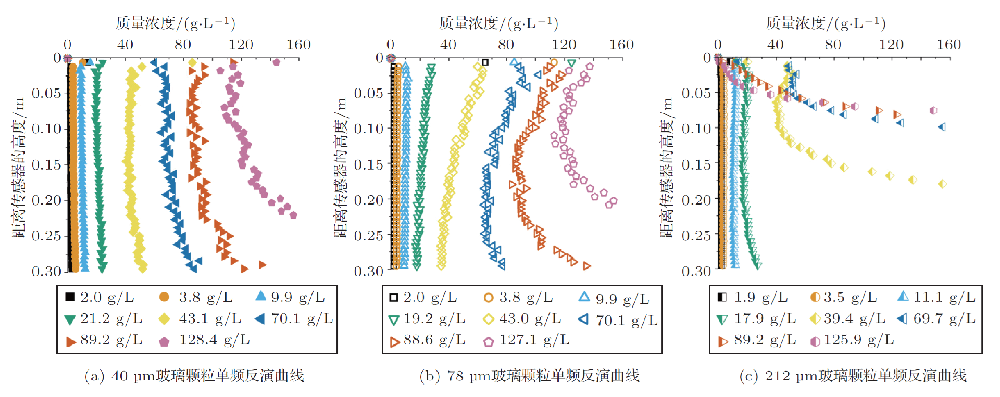
In Equation (1), P0 denotes the sound pressure at the initial position, while P represents the sound pressure after the wave has traveled a distance L; V0 is the received voltage at the starting point, and V is the received voltage after the wave has propagated a distance L. To date, researchers have established concentration‑attenuation relationship curves for various suspensions based on the principle of ultrasonic attenuation, as illustrated in Figure 1.
3. Online Ultrasonic Concentration Measurement Technology During slurry production and storage, varying process conditions or environmental factors often give rise to physicochemical reactions, involving the transfer and exchange of matter and energy, which inherently introduce numerous uncertainties and nonlinearities. Traditionally, periodic offline analysis has been the norm, but its significant time lag renders it incapable of meeting the need for real‑time data acquisition. Online monitoring technologies have gradually evolved to address the real‑time measurement and control of such dynamic variables. Online ultrasonic concentration measurement offers the following benefits: it enables direct slurry concentration measurement without halting production; reduces the incidence of defective products; swiftly identifies anomalies; minimizes unnecessary resource consumption; and facilitates more precise process control.
3.1 Classification of Online Ultrasonic Concentration Measurement Technologies 3.1.1 Immersion‑Type Ultrasonic Concentration Meter The immersion‑type ultrasonic concentration meter immerses the probe directly into the slurry, typically requiring a hole to be drilled in the slurry container and the meter secured within. By analyzing the emitted‑reflected‑received ultrasonic echo signals, the meter calculates the concentration of the sampled slurry with relatively high accuracy. However, installation is laborious and complex, necessitating pipeline shutdowns and production halts. Moreover, sampling stationary slurries can disrupt their homogeneity, and prolonged contact between the probe and the slurry may lead to corrosion. A schematic diagram of the immersion‑type ultrasonic concentration meter is shown in Figure 2(a).
3.1.2 Clamp‑On Ultrasonic Concentration Meter The clamp‑on ultrasonic concentration meter uses two transducers clamped onto the outside of the container. It calculates the slurry concentration by analyzing the echo signals generated when one transducer emits and the other receives. Compared with the immersion type, it offers lower accuracy but simpler installation; being non‑contact, it does not disturb the homogeneity of stable slurries; and installation requires no pipeline shutdown or production halt, allowing flexible selection of the measurement height according to actual production needs. This type is currently the focus of active research and development.
3.2 Application of Online Ultrasonic Concentration Meters Ultrasonic concentration meters are extensively used in the food, paper, and chemical industries, capable of measuring multiple parameters. Through field surveys, we examined two leading online ultrasonic concentration meters and compared them with instruments from other concentration‑measurement fields. In terms of applicability, they accommodate most industrial slurry types; technically, they provide tailored compensation for varying particle sizes and temperatures, exhibit high sensitivity, and deliver precise data. Table 1 summarizes the basic application status of these online concentration meters, noting that the measurable concentration ranges have evolved with recent technological and equipment upgrades.
Sensor technology for monitoring slurry mixing processes based on ultrasonic concentration measurement is among the most critical components of Industry 4.0 [30]. The world is undergoing its fourth industrial revolution, in which digital technologies—including artificial intelligence, robotics, and the Internet of Things—are deployed to enhance manufacturing productivity, efficiency, and sustainability [31]. Data collection and utilization are becoming increasingly vital for industrial production. Slurry mixing is a crucial stage in many manufacturing processes; in the production of polymers, cement, and rubber, the quality of the final product hinges on the degree of mixing [32]. The concentration of the slurry continuously fluctuates during mixing, making real‑time monitoring indispensable [33]. In ceramic manufacturing, assessing the homogeneity of ceramic slurries ultimately aims to determine their shelf life; only by understanding the current concentration state and estimating the remaining storage time can one appropriately prioritize slurry batches and prevent degradation. Although rheological measurements, centrifugal settling tests, particle‑size distribution analyses, and zeta‑potential characterization are available, obtaining representative samples from large vessels is challenging, and transporting them to the laboratory for testing also consumes time. Consequently, these methods cannot provide real‑time feedback on the slurry’s mixing status, underscoring the need for more advanced technologies to monitor the mixing process on line.
Density meters, concentration meters, ultrasonic density meters, acoustic impedance density meters, acoustic attenuation density meters, sound‑velocity density meters, tuning‑fork density meters, Coriolis force density meters, optical concentration meters, differential‑pressure density meters, Na22 density/concentration meters, microwave density/moisture meters, conductivity density meters, and external‑mount density meters—please contact Xi’an Pisonics Information Technology Co., Ltd. Our Chinese website: https://www.pisonics.cn; our English website: https://www.pisonics.com/
Contact: Manager Cui; Phone: 15902932017; Email: info@pisonics.com