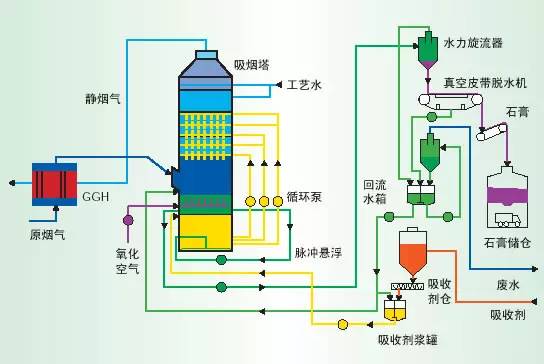
Wet flue-gas desulfurization (FGD) technology is the primary means of controlling sulfur dioxide emissions in coal-fired power plants. In limestone–gypsum wet FGD systems, the preparation and conveyance of limestone slurry and gypsum slurry are critical process steps. Among these, slurry density, as an important process parameter, directly affects the utilization rate of the desulfurizing agent and the overall desulfurization efficiency. Accurate measurement and control of slurry density are essential to ensuring the long-term stable operation of the FGD system. However, under FGD operating conditions—characterized by high temperature, high pressure, and high solid content—the selection and application of density meters face significant challenges. Improper meter selection and configuration can lead to measurement inaccuracies, frequent clogging, and other issues, thereby compromising desulfurization performance. Therefore, studying the criteria for selecting slurry density meters and optimizing their application in FGD systems is of great importance for enhancing density measurement and control capabilities and ensuring the safe, efficient operation of the FGD system.
1 The Importance of Limestone–Gypsum Slurry Density Measurement in FGD Systems
The core of a limestone–gypsum wet FGD system lies in the slurry circulation and SO2 absorption processes. The system’s efficiency and operational stability depend largely on precise control of slurry density. Slurry density directly influences the utilization rate of the desulfurizing agent; since limestone is typically slurrified on-site, a density that is too low reduces the absorbent content per unit volume, lowering the Ca/S molar ratio and diminishing desulfurization efficiency. Conversely, excessive density accelerates pump and pipeline wear, increases energy consumption, and promotes clogging. Thus, accurate control of the limestone slurry concentration is crucial for achieving desired desulfurization performance while minimizing costs. Slurry density is closely linked to the physicochemical reactions within the desulfurization tower: it affects the atomization quality and droplet distribution of the slurry, which in turn impacts the mixing between the desulfurizing agent and flue gas as well as the liquid–gas contact time. Proper density optimization enhances the diffusion‑mass transfer efficiency of flue gas in the slurry, ensuring thorough completion of the desulfurization reaction. Moreover, slurry density serves as a key basis for process optimization in wet FGD. By monitoring density changes at the inlet and outlet of the desulfurization tower, one can indirectly assess the consumption rate of the desulfurizing agent and the amount of SO2 absorbed, providing valuable guidance for fine-tuning process parameters and reducing reagent usage. Fluctuations in slurry density also often signal impending issues such as spray nozzle blockage or abnormal liquid levels, making density measurement instrumental for early fault detection and maintaining safe, reliable system operation.
2 Selection Considerations for Limestone–Gypsum Slurry Density Meters in FGD Systems
2.1 Measurement Range and Accuracy Requirements
FGD systems have well-defined requirements for the measurement range and accuracy of limestone and gypsum slurry densities, and the selected density meter must meet these process control needs. The concentration of limestone slurry typically falls between 10% and 35%, corresponding to a density of 1.05 to 1.25 g/cm³. This relatively wide range places stringent demands on the meter’s linearity. Process optimization further mandates high measurement accuracy; deviations exceeding ±0.5% can significantly impair desulfurization efficiency. Consequently, the meter should exhibit excellent repeatability and long-term stability. Gypsum slurry density control is even more demanding, with concentrations ranging from 15% to 25% (1.12 to 1.19 g/cm³) and accuracy requirements better than ±0.2%. Beyond range and precision, the meter must also demonstrate robust dynamic response characteristics to accommodate rapid density fluctuations during slurry preparation and transport, generally requiring measurement intervals shorter than 1 second and response times less than 10 seconds. Given the complexity of FGD conditions, the meter should possess strong anti-interference capabilities to ensure that vibrations, bubbles, and other factors do not compromise measurement accuracy.
2.2 Corrosion and Wear Resistance
FGD slurries are mildly acidic, with pH values between 4.5 and 6, posing stringent requirements for meter material selection and structural design. Impurities such as chloride ions and heavy metal ions in the slurry exacerbate electrochemical corrosion of metallic components. Therefore, wetted parts of the density meter should be fabricated from high-quality austenitic stainless steels like 316L and 904L, or corrosion-resistant alloys such as Hastelloy C, with surface passivation treatments applied to key areas to enhance corrosion resistance. High suspended solids content and coarse particle sizes are hallmarks of FGD slurries; particles ranging from 10 to 800 μm can account for over 20% of the slurry, resulting in severe abrasion. Conventional wetted components tend to suffer rapid wear and short service lives. To address this, meters should employ wear‑resistant materials, incorporating wear‑proof coatings on impellers, bearings, and other critical parts, and optimizing flow path designs to mitigate wear risks. For non‑contact meters, the durability of the housing against erosion and abrasion must also be considered, with protective linings made from special materials such as ceramics or PTFE when necessary to ensure long‑term measurement performance.
2.3 Installation and Maintenance Convenience
The harsh operating conditions and complex site environments of FGD systems pose challenges to meter installation and maintenance. Therefore, adaptability to installation scenarios and ease of servicing should be prioritized during selection. Insertion‑type meters offer good adaptability, allowing direct mounting into pipeline flanges with straightforward installation; however, their sensing probes are immersed directly in the slurry, making them susceptible to clogging and wear. Alternatively, bypass installations position the meter in a parallel loop, effectively isolating it from the main flow and reducing wear, though at the cost of increased system resistance. Each approach has its advantages and drawbacks, and the choice should be based on site pipeline conditions, available maintenance space, and other factors. From a maintainability perspective, low‑maintenance models are preferred. For radiation‑based meters, their service life under FGD conditions should be assessed to minimize the frequency of on‑site replacements. Vibration‑based and Coriolis meters, in particular, should feature self‑diagnostic capabilities for remote fault detection and early warning. Routine cleaning and calibration of the meter must be convenient and feasible, ideally supported by functions such as automatic cleaning or simple on‑site adjustment procedures.
2.4 Temperature Compensation and Pressure Effects
FGD slurry temperatures vary widely, with inlet temperatures ranging from 40°C to 80°C. Such temperature swings induce noticeable fluctuations in slurry density. To ensure measurement accuracy across different temperatures, the meter must incorporate reliable temperature compensation. Common methods include temperature–density function compensation and temperature–volume correction coefficient compensation; the appropriateness of the chosen method directly affects measurement precision. Additionally, working pressures at various meter installation locations within the FGD system can differ substantially: pressures upstream of the inlet pump are typically below 0.3 MPa, while those in the spray headers at the tower top often exceed 0.8 MPa. Pressure variations also influence density measurements—generally, each 10 MPa increase raises the reading by a few thousandths. When selecting a meter, its pressure rating must be evaluated; devices rated above 1 MPa should be chosen for high‑pressure applications. For differential pressure‑sensitive meters, such as those employing direct pressure sensing, zero drift caused by pressure changes should be assessed and, if necessary, compensated to eliminate errors arising from static pressure fluctuations.
2.5 Data Transmission and System Integration Capability
FGD DCS systems place high demands on the acquisition and processing of density data, necessitating careful consideration of the meter’s data transmission and integration capabilities during selection. Fieldbus technology is now widely adopted in DCS systems, and many density meters are equipped with fieldbus communication interfaces supporting mainstream protocols such as Profibus, HART, and Foundation Fieldbus, enabling bidirectional digital communication of process parameters and diagnostic data. Digital communication effectively mitigates signal interference that can cause analog measurement drift, enhancing control accuracy. Digitally connected meters can be remotely configured, commissioned, and managed according to DCS control strategies, greatly increasing system integration flexibility. Under FGD conditions, the hot, humid, and highly corrosive site environment also imposes stringent requirements on meter communication cables, necessitating shielded, high‑insulation specialty cables—such as Profibus‑DP cables with PUR jackets. Even meters lacking digital communication capabilities should provide standard 4–5 V voltage signal outputs, paired with D/A conversion modules to ensure compatibility with DCS systems.
3 Optimization Strategies for Limestone–Gypsum Slurry Density Meter Applications in FGD Systems
3.1 Optimization of Installation Location and Method
Selecting appropriate installation locations and methods is crucial for ensuring measurement reliability and system safety. For FGD conditions, meters should be installed in pipeline sections where slurry mixing is stable and air entrainment is minimized—for example, at the outlet of the limestone slurry tank or just upstream of the recirculation pump—where the slurry is well mixed, flow velocity is moderate, and measurement deviations are kept to a minimum. Installation near centrifugal pump outlets or pipeline bends, where turbulence and air entrapment are prevalent, should be avoided to reduce the impact of bubbles and vortices on measurements. Vertical insertion at the bottom of the pipeline is recommended for insertion‑type meters to prevent sediment accumulation, though the insertion depth should not be excessive to minimize scouring by the slurry. For bypass meters, the bypass loop should be kept as short as possible and arranged parallel to the main line to avoid dead zones or deposition, ensuring uniform slurry characteristics throughout. A flushing port should be provided in the bypass loop for periodic slag removal, with automated discharge devices installed where necessary. In the challenging FGD environment, meter installation should also adhere to the principles of “easy inspection” and “simple maintenance,” such as reserving ample service space around the instrument, equipping it with lifting and repair tools, and maintaining a robust spare parts management system to minimize labor and resource inputs for maintenance operations.
3.2 Signal Processing and Data Filtering Techniques
The complex and noisy industrial environment often introduces noise and other anomalies into density meter signals, compromising measurement reliability. Therefore, DCS systems must apply appropriate signal processing and filtering to enhance data quality. For FGD conditions, algorithms such as amplitude limiting, median filtering, and first‑order lag filtering can be employed to refine the data. Median filtering, for instance, removes extreme values within a specified time window, effectively eliminating spurious signals caused by bubble entrainment. First‑order lag filtering smooths short‑term density fluctuations, yielding a more stable control signal. Filter parameter tuning should balance interference suppression with minimal signal delay, taking into account signal variation frequency and system sampling intervals. The DCS system should also feature comprehensive signal diagnosis capabilities: by analyzing the rate of change and deviation of density readings, it can promptly identify instrument malfunctions and ensure reliable system operation. For example, when a density reading exceeds the meter’s range by more than 20%, the system should issue an alarm indicating an instrument anomaly; prolonged abnormal fluctuations may suggest clogging or scaling. Intelligent diagnostic results should be fed back into the maintenance management system to generate work orders and guide timely repairs. Adopting rational signal processing algorithms and smart diagnostic strategies can significantly reduce the adverse impact of FGD conditions on meter measurement accuracy, enhancing system control performance and operational safety.
4 Instrument Selection
4.1 Tuning Fork Density Meter
Disadvantages:
- Prone to scaling
- 易腐蚀
- Not wear‑resistant; typically fails within a few months
4.2 Acoustic Impedance Density Meter
Advantages:
- Wear‑resistant (silicon carbide/sapphire, Mohs hardness second only to diamond)
- Corrosion‑resistant; virtually unaffected by acids or alkalis
- Does not scale: full‑bore design with no obstructive structures
- Long service life
Density meters, concentration meters, ultrasonic density meters, acoustic impedance density meters, acoustic attenuation density meters, sound velocity‑based density meters, tuning fork density meters, Coriolis force density meters, optical concentration meters, differential pressure density meters, Na22 density/concentration meters, microwave density meters/moisture analyzers, conductivity density meters, and external attachment density meters—please contact Xi’an Pisonics Information Technology Co., Ltd. Our Chinese website: https://www.pisonics.cn; our English website: https://www.pisonics.com/.
Contact: Manager Cui; phone: +86 15902932017; email: info@pisonics.com.